Impressions: A Christian Merchant’s Wife of Coppergate, Mid 10th Century

Location: Coppergate, Jorvík (York), England.
Date: 930-975AD (Periods 4B and 5A.)
Culture: Anglo-Scandinavian.
Estimated Social Status: Affluent urban freewoman.
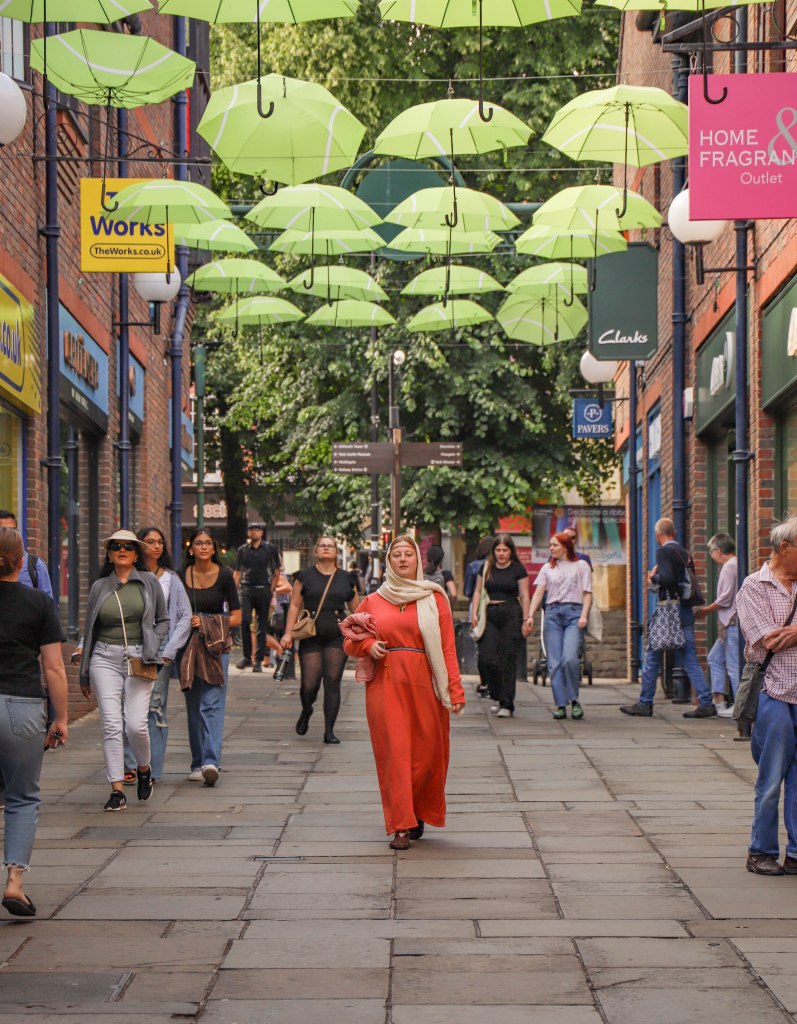
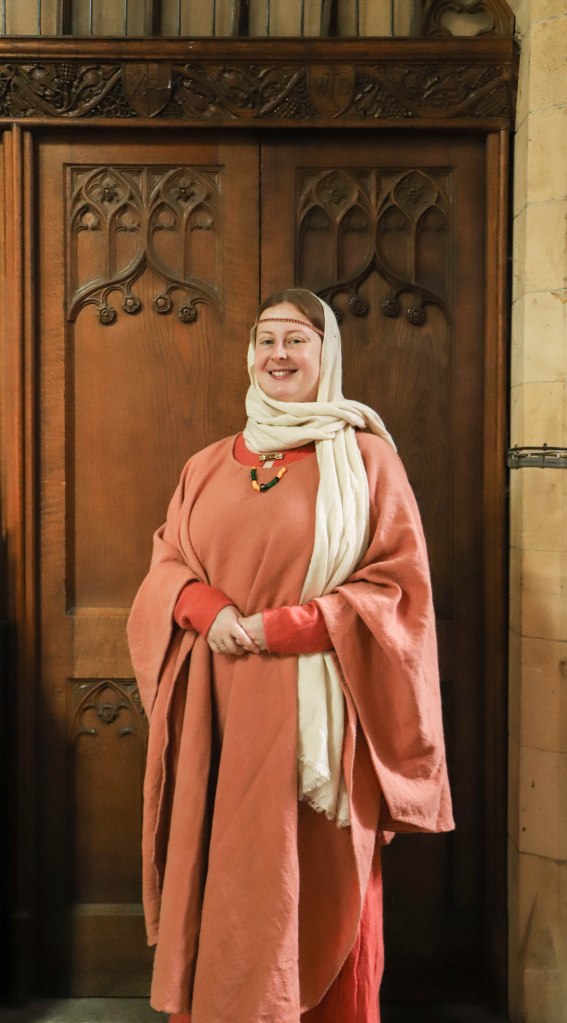
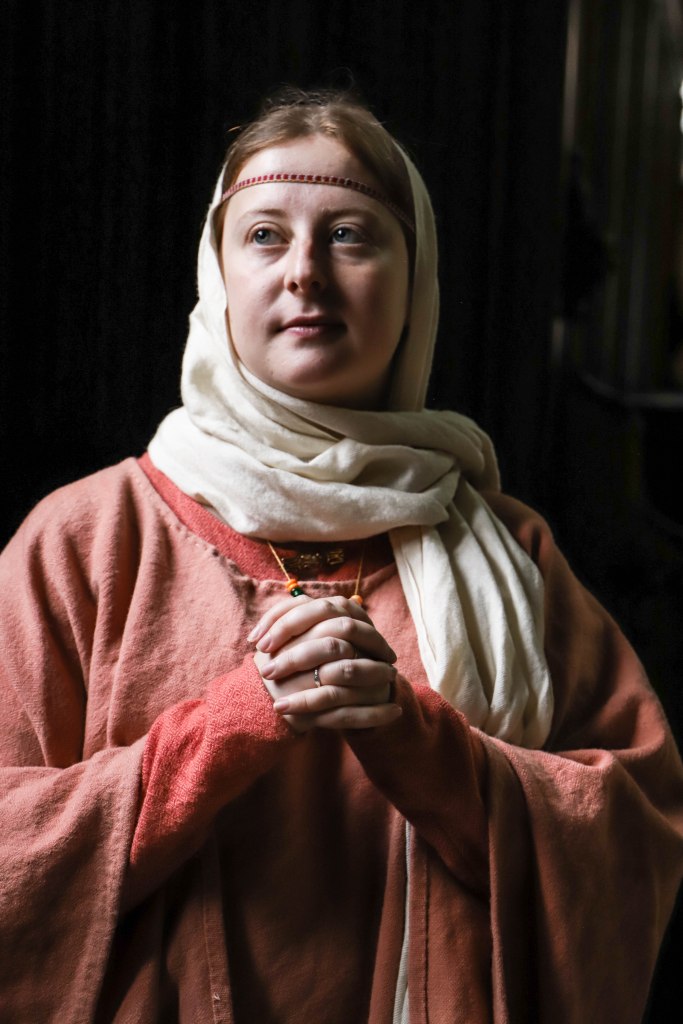
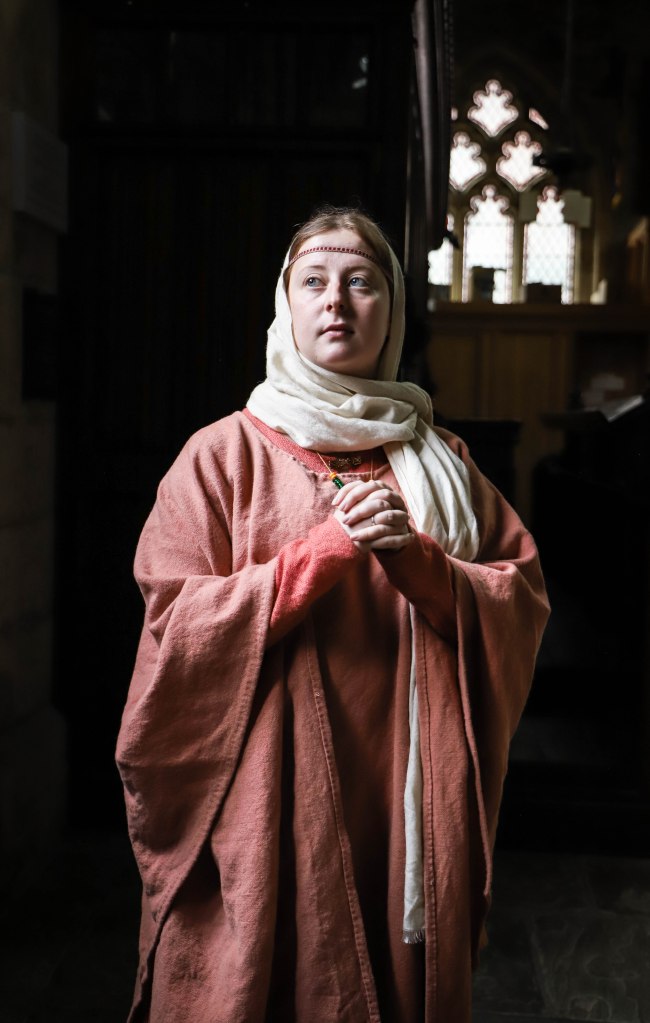
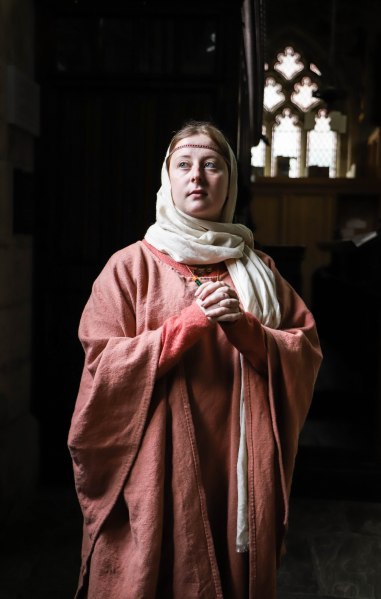
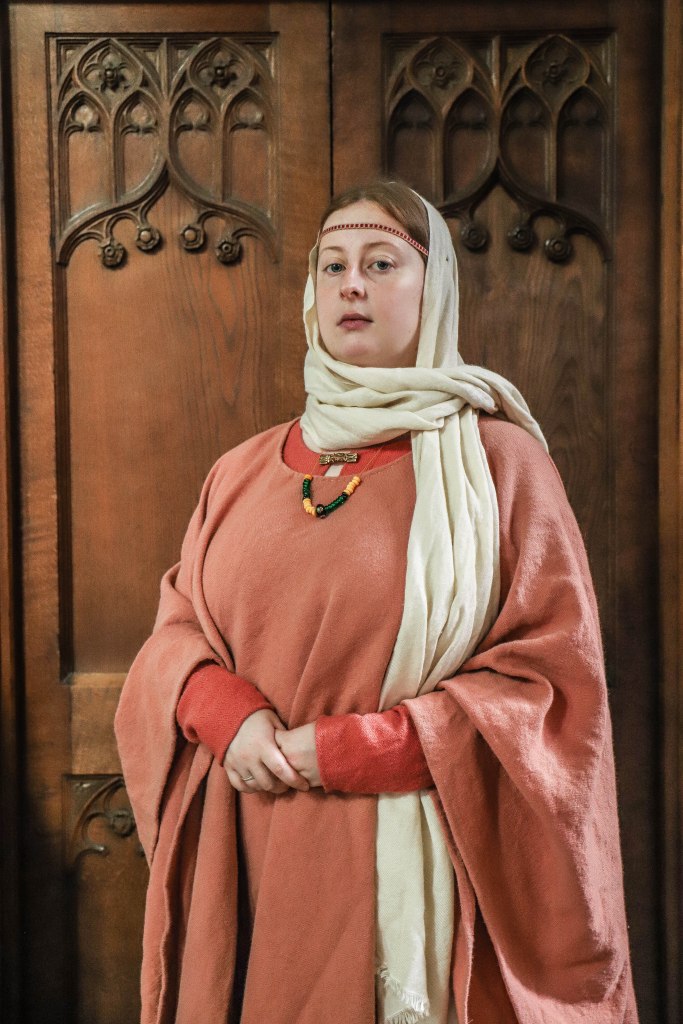
This impression combines replicas of some of my favourite items found in the 10th century levels of 16-22 Coppergate. When combining them, I envisioned the daily life of someone living there and what she might wear day-to-day. As you can see, I thought there was nowhere better to photograph this impression than on Coppergate itself.
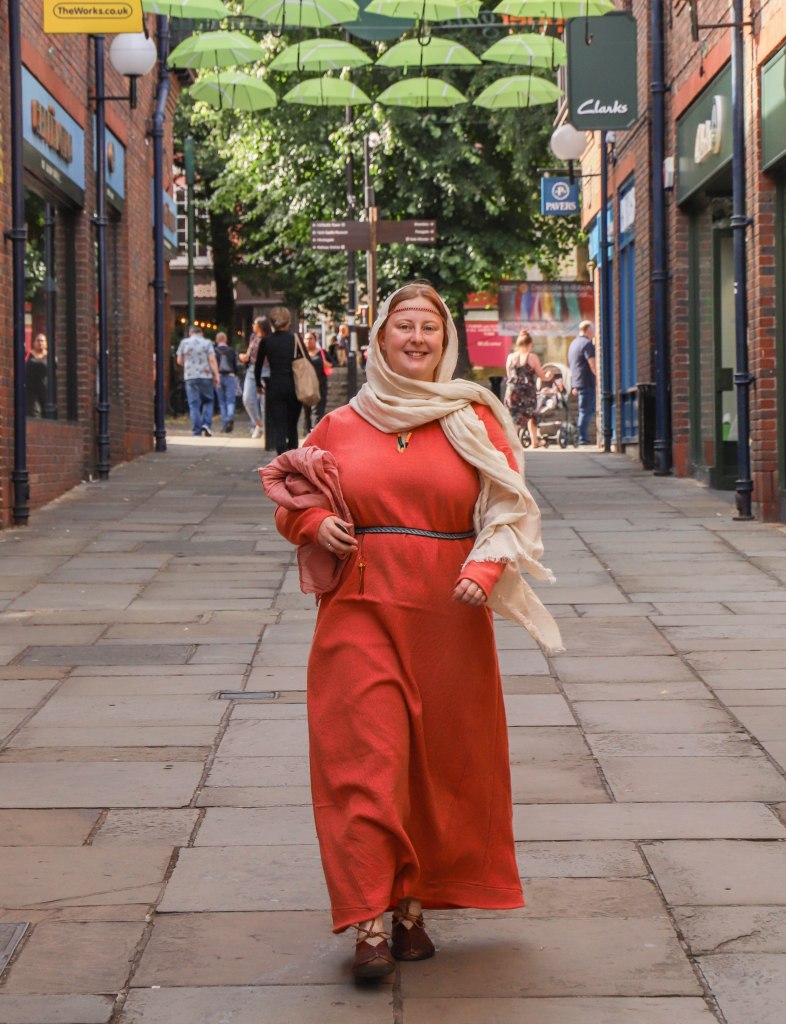
This, like all my impressions, is a continual work in progress- you can always improve and add to what you have. I’ve got household goods, personal grooming equipment and textile-working tools that would fit within this impression- they will feature in their own articles rather than making this one even longer!

That being said, I feel like this article shows several different ways the fragments and artefacts I have chosen could be pieced together to make a plausible outfit: to be dressed up or down as needed by its owner.

All photographs of me are taken by Sarah Murray. Photographs of the original finds are my own unless otherwise stated, illustrations or other images from archaeological publications are shared for educational purposes.

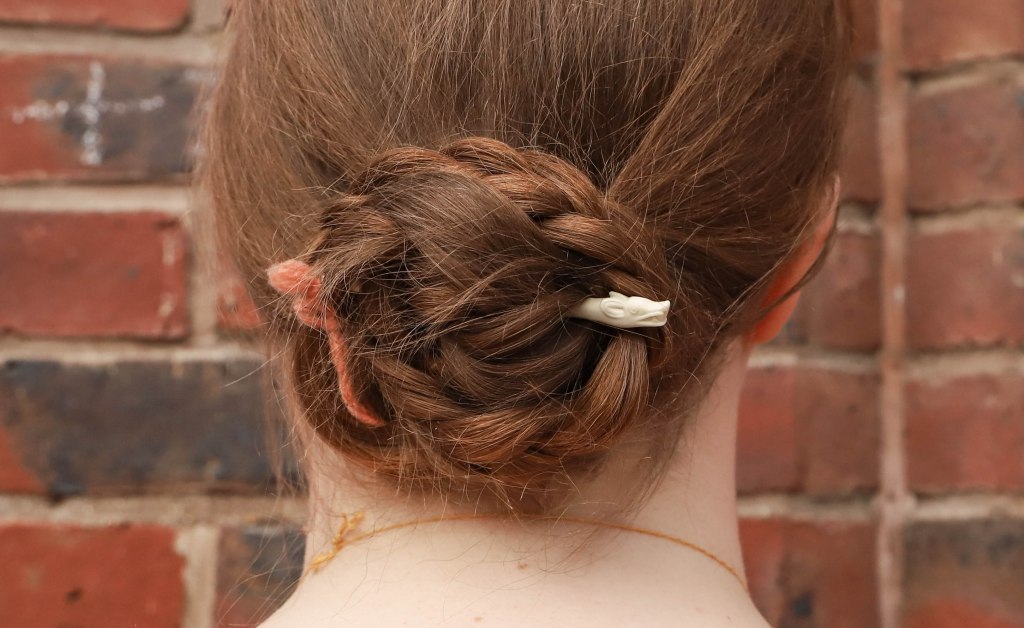
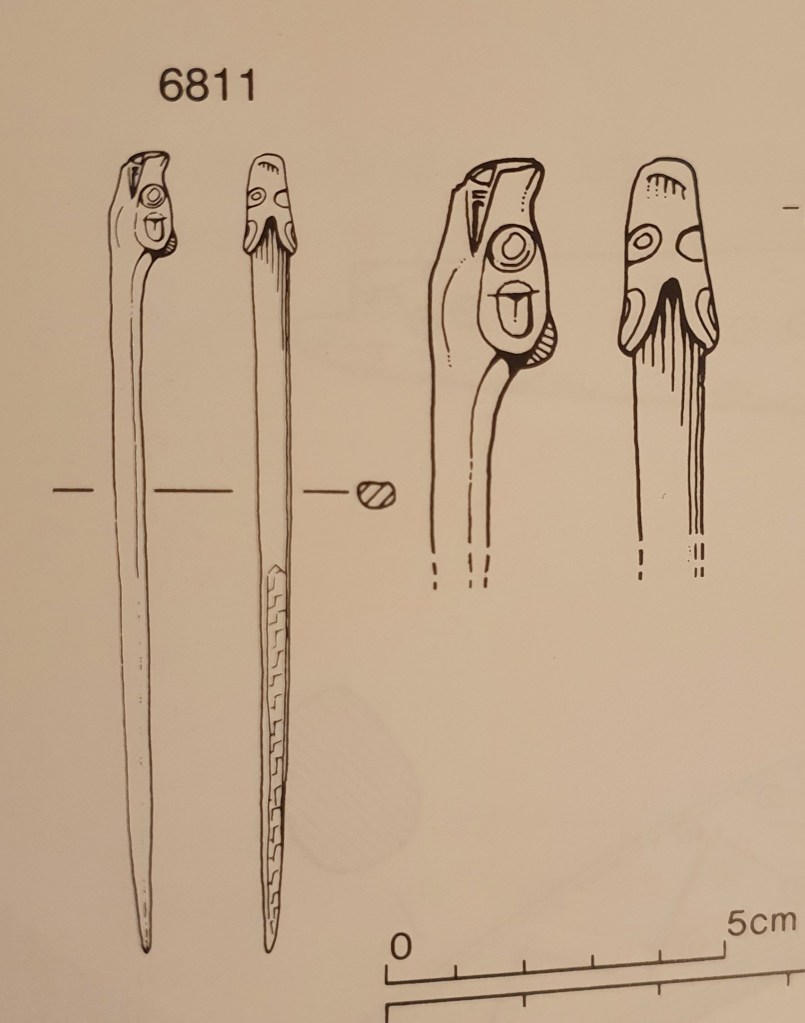
Zoomorphic bone pin. Item no. 6811, period 4B (c.930-975AD.)

MacGregor, Mainman & Rogers (1999.) p. 1948.

This is described in MacGregor, Mainman and Rogers (1999) as being a “classic Viking Age type” of pin, with a toothy grinning beast atop it. It’s quite short at just over 11cm long and with no hole drilled through it, it would make a poor cloak pin. I chose to use mine as a hairpin and it works fairly well, though I am very precious with it. My replica is a pretty close one (albeit missing a funny little asymmetrical design on the shank) and was made for me by commission by my friend Peter Merrett.

Regarding my hairstyle, it is a really simple braid wound into a bun and secured with my pin and a fine wool braid (dyed with madder to match my dress.) I didn’t base it on anything, it is just an easy way to keep it out of my face without any modern pins or elastics. Amusingly, a friend pointed out how similar my hair looked to a disembodied bun found in the grave of a late Roman lady from York (now kept on the Yorkshire Museum, just upstairs from the Viking items!)

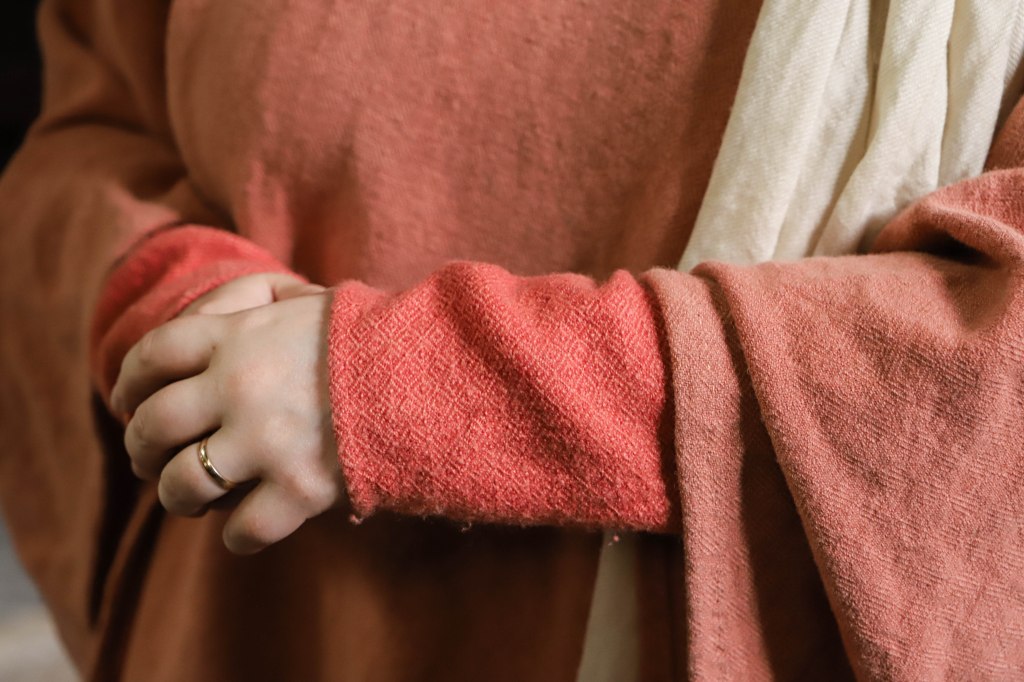
Wool dress in 2/2 diamond twill, dyed with madder. Inspired by fragment 1308, period 4B.

Walton (1989) describes fragment 1308 as follows:

“Tattered fragments, largest c.40x30mm, of reddish 2/2 diamond twill, (…) Dyed with madder. See also 1301.”

1301 is a “red non-reversed 2/2 twill” also dyed with madder. It was suggested that they could have been part of the same cloth originally, though I’m not sure if this implies that maybe one of the two different weaves was in fact a weaving fault. I chose to make my dress out of the diamond twill, a weave found elsewhere in the late Anglo-Scandinavian period at York (Tweddle, D. 1986)

It is interesting to note that 1301 and 1308 were also found in conjunction with another cloth, this time a mineralised grey tabby thought to be vegetable fibre, 1330. If it was indeed a vegetable fibre cloth like linen, hemp or nettle: could this represent an undershirt/dress? I usually wear a simple underkirtle made of linen tabby, but I foolishly chose not to on the hot day we took photos. This made quick costume changes a bit challenging.
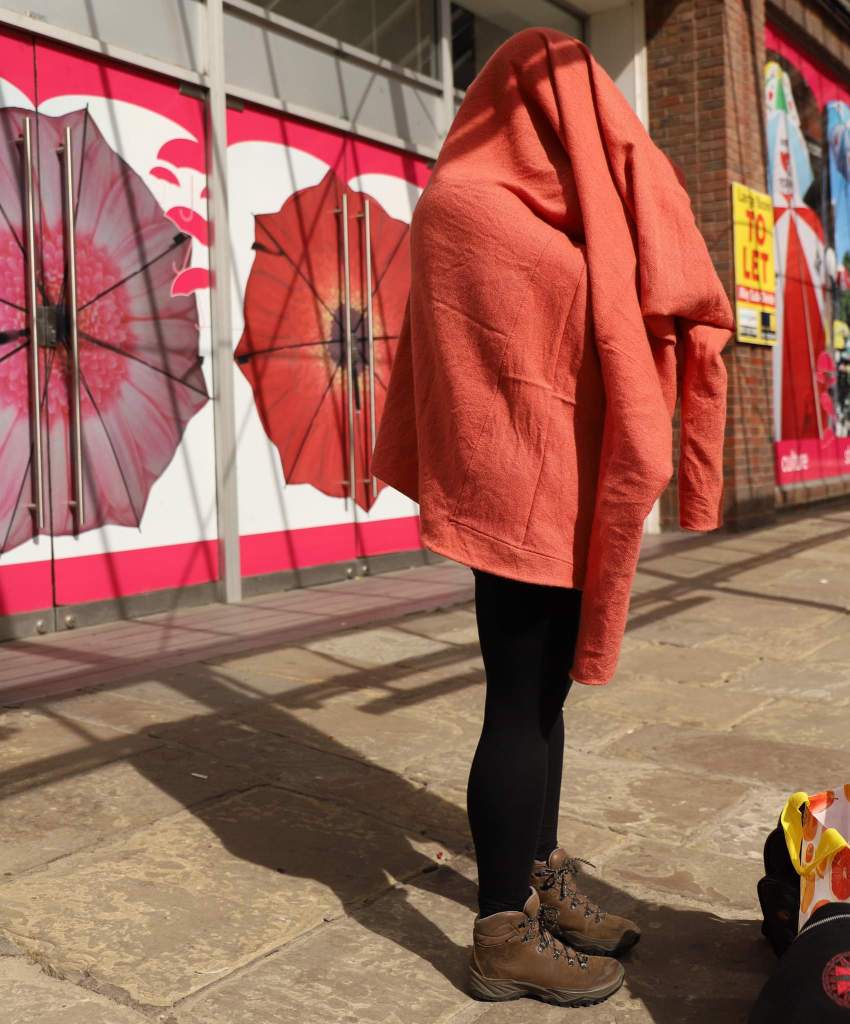
In terms of pattern, I kept it very simple. I made a slim-fitting skirted dress with side gores from the waist, underarm gores for movement and a keyhole neckline. The tunics from Skjoldehamn, Moselund and Kragelund (dated to late 10th-early 11thC) all feature similar constructions with mostly rectangular bodies and triangular gores to add width and shape. English sources show ankle-length dresses fitting this silhouette on all female figures. My dress is handsewn using a mixture of madder-dyed wool thread and fine linen thread.

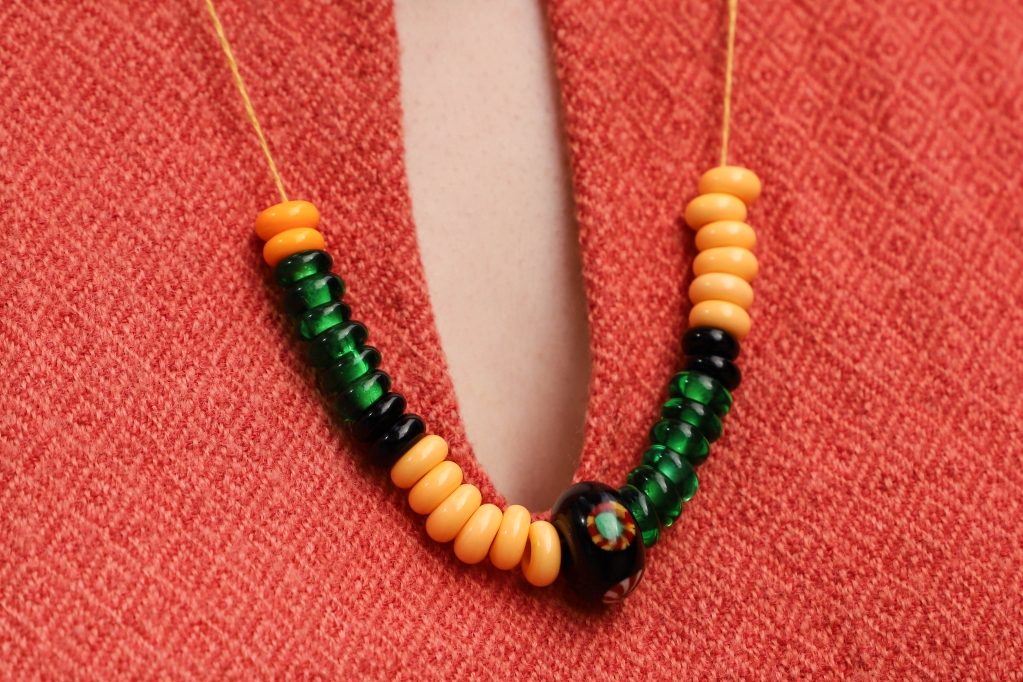
Glass bead necklace. Based on item no. 10350 and a selection of small beads found in 16-22 Coppergate, period 4B.
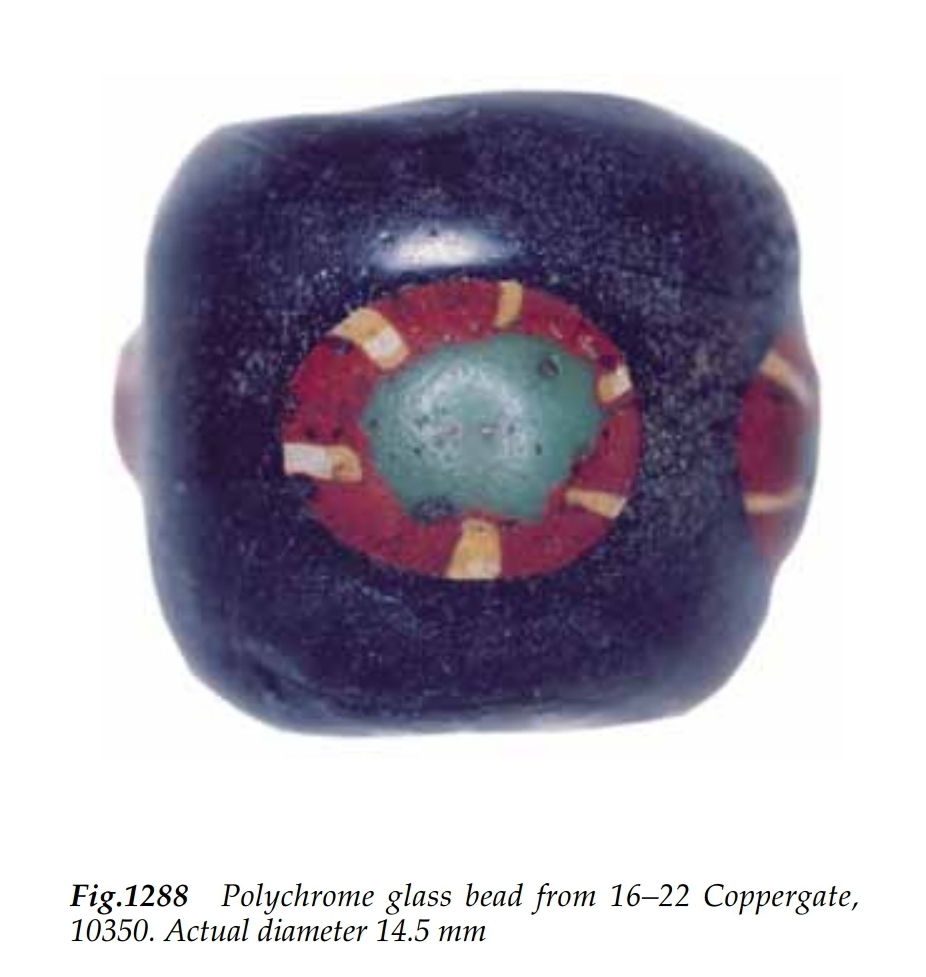
Mainman & Rogers (2000) p.2594.

289 glass beads and fragments were found in Coppergate. This necklace is a creation of my own design, using a combination of beads found commonly in 16-22 Coppergate. The centre piece is a glass bead based on item no. 10350, described as a “barrel-shaped glass bead. Very dark, appearing black, decorated with green blobs surrounded by a red circle with yellow lines through” (Mainman & Rogers, 2000.) The original measured 14.5mm in diameter. My reproduction is a little more rounded than the original.

The other beads are small monochrome globular glass beads in shades of yellow, green and black. Along with blue, these are the most common colours of globular beads found in Coppergate in period 4B, with the most popular types of beads numerically being Globular (Type 2), Cylindrical (Type 3) or Segmented (Type 7.) Only 10 percent of the beads found in York were polychrome, so I wanted monochrome beads make up most of my necklace. I struggled to get appropriate segmented beads of the type I wanted, so for now I chose to make a necklace using only globular beads. These are all from Tillerman Beads and threaded on a string of linen thread.

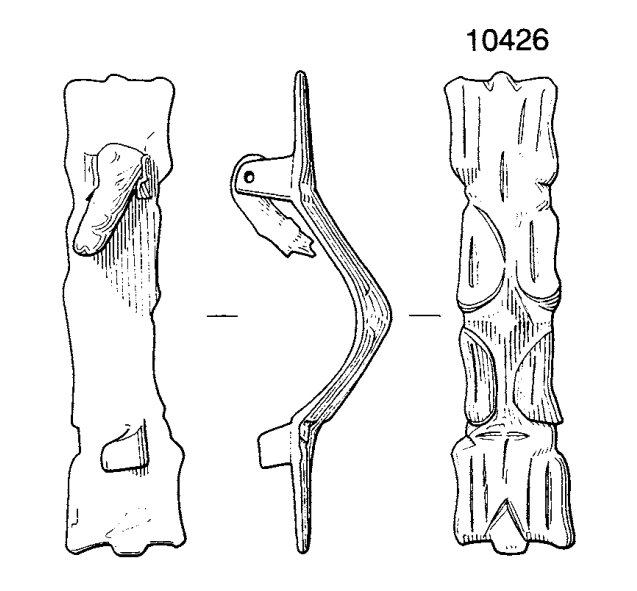
Copper alloy ansate brooch. Item no. 10426, period 4B.
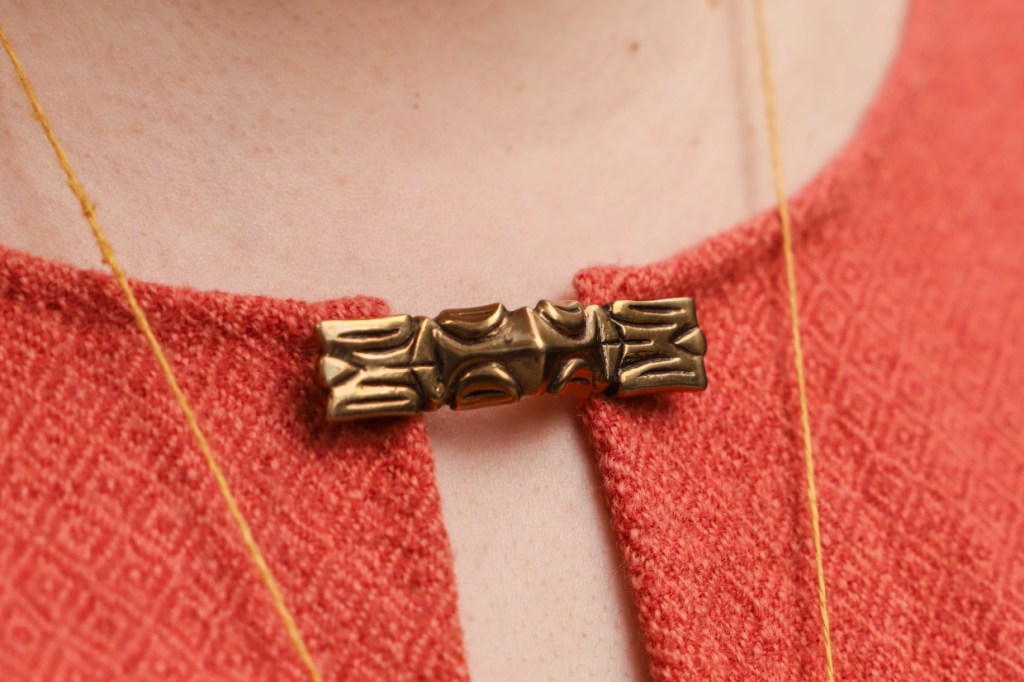
Mainman & Rogers (2000.) p. 2570.

Item 10426 is described as follows:

“Equal-armed bow brooch of the ‘caterpillar’ type, with a subrectangular bow with unexpanded subsquare terminals with indented edges. The catch-plate, attachment plate and part of the pin survive on the reverse. The upper faces of the terminals are decorated with incised lines, and the bow with mouldings.” (Mainman & Rogers, 2000.)

I hadn’t seen this type of brooch before and was very surprised to see it dated to the mid tenth century, as it looked alien to me. Apparently, it used to be believed that ansate brooches were most popular between the 7th and 9th centuries, but several finds in York, London and Lincolnshire indicate that they stayed in use until the 10th century.

I’m a sucker for novelty and vintage fashion, so I relished the opportunity for an alternative to the disc brooch. My replica is from Asgard.

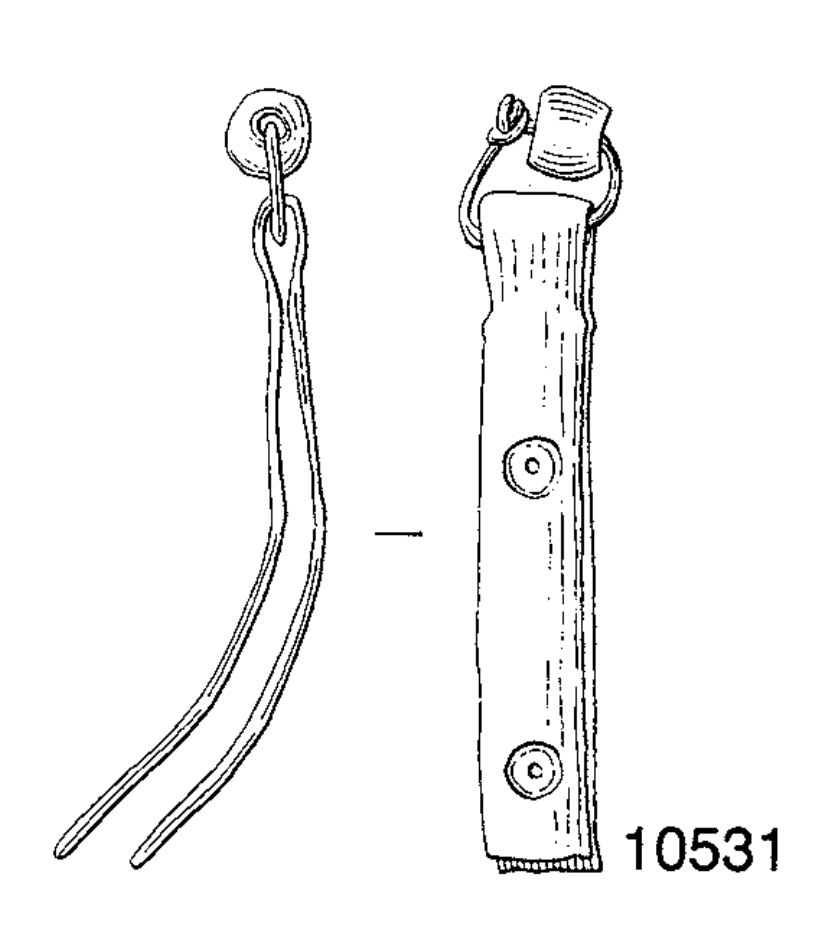
Copper alloy toiletry set with glass bead. Item no. 10531, period 5B (c.975- mid 11thC.)
Mainman & Rogers (2000.) p. 2600.

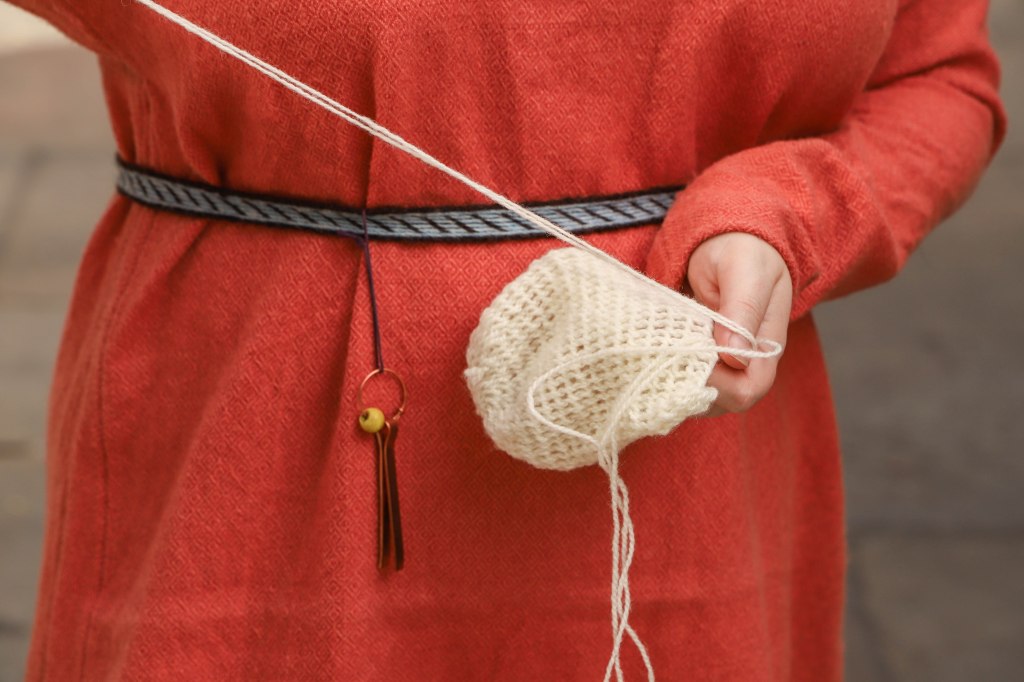
This object is a bit cheeky and I will be replacing it in the future. I included it in my photo set without double-checking date and so despite kicking myself now, here it is. 10531 is a copper alloy toiletry set, with a set of little tweezers set on a twisted suspension ring.

It dates to period 5B, which is approximately 975AD to the early to mid 11th century. The lower end of this scale fits the end of my goal period, but it’s not close enough really. Thankfully, there is a similar pair found on site that dates to period 5A (the same as my silk cap) which is specifically 975AD.
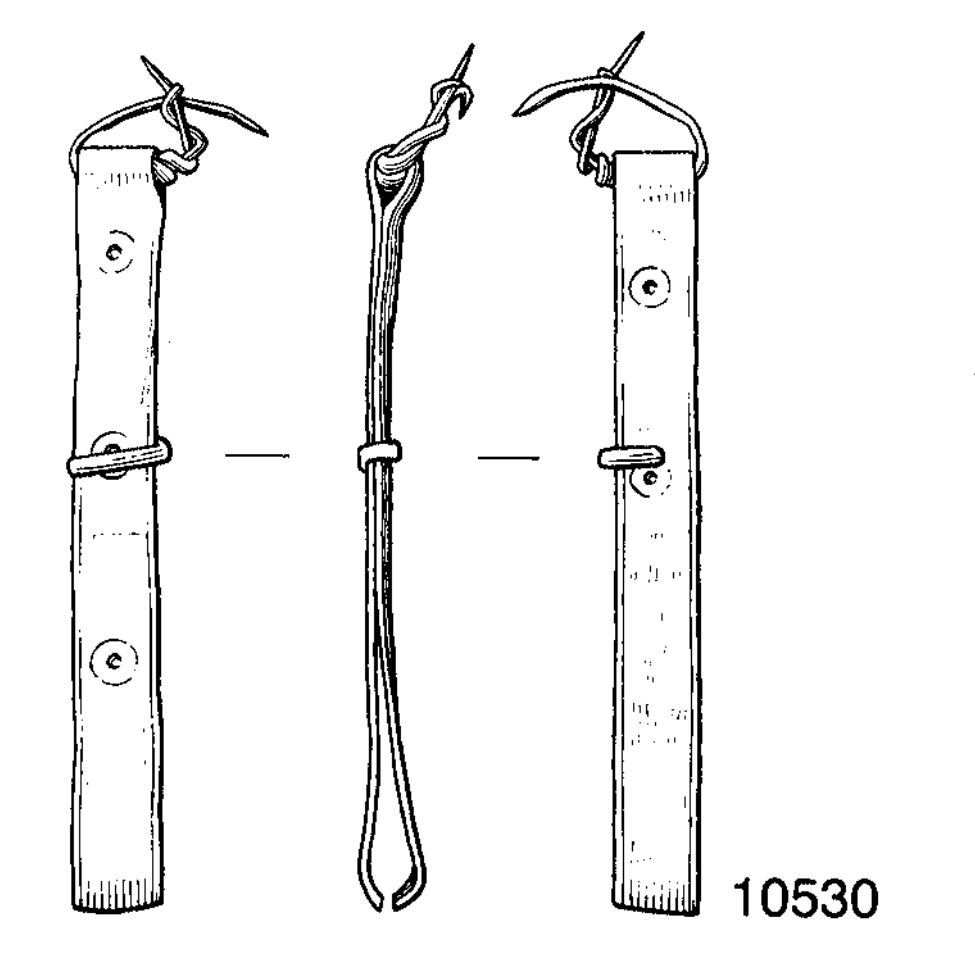
Mainman & Rogers (2000.) p. 2600.

You can also see a peek of what I’m up to here- with my bone needle, I’m making the York sock! It will be the subject of its own article soon, so please don’t think that I forgot the iconic naalbound sock (I could never.)

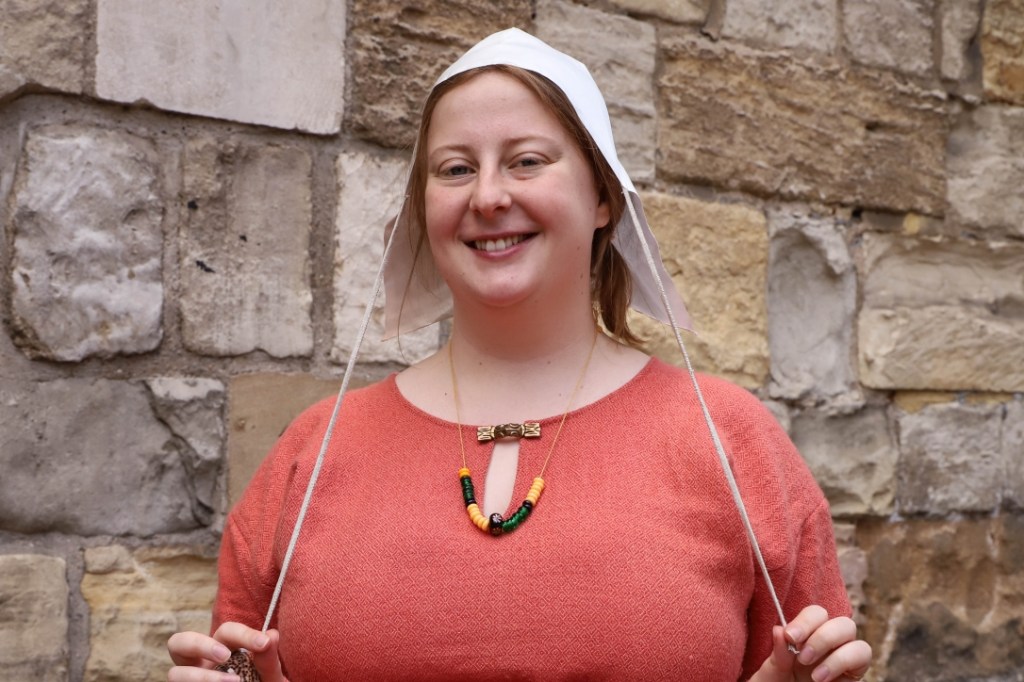
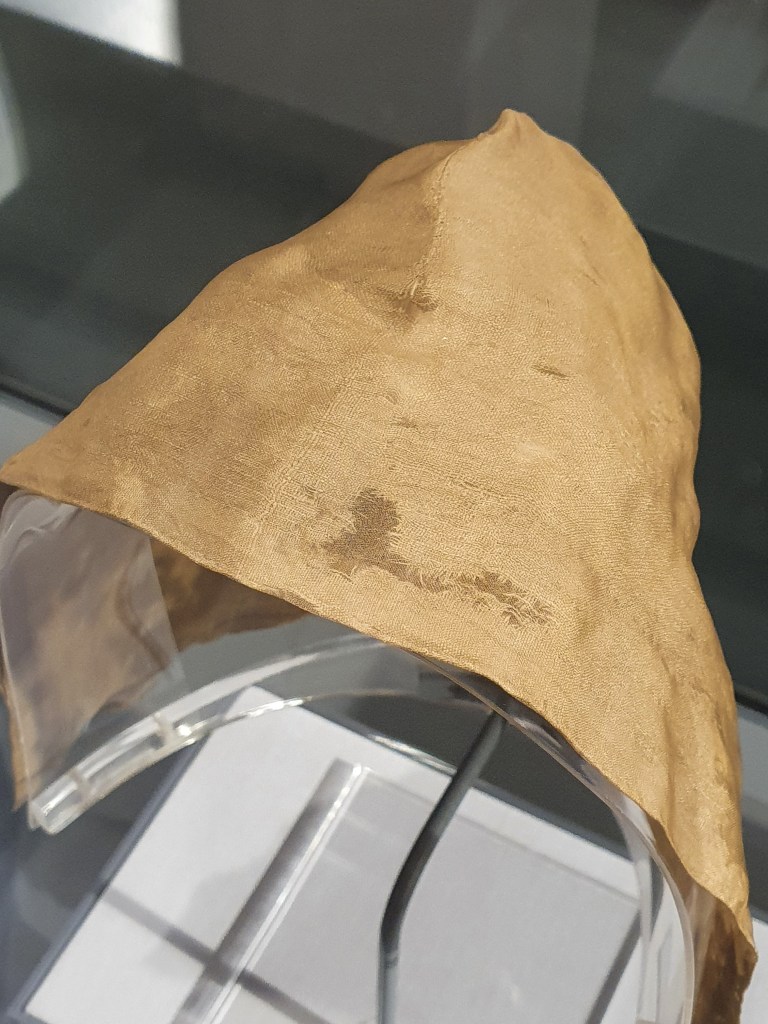
Silk cap. Item no. 1372, period 5A (c.975)
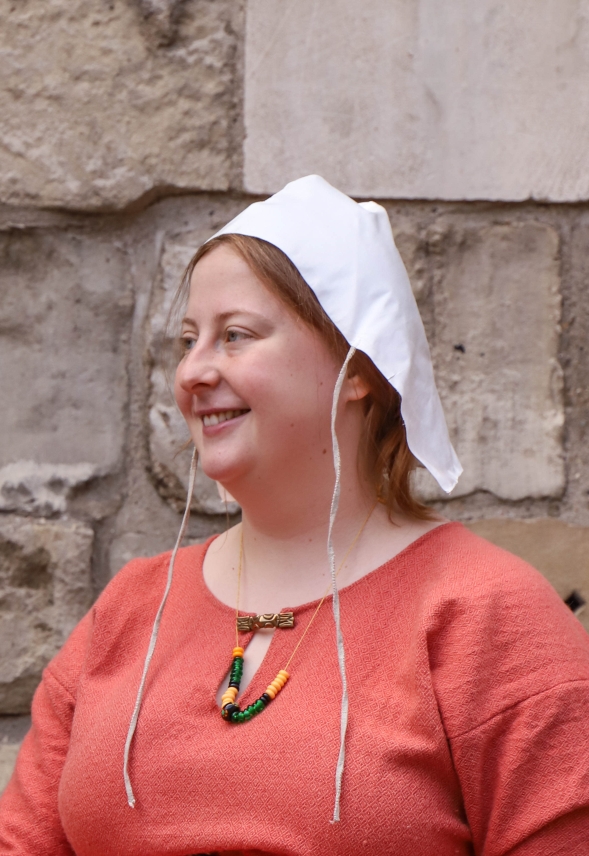
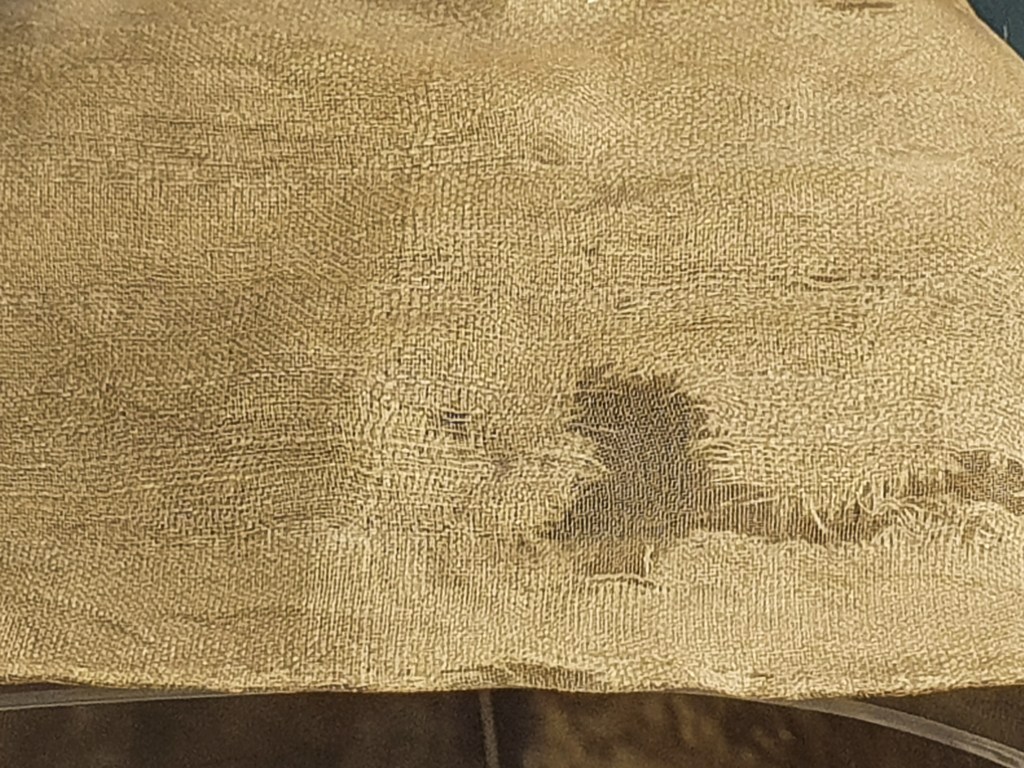
This cap is a replica of the most complete of several potential silk caps found in VA York, item no. 1372. With the exception of one fragment, they are all believed to be made of undyed silk imported from Iran. (Walton, 1989.) Of course, this would be a very expensive status symbol to own and we can imagine that the original owners would have been proud of them. Similar caps have been found in Lincoln and Dublin, with the latter providing caps made from both wool and silk. (Wincott-Heckett, 2003.)

I made my cap exactly to the measurements of the original, now kept in the Yorkshire Museum. This included placing the linen ties (not extant but indicated by stitch holes and pull marks) about halfway up the front edge of the cap- this didn’t fit me especially well.

It’s my personal opinion that this cap was originally made for an adult, with the ties being added higher up on the cap to alter it for a child’s use. Reuse of caps like this can be seen among the Dublin and York examples alike, with holes and tears being lovingly repaired to extend their use. I think with my next cap, I’ll make it to the same dimensions but attach my ties a little lower at chin level. I think I’ll alter the curve at the crown too, I made it as close as possible to the original measurements but it simply doesn’t fit my head as well as it could.

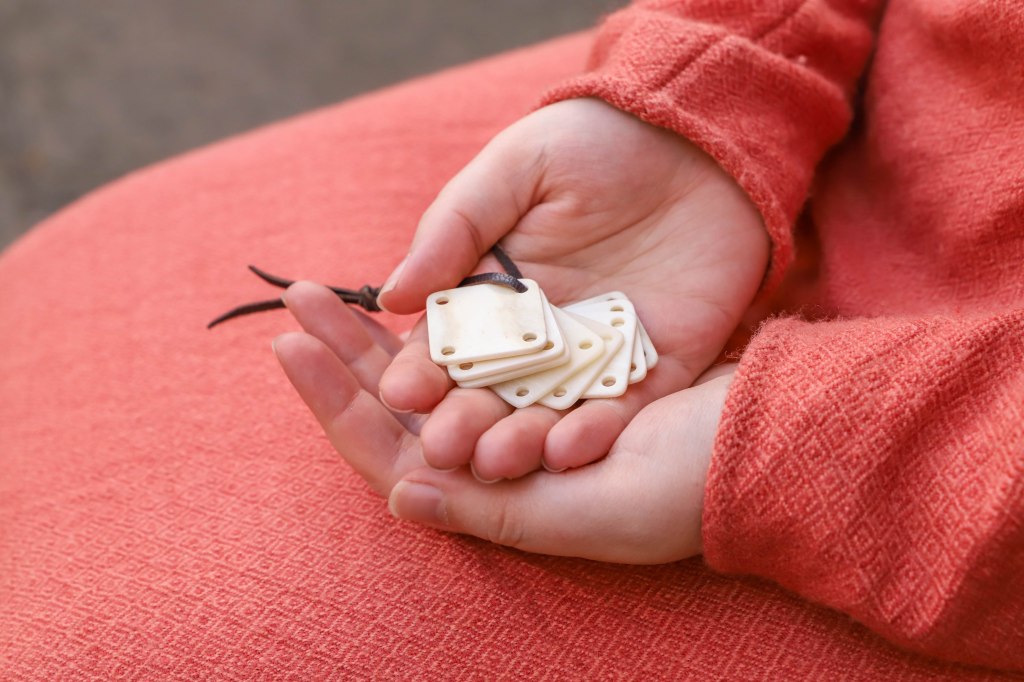
Bone weaving tablet (item no. 6679) and silk tablet woven braid (item no. 1340.) Both period 4B.
MacGregor, Mainmain and Rogers (1999.) p. 1969.

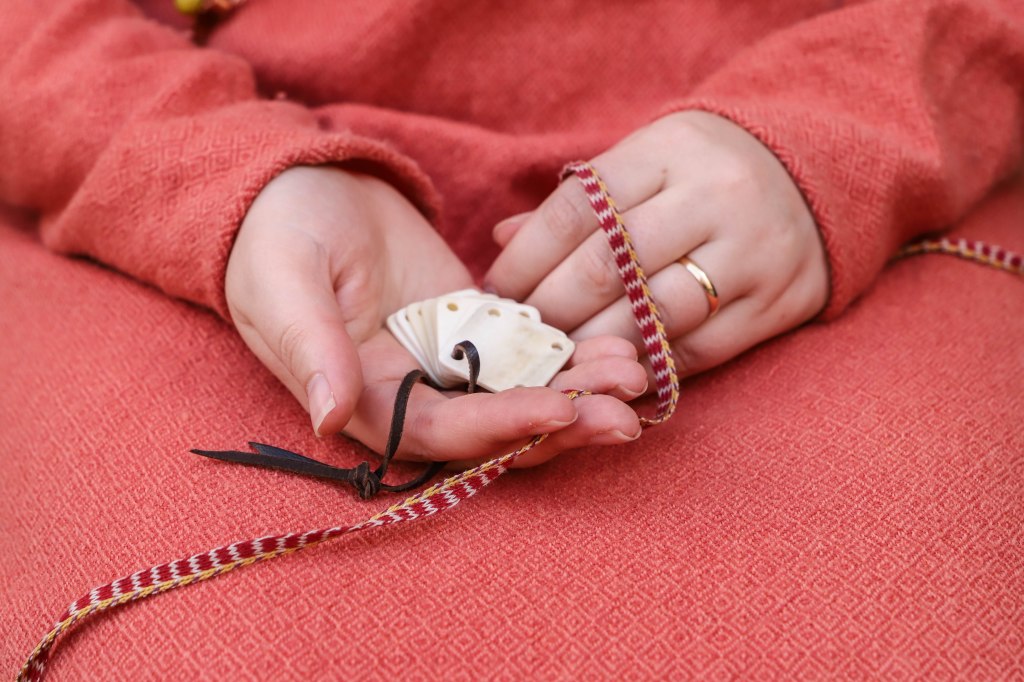
Firstly, we have a set of bone tablets based on a single example found in Tenement C, 16-22 Coppergate. It’s a very thin bone plate that is almost but not quite square: 27x24mm in dimension. My set is a little more evenly square, but that’s actually better for tablet weaving so I’m not too upset about it.

Weaving tablets from the Viking Age usually tend to be made from wood or bone, however, the average tablet is bigger than the York example at 30-40mm square. MacGregor, Mainman and Rogers (1999) suggest that the dainty nature of item 6679 means it was used for weaving fine silk braids, like the one found contemporarily on Coppergate (1340.)
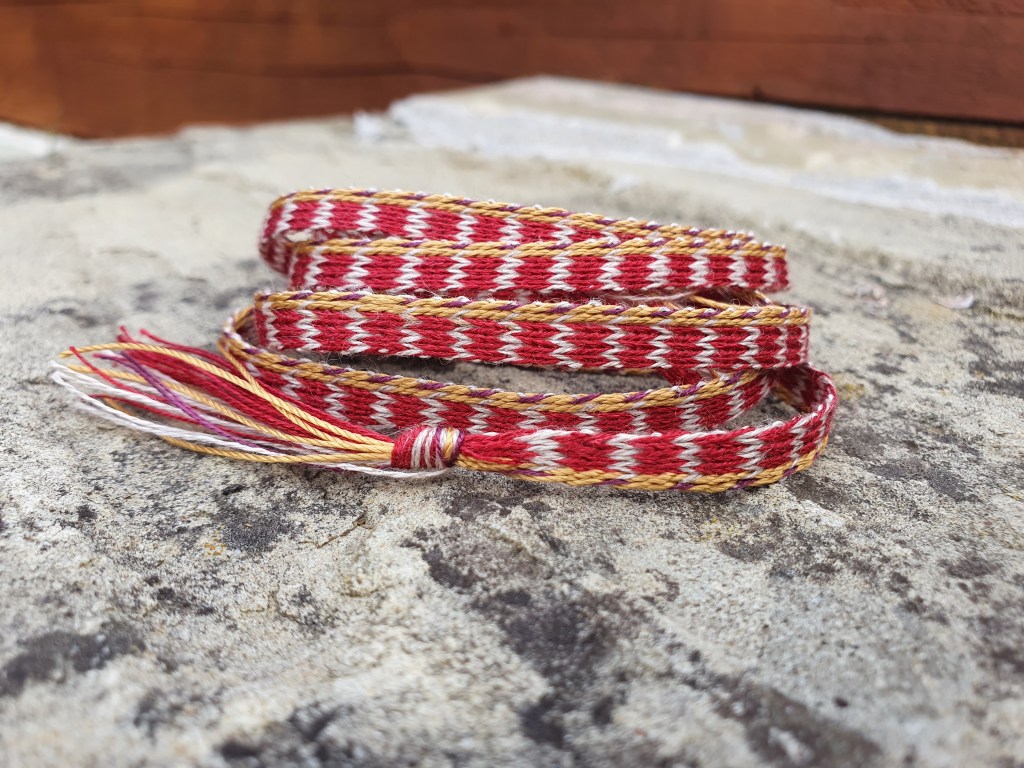
Walton, P. (1989.) p. 382.

I’ve already written an article on the silk and linen tablet woven band, that you can read here. In short, the original fragment was a tangled length of silk (1.47m) with a knot at one end. A few inches show evidence of having been woven with tablets, with gaps being left in the pattern that it is believed was filled with vegetable fibre, like linen.

Chemical analysis of the fibres indicated that some were dyed with madder and woad, with others only madder or no dye detected. In my recreation, I interpreted the undyed silk as being golden yellow in colour- this was based on a belief on my part that undyed silk would have been golden in period. This came from Walton’s (1989) quoting from an Old English leechbook, describing a jaundiced patient as ageolwað swa god seoluc “yellow as good silk.” If I made another version of this band, I would replace the yellow silk in the border with white or cream silk instead.

White veil in undyed 2/2 twill wool. Inspired by item no. 1300, period 4B.
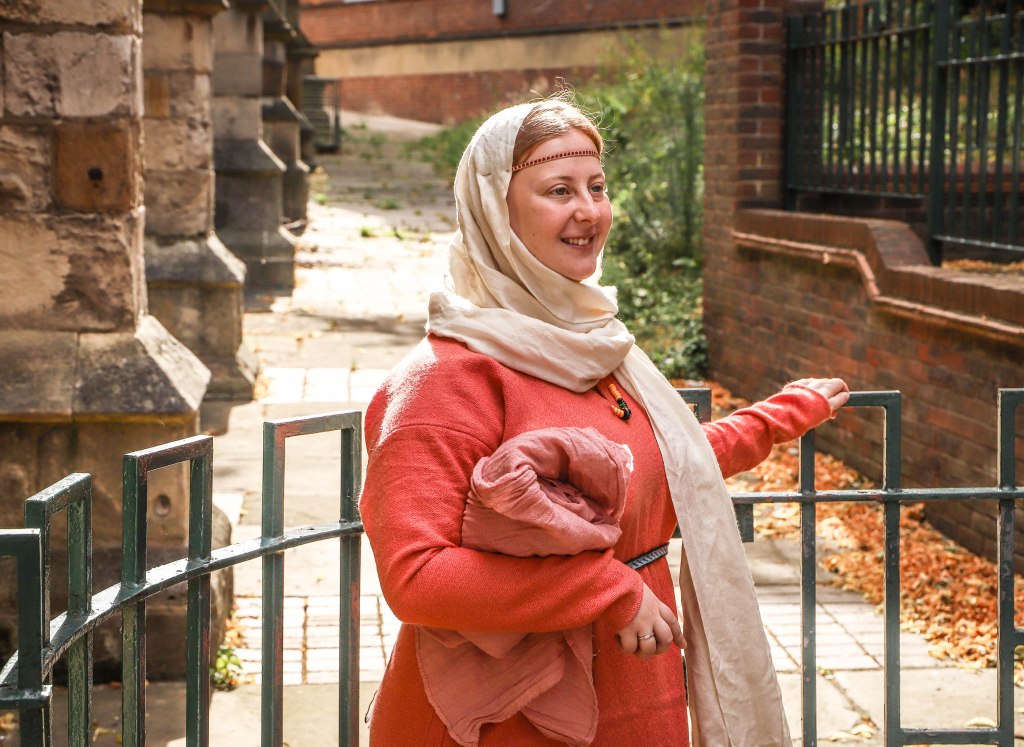
This alleyway beside the Jorvik Viking Centre had beautiful natural lighting, but was filled with rubbish and leaves. I figured that this was pretty accurate for a Viking street.

My wool veil is mostly inspired in cut by contemporary English art from the 10th century. Women are almost exclusively depicted as veiled, with the only rare exceptions being sinners in religious texts (Lot’s daughters are seen with their heads uncovered, but even they are shown veiled before they sin.)

I chose a light soft wool veil like the fabrics used in the Dublin caps and scarves (Wincott-Heckett, 2003) but unlike the Dublin examples, my scarf is a 2/2 twill, not a tabby. I aim to rectify this in the future, but for now, I feel that the length and drape of my scarf matches the period depictions and 2/2 twill is a commonly found weave in Anglo-Scandinavian York.

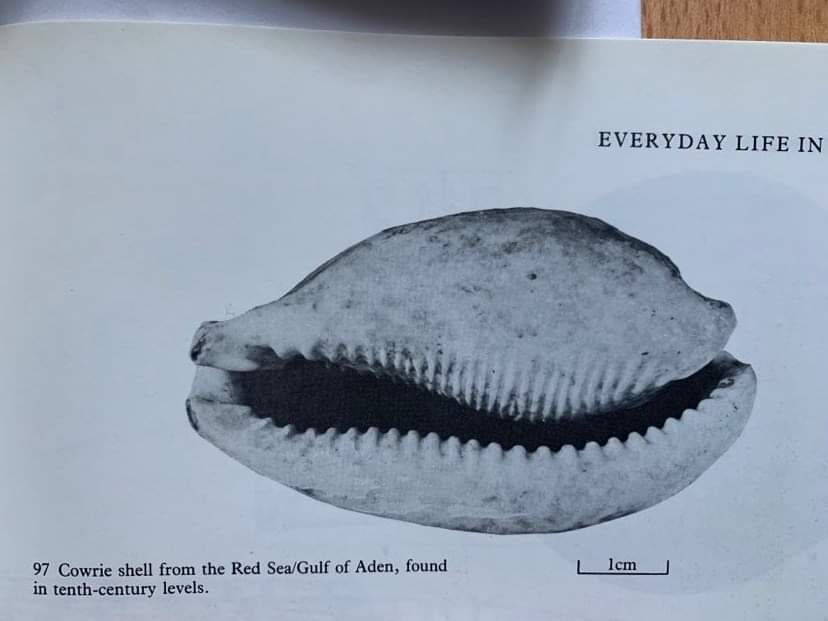
Cowrie shell Cypraea pantherina (Solander.) Item no. 11163, period 4A. (Late 9th/early 10thC- 930/5AD.)
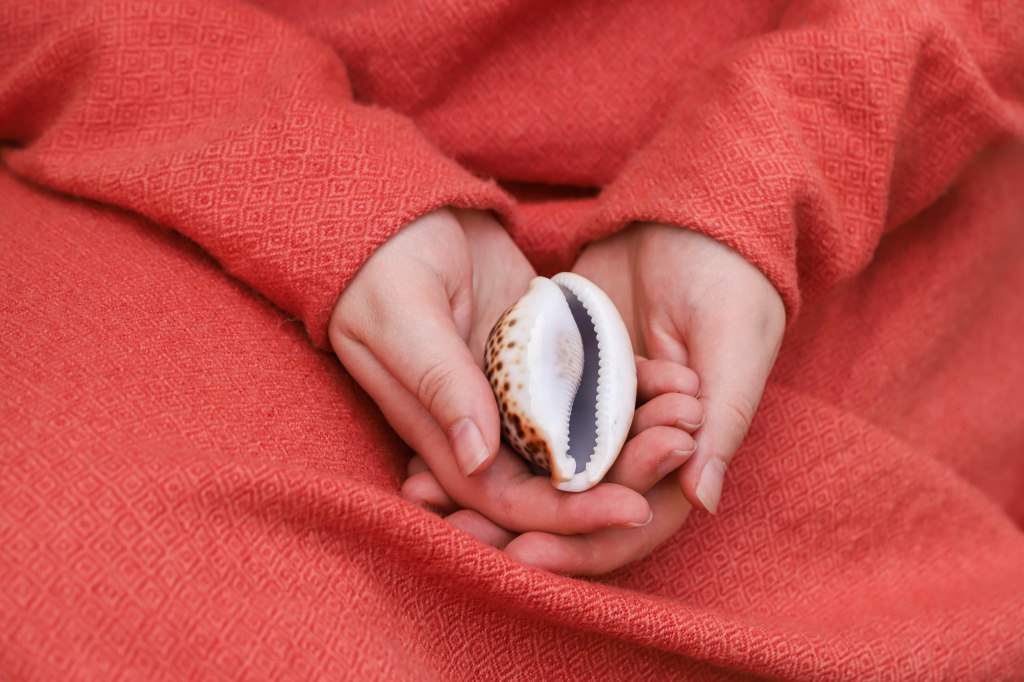
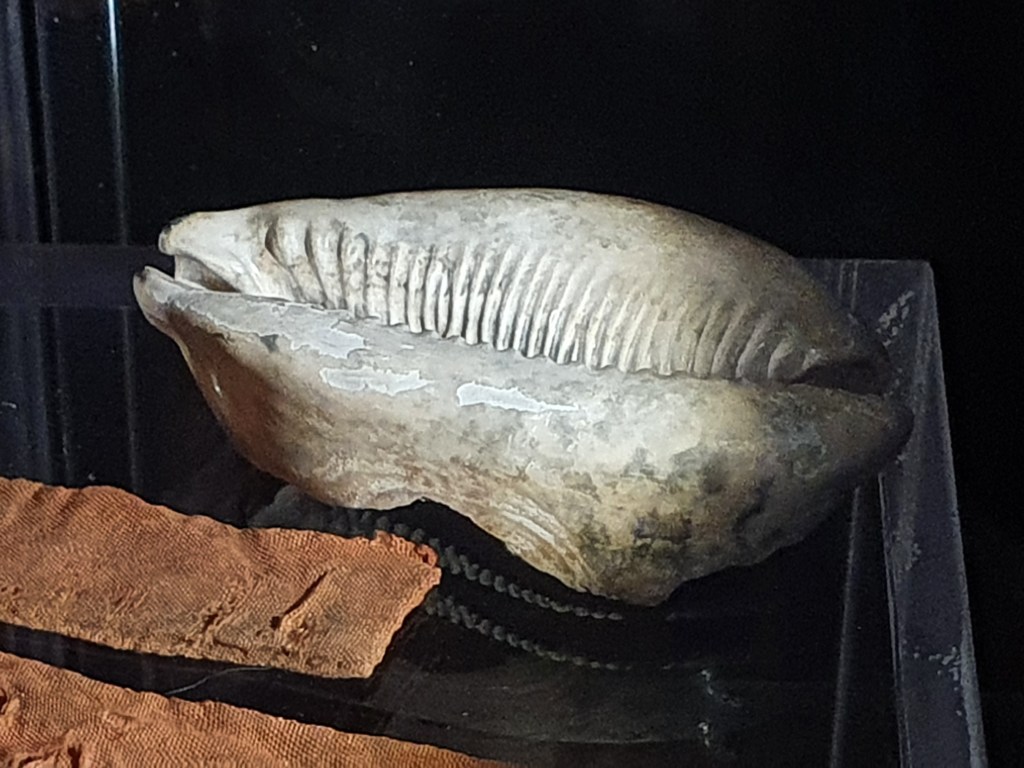
Hall, R. (1984) The Viking Dig.

This is a little earlier than my general timeline, but I thought it would be a fun thing to include. A panther cowrie shell found in early 10th century levels on Coppergate (11163) must have been brought by traders from abroad, as they are native to the Red Sea area. The original showed signs of saw marks, suggesting that it may have been used in the production of jewellery or ornamentation (Hall & Kenward, 2004.)

My cowrie is whole and shiny, I plan on keeping it that way. However, I am intrigued by the idea of jewellery featuring cut shell- I don’t know of any such jewellery found in York so far!

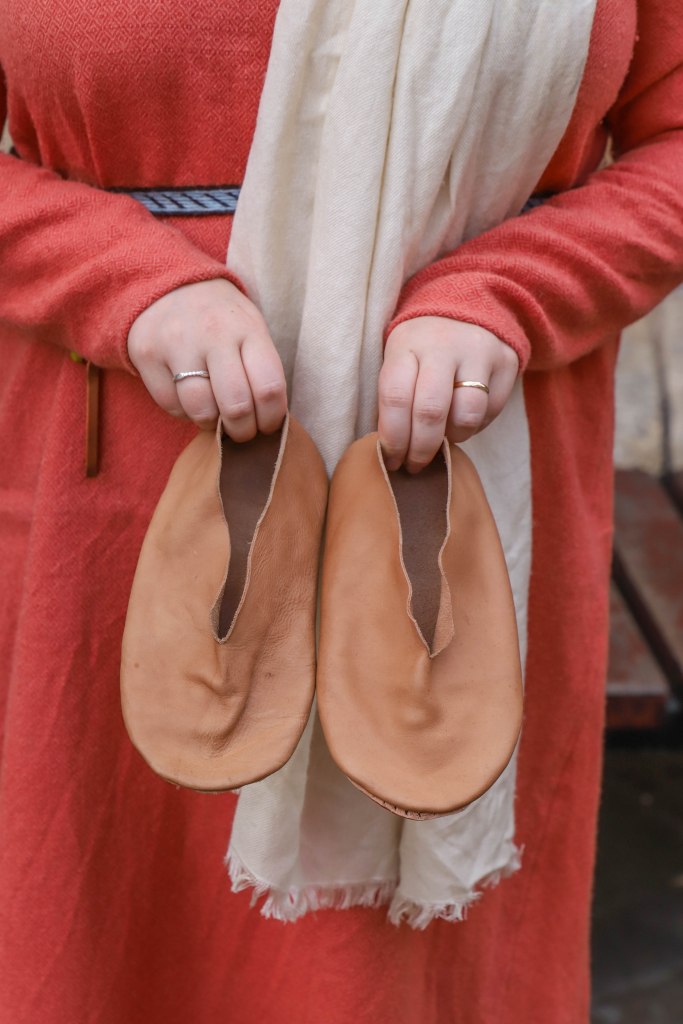
Low cut shoes. Item no. 15358, period 4B.
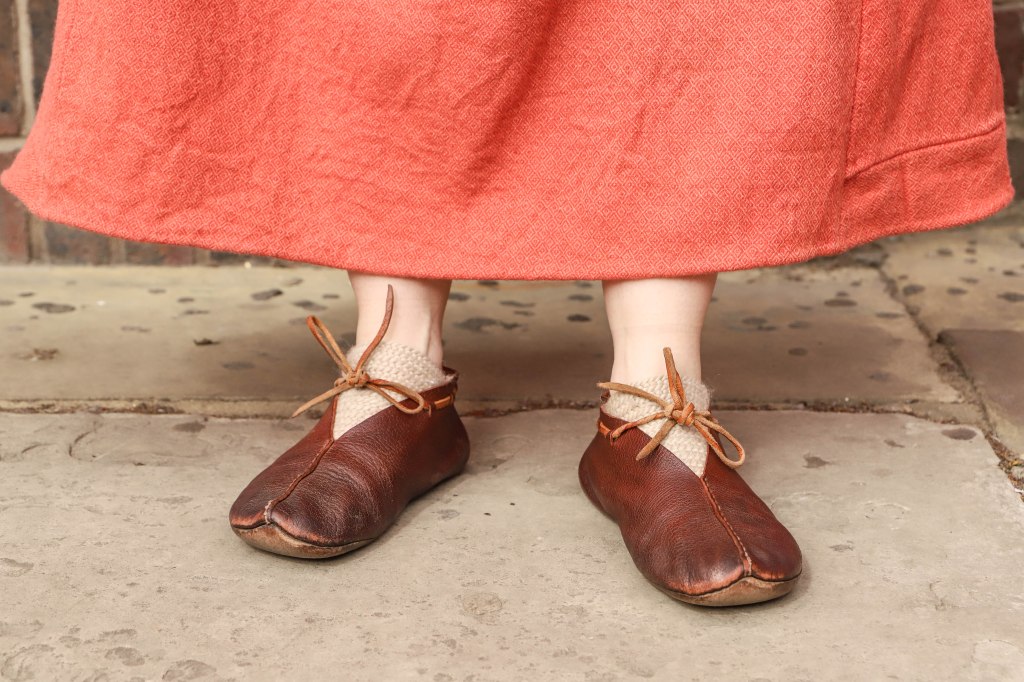
My stand-in shoes, based on a find from Hedeby and similar in cut to Style 2 shoes with a centre front seam. I made my socks, they are Oslo stitch and will be replaced by my Coppergate socks. Like the Coppergate sock, they are made of undyed wool.
The treacherous articles themselves, mocking me.

I was supposed to have a pair of very simple slip-on shoes made by a lovely friend, based on several pairs of shoes of Style 2. And get them I did- but they do not fit. Harrumph.
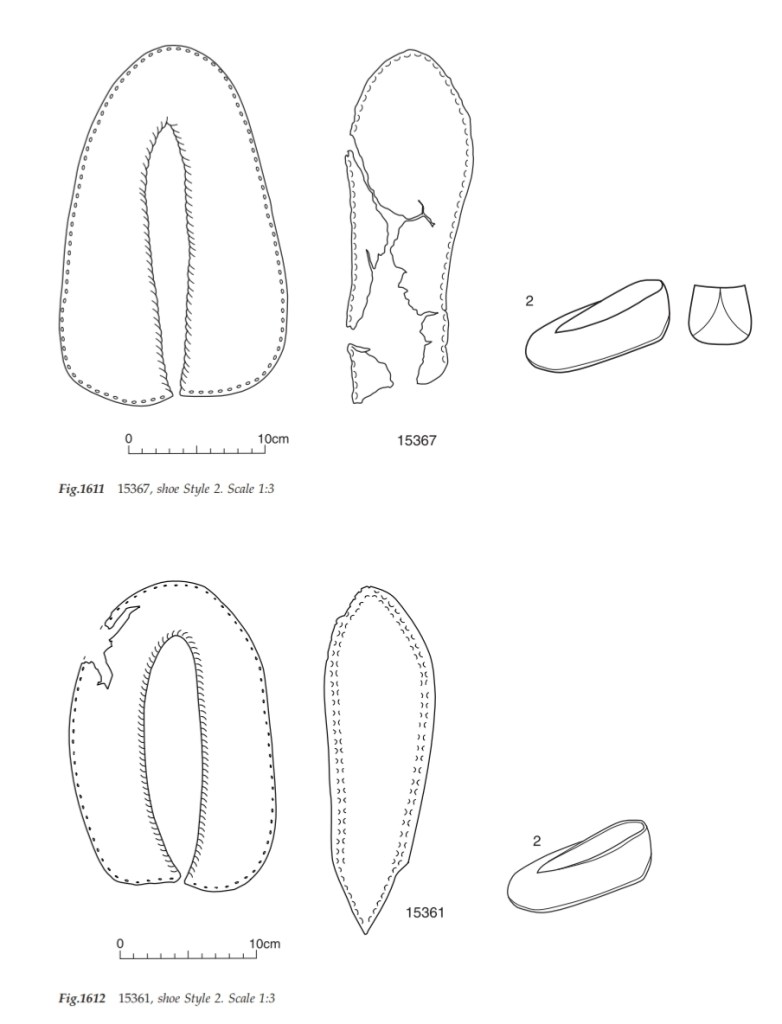
Mould, Q., Carlisle, I. & Cameron, E. (2003.) p.3286

Style 2 is described as “low cut, slip on shoes with a seam at centre back” and they were found in copious amounts in York (Mould, Carlisle & Cameron, 2003.) Shoes of this style have also been found in London, Dublin and Hedeby. The York examples were constructed in a fairly standard way but variations exist, with decorative bands being added around the throat, tooling on the heel risers and the uppers being pieced using several pieces of leather.

As a style, this shoe saw popularity in York from Period 3 (mid 9thC-early 10thC) all the way until Period 5B (c.975- mid 11thC.) Interestingly, finds sharply decline to only 1 pair after the mid 11th century: coinciding with the Norman Conquest. Why didn’t the Normans like these cute shoes? We may never know. Perhaps, like me, they couldn’t get a pair to fit!

Mantle. Inspired by fragment 1308, period 4B (c.930-975AD.)
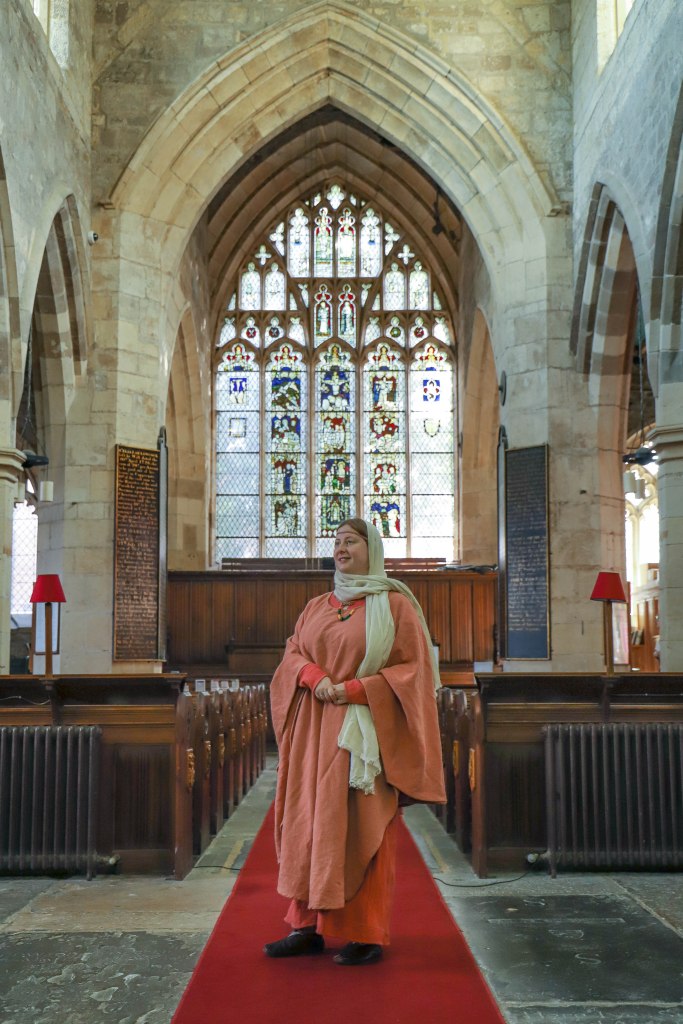
For my mantle, I used another 2/2 diamond twill wool dyed with madder, based on the same fragments that inspired my dress. While it is dyed with the same dyestuff, it is a different shade. I bought this lovely fabric from one of my favourite cloth sellers, A Selyem Turul from the Netherlands.

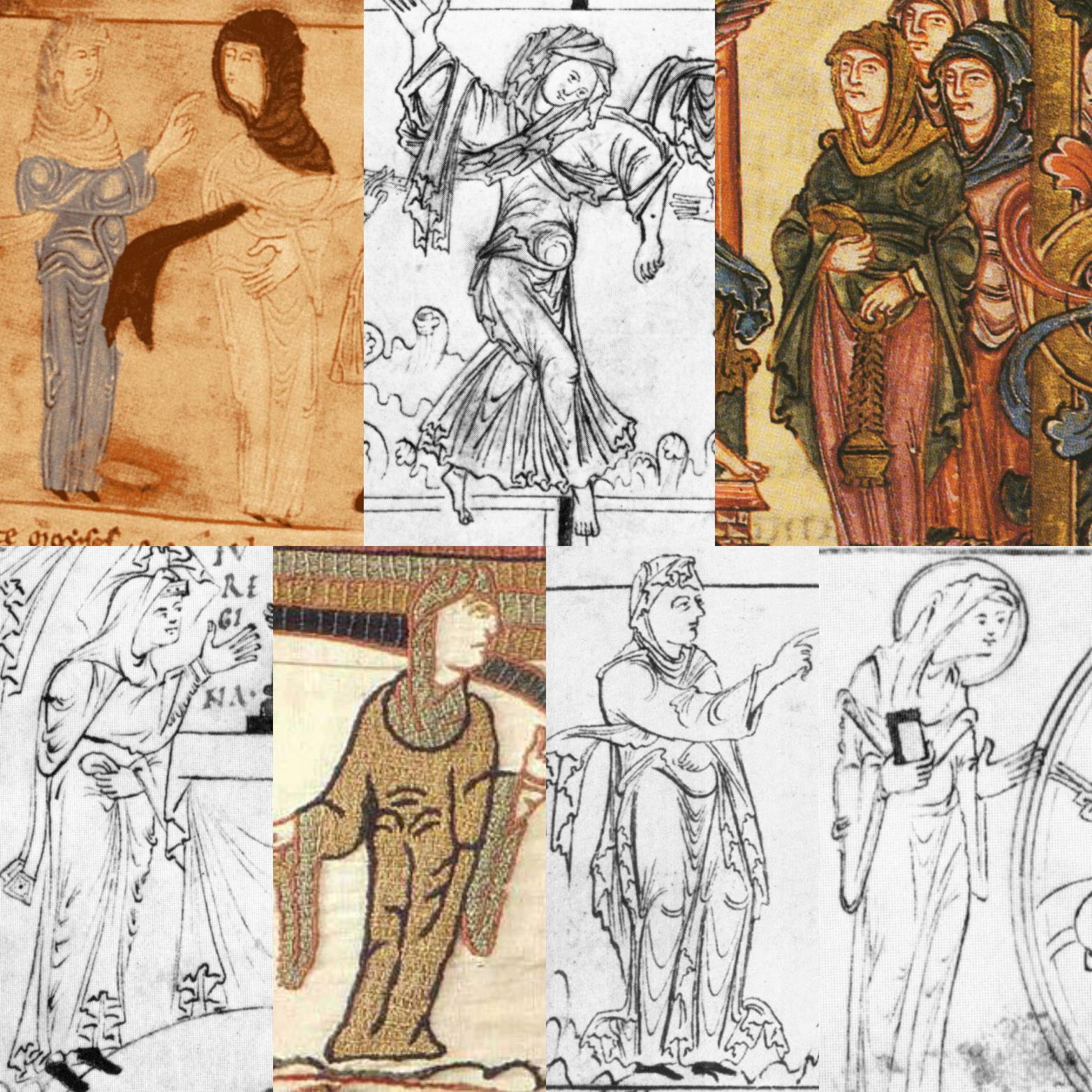
I drew up the pattern myself as it is quite simple, using several late English illuminations as a guide for the drape and silhouette. Towards the end of the Viking Age in England, mantles of this type replace cloaks increasingly on female figures in English art. I imagine that an affluent citydweller in a cosmopolitan place like York might seek to keep up with the fashion of the English elite by swapping her cloak for a closed garment like this.
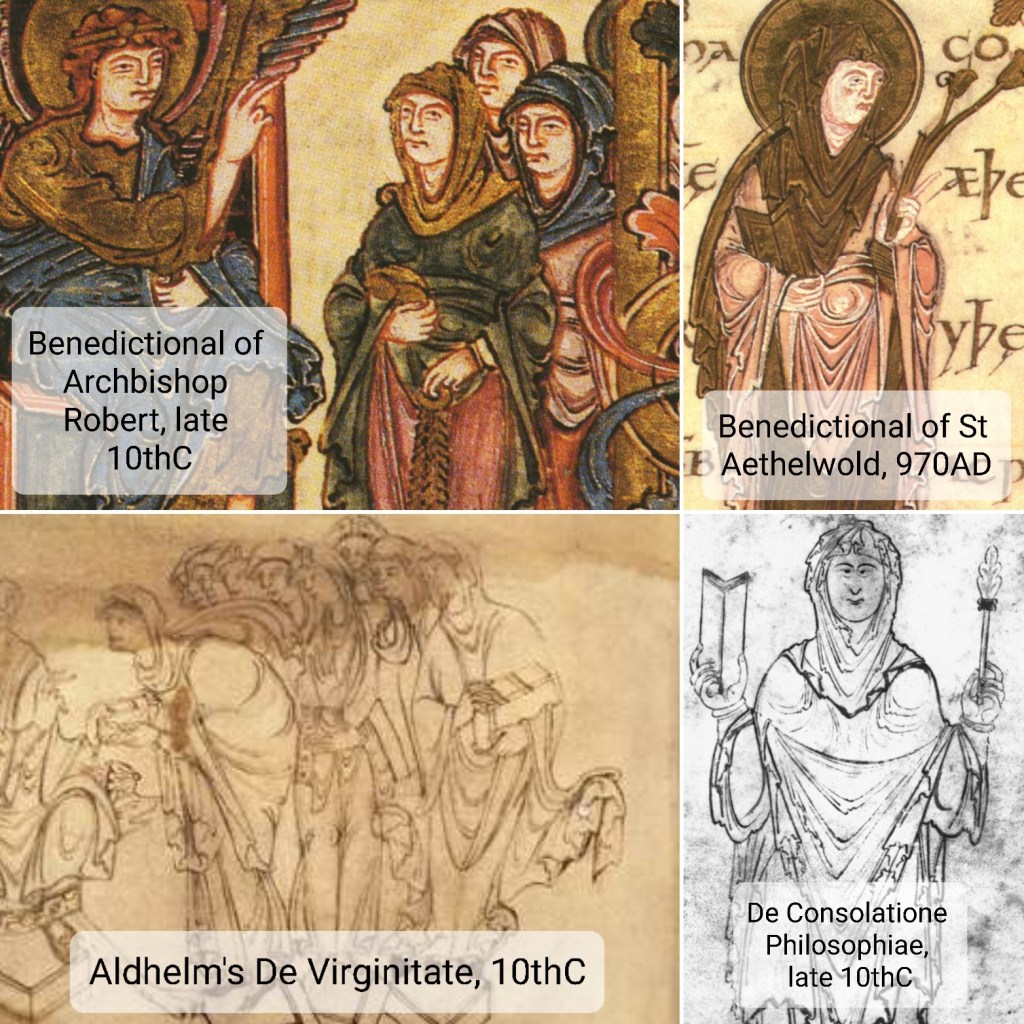
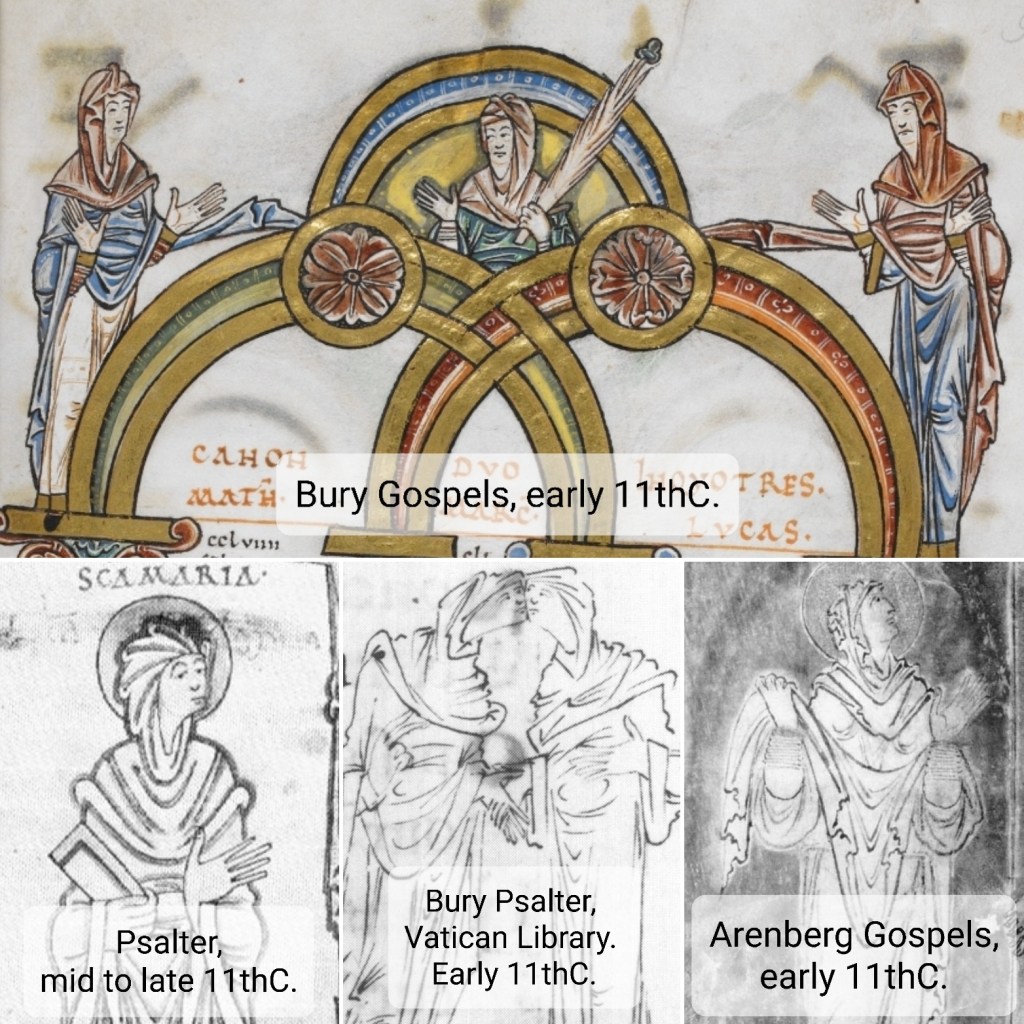
Just a small selection of images compiled by me, many more examples exist. Many English sources can be seen in full online on the British Library website, the other sources can be found here.

Of course, a cloak could be just as appropriate for an impression like this- the archaeological record from the Anglo-Scandinavian period has left us a wonderful array of of cloak pins to choose from, as well as heavier textile fragments believed to belong to cloaks or overgarments.

An improvement I would incorporate for my next mantle would be to make the neckline smaller- I did not realise how much it would stretch!

Christianity in Anglo-Scandinavian York

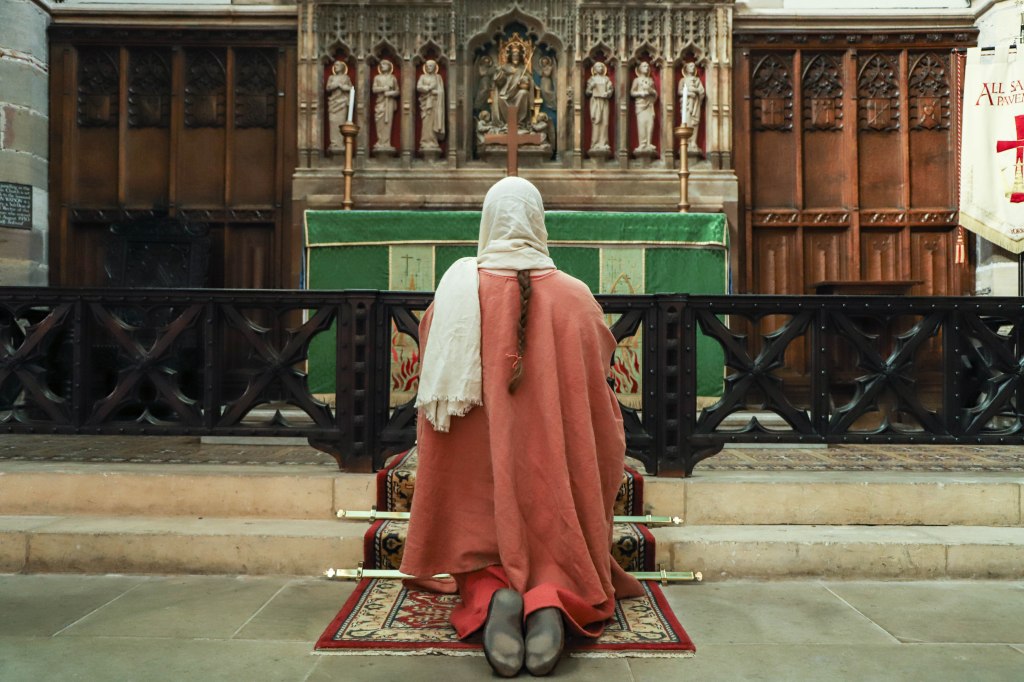
I wanted to represent an aspect of daily life that likely would have been as meaningful to people in the 10th century as it is to people today- faith. York was already well-stocked with churches long before the Scandinavians arrived, though only traces of these early buildings survive today.
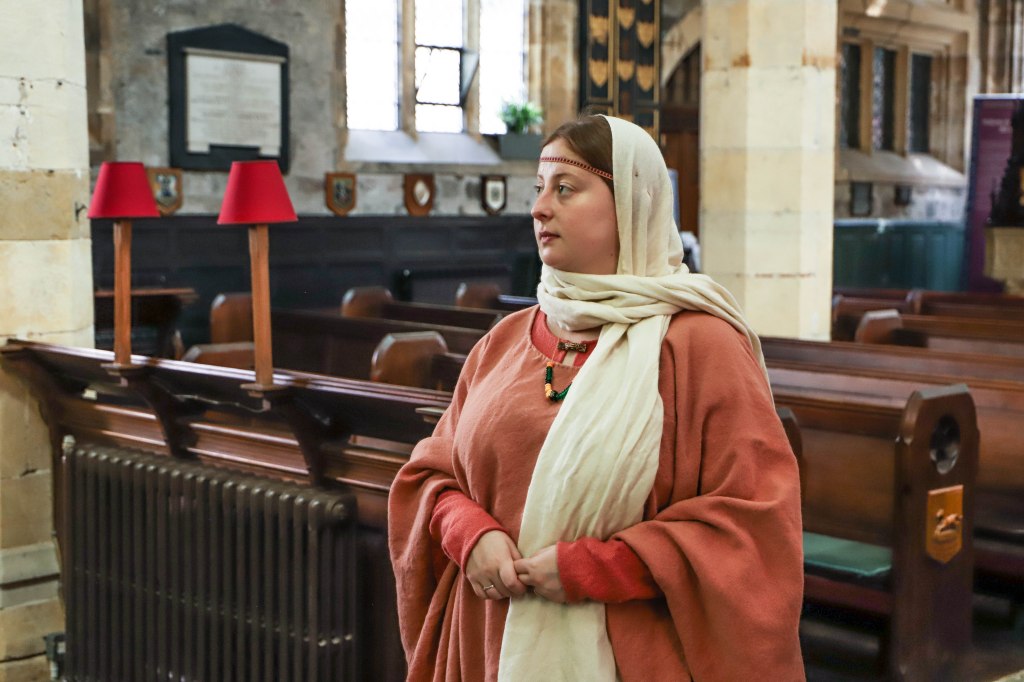
I tried to think of my York woman’s calendar and schedule: what would she have spent her time doing? Probably much the same as me: working, doing household chores, shopping, visiting with friends and relatives. Church on a Sunday? I was raised Christian, but don’t attend services regularly. I do however find quiet time to be alone with my thoughts vital. The peaceful surrounds of old stone and silence found in historical buildings is relaxing and comforting. Did early Christians feel the same way?
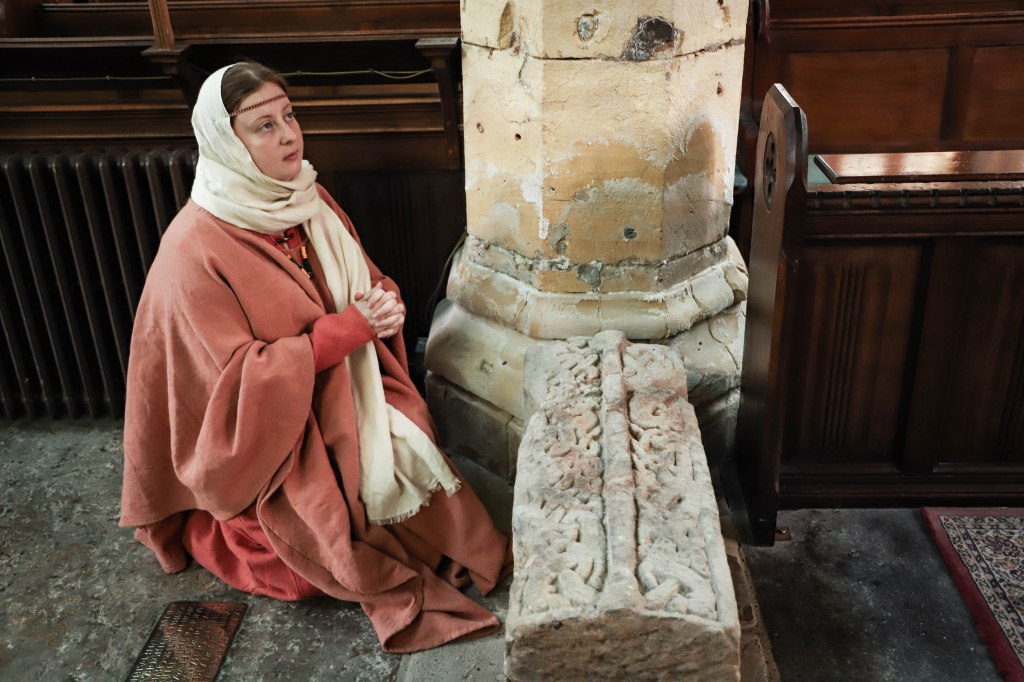
I wanted to take some photographs inside a church only a stone’s throw away from Coppergate- All Saints Pavement. The current building dates to the late Medieval period, but it is believed that an earlier church and burial ground existed on the site by the 10th century. This could very likely have been my York woman’s local church.

A tiny yet beautiful grave cover was found during excavations at All Saints in the 1960s, dated to the 10th century and probably belonging to a child. Every time I see it, I take a moment to stop and spare a thought for who it belonged to and who they might have become, had they lived. Their passing must have been an enormous loss to their family, who chose to honour their little life by laying them to rest somewhere familiar with a gorgeous carved gravestone covered in sprawling interlaced beasts.

(I feel it’s very important to note that to my knowledge, there are no human remains buried underneath the 10th century grave cover. However, there are other remains buried in All Saints Pavement and it continues to be an active, consecrated place of worship. Sarah and I were quiet and respectful during the entirety of our visit.)
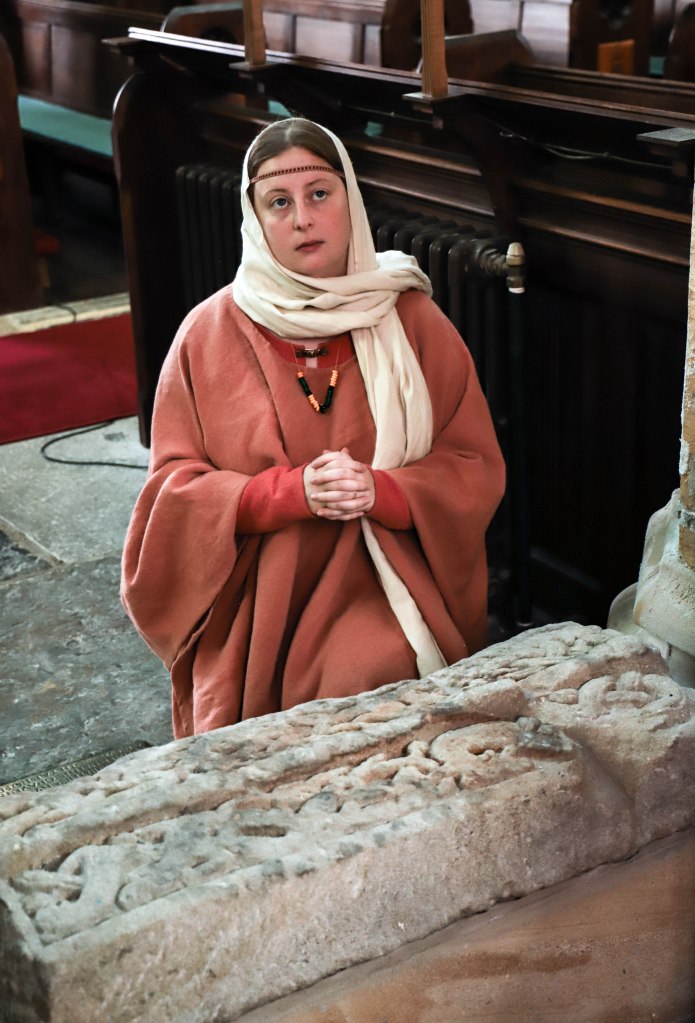
Religion in the Viking Age is a gargantuan topic and one I would be happy to tackle in its own article, should there be interest. I already have several projects on the go that involve churches in York- you’ll just have to watch this space.
If you liked this article, consider buying me a cup of coffee! My Ko-fi link is here: https://ko-fi.com/eoforwicproject

References

Hall, R. (1984) The Viking Dig. ‎London: The Bodley Head Ltd.

Hall, A. & Kenward, H. (2004). Setting People in their Environment: Plant and Animal Remains from Anglo-Scandinavian York. In: Hall, R. A. (Ed). Aspects of Anglo-Scandinavian York. York: Council for British Archaeology. p.419.

MacGregor, A., Mainman, A. J. and Rogers, N. S. H. (1999) Bone, Antler, Ivory and Horn from Anglo-Scandinavian and Medieval York. London: Council for British Archaeology. pp.1948-1949.

Mainman, A. J. & Rogers, N. S. H. (2000) Craft, Industry and Everyday Life: Finds from Anglo-Scandinavian York. York: Council for British Archaeology. p2451-2671.

Tweddle, D. (1986) Finds from Parliament Street and Other Sites in the City Centre. London: Council for British Archaeology. pp.232-234.

Walton, P. (1989) Textiles, Cordage and Raw Fibre from 16–22 Coppergate. York: York Archaeological Trust. PDF.

Wincott Heckett, E. (2003) Viking Age Headcoverings from Dublin. Dublin: Royal Irish Academy.

Bibliography and other links

All Saints Pavement: https://www.allsaintspavement.co.uk/

A Selyem Turul on Facebook- the source for my natural dyed cloth (when I don’t dye it myself!) : https://m.facebook.com/DeZijdenValk

Asgard, where I got my ansate brooch replica: https://www.asgard.scot/item/ABR026-BRZ-york-equal-arms-brooch-bronze

British Library Catalogue of Illuminated Manuscripts: https://www.bl.uk/catalogues/illuminatedmanuscripts/welcome.htm

Kragelund tunic: http://www.forest.gen.nz/Medieval/articles/garments/Kragelund/Kragelund.html

Moselund tunic: http://www.forest.gen.nz/Medieval/articles/garments/Moselund/Moselund.html

Skjoldehamn tunic: http://www.forest.gen.nz/Medieval/articles/garments/Skjoldehamn/Skjoldehamn.html

The Roman Girl’s Hair Bun: http://www.historyofyork.org.uk/themes/roman/hair-of-a-roman-girl

Tillerman Beads: https://www.tillermanbeads.co.uk/
Impressions: A Wealthy Anglo-Scandinavian Woman of Jorvík, Mid 10th Century

Location: Jorvík (York), England
Date: Mid to late 10th Century
Culture: Anglo Scandinavian
Estimated Social Class: Middle, wealthy urban

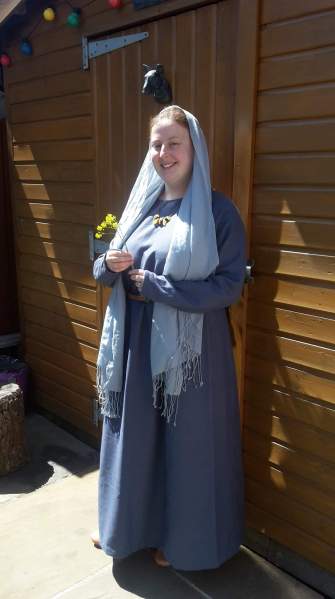
This will hopefully be the first of several speculative York impressions, built to showcase various artefacts and show how they potentially could have been worn/used in their day. It is not based on a grave nor is it to be taken as absolutely representative of the fashion of the place and time. My aim is to show a sensible and plausible outfit based on contemporary artefacts unearthed across York and give context to those remains and fragments.

Excuse my modern garden backgrounds, my 10th century longhouse was in the wash.

Starting from top to bottom:

Headscarf

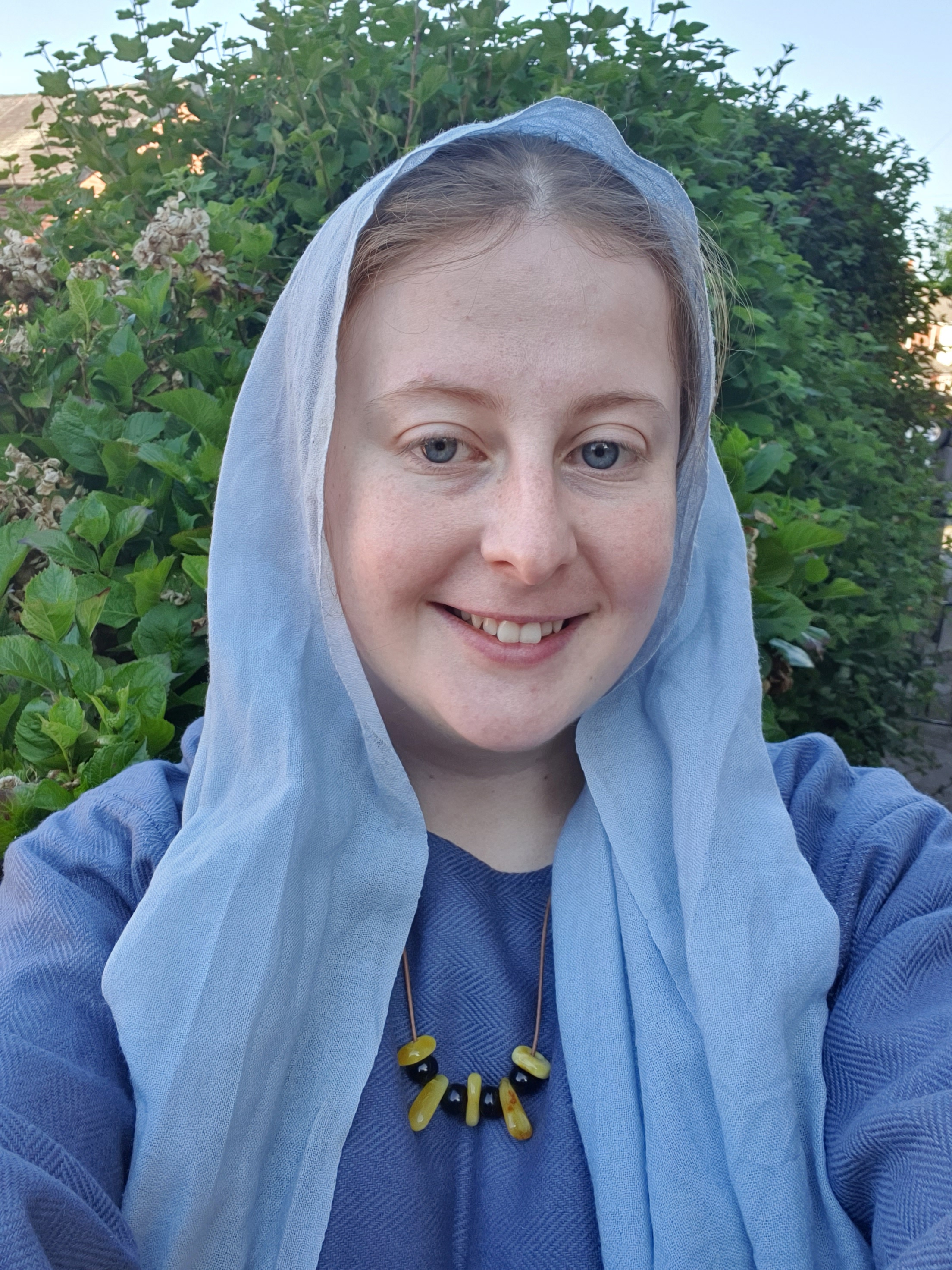
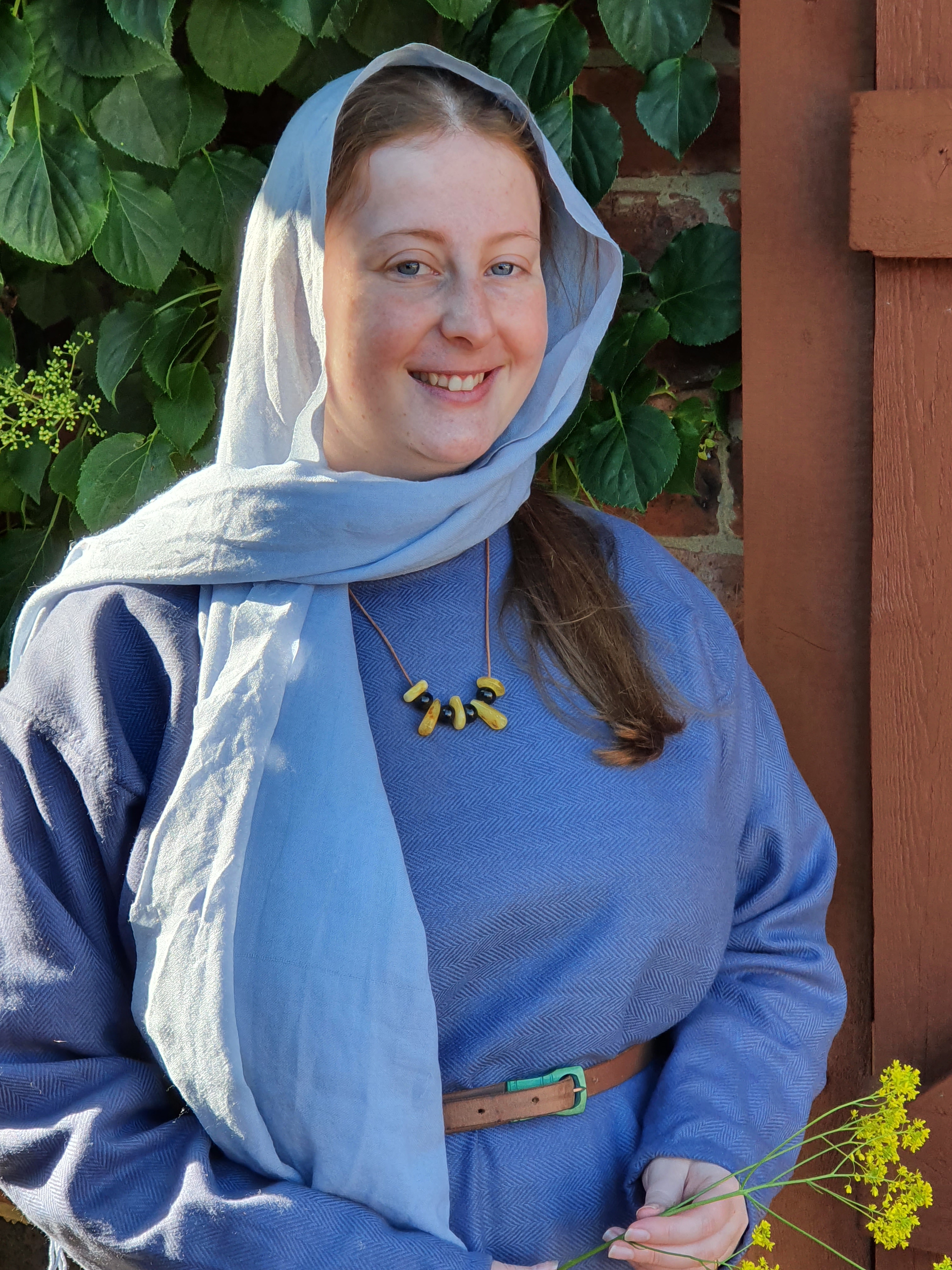
My veil is a plain weave, pale blue wool scarf. It is not naturally dyed, but in shade it closely mimicks woad. Women are almost exclusively portrayed veiled in Early Medieval English art, yet few examples of such veils are represented in the archaeological record. Fine woollen scarves with tassels have been found in Dublin, dating to the early 10th to mid 11th centuries (Wincott Heckett, 2003, pp.9-43). My veil is closer in size to the larger examples found at VA Dublin, such as the silk scarf DHC17 from Fishamble Street (dated to the early 11th century) but matches most closely with contemporary English manuscript depictions in size.

I wear this scarf several different ways even within the same day, tossing the ends over my shoulders as and when it’s required. The weather was balmy when I took these photos, so pins and a fillet weren’t needed. On windier days or if I’m feeling a little more haughty and austere, I’ll pin my veil onto a cap worn underneath and sometimes a fillet. Period variation in wimple/veil style is supported by English manuscript depictions, which show several different styles were worn. Presumably this was down to preference, though of course it could be an indicator of class or piety.

I could talk all day long about headcoverings, suffice to say that I will cover them in greater detail in a future post if people wish.

Necklace of amber and jet

The whole necklace, threaded on a fine leather thonging.
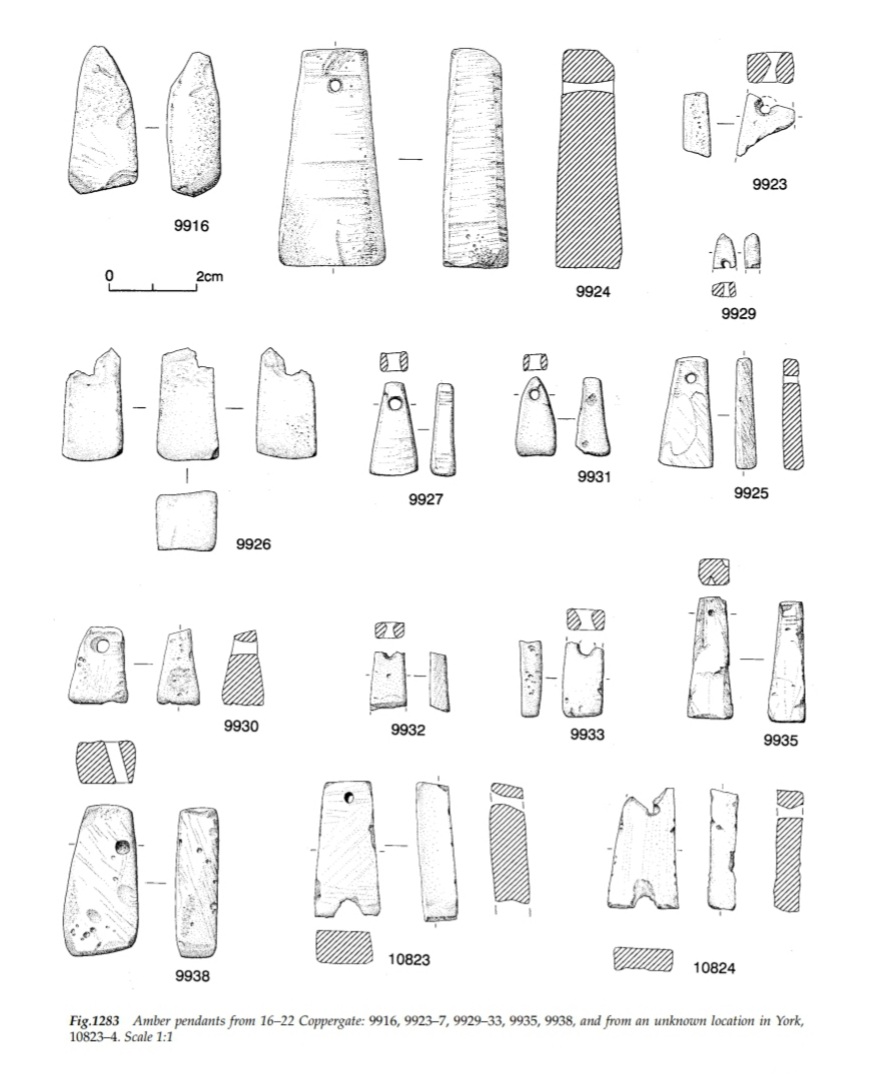
One of the triangular amber pendants.

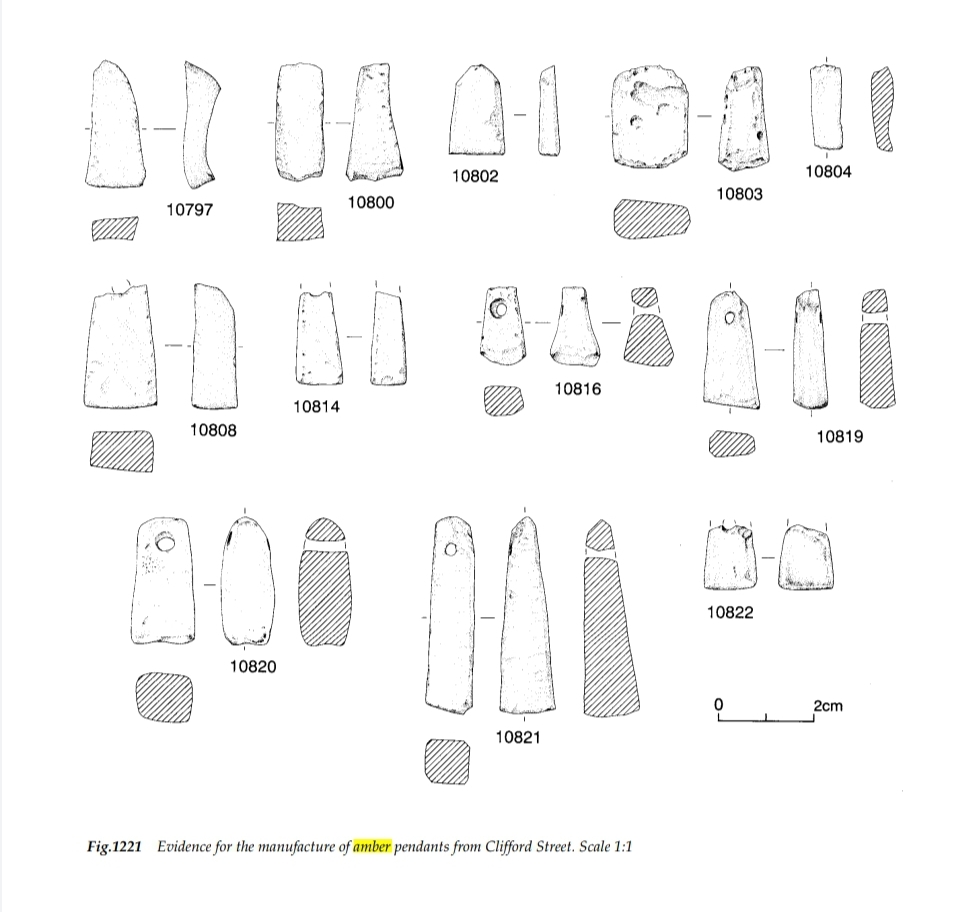
My necklace is made up of amber and jet, based on pendants and beads found at 16-22 Coppergate and other nearby sites. Extensive evidence for amber working in York was found at Clifford Street and 16-22 Coppergate, with fragments also being found at 22 Piccadilly and elsewhere on the Coppergate site (Mainman and Rogers, 2000). The wedge-shaped pendants I used are a little more rounded than the originals, but they can be replaced as and when I find a gemologist who will make me a more accurate replica. 😁 Many of the amber beads and pendants found at 16-22 Coppergate were dated to period 4B (c.930/5-c.975 AD.)

Found in (Mainman and Rogers, 2000, p.2507)
Found in (Mainman and Rogers, 2000, p.2589.)

The evidence for jet working at 16-22 Coppergate is definite, whether or not that evidence belongs to the Anglo-Scandinavian period is a subject of debate. Some items were found in Anglo-Scandinavian levels, but it has been argued that they were Roman items that ended up deposited in later levels through the passage of time. It does however remain possible that some of these jet items were indeed stratified correctly and I am working with that assumption.

The beads I used for my necklace are Whitby jet, dating to the late Victorian or early Edwardian period. They’d been reassembled into a new modern necklace, so I liberated them and used them for this project. Like their amber brethren, they are not perfect- they’re a little too spherical and neat. The jet finds from York consist of finger rings, bracelets, gaming pieces, pendants and manufacturing evidence (Mainman and Rogers, 2000). There was also an item identified as a bead (dated to the 5A period, approx 975 AD) but unfortunately it was stolen. I have included my beads in this impression based on the semi-worked fragments, the lost bead and the similar beads found in glass, amber and other materials.

Dress

The flower I am playing with is from my immortal woad plant, which is busy taking over my poor mum’s raised bed. I am pretending to be sorry about that.

My dress is made of a 2/2 chevron (herringbone) twill wool. I’ve dyed lots of wool blue using woad, but not this wool- it is chemically-dyed mimicking shades of a natural woad vat. It is handsewn by me with wool and linen thread. Textile fragments of broken chevron twill dyed with indigotin (the blue colour compound found in woad) were found at Coppergate, item number 1302 (Walton, 1989). The material was dated to period 4B, indicating a date of c.930/5-c.975 AD. It is described it thus:

“Fragments, largest 140 x 100mm, of mid brown 2/2 chevron twill, 8/Z/0.9 x 5-6/S/1.2 (Fig.134a). Yarn soft and unevenly spun. Fleece type, Z medium, S hairy. Dyed with indigotin. Hard concretions containing cess-like material adhere to parts of the textile.” (Walton, 1989)

In all the surviving textiles from Anglo-Scandinavian Jorvík, woad is represented but it is not the most common dyestuff. Madder- and bedstraw-dyed fragments are the most numerous by leaps and bounds, which indicates a distinctly English taste in Anglo Scandinavian York (I’ll discuss this at more length in a future article.) Woad however certainly did feature in the clothing of Jorvík city dwellers and I just so happened to have some suitable fabric leftover from a dress made for a dear friend many moons ago. Being a Yorkshire lass through and through, regardless of the century, I was using it.

No complete or near-complete garments have survived from Jorvík apart from the famous sock and several head-coverings. I therefore kept the pattern of my dress and undertunic as generic as possible. Women in contemporary English art are always shown wearing ankle length, long-sleeved garments, usually with some indication of skirted construction. It is believed that this might have been the case in Scandinavia too, with women in contemporary art there usually being shown to wear garments that are at least longer than men’s (Ewing, 2007).

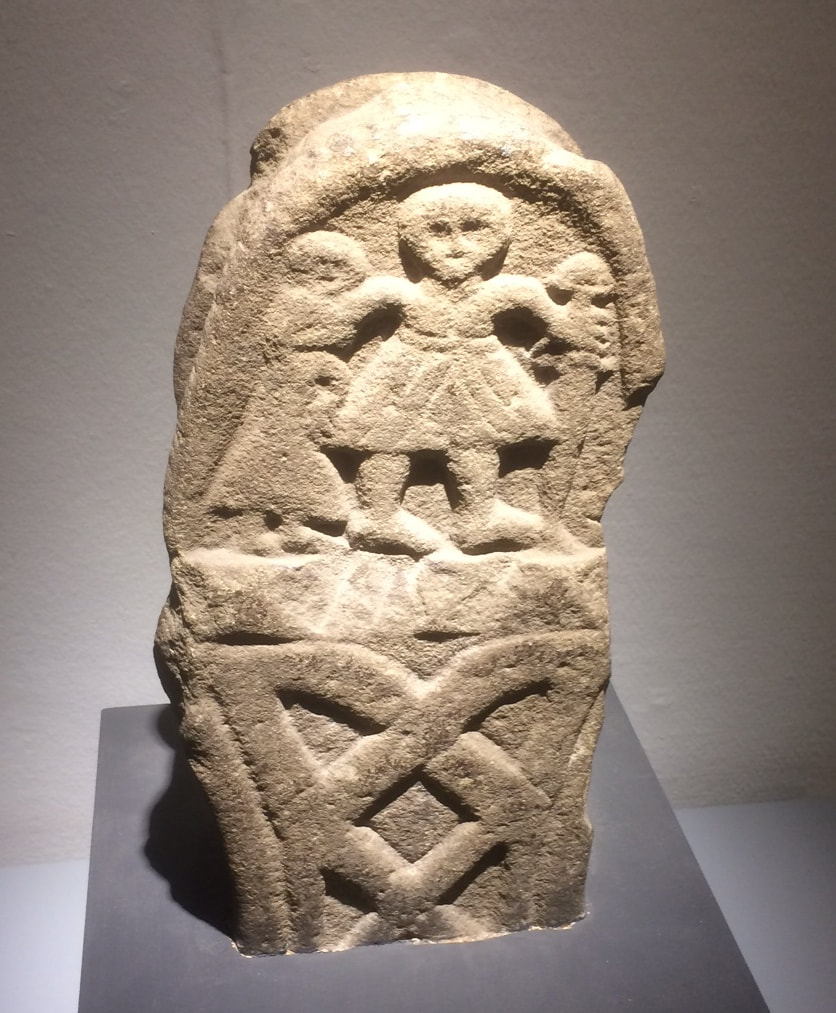
An Anglo-Scandinavian cross fragment from All Saints Church in Weston (North Yorkshire), dated to the 9th century. It is believed to show a warrior with a female captive and be a reworking of an original Anglian cross. Source.

Towards the end of the Viking Age in England, the sleeves on women’s overgarments appear to have grown wider, with tight-sleeeved garments being seen peeking from underneath them. I kept the sleeves on my dress relatively close to the arm so it would be more suitable for earlier impressions, with the opportunity to dress it up later with the simple addition of a mantle or baggier-sleeved overdress.

It is also prudent to note that almost all of the women portrayed in contemporary English art were very high in social status or were religious figures. They represent an ideal of the most aristocratic and modest women, not the daughters and wives of merchants (even wealthy ones) who might have walked through Coppergate. So, my York lady may well have worn her dresses with baggier sleeves on special occasions but likely not to go to the market.

Details from various 10-11th century sources: Top left- Folio 10 of the Old English Illustrated Hexateuch, 11thC English. Top middle- Luxoria from Prudentius’ Psychomachia, late 10thC English. Top right- Detail of supplicants from the Benedictional of St Aethelwold, late 10thC English. Bottom left: Detail of Queen Emma from the New Minster Liber Vitae, 1031 AD English. Bottom middle left- Detail from the Bayeux Tapestry, late 11thC English (suspected.) Bottom middle right- Patentia also from Prudentius’ Psychomachia. Bottom right: Mary also from the New Minster Liber Vitae. Source.

Surviving remains of skirted tunics such as the Skjoldehamn, Haithabu and later Herjolfsnes finds show examples of how these women’s garments in the Viking Age could have been constructed. Due to cloth constraints and to better fit my body, I opted for bottle-shaped side gores starting at my underarm. This construction provided the correct period silhouette while remaining comfortable.

My undertunic (or serk) was made in a similar pattern, only in undyed linen with a plain round neckline and triangular gores.

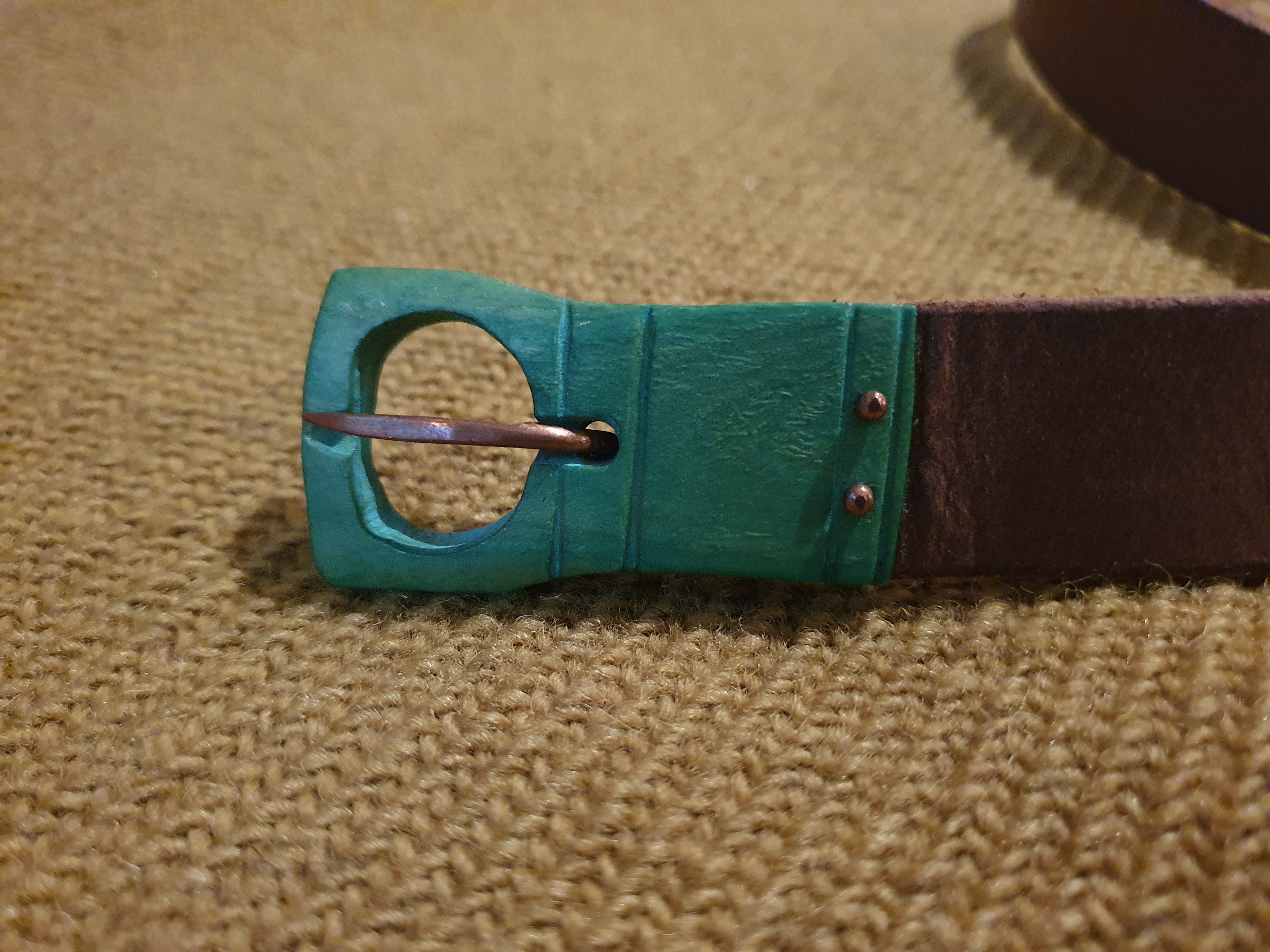
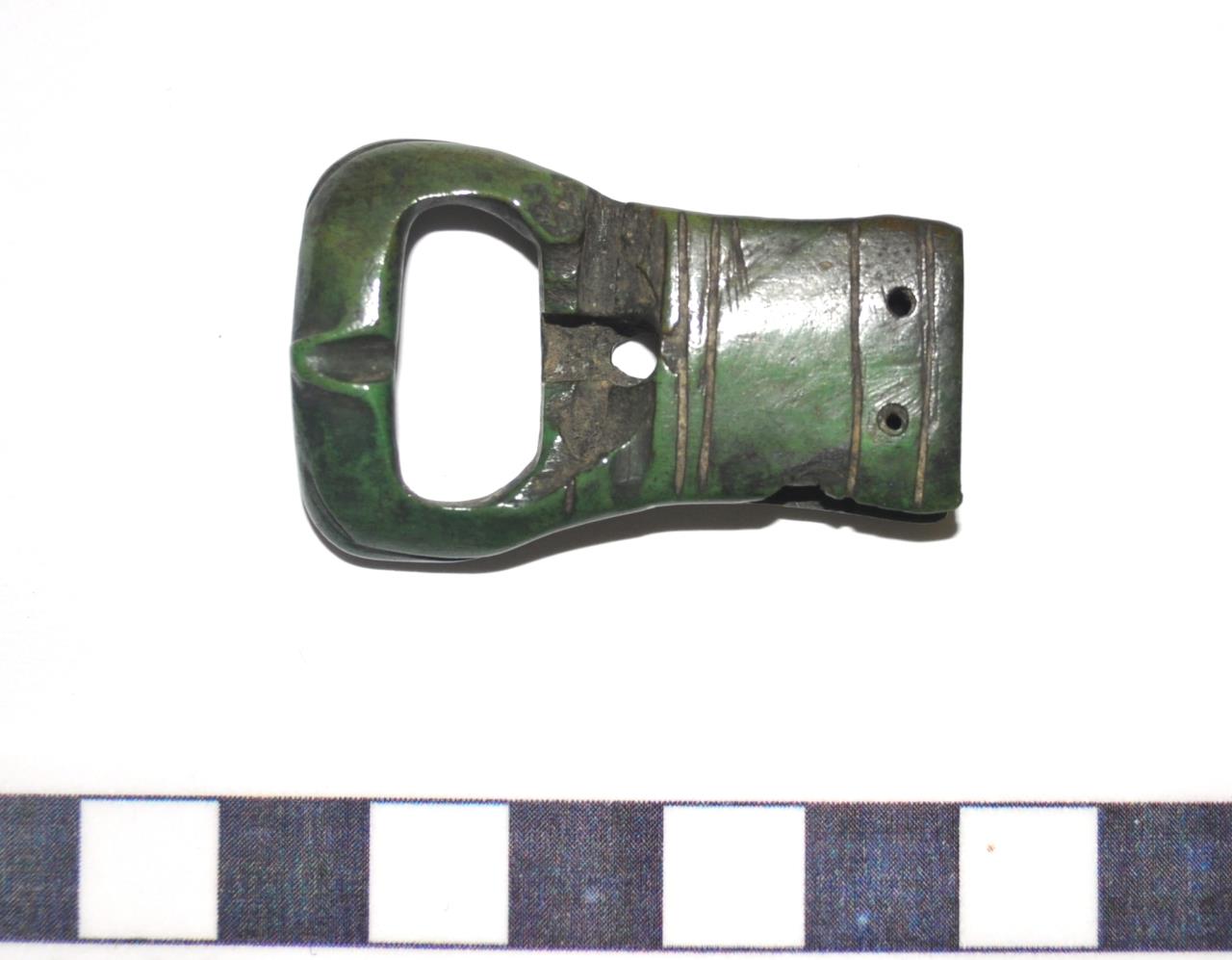
Leather belt with dyed bone buckle

Source.

Over my dress, I wear a belt of dyed bone buckle. This is an unusual item, currently kept in the Yorkshire Museum. The museum lists it only as Anglo-Scandinavian and dating to between 866 and 1066. It is generally believed that Early Medieval women did not wear leather belts, either opting for textile belts that have rotted away since or foregoing belts altogether.

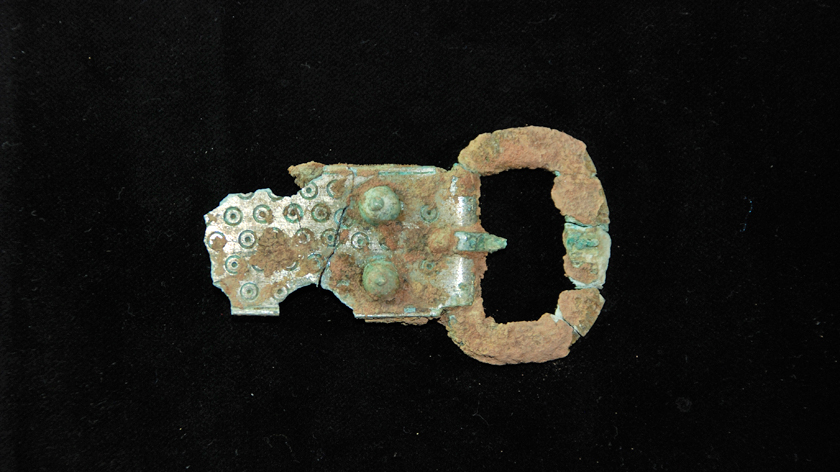
However, a 10th century grave of a woman in Cumwhitton (Cumbria) has challenged this assumption. One of the female graves contained a belt buckle and strap end, both made of copper alloy (Paterson, Parsons, Newman, Johnson & Howard Davis, 2014). I am fond of the York dyed buckle and since it was not found in a grave context, I feel comfortable including a leather belt as part of a wealthy female impression.

The Cumwhitton belt buckle from Grave 2. Source.

An interesting discussion of belt hardware surviving in female graves can be found in the bibliography. My replica of the belt and buckle was made by Sándor Tar on Facebook.

Leather turnshoes

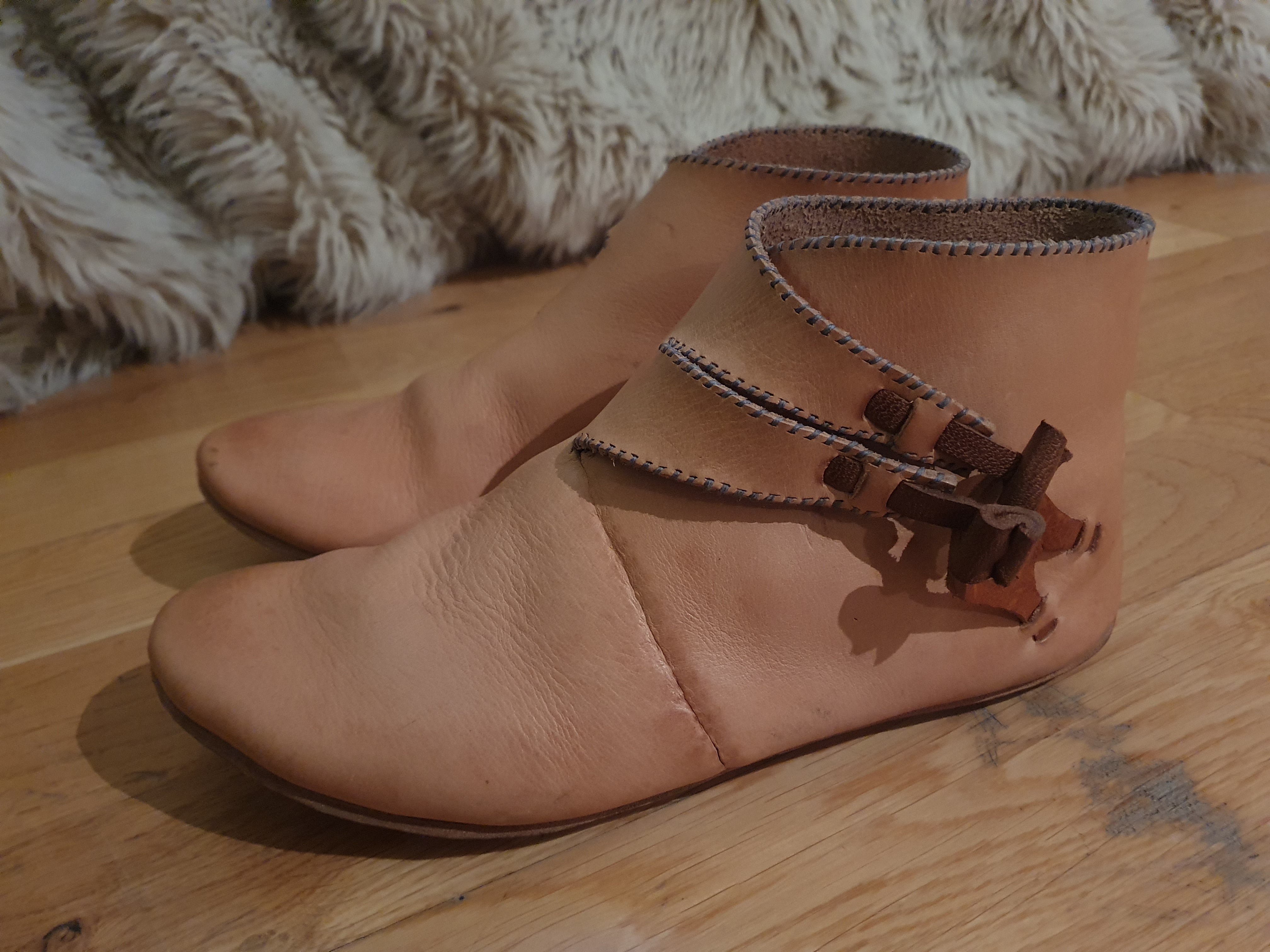
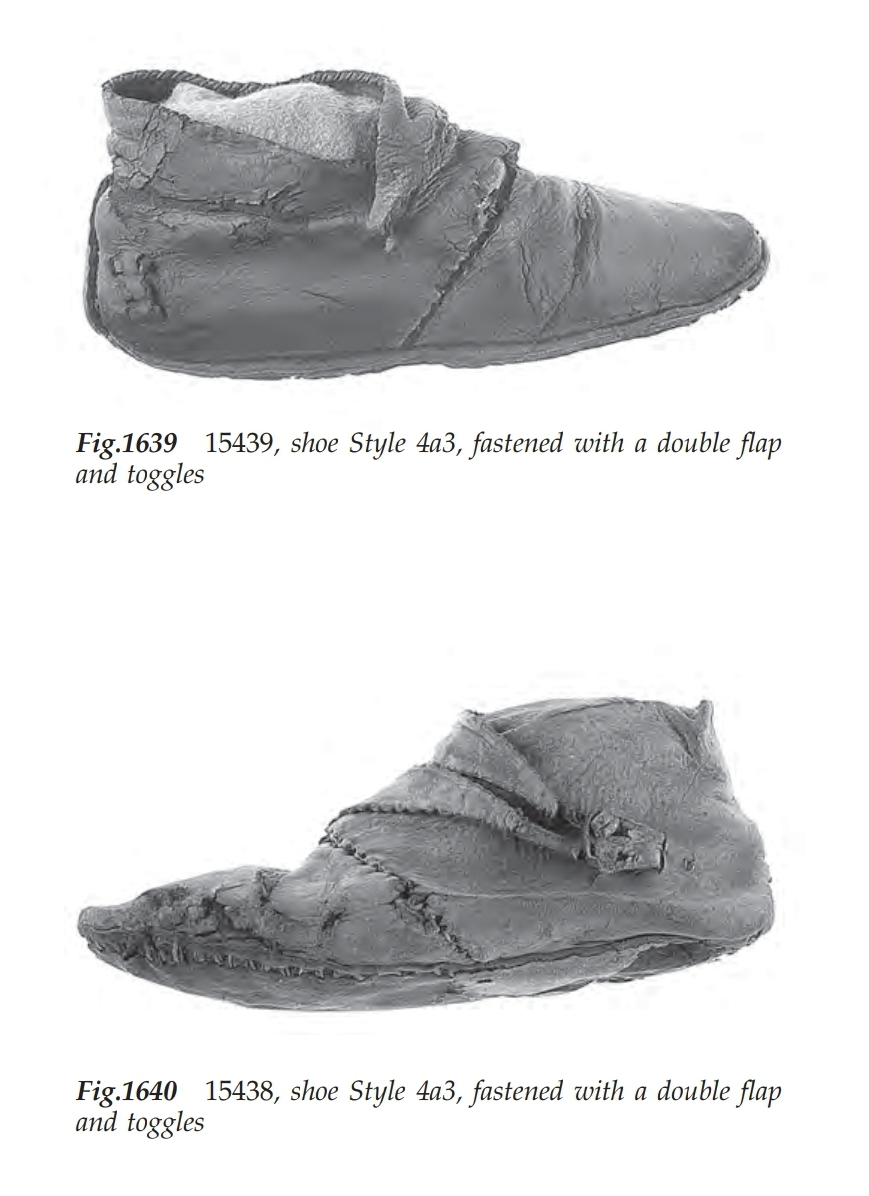
Type 4a3 leather turnshoes.

On my feet, I wear leather shoes, based on the Style 4a3. They are of a turnshoe construction and made of vegetable tanned leather. This pair was made by Torvald’s Leather Workshop.

Shoes of Style 4a3 have been found at 16-22 Coppergate from the earliest layers of occupation (mid-late 9th century at the earliest) throughout the whole Anglo-Scandinavian period, but finds of this type are most numerous in the mid 10th century layers (Mould, Carlisle and Cameron, 2003). Shoes of this style were also found at nearby Hungate and fragments indicating this style have been found in Oxford also.

Style 4a3 shoes, image from Mould, Carlisle and Cameron, 2003, p.3306.

I love this style of shoe, I think they’re really cute and so evocative in their style of Viking Age fashion itself. The only problem? The pair I have have the flaps on the wrong side of the foot! A large group of the shoes found in Jorvík had flaps and toggles over the instep- fastening on the inside of the foot, not the outside. Mould, Carlisle and Cameron (2003) even acknowledge that it seems like toggles on the outside of the foot would be more practical, but I found the opposite to be the case when actually putting them on. I’m aiming to replace these shoes in the future with ones closer to the originals, but they are gorgeous nevertheless and being handmade they are very comfortable.

Underneath these shoes, I wore a pair of woollen naalbound socks, loosely based on the Coppergate socks. However, they have graciously served me for several years now in all weathers and are not fit to be seen. I will certainly cover the mighty Coppergate sock in the future though.

Who might have worn this?

The wife or daughter of a wealthy urban merchant perhaps, someone who had the cash spare to afford dyed garments such as my dress and scarf. Worked amber and jet beads too would likely have been status items, with amber being imported from abroad from the Roman period.

It is also possible that a wealthy woman from more rural areas could wear an outfit like this, the wife of a rich farmer perhaps. This is not the kind of clothing one wears during the working day however, so it would be relegated to Sunday best or feasting clothing (I suspect that this would also be the case for an urban woman.)

References

Ewing, T. (2007) Viking Clothing. Stroud: Tempus Publishing. p9-70.

Mainman, A. J. & Rogers, N. S. H. (2000). Craft, Industry and Everyday Life: Finds from Anglo-Scandinavian York. York: Council for British Archaeology. p2451-2671.

Mould, Q., Carlisle, I. & Cameron, E (2003). Craft, Industry and Everyday Life: Leather and Leatherworking in Anglo-Scandinavian and Medieval York. York: Council for British Archaeology. p3306-3310.

Paterson, C., Parsons, A. J, Newman, R. M, Johnson, N & Howard Davis, C. (2014) Shadows in the Sand: Excavation of a Viking-age cemetery at Cumwhitton, Cumbria. Oxford: Oxford Archaeology North.

Walton, P (1989). Textiles, Cordage and Raw Fibre from 16-22 Coppergate . York: Council for British Archaeology. p285-474

Wincott Heckett, E (2003). Viking Age Headcoverings from Dublin. Dublin: Royal Irish Academy. p9-43.

Bibliography

The entry for the dyed bone buckle from York in the York Museum Trust online collection. https://www.yorkmuseumstrust.org.uk/collections/search/item/?id=7484&search_query=bGltaXQ9MTYmc2VhcmNoX3RleHQ9QnVja2xlJlZWJTVCMCU1RD0mR3MlNUJvcGVyYXRvciU1RD0lM0UlM0QmR3MlNUJ2YWx1ZSU1RD04NjYmR2UlNUJvcGVyYXRvciU1RD0lM0MlM0QmR2UlNUJ2YWx1ZSU1RD0xMDY2JkZOPQ%3D%3D

An article on belt hardware present in female graves in the Viking Age. http://www.medieval-baltic.us/vikbuckle.html

A corpus of 10-11th century images of English clothing in art. http://www.uvm.edu/~hag/rhuddlan/images/index.html

More information about the All Saints Church cross fragment (Weston, North Yorkshire.) https://m.megalithic.co.uk/article.php?sid=26680

An 11th Century Man’s Hat from Dublin- A Parallel With Early Medieval Frisia?

Hats! One of my favourite things. The discerning Early Medieval woman (and those who wish to dress like one) seem to be relatively spoiled for choice: caps, hoods, veils, wimples and even headbands are all options. Unfortunately, the evidence for male headgear in period is generally not as well-represented. Chrystel R. Brandenburgh (2010) did a fantastic study of early textiles found in Frisia (a region in what is now the Netherlands) which details several hat fragments dated to the Viking Age, including an extremely spiffy example from Aalsum.


The original hat found in Aalsum (object nr. FM 33-373), in the collection of the Fries Museum. Photo taken from Brandenburgh (2010).

The Aalsum hat is dated to 750-900 AD, towards the end of the estimated habitation of the find site. It is woven in a 2/2 diamond twill and is made of brown wool with no dye being detected. While there are a couple of other hats from Frisia with some form of neck flap (presumably to shield the neck from the elements), I was interested by this hat. Nothing similar shows up in sources from the British Isles nor Ireland that I know of, either written or pictorial.

That is, until I saw this in one of my books on Viking Age Dublin.


Well. Hello, handsome.

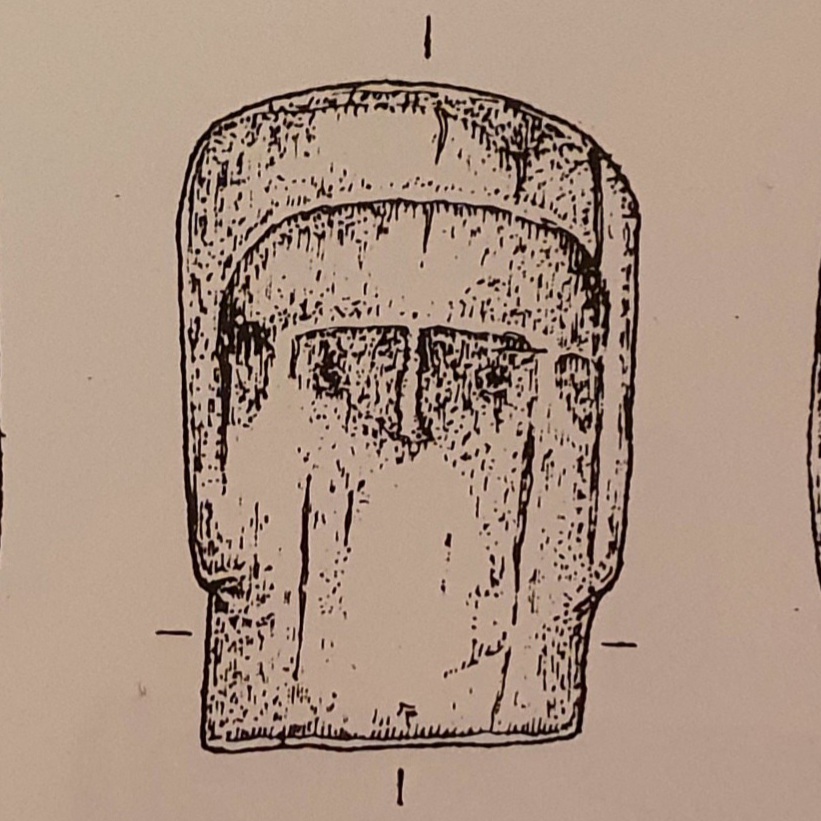
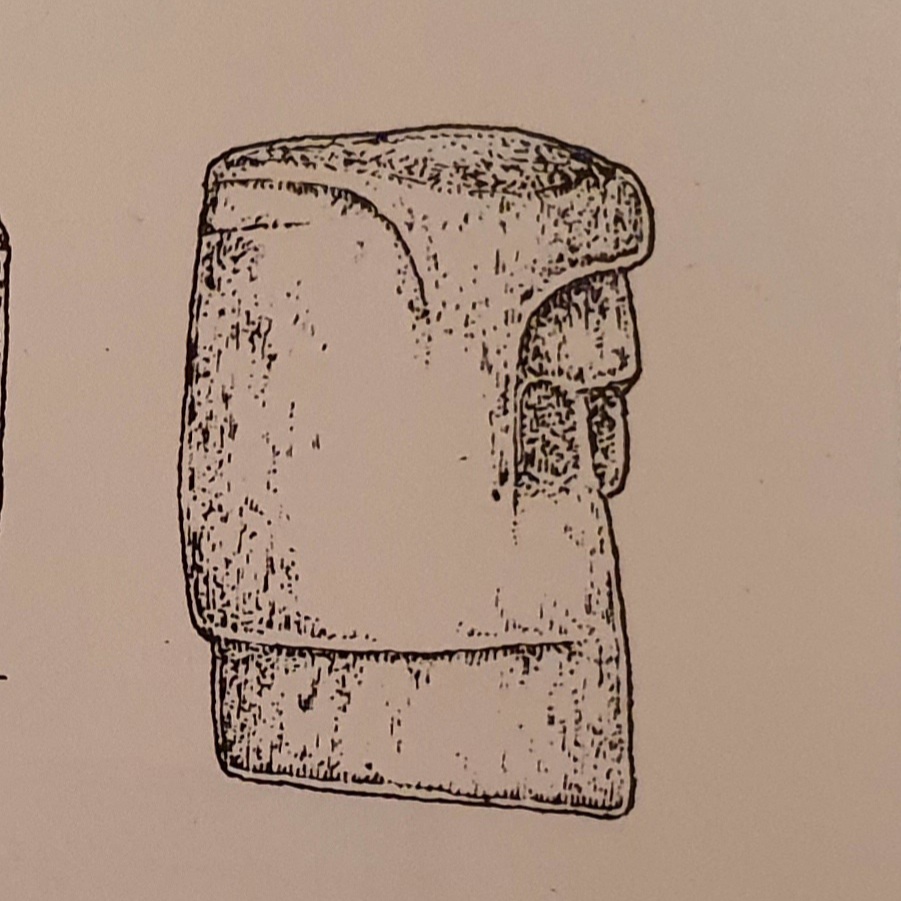
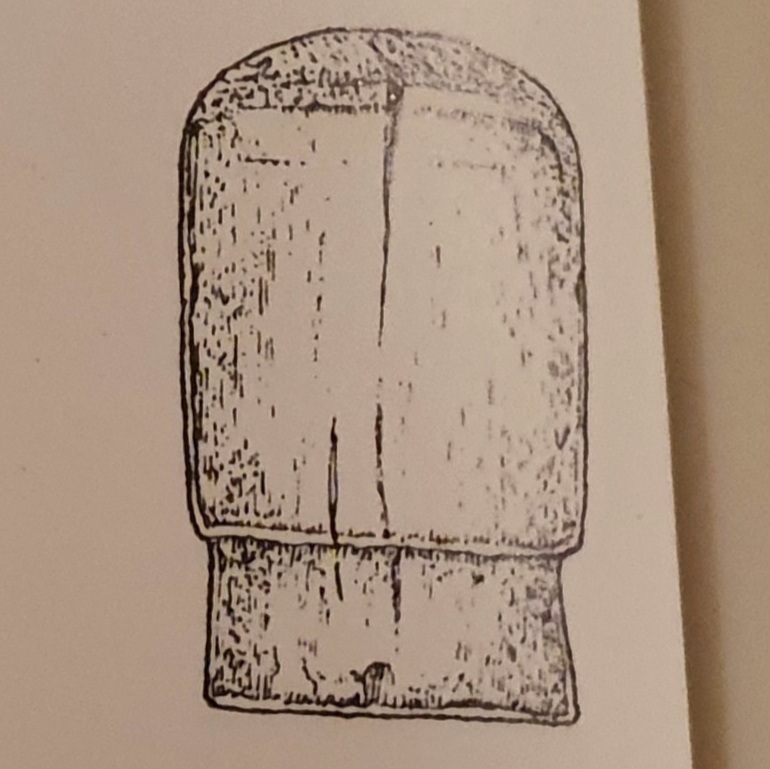
This cute little guy is featured in Viking-Age Decorated Wood by James T. Lang, part of the Medieval Dublin Excavations 1962-81 series (page 32). A friend had mentioned this to me a few years ago, but we didn’t know anyone who had a copy to check. To my joy, I managed to snaffle one on eBay during the last lockdown and finally I was face-to-face with our lad.

He is described thusly:

“DW110. Small human head (gaming piece?) (E112:945) Christchurch Place (Fig.48)
In an antler pit, 26/1, contemporary with 11/1 platform. Late eleventh century.

H. 3.2 cm, D. 2.0 cm.

A primitive human head in a ‘Canterbury cap’. The eyes are mere dots.”


I hadn’t heard of a Canterbury cap before, so I Googled it. Turns out that this is a Canterbury cap, worn fetchingly by Archbishop Thomas Cranmer:


Hmmm. I’m not convinced. It’s not totally unlike the hat on the Dublin figurine, but I believe it to be distinct nevertheless. Other photos of Canterbury caps are just as different as Cranmer’s, they are much closer to a modern cardinal’s biretta than anything else. I would describe the Dublin figurine as having much in common with the Frisian Aalsum hat, despite there being an estimated 2 centuries between them (the Dublin figurine is put at late 11thC, meanwhile the Aalsum hat is dated to 750-900 based on the other objects found nearby.)

So, I decided to recreate a version of the Dublin figure’s hat, based on the earlier find from Aalsum. Bear in mind, this is highly speculative and something I did for fun. I do not believe that this one tiny late 11th century figurine is carte blanche for every Tumi, Ríkarðr and Halfdan to make them for their Danish or Anglo-Danish impressions. If you do find the Dublin figurine compelling, I would gently advise you to keep your hats for your late 11th century Dublin (or perhaps general Hiberno-Norse) outfits.


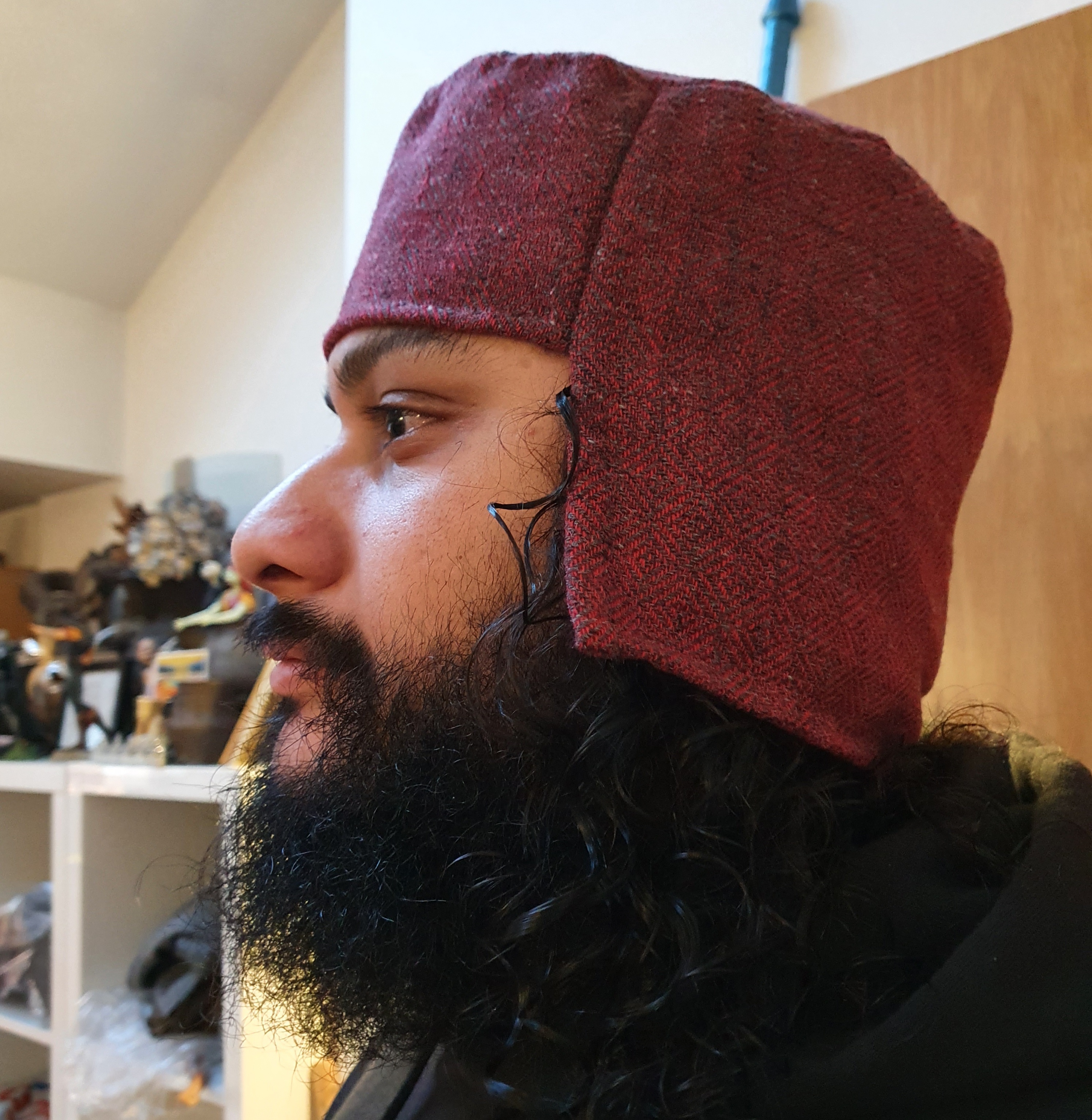
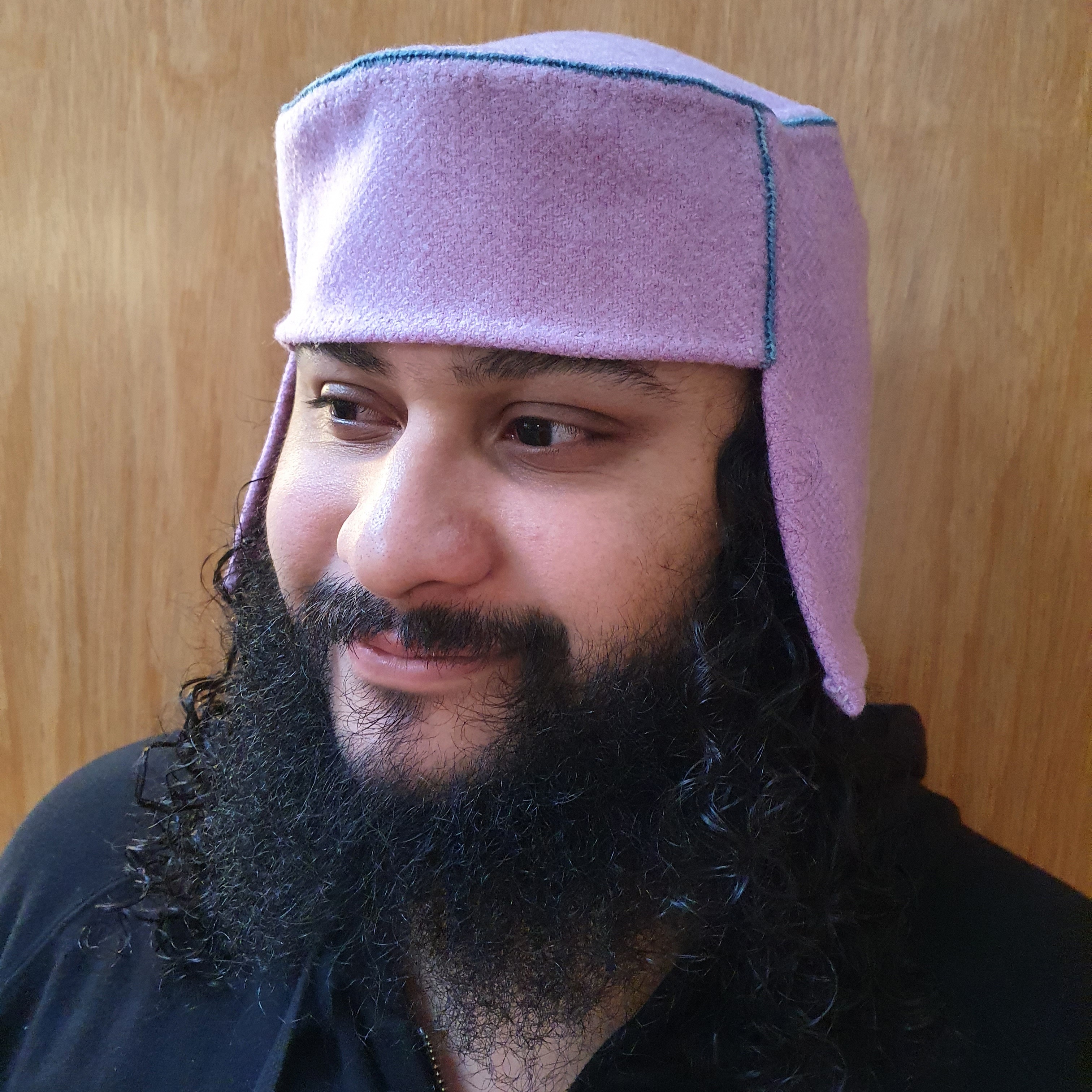
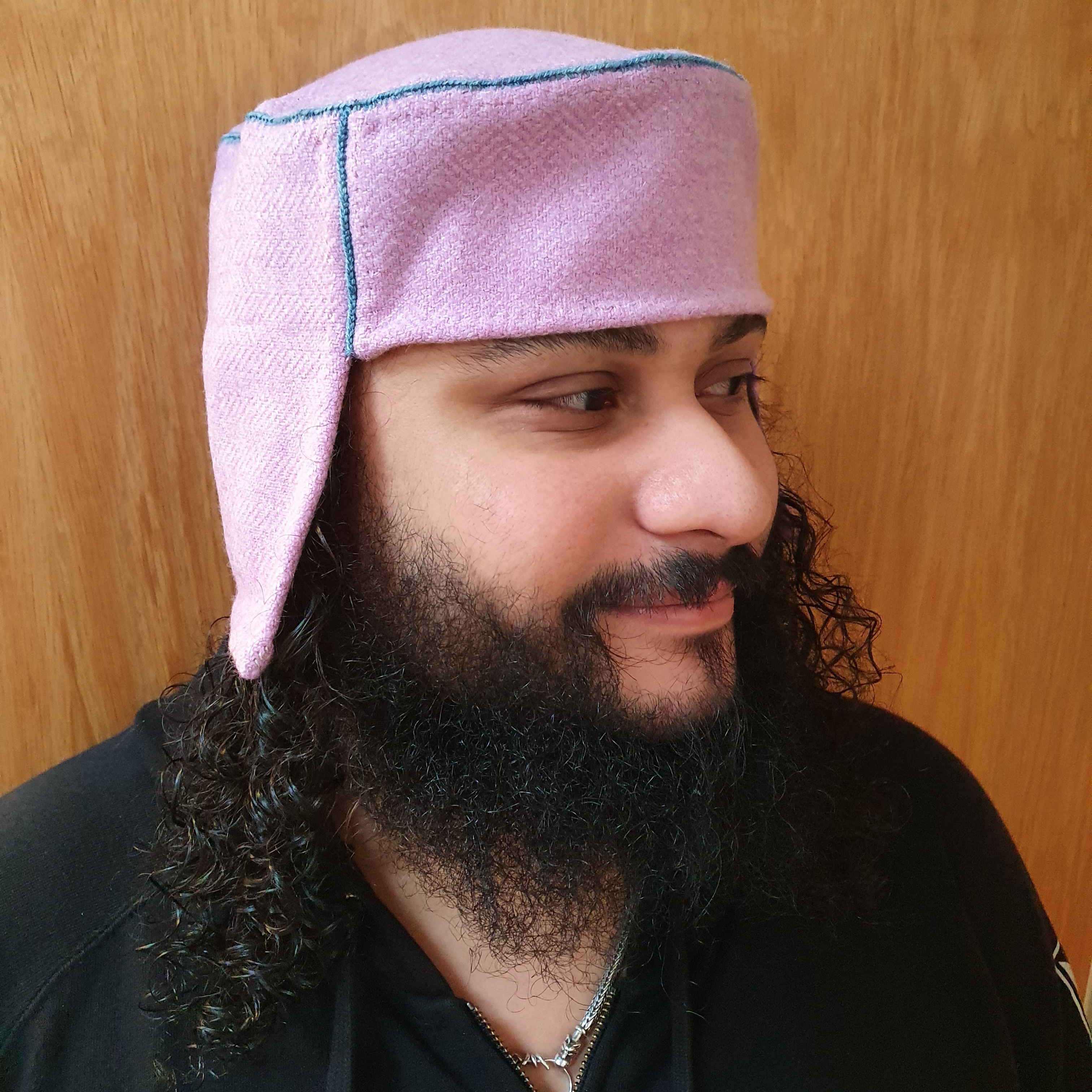
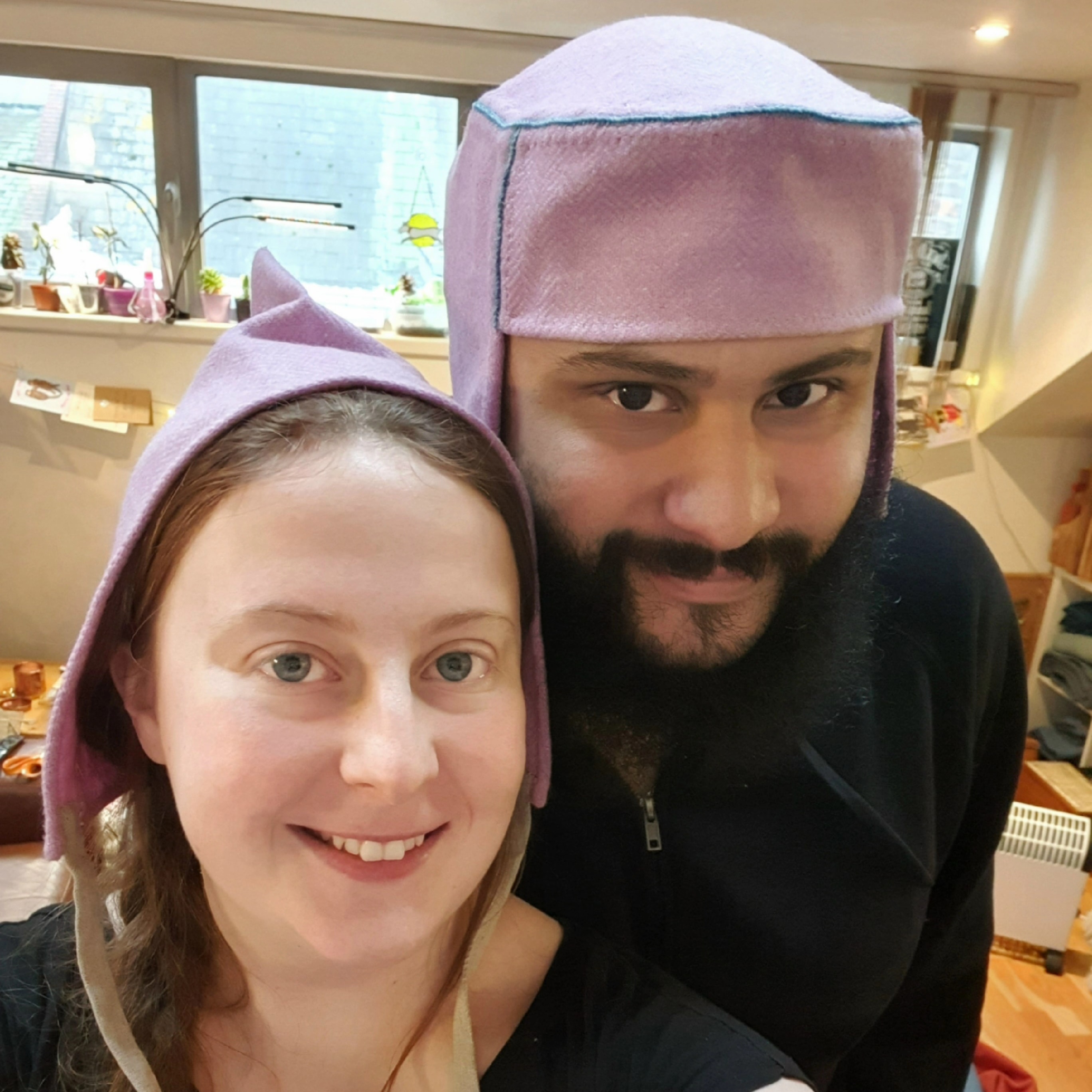
I actually made two hats- the first from some leftover red diamond twill and the second from some pinkish-lilac herringbone scraps. Both hats are made of wool and like the Aalsum find, they are not lined. I hemmed each piece individually with a rolled hem, then attached them all together with a whip stitch. Several of the Frisian hats were made in this way, as well as some of the woollen and silk caps from Dublin. It results in a strong and neatly constructed garment which is easy to fix if seams start to pull apart through wear.


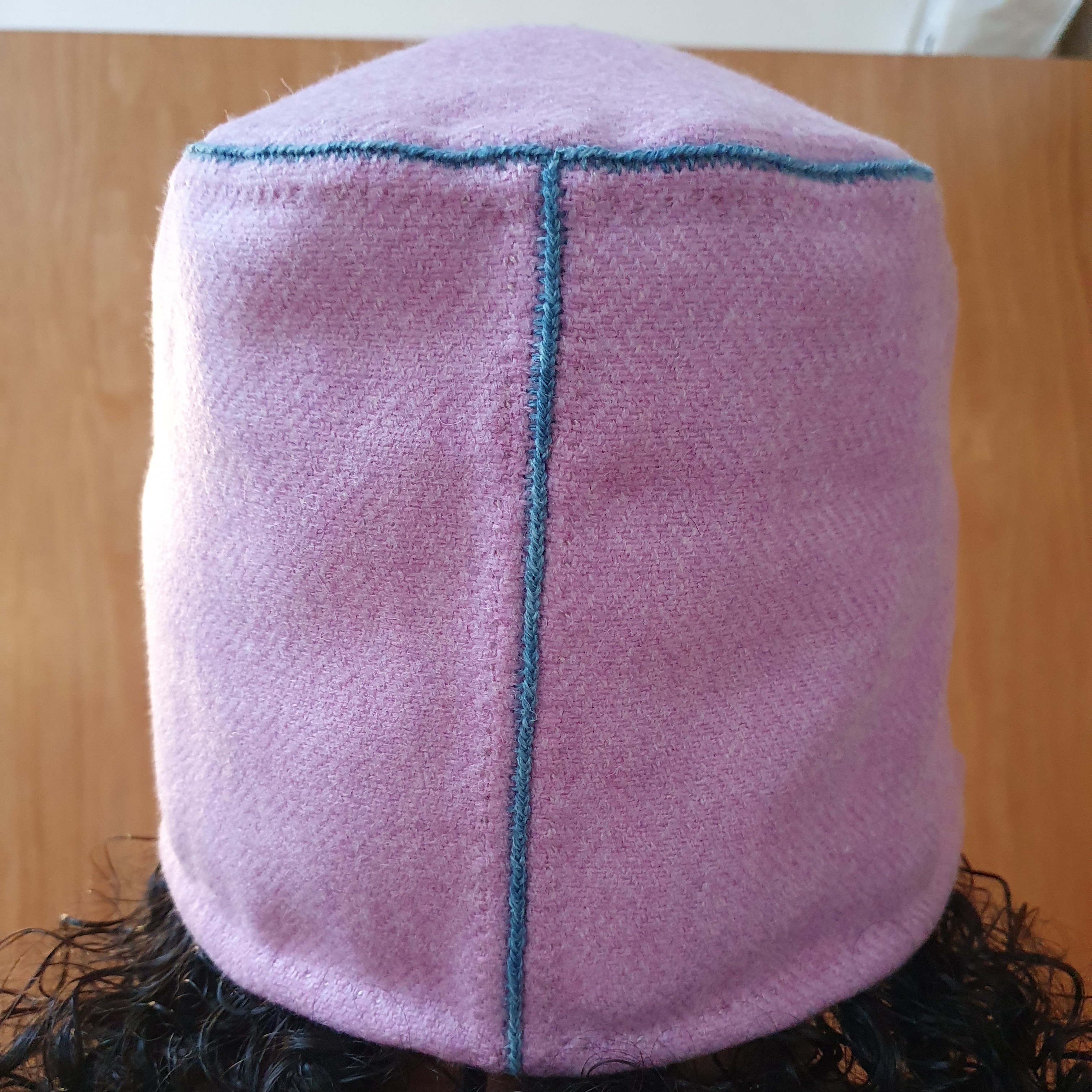
Like every project, I learned as I went along. In future, I would cut the front piece of the hat a little shorter if I was really aiming for a Dublin figurine look. In addition to this, you can see in the photos of the red hat, there is a slight bunching at the front and the top seam had a habit of falling inwards slightly. This could be as a result of my pattern cutting (I drew out the oval for the top by hand) or indeed due to the nature of the whip stitched seam. I decided to try some decorative seam treatment on the second hat, both for aesthetic and structural purposes. I felt that it did remedy the caving-in issue somewhat due to giving it some more structure, plus it’s pretty. I used some woollen embroidery yarn that I had dyed with some of my homegrown woad, I think it gives a nice contrast to the pink-lilac.


Stitchwise, I opted for a chain stitch variant similar to the examples found on the hats from Dokkum, Oostrum and Leens. Most of these examples had a chain stitch that was visible on the outside of the hat and was done in a darker coloured thread, which would imply decorative contrast being the intent.

But the most important part: what is it like to wear? Well, my very own Dubgaill said he found this style of hat to be perfectly comfortable. He liked that it would protect the back of his neck from the elements and it’s cosy around the ears. That’s good enough for me!

I also had enough left of the pink herringbone to make myself a Dublin cap. We now have matching 10-11th century Irish hats, meaning we can be one of those sickening couples in both 2021 and 1021. Always good to know.


References:

Brandenburgh, C. R.. (2010). Early medieval textile remains from settlements in the Netherlands. An evaluation of textile production. Journal of Archaeology in the Low Countries. 2 (1), p41-79.

Flicke, G. (1545) Portrait of Thomas Cranmer. [Oil on panel] London: National Portrait Gallery. Found online at: https://commons.wikimedia.org/wiki/File:Thomas_Cranmer_by_Gerlach_Flicke.jpg

Lang, J. T. (1988). Viking-age Decorated Wood: A Study of Its Ornament and Style. Dublin: National Museum of Ireland. p32.