A Late Summer Meal with Blackberries

The weather we’ve had this past month has been scorching. Since I got back from Denmark, I’ve been hiding in the house and using work as an excuse to avoid the sun. My lovely friend Daisy is similarly melanin-deficient, but we can never resist the draw of foraging.

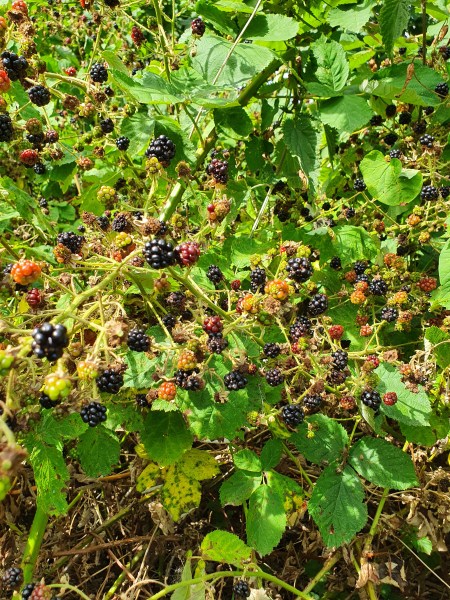
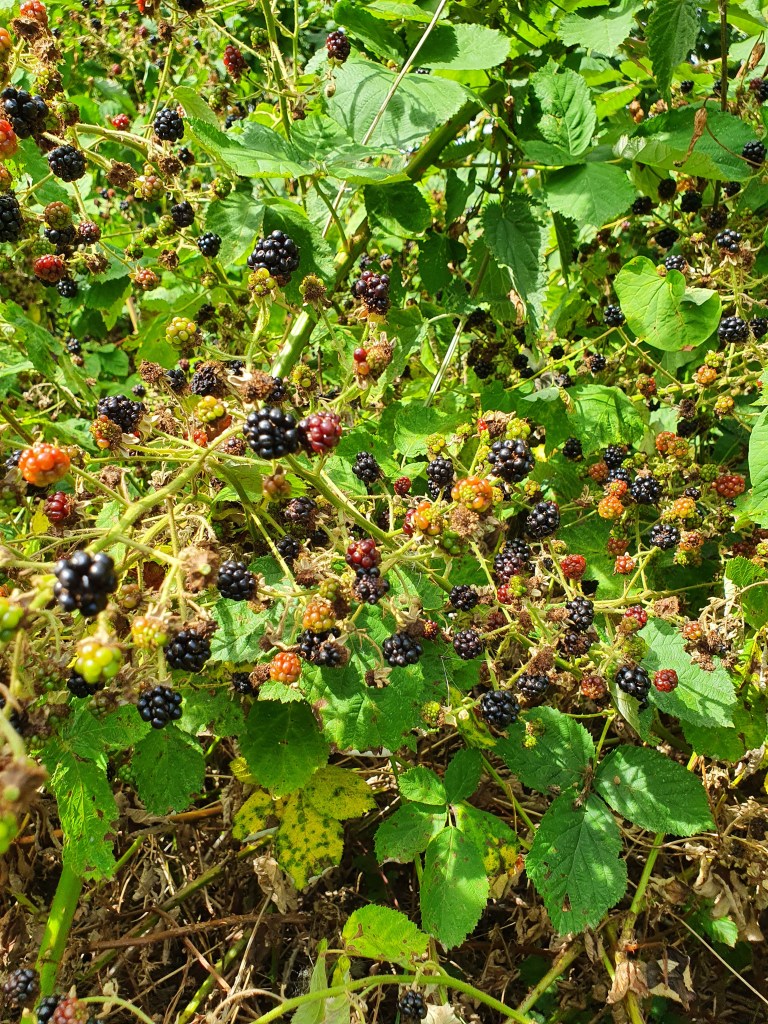
The little woodland near us has exploded in growth. The brambles are heavy with fruit and we were eager to harvest a few before they were gobbled by other foragers.

Blackberries are found in the archaeological record at York (Hall & Kenward, 2004) during the Viking Age. As someone interested in historical food from the UK, I’m always excited to use ingredients that can add some sweetness and tartness to dishes- depending on the season, these can be few and far between in the VA. I picked just shy of a kilo of blackberries and decided to use them to make a full period-plausible meal to enjoy with Eric and Daisy. I’ve included two easy recipes using the blackberries below- I don’t think you all need a recipe to roast a chicken!

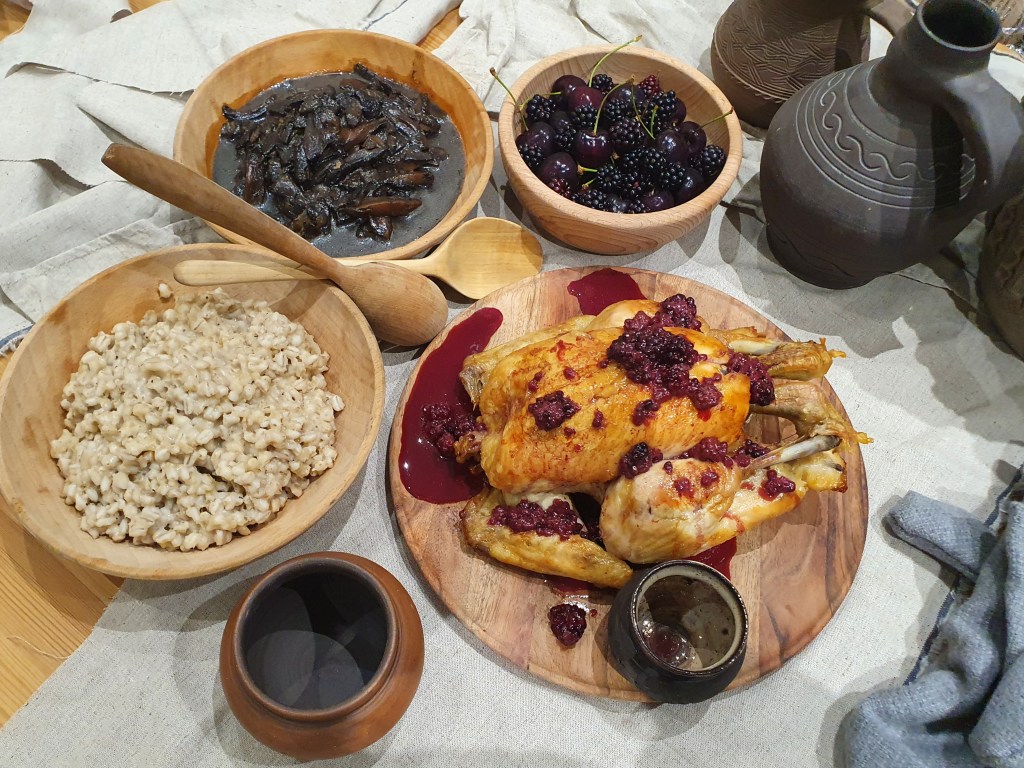
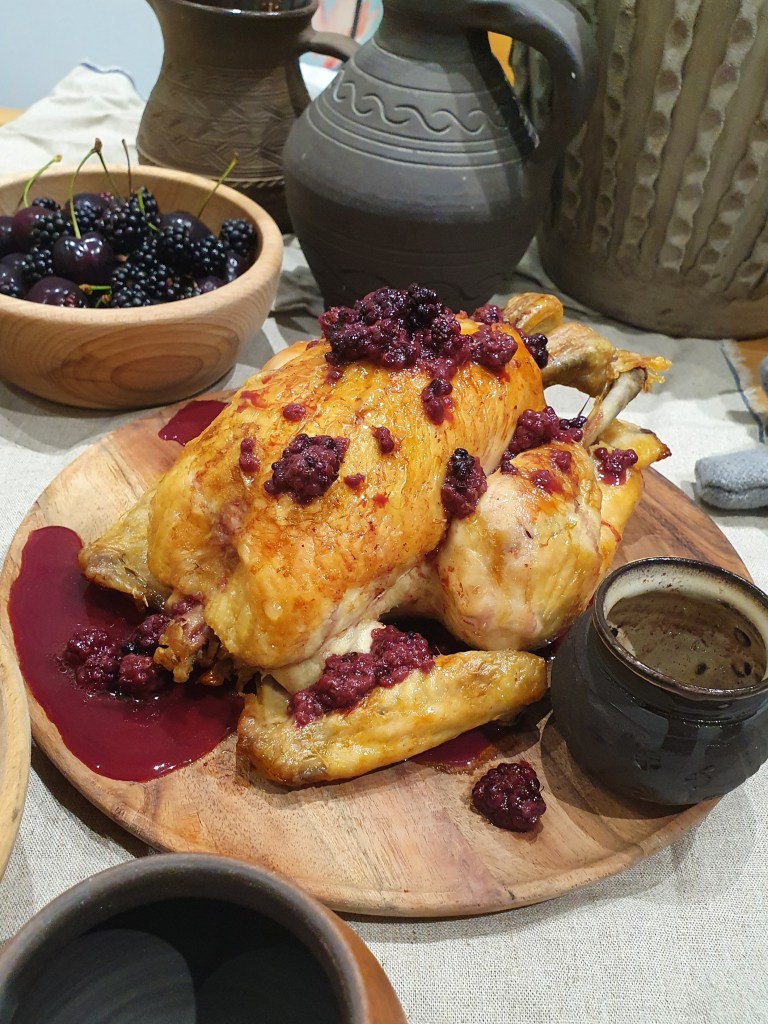
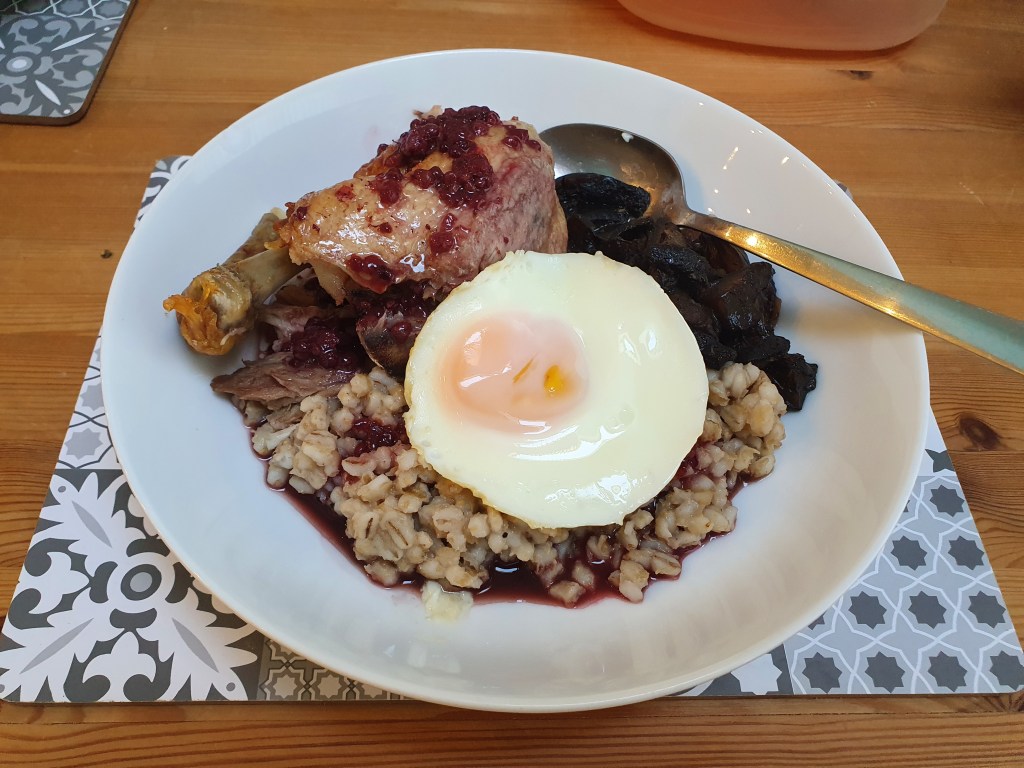
The Menu: Roast chicken with blackberry sauce, drunken mushrooms, fried and boiled eggs, buttery pearl barley and wheat bread. Stewed blackberries and cherries with hazelnut cookies and cream. (Not all pictured, because we’re greedy.)

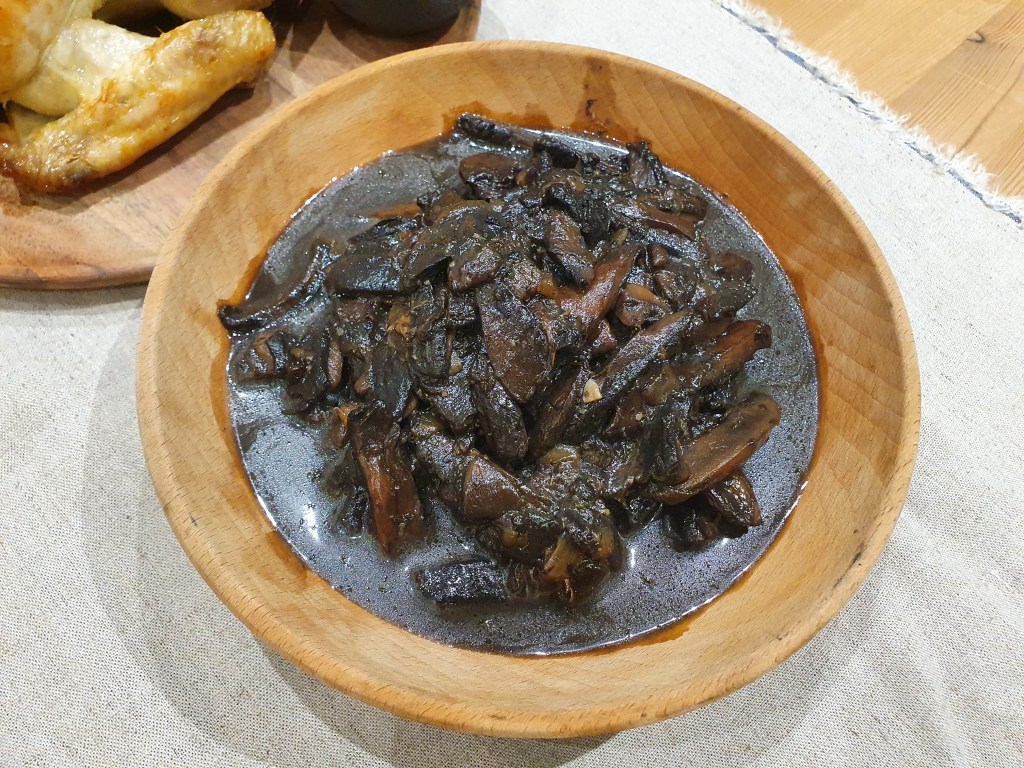
Drunken mushrooms (mushrooms cooked in beer, with onions, garlic and thyme.)
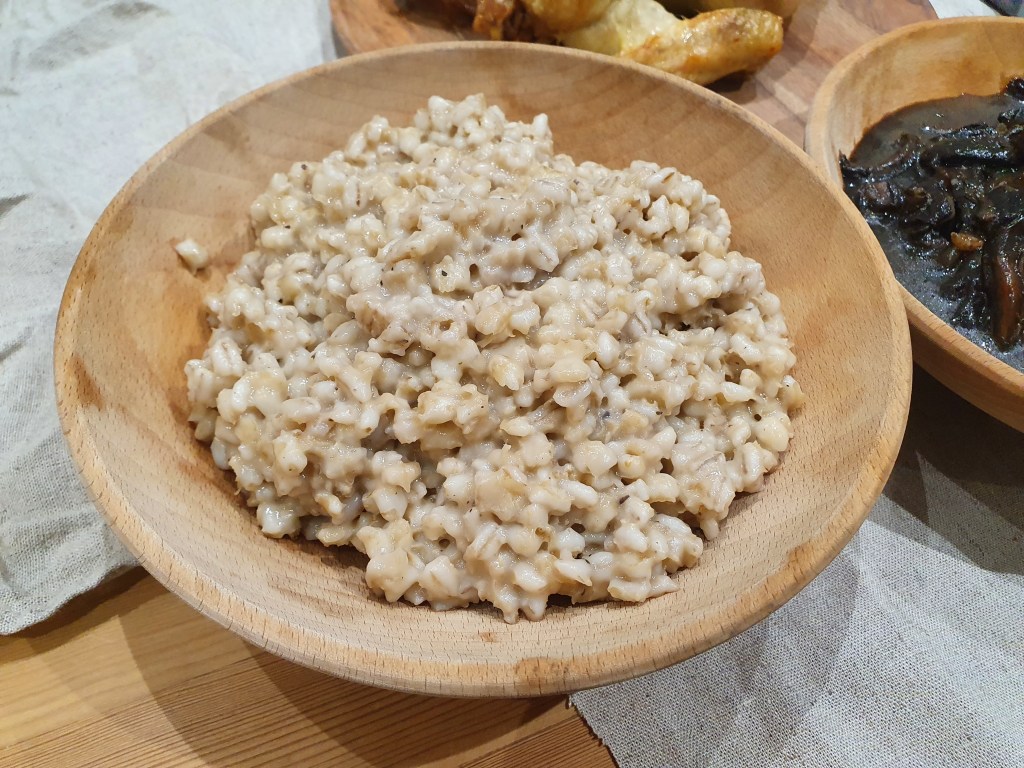
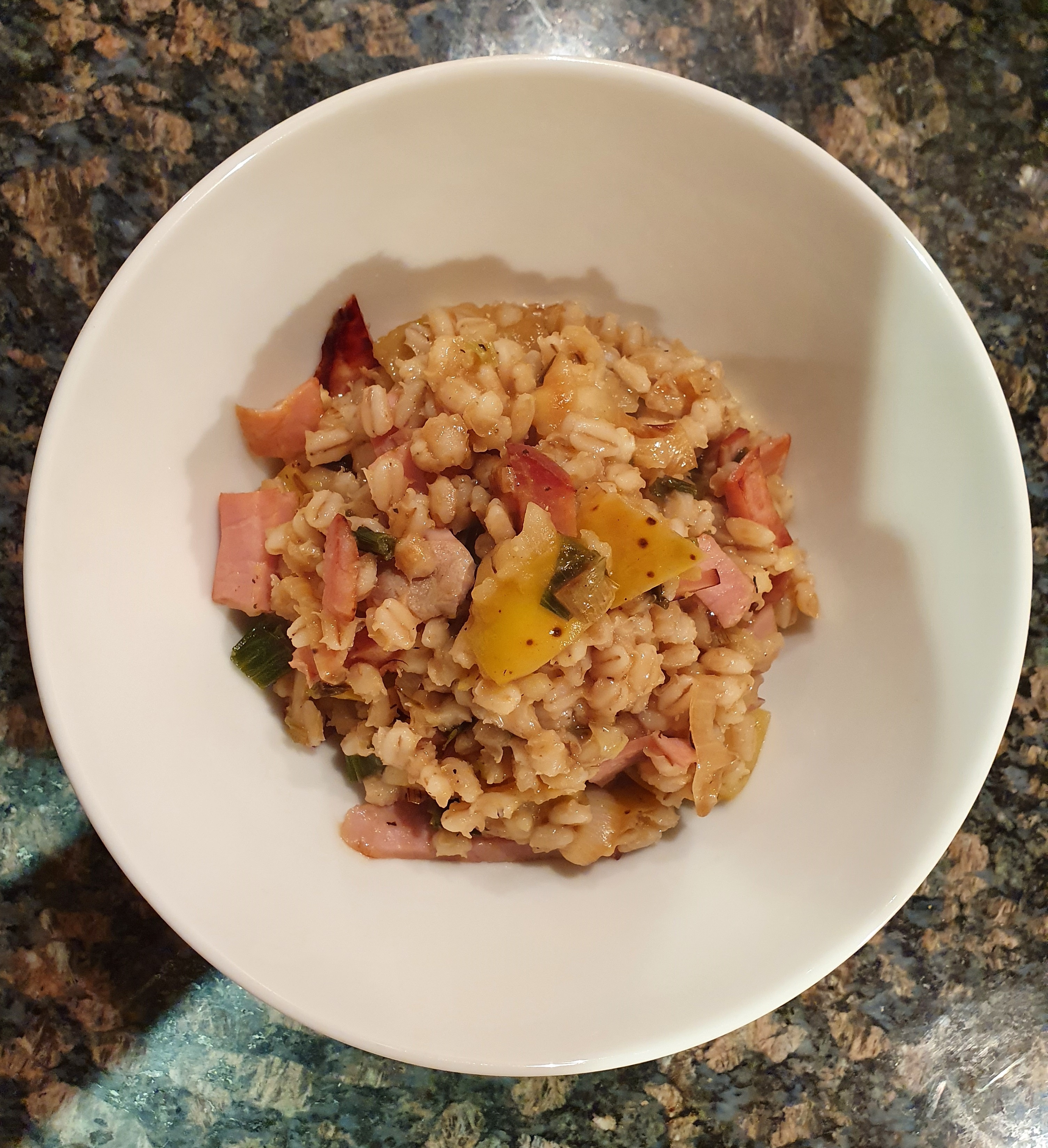
Leave it to pearl barley to look uninspiring- yet I love the stuff. Buttery Viking risotto!
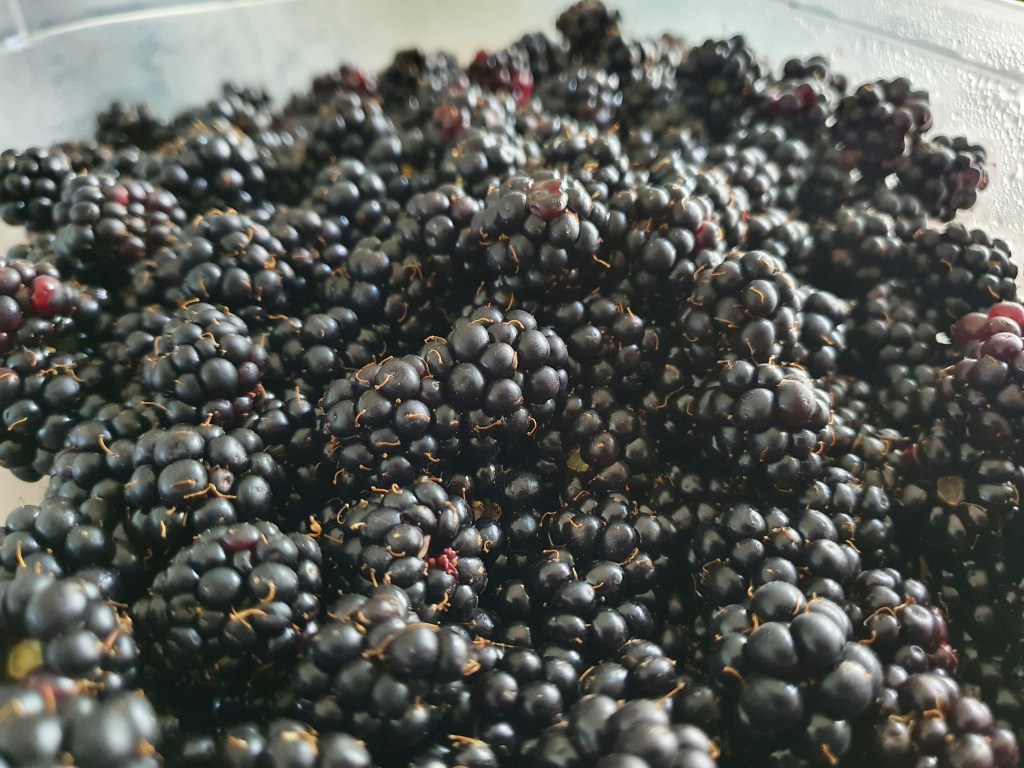
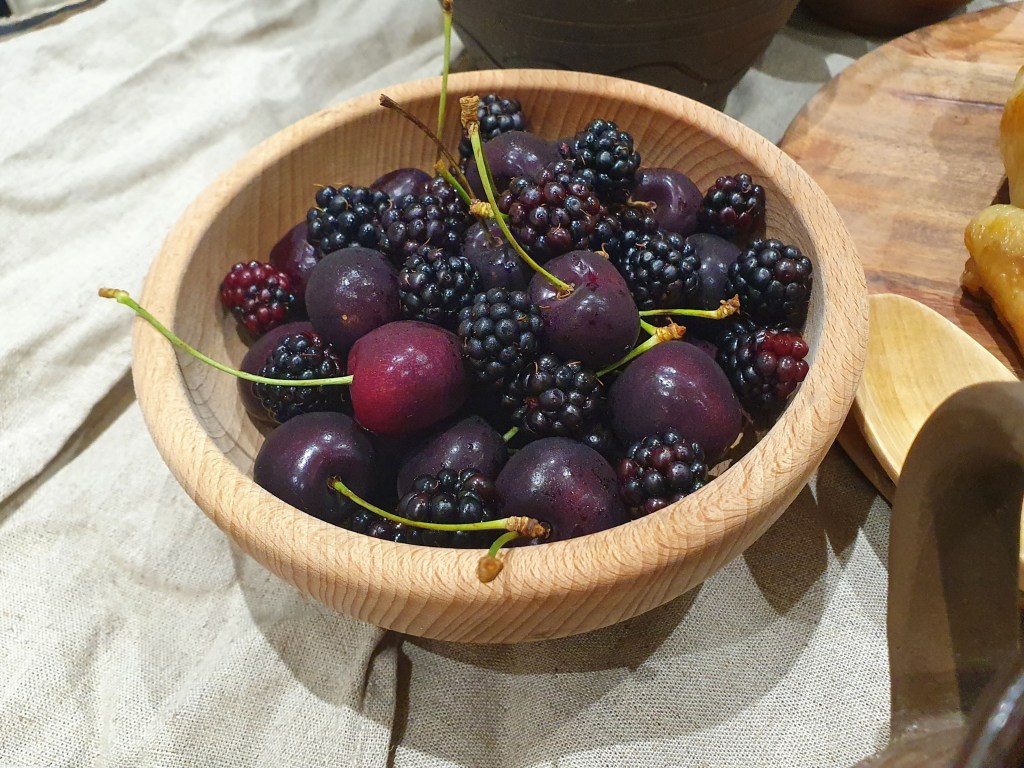
Fresh berries- I can never resist eating at least a couple before cooking!
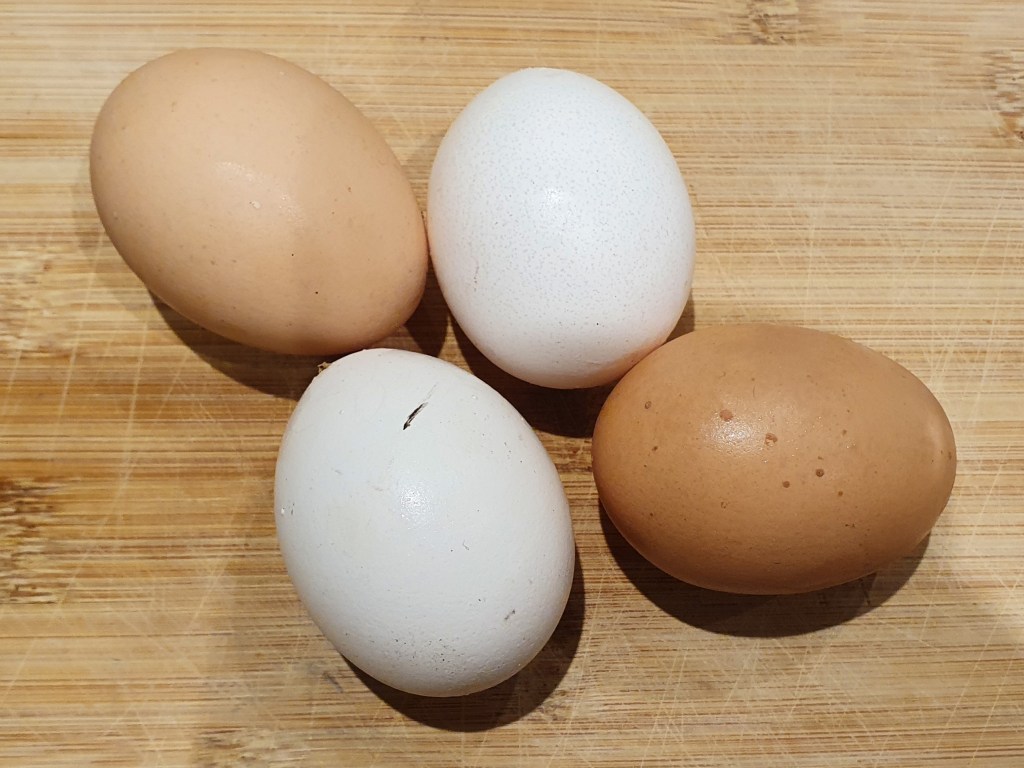
These wonderful eggs are from our lovely next-door neighbours, who keep some happy hens in their garden. They’re delicious eggs and it added a sense of authenticity to our meal that they came from the neighbours! We had them hard-boiled one day and fried the next, on top of our roast.

Blackberry Gravy

This sauce can be paired with any meat- I chose to do chicken this time because I’d not roasted one in a while. It will however go very nicely with gamey meats like venison and pigeon or even with more traditional roasts like beef or pork. I imagine the addition of apple would go fabulously with a fatty pork joint.

Using meat drippings for this gravy will cause the fat to rise to the top and be less pretty, but it tastes much better. Just make sure not to add salt if you use drippings- that’s a lot of sodium!

Ingredients:

  • 2 tbsp butter or vegetable oil
  • 1 small brown onion or handful of shallots, chopped finely
  • 2 cloves garlic, peeled
  • 200g fresh blackberries
  • 1 tbsp white wine vinegar
  • Meat drippings from your roast or 150ml stock of your choice
  • 2 tbsp honey (adjust to taste)

Method:

1. Melt your butter over a low-medium heat and add your chopped onions and garlic. Cook gently until onions are just softening.

2. Wash your blackberries well and pat dry with kitchen paper. Add your blackberries, vinegar and meat drippings/stock to your onions and combine over a medium heat. Allow to simmer gently for around 5 minutes, stirring frequently to prevent burning.

3. Once your berries have softened and released their juice, taste your gravy and if you like, add your honey. Make sure honey is melted and combined, then serve hot over your meat.

Stewed blackberries and cherries

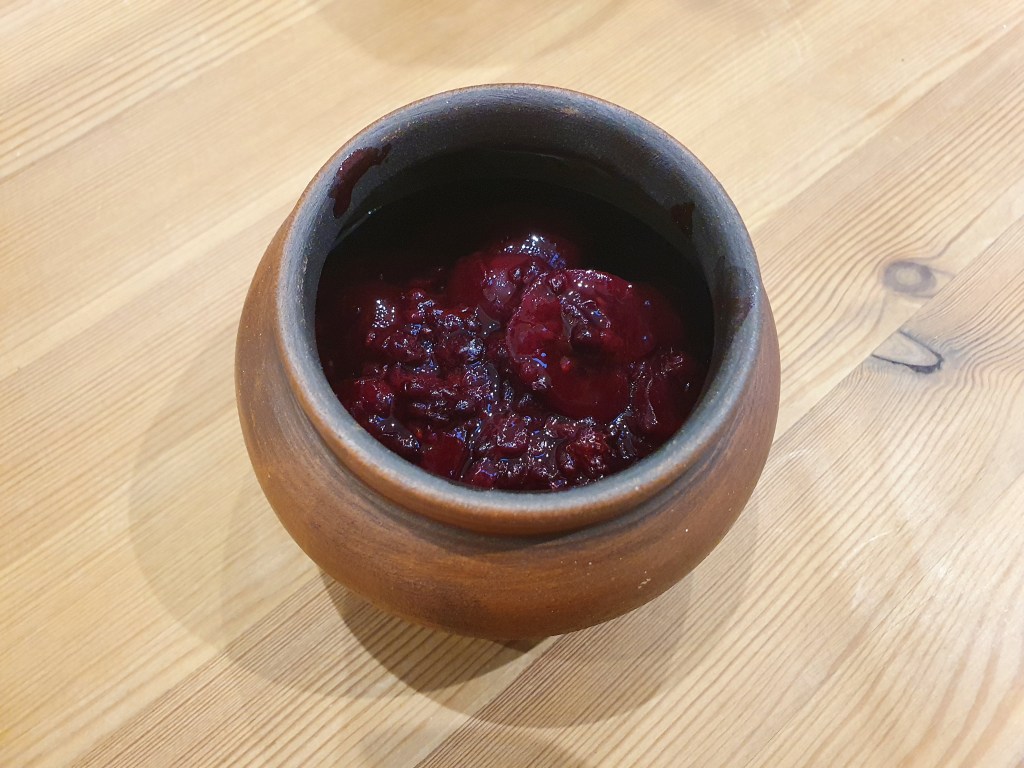
Stewed blackberries and cherries, in my pretty new cup from Ribe.

This is pretty bog-standard. Recipes for fruit pottages exist from later in the Medieval period and fruit soups of many kinds exist in several European cuisines to this day. Therefore, I reason that Viking Age folks would also have stewed their fruit if they had a glut from the hedge or the garden. Cherries have not been found in the archaeological record at York, but evidence can be found in both Hedeby and Dublin (Mitchell, 1987) and wild cherry is native to the UK.

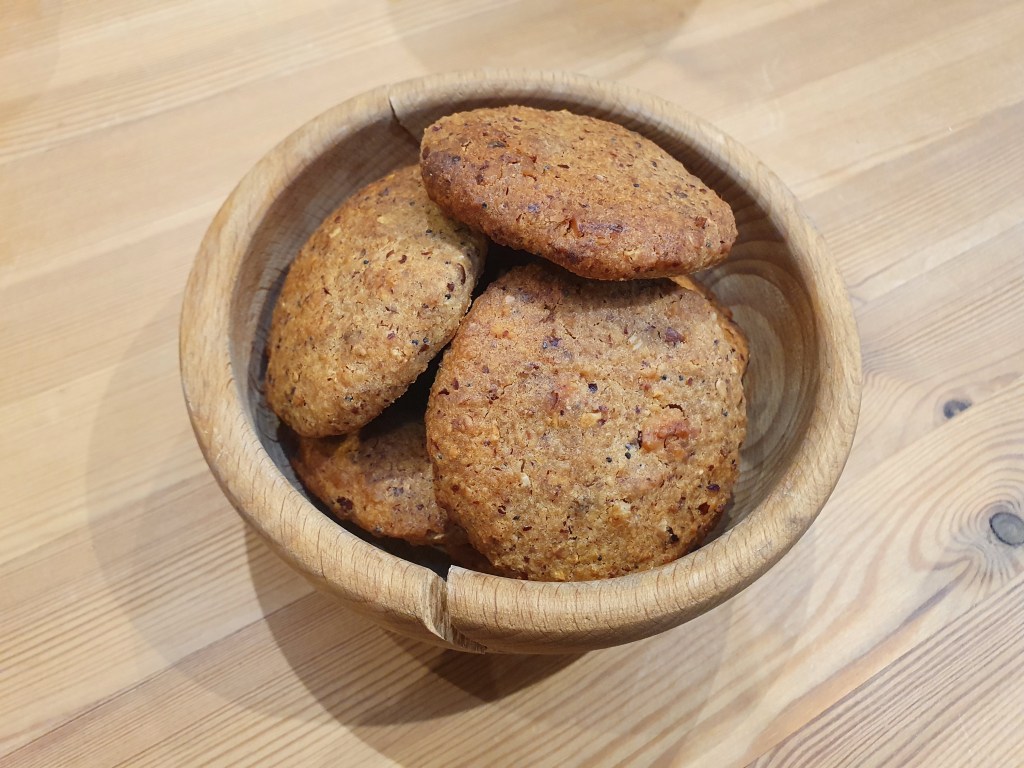
This recipe is very tasty with porridge and yoghurt, but I served it on this occasion warm from the pot with cream and hazelnut cookies. My favourite recipe is written by my friend Craig, author of Eat Like A Viking and can be found here: give them a go!

Hazelnut cookies or patties.

Ingredients:

  • 500g cherries, stones removed and halved
  • 500g blackberries
  • 100ml water or good sweet mead
  • 2 tbsp honey
  • Small pinch of salt

Method:

1. Place water/mead in a saucepan and heat over a medium-high heat. Wash your fruit well and add to pan. Stir gently and frequently until the fruit mix comes to a simmer- no need to let it boil. Turn down the heat to medium and keep it at a simmer for about 8 minutes, until the fruit is soft and the liquid has reduced a little.

2. Carefully taste your fruit mix (it will be very hot!) and add honey to taste. Some people prefer a more tart flavour to their stewed fruits, whereas I love the taste of honey. Less honey is probably more historically accurate!

3. Serve immediately with cream and cookies. If you have any left over, this would make a great crumble or pie filling- but bear in mind that without sugar, it will be more runny than modern recipes.

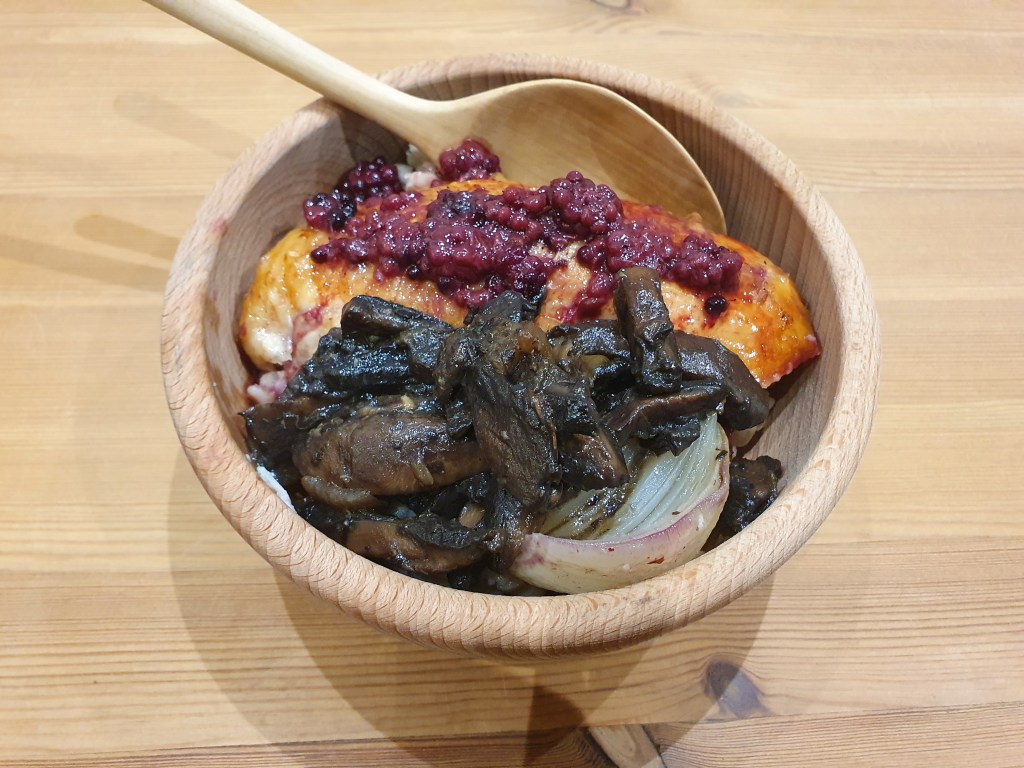
If you were interested how this all looked as modern dish, here we are:

Absolutely banging.

All the items included in our meal are either represented in the archaeological record in Anglo-Scandinavian York or indeed would have been available to people living there. It’s unlikely that people would have eaten as richly as this every day, but for a little feast among friends after foraging for berries in the sun, I think it does nicely.

References

Hall, R. A. & Kenward, H. (2004). Setting People in their Environment: Plant and Animal Remains from Anglo-Scandinavian York. In: Hall, R. A. (Ed). Aspects of Anglo-Scandinavian York. York: York Archaeological Trust. pp.372-426.

Mitchell, G. F. (1987). Archaeology & Environment in Early Dublin. Medieval Dublin Excavations 1962-81, Series C, Volume 1. Dublin: Royal Irish Academy and the National Museum of Ireland.

Impressions: A Hiberno-Scandinavian Townsperson of Dyflin, Mid 10th Century

Or, Adventures In Wood Quay!

Location: Dyflin (Dublin), Ireland
Date: Mid to late 10th Century
Culture: Hiberno Scandinavian
Estimated Social Class: Free working woman

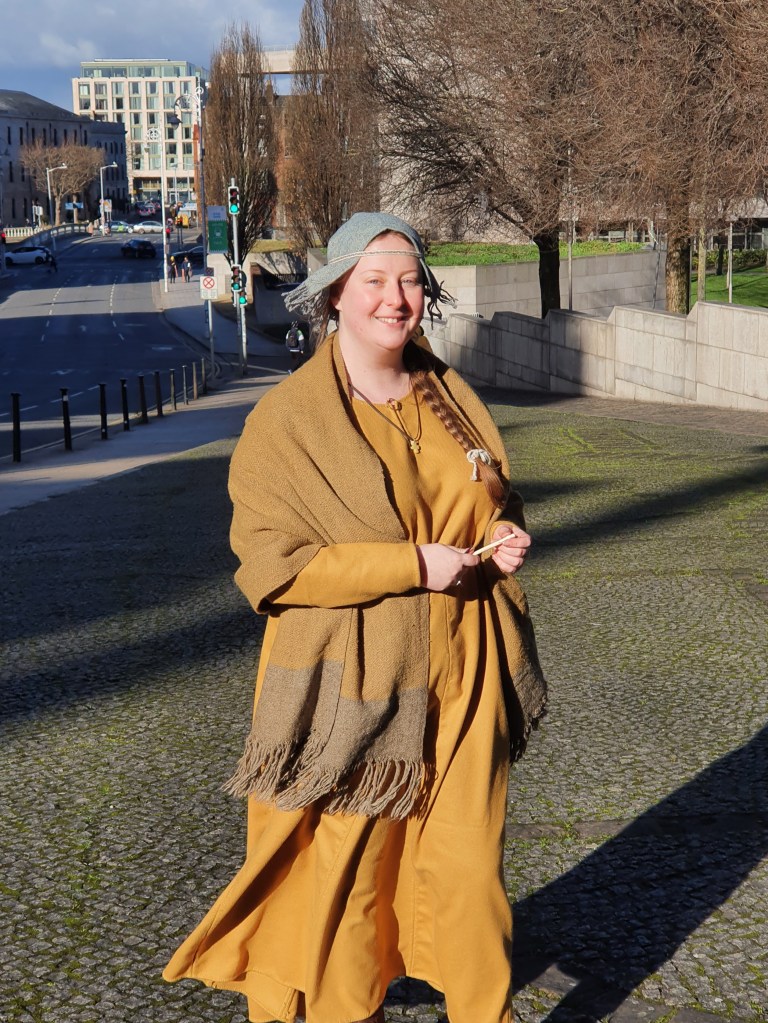
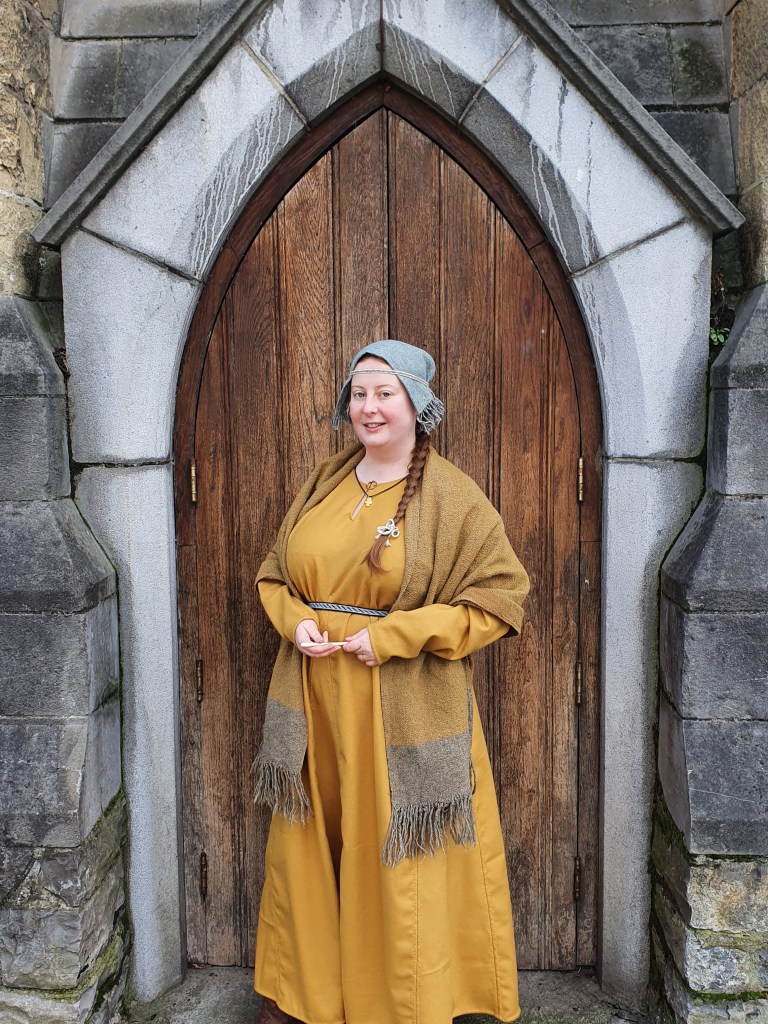
This Valentines Day wasn’t especially traditional, but it was one of my best ever. Due to Coronavirus nerfing many routes to Luxembourg from England, Eric and I had to fly via Dublin in order to see our family. We decided to make the most of it and stay for Valentines Day on the way back.

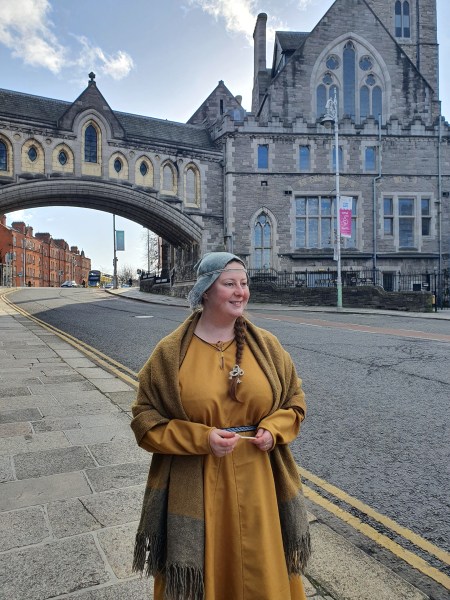
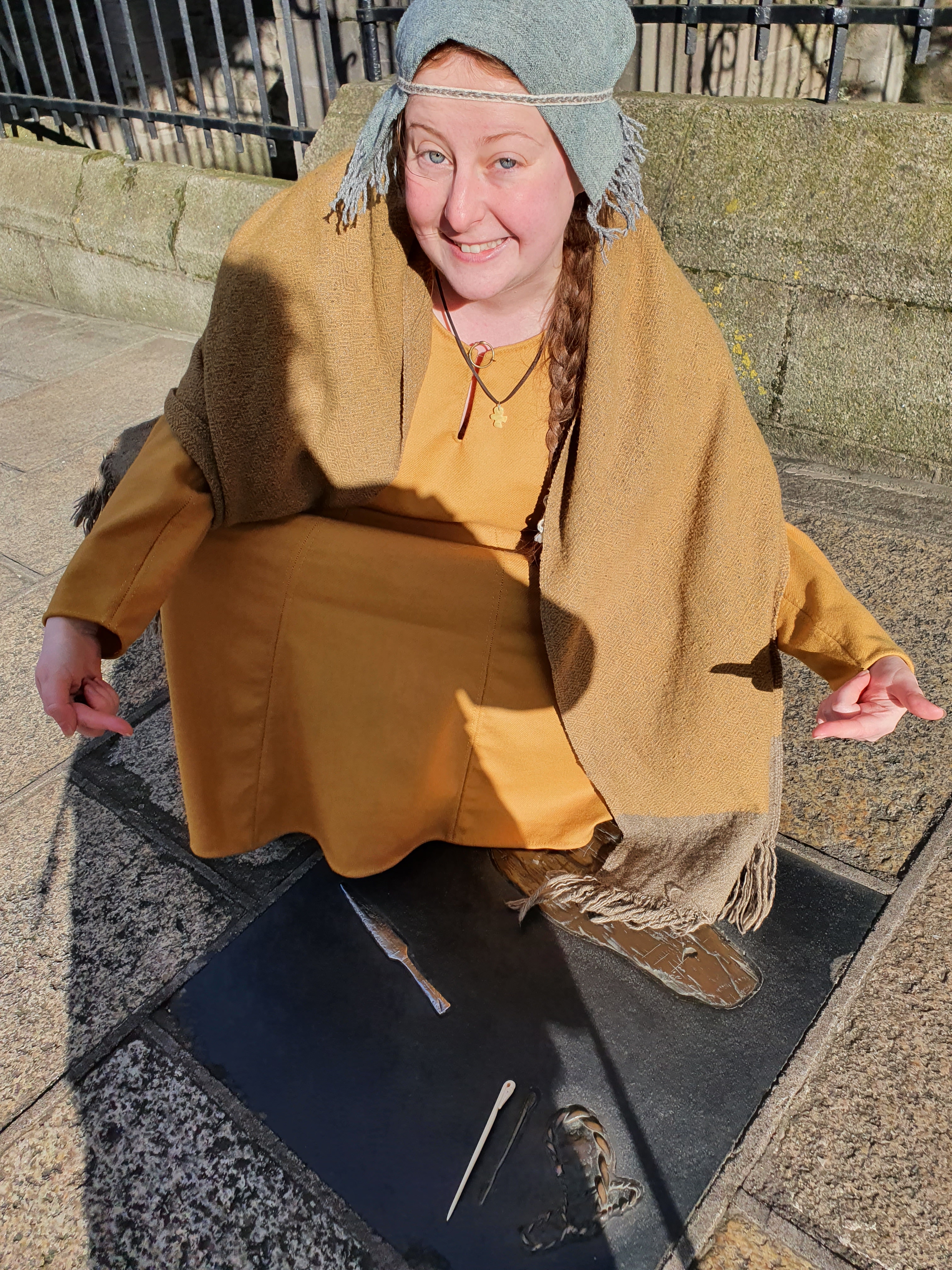
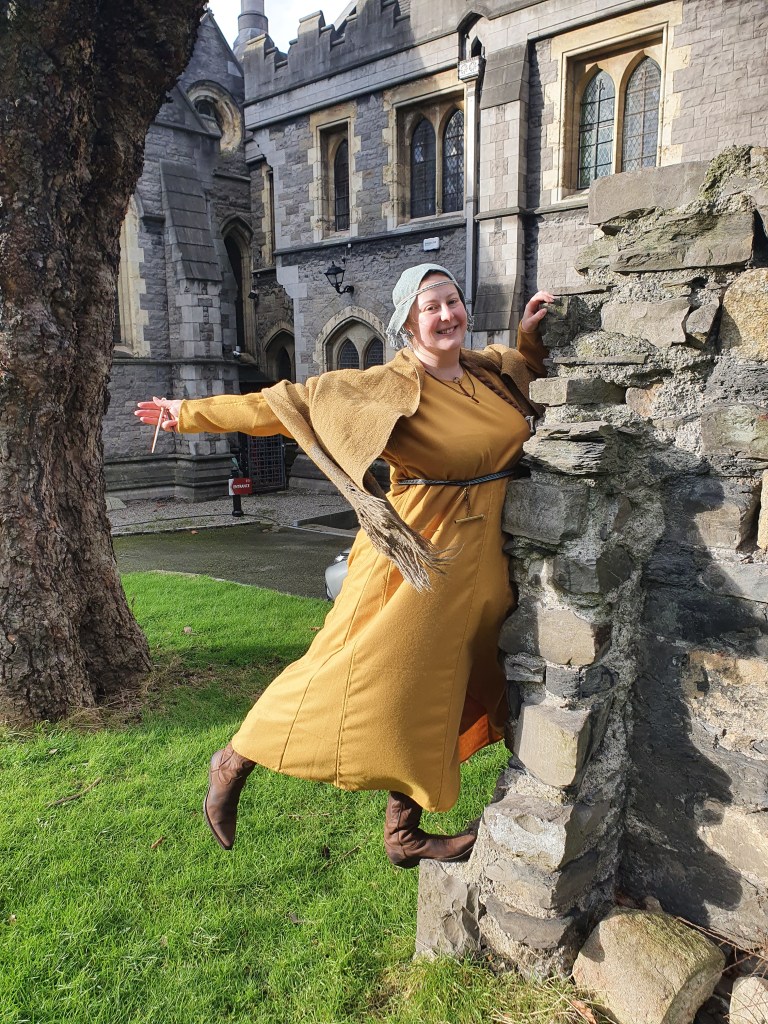
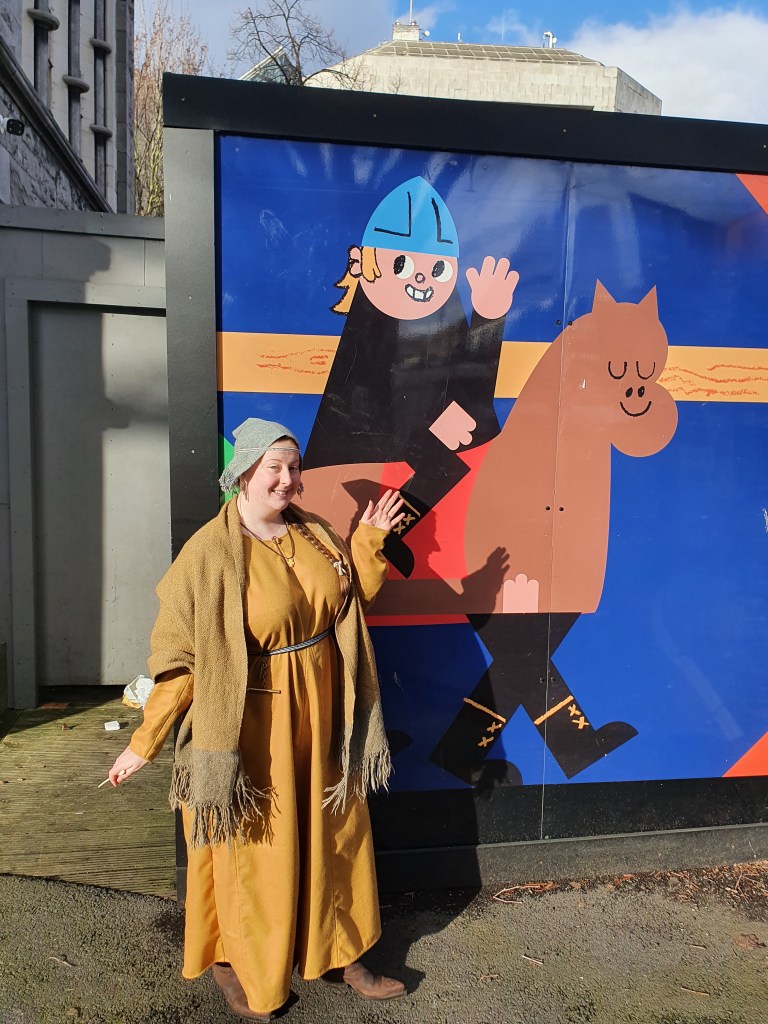
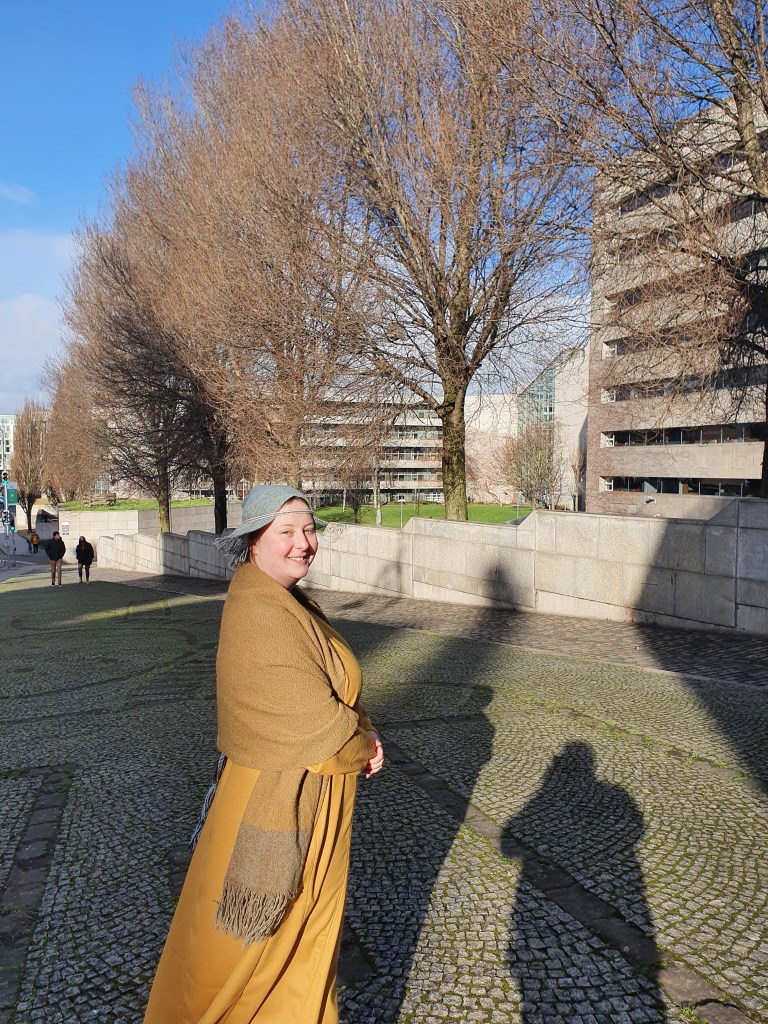
What did I want to do? I wanted to go to Wood Quay and pose in the cold in a quickly cobbled-together Dublin impression.

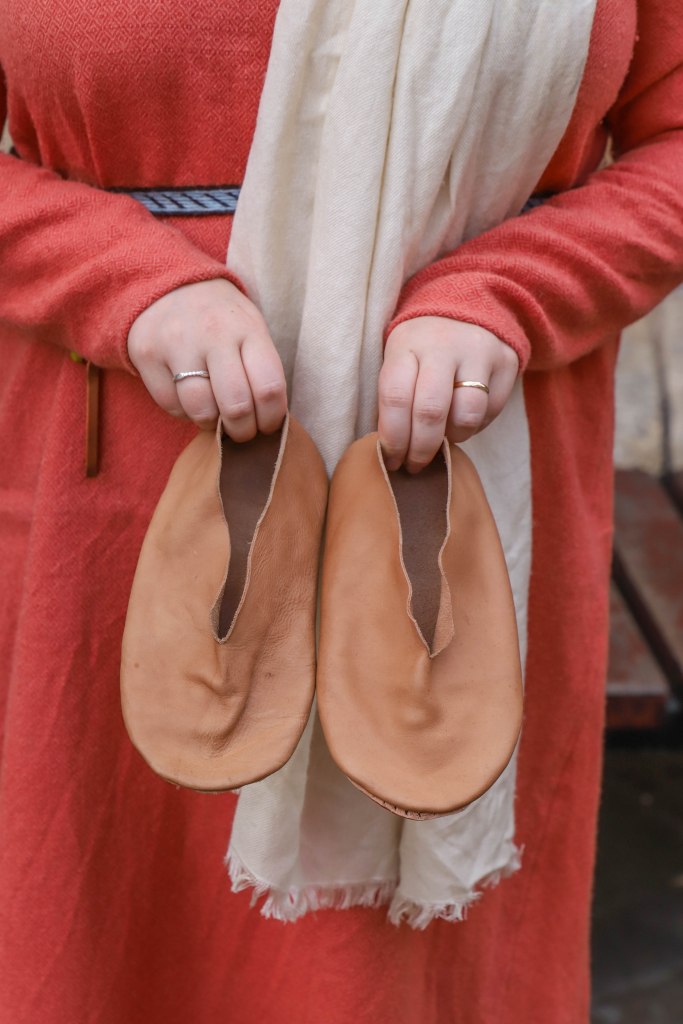
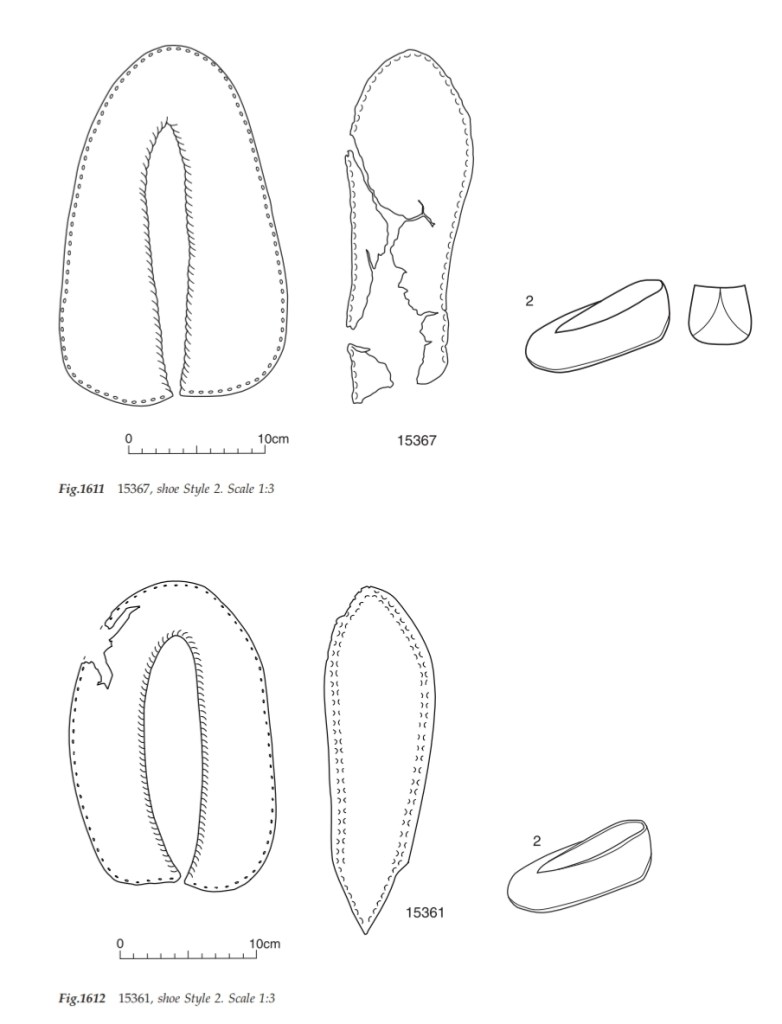
This outfit isn’t especially complex, as I could only take a small bag that would fit within my cabin luggage. That means no undertunic and no turnshoes- you can see my cowboy boots in later pictures. This set of gear is a work in progress and in future, I’ll be getting a few pairs of suitable shoes based on Dublin remains. (Note: if anyone has access to good publications on shoes from Viking Age Dublin, please hit me up!)

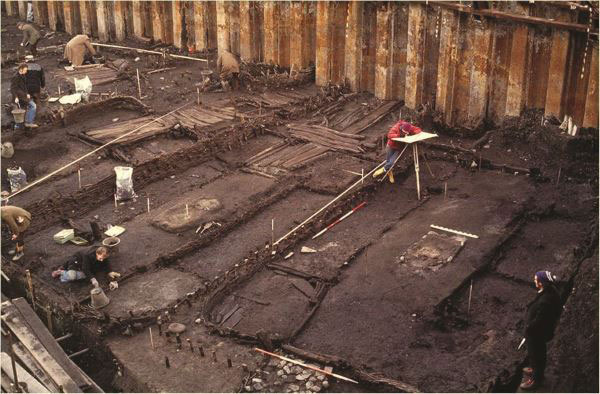
Wood Quay is a historic area of Dublin, only a stone’s throw away from bustling Temple Bar and the Ha’penny Bridge. It made headlines worldwide in the 1970s when the area was revealed to be an archaeological goldmine during the building of a new Dublin City Council headquarters. The story is actually fascinating and I can write a “For Dummies” article in future in folks are interested.

Excavations on Fishamble Street, showing the outlines of Hiberno-Scandinavian homes- they are Type 1 in shape. Photo credit: National Museum of Ireland.

The short version, however, is that there was nationwide and international protest against the development, in order to first properly excavate the whole block of all its rich historical goodies. Dublin City Council ignored them and built their new civic offices on the site anyway, with excavations finishing in the March of 1981 (Wallace, 2016.)

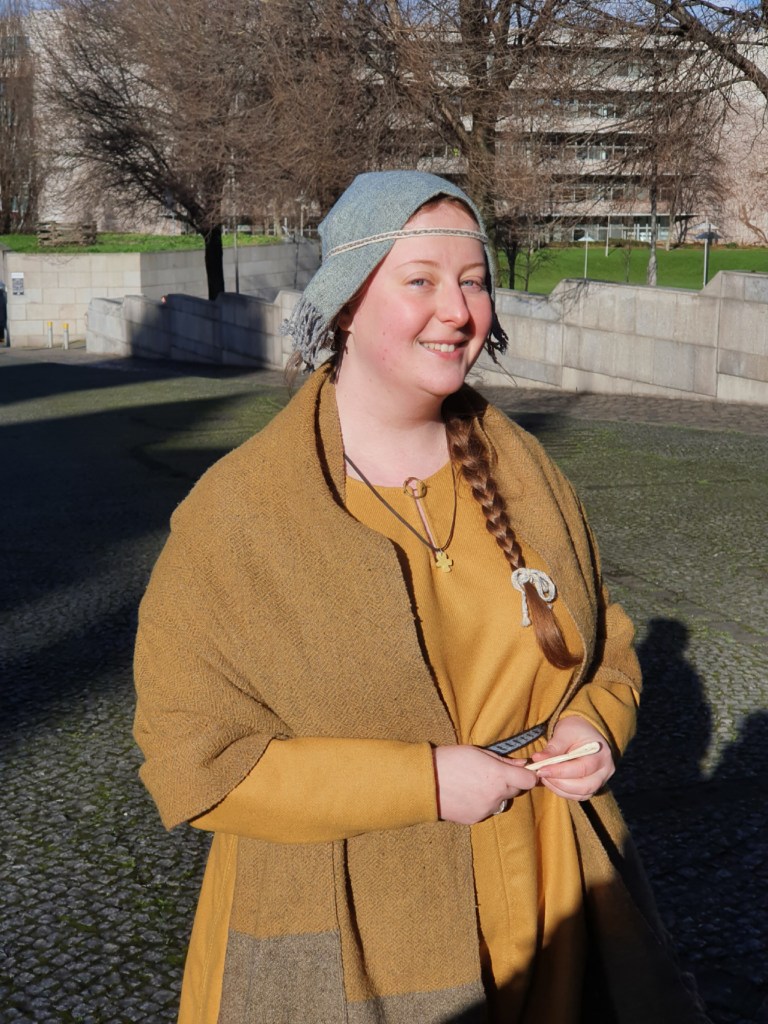
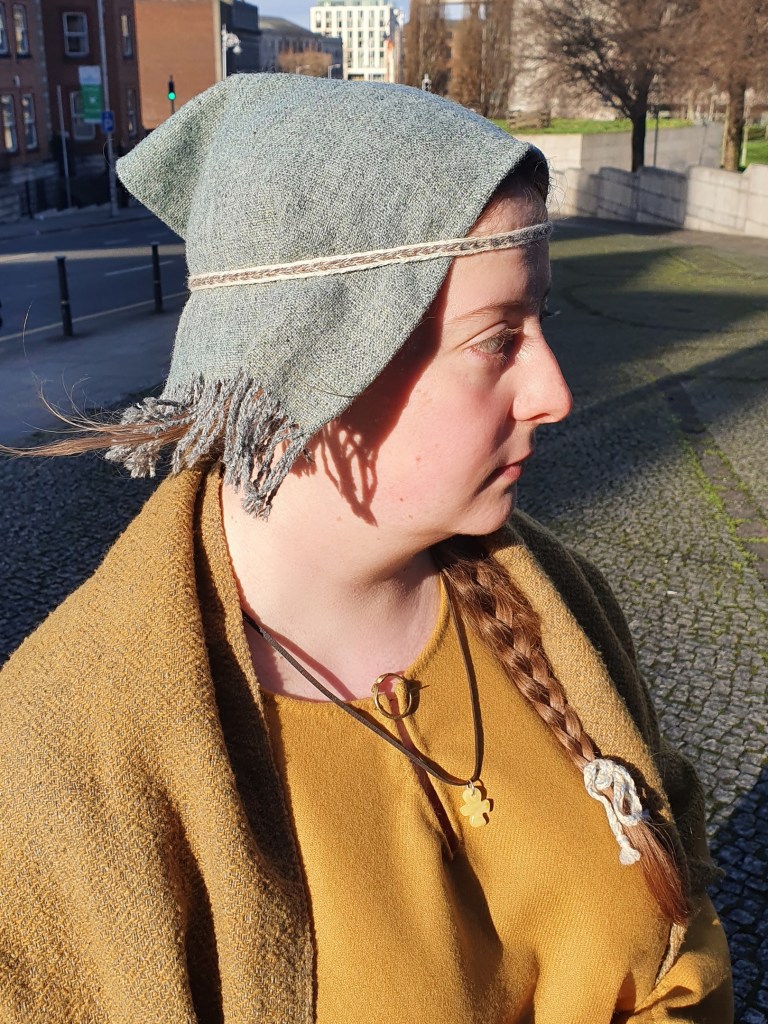
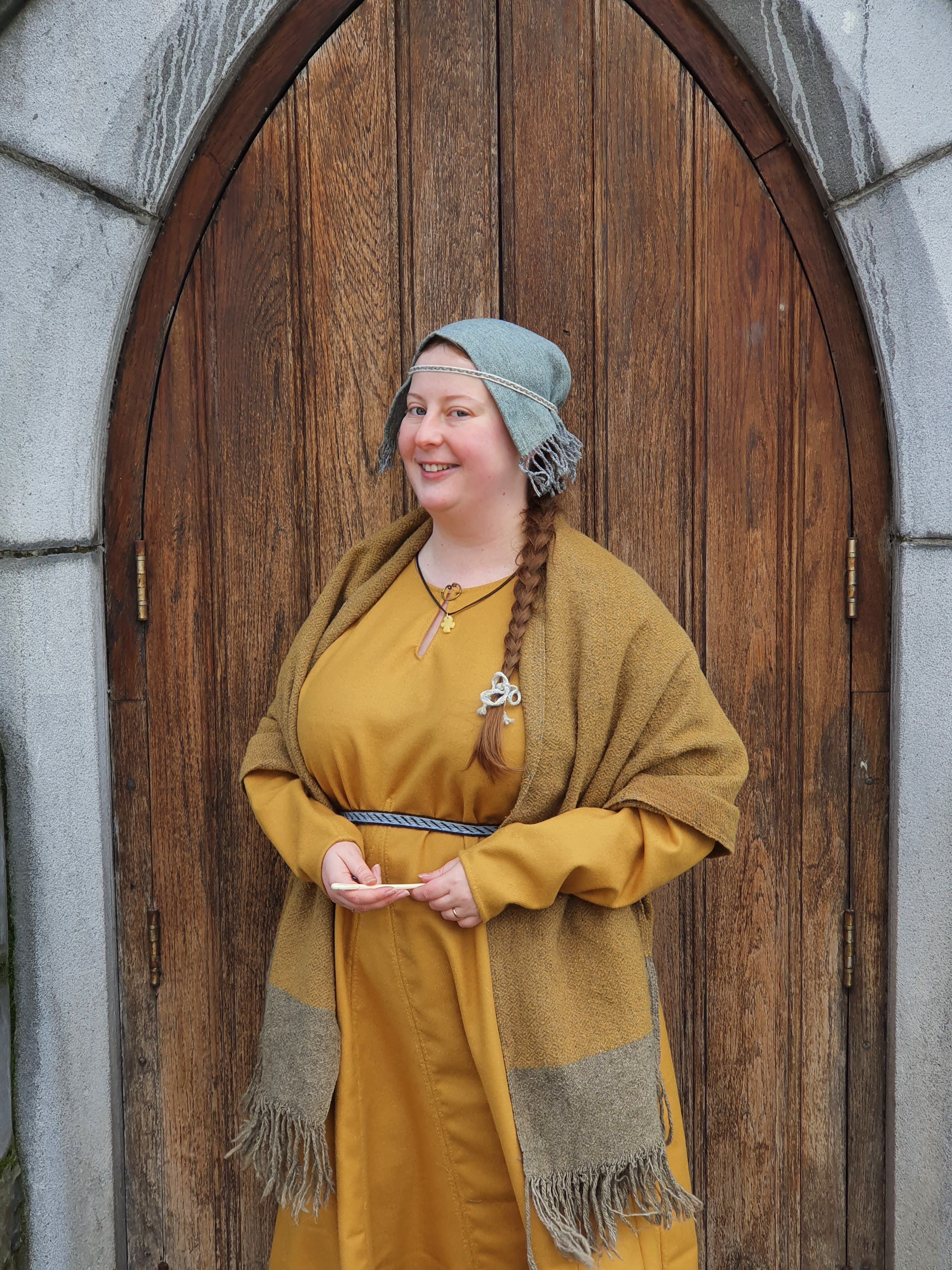
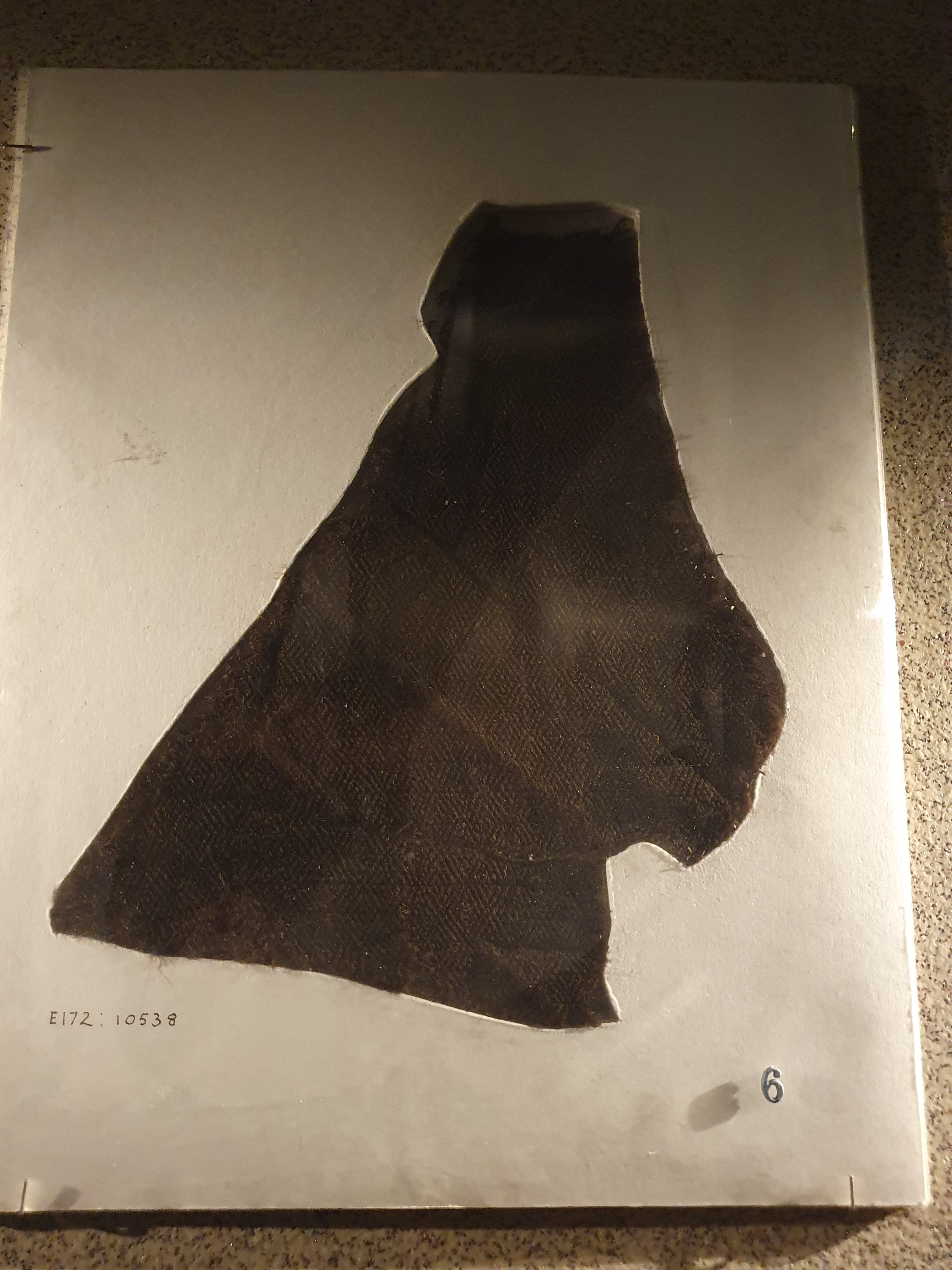
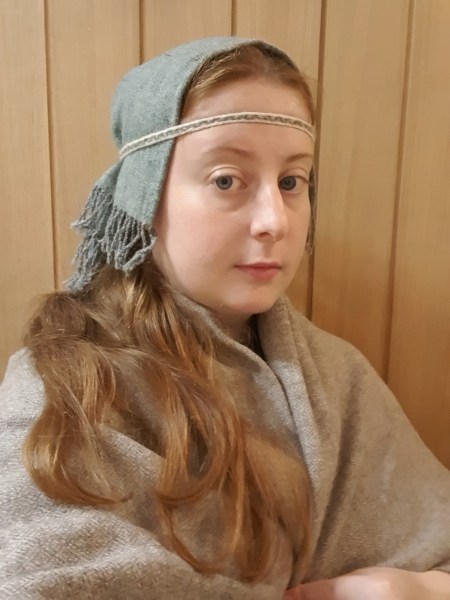
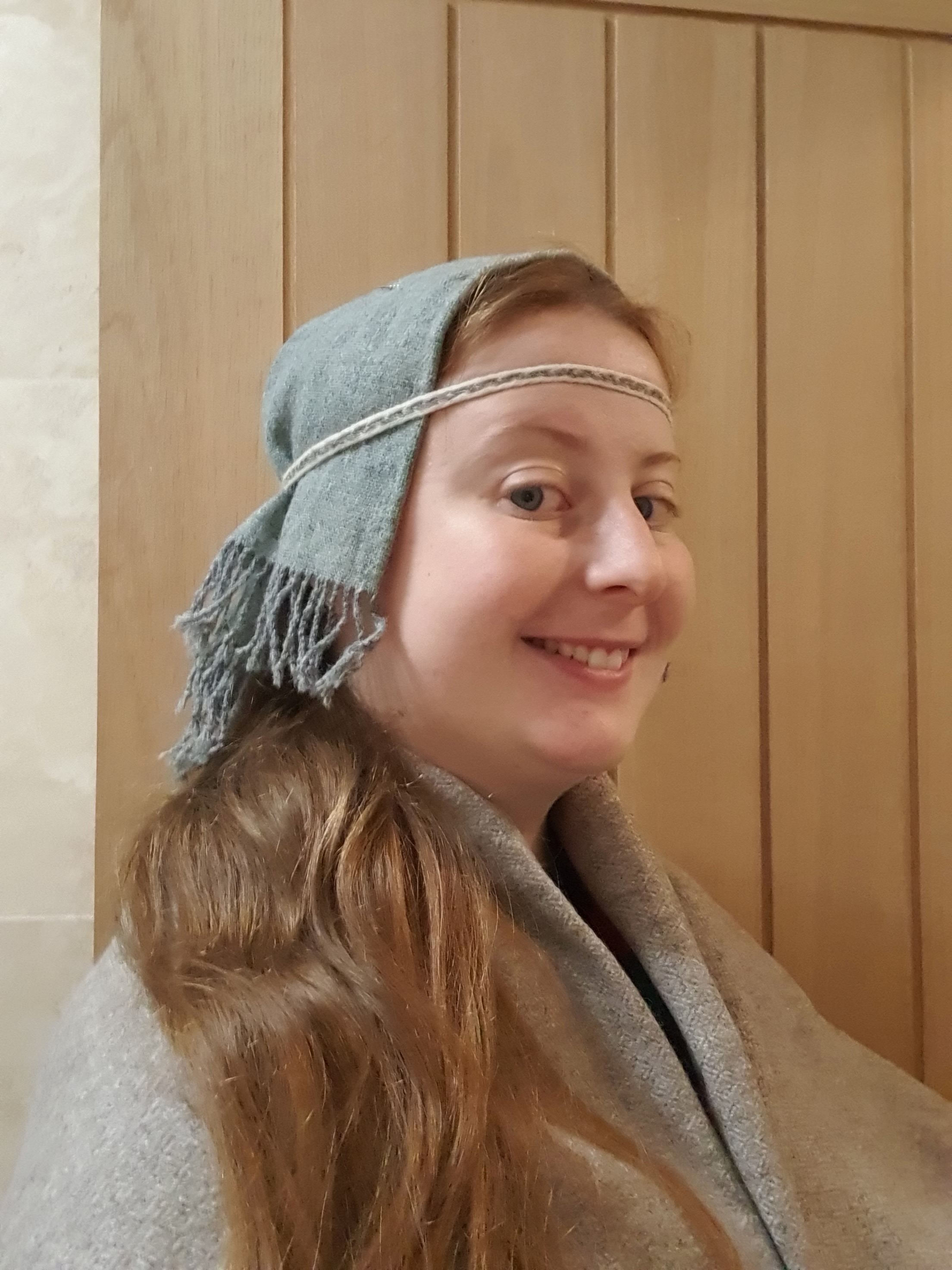
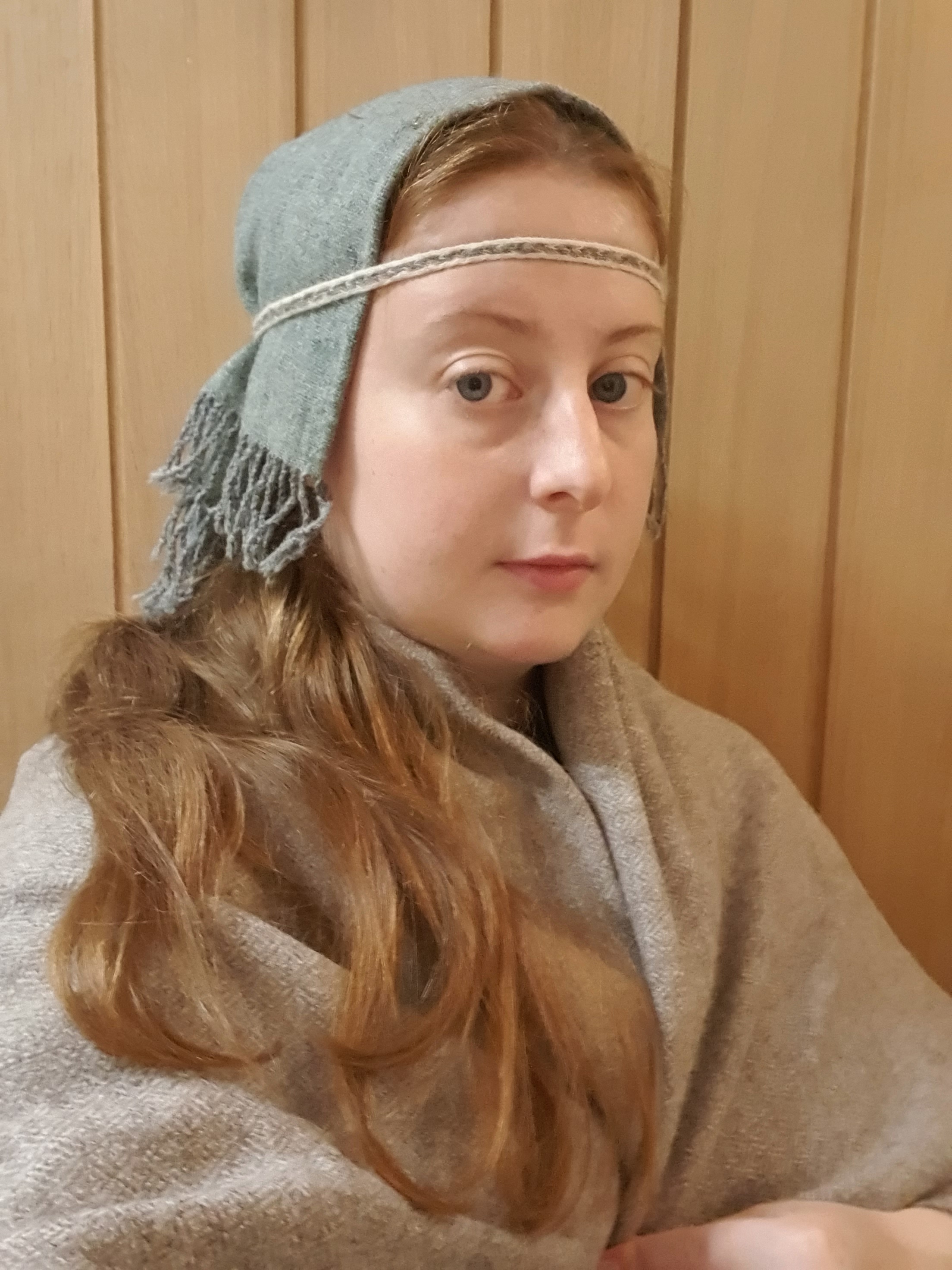
Headscarf based on fragment DHC6 (Fishamble Street)

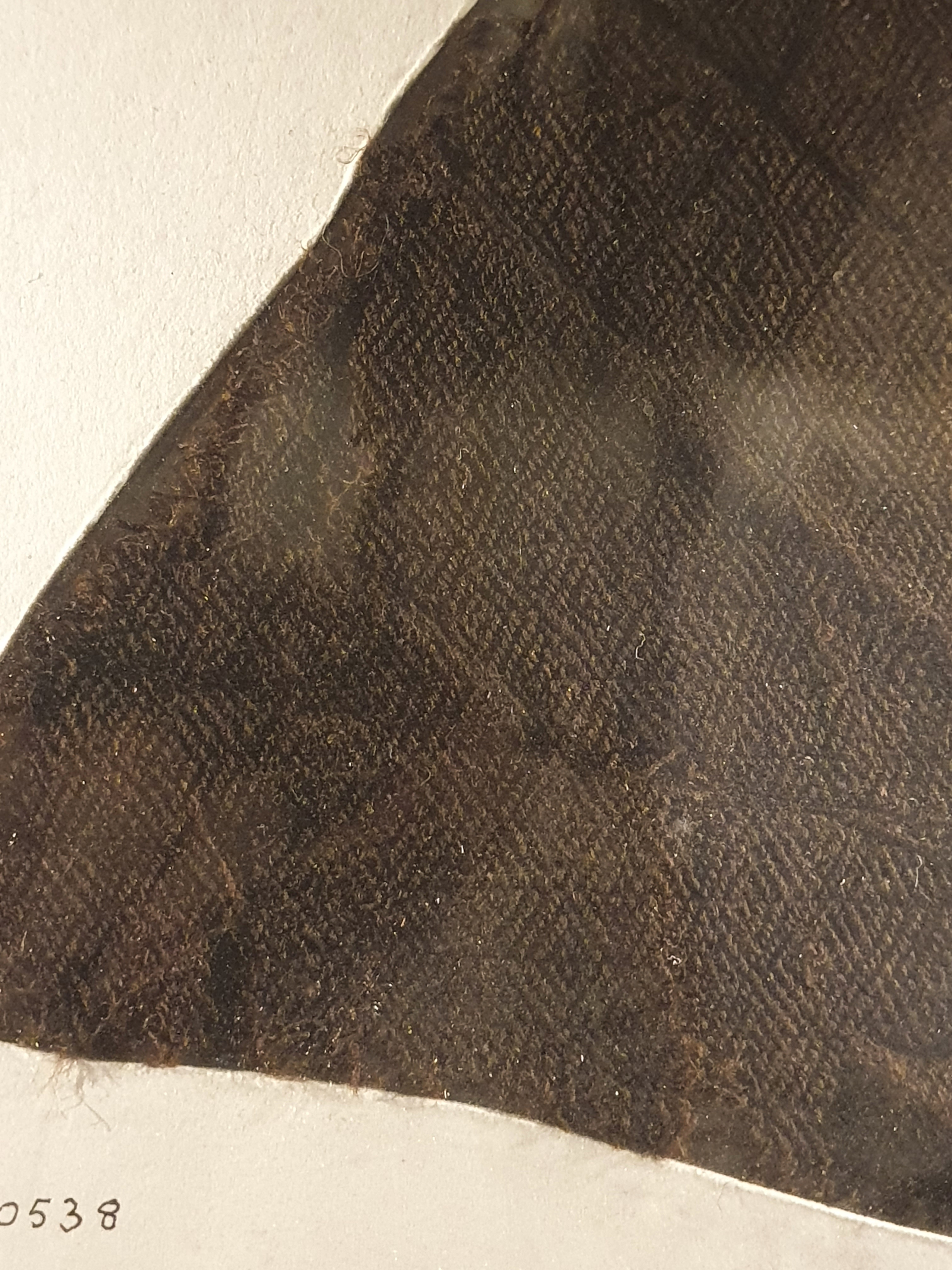
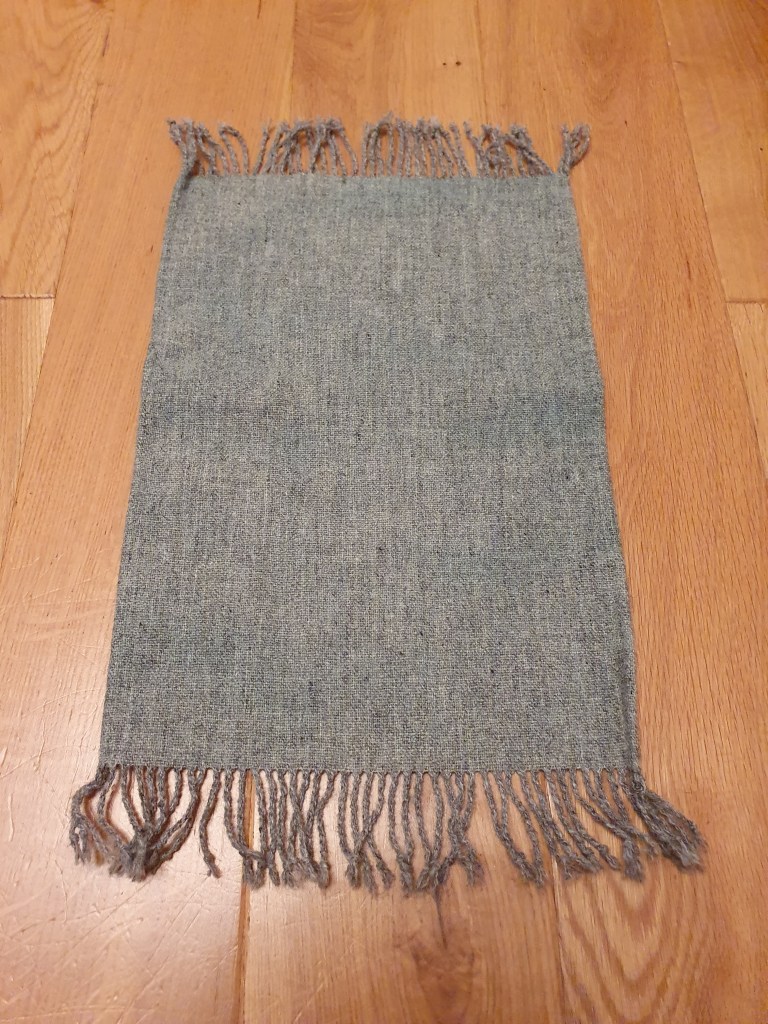
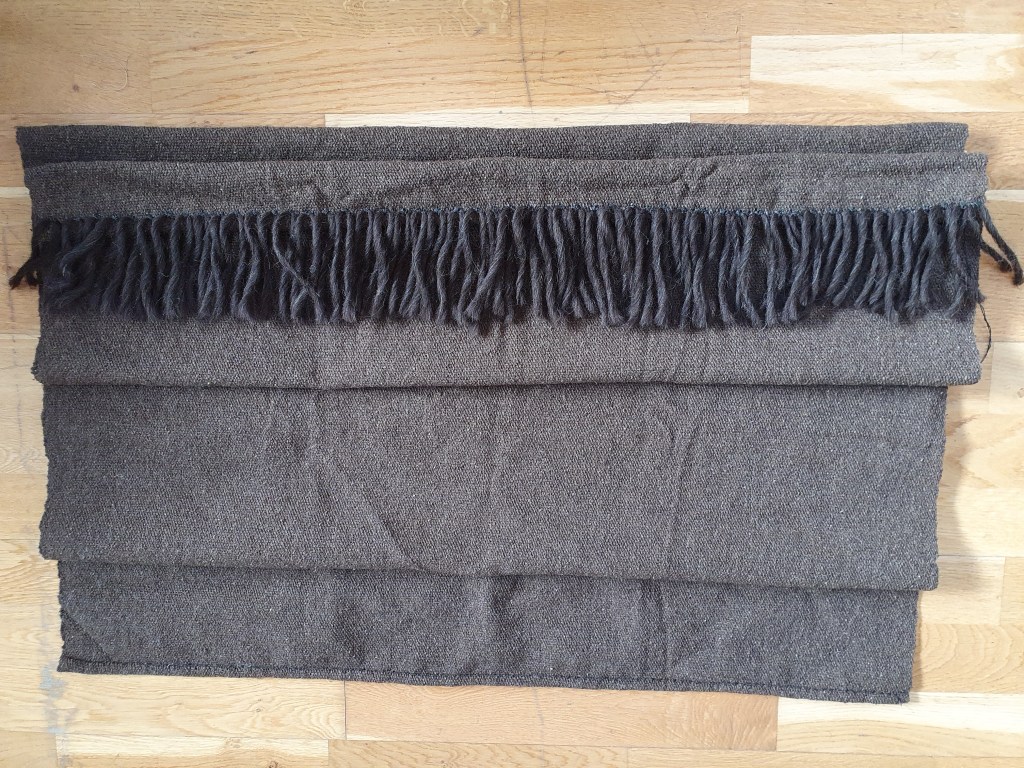
I’ve written about this piece before (my article about it can be read here.) It’s a plain weave woollen scarf, dyed with an exhaust woad bath over a naturally pale grey. It was found on Fishamble Street and dated to the mid 10th century. I tasselled the ends by hand and the dimensions of the scarf are based directly on the textile remains labelled DHC6, though my tassels are slightly simpler than the original.

I like to wear it by itself without a cap and with a simple woollen fillet (tablet woven), but it could easily be combined with other headbands and caps to give different looks. I tied my hair with a very simple finger loop braid- we don’t have any evidence that I know of for hair ties in the Viking Age, but simple cords, braids and thonging must have been used.

I imagine that a weakly dyed item of wool such as this could reasonably have been worn by an average city dweller wanting to keep up with trends. It isn’t a large item and so likely would not have carried the same prestige as the huge voluminous veils worn by queens and saints in manuscripts, however, it could have served to provide either some form of modesty or just fashion for the wearer. Wincott-Heckett (2003) suggests that these small tasselled scarves were of local production and so could indicate a local fashion.

Amber pendant in cross shape (Fishamble Street)

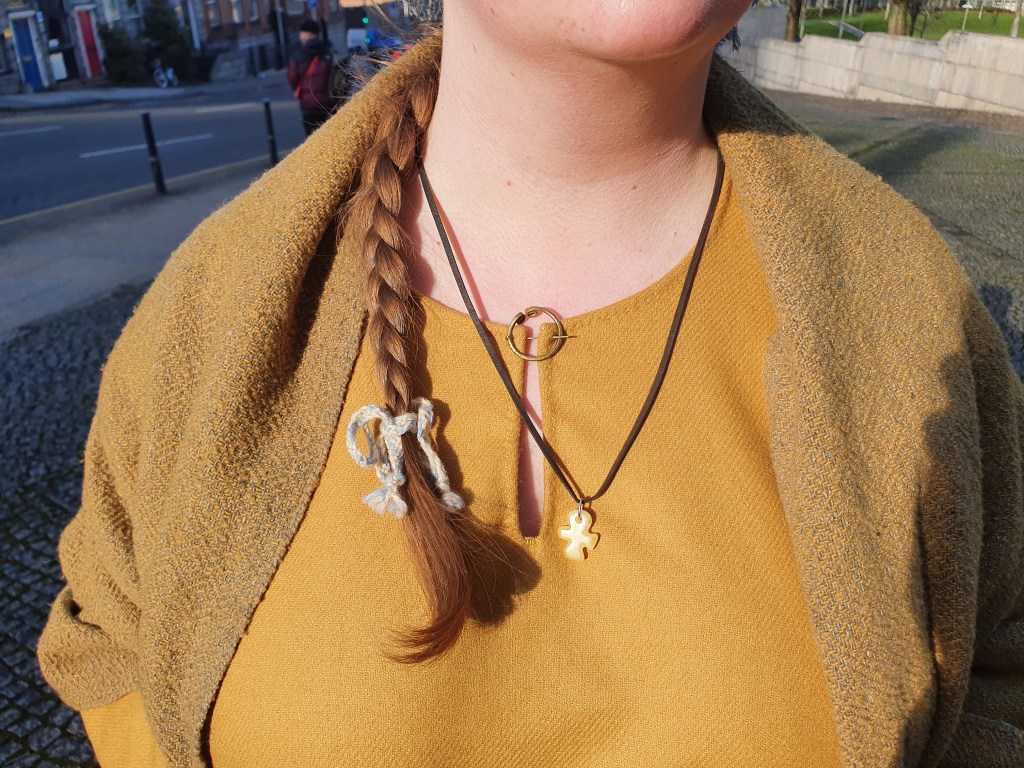
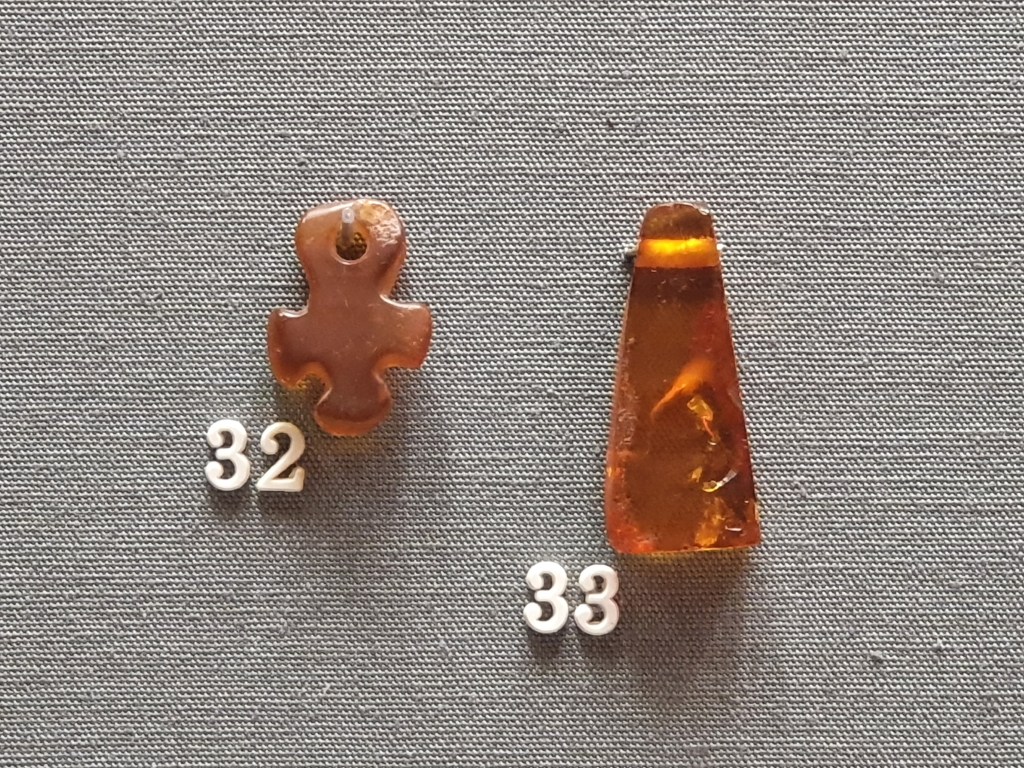
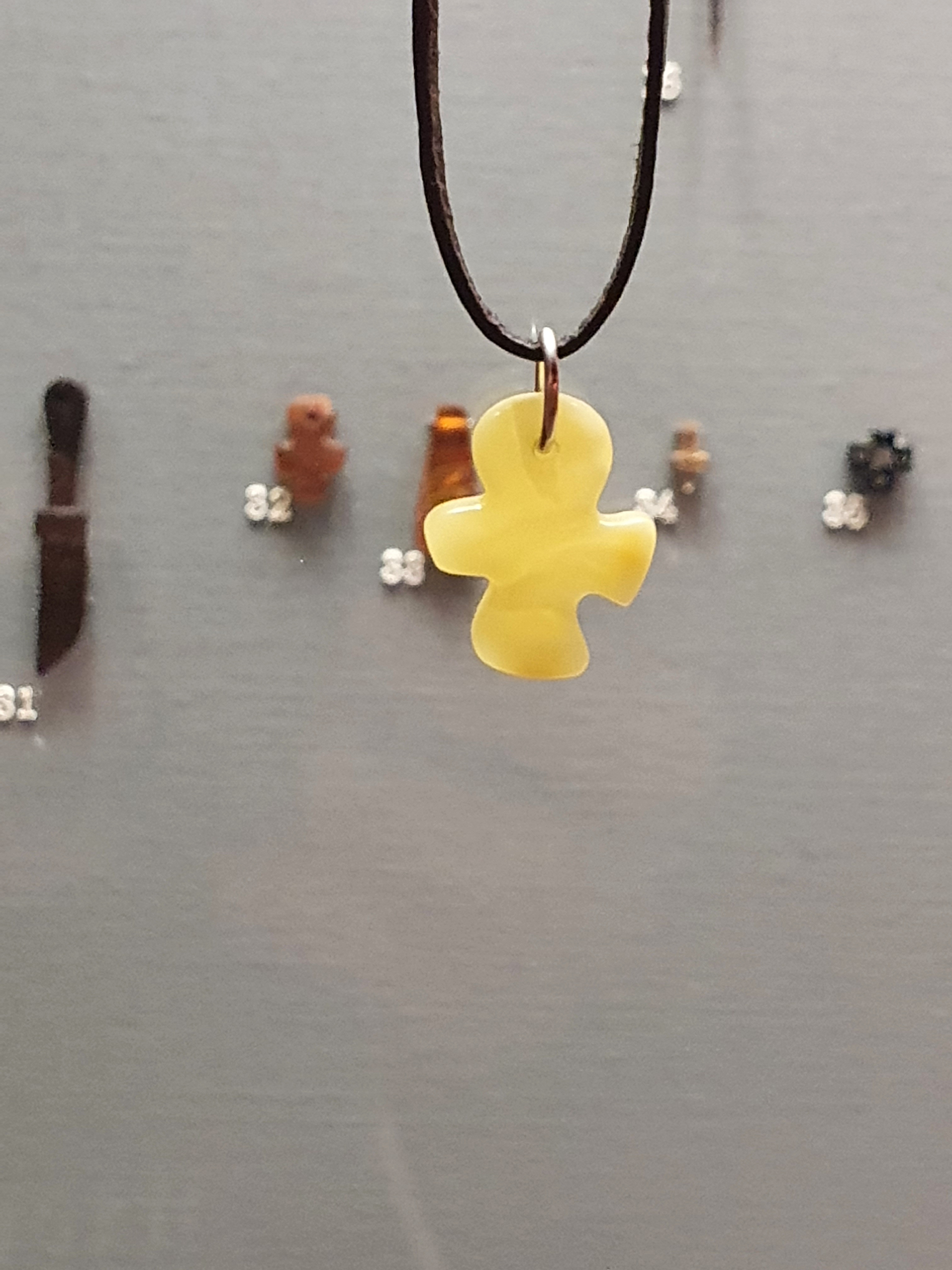
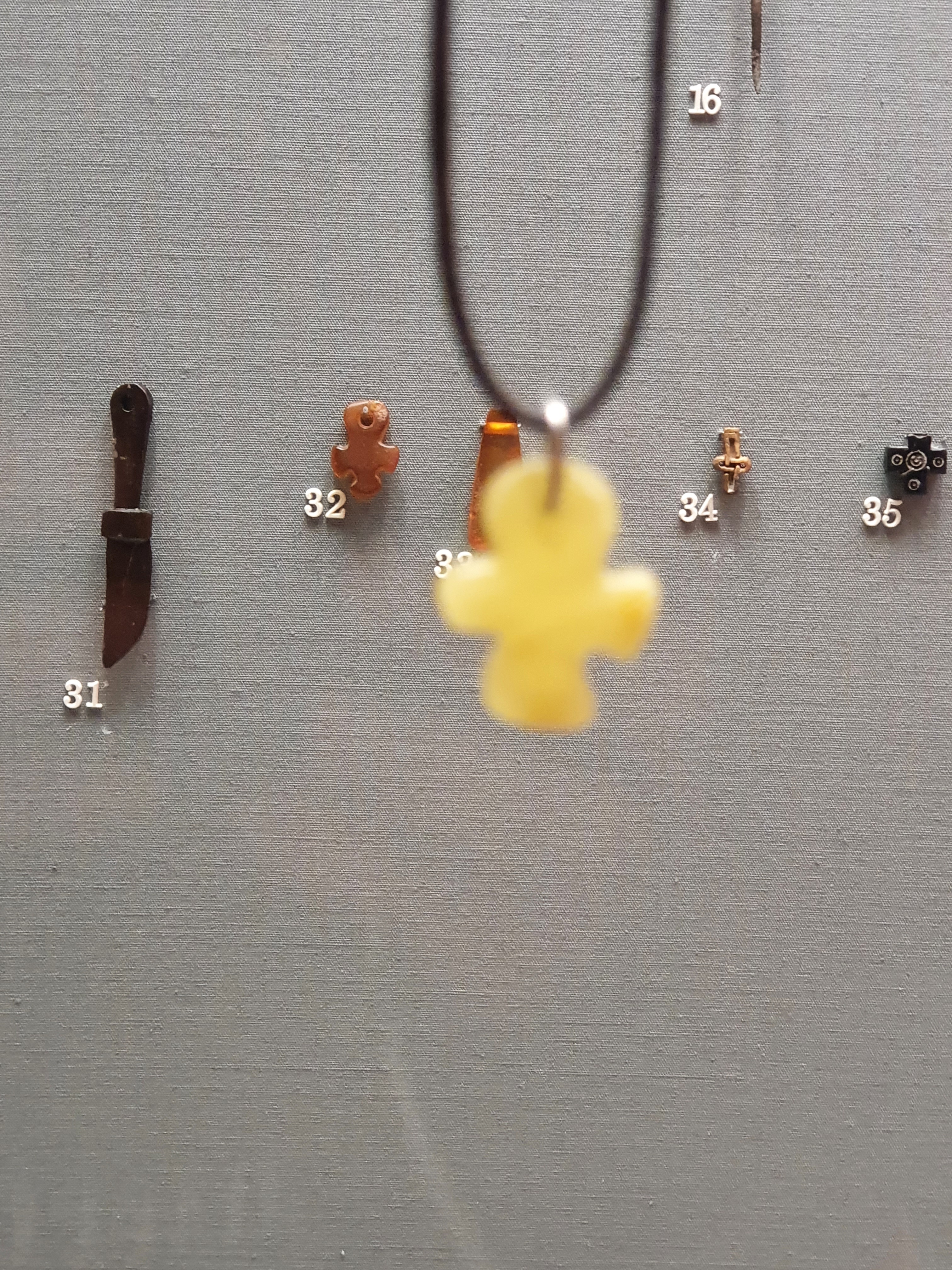
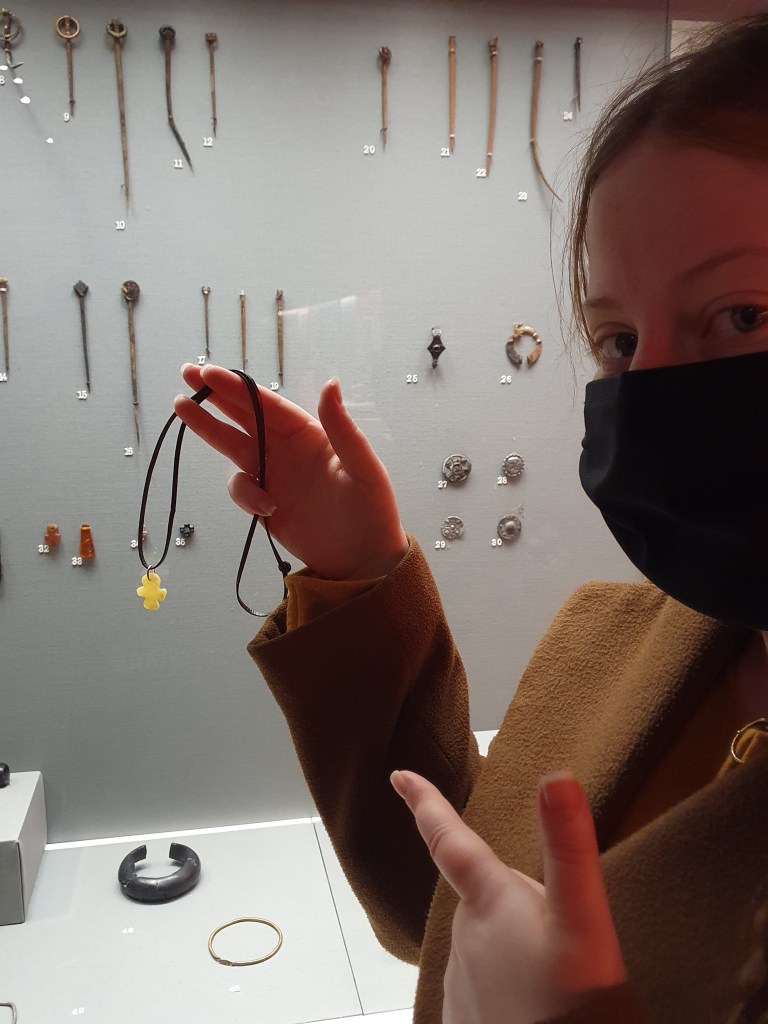
This pendant was made for me by my friend Peter Merrett, based on an example found on Fishamble Street (E190:6248.) It was dated to the mid to late 10th century.

My version is in a lighter amber than the original, which was more orange. Lots of amber fragments were found in the Wood Quay area and particularly in Fishamble Street. Wallace (2016, p.291) explains how at least one house specifically (FS 20 at building level 5 in yard 2) showed evidence that it was the main centre of amber production in late 10th century Dyflin. 257 objects were found in and around the site, while 1,240 worked amber pieces in various stages of completion were also discovered there.

Amber was found in fifty-three of the buildings on Fishamble Street, with 41% of them being recovered from FS 20 and its yard. The Dublin amber finds were made up of beads, pendants, rings and of course the waste and unworked amber nuggets. While some of the amber items for sale in Dublin may have been for a foreign market, it seems that the cruciform pendants had a local flavour- cross pendants in amber haven’t been found in England and the English jet crosses aren’t especially similar in style in my opinion.

Since amber would have been a commonly traded good in the Wood Quay neighbourhood, I envision my Dublin woman as having a piece or two. Perhaps like me, she bought her cross pendant from her craftsman friend up the road or indeed, perhaps she was the craftsperson herself.

Bone bird-headed pin (Winetavern Street/Christchurch Place)

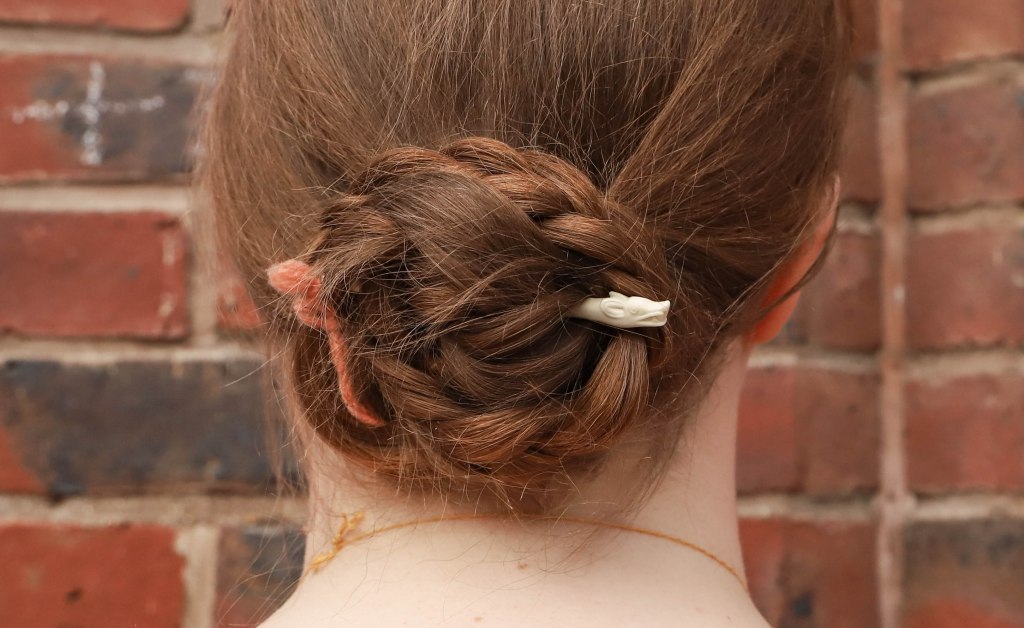
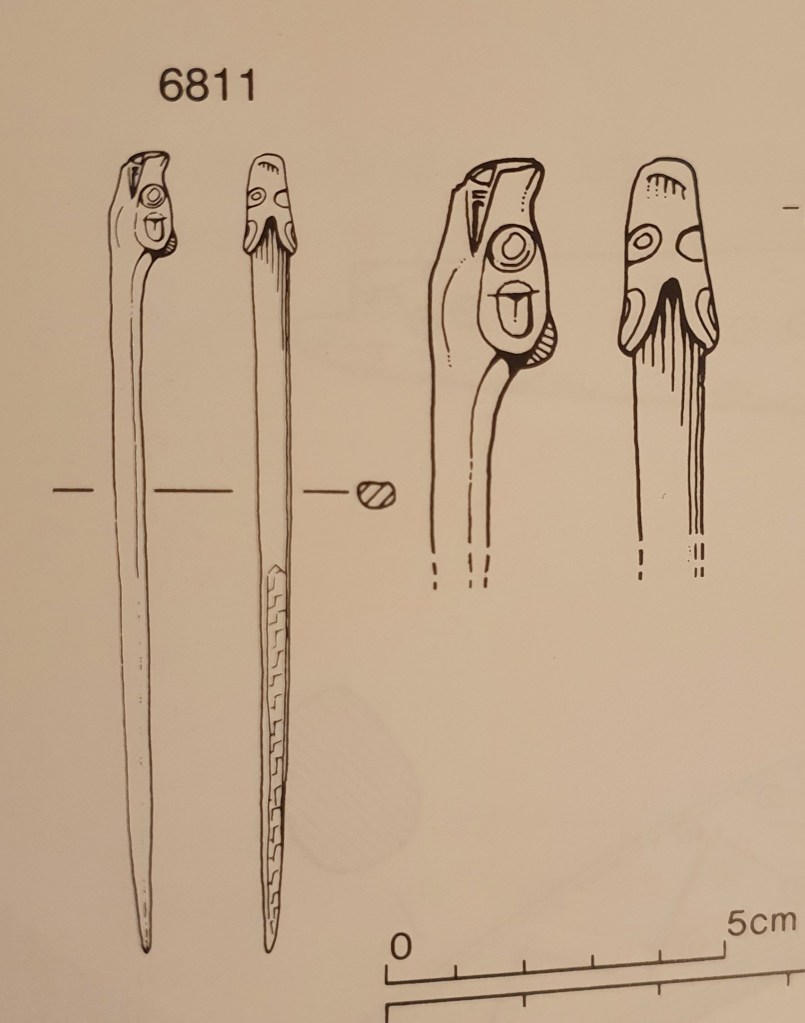
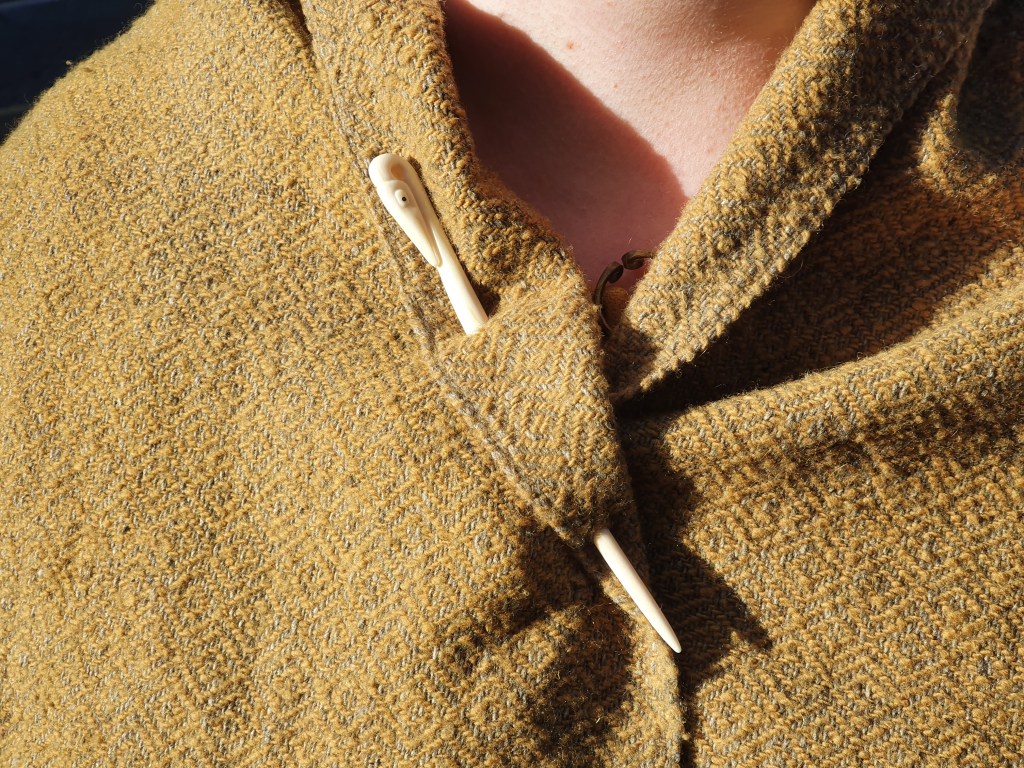
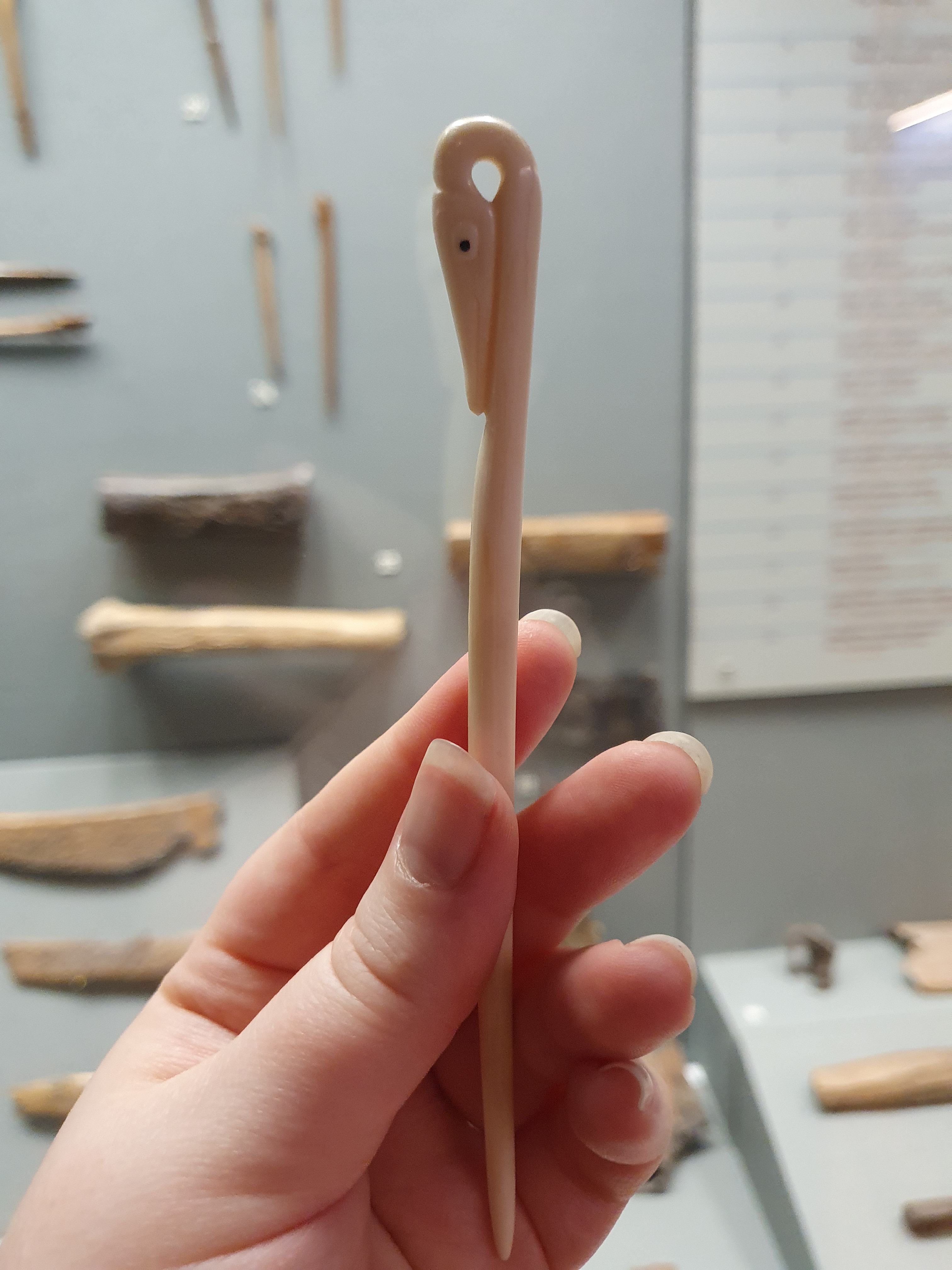
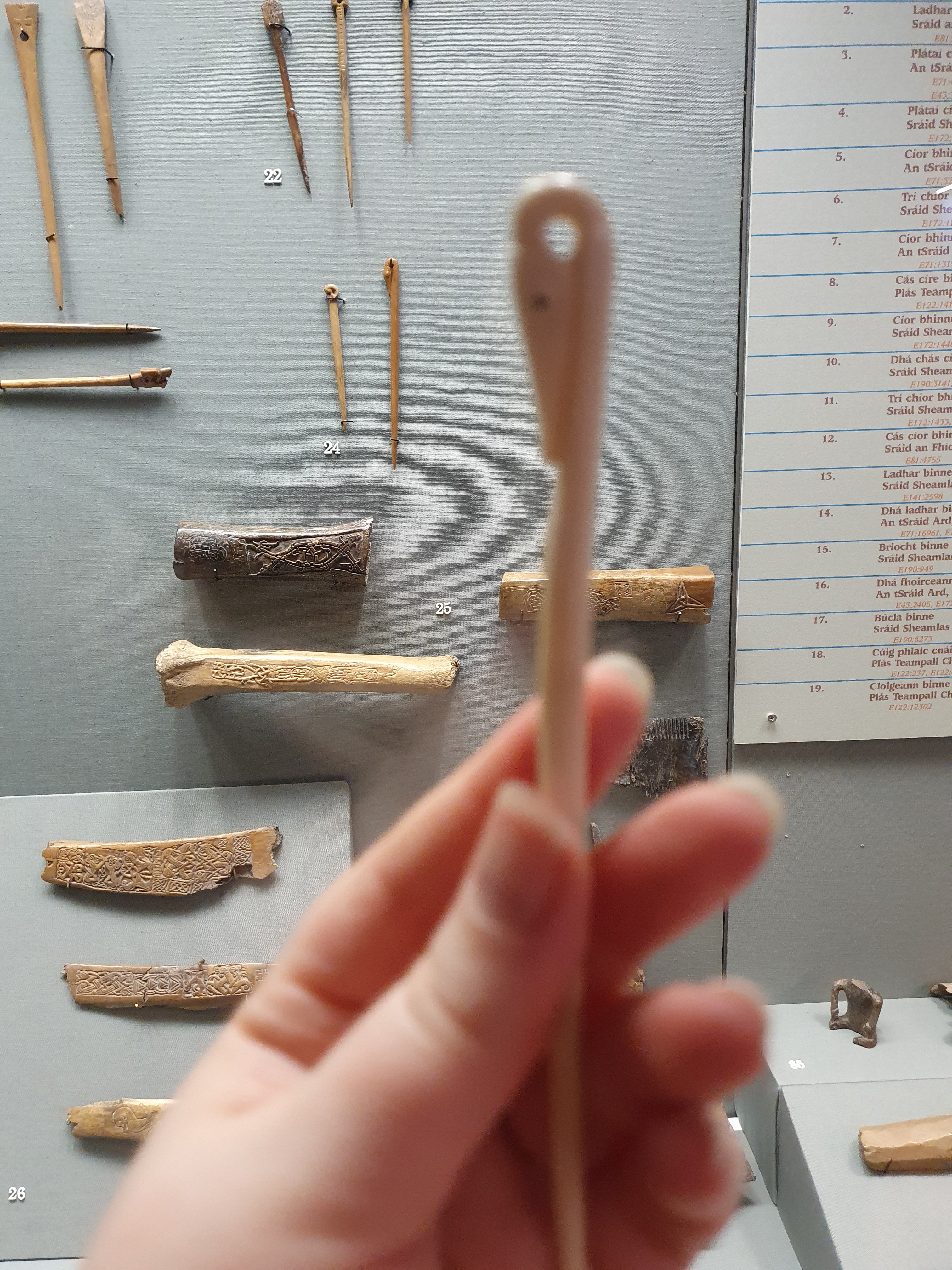
This pin is based on a bone pin (E122:61) found on either Winetavern Street (Wallace, 2016. p.303) or Christchurch Place (National Museum of Ireland, 1973)- different publications give different find sites. It has a carved terminal in the shape of a bird and was dated quite vaguely to the 10-11th century.

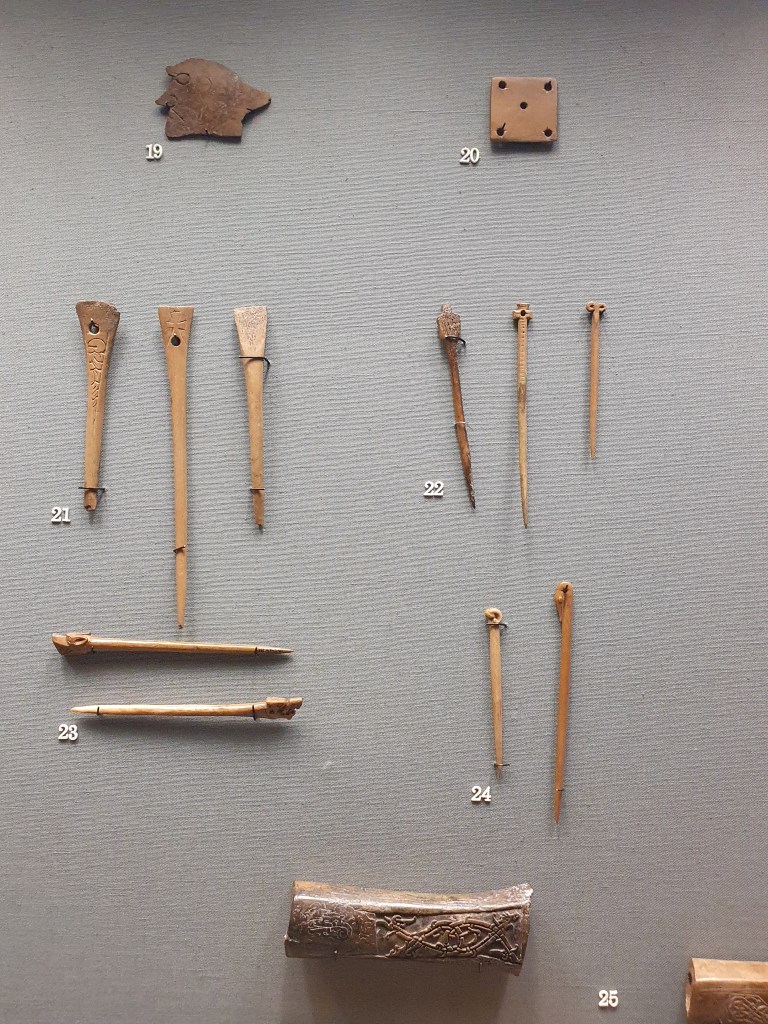
A multitude of bone pins were found in Viking Age Dublin. Like the York examples, they range from plain all the way to ornate- some of the more decorative examples include cruciform tops, ram’s horn and animal-headed. We can’t tell for certain if they were used for fastening clothing, as hair pins or indeed for some other purpose.

Do you think it looks more like a swan or a goose, a duck, a pelican? I can’t decide but I like it a lot.

Copper alloy toiletry set (Fishamble Street)

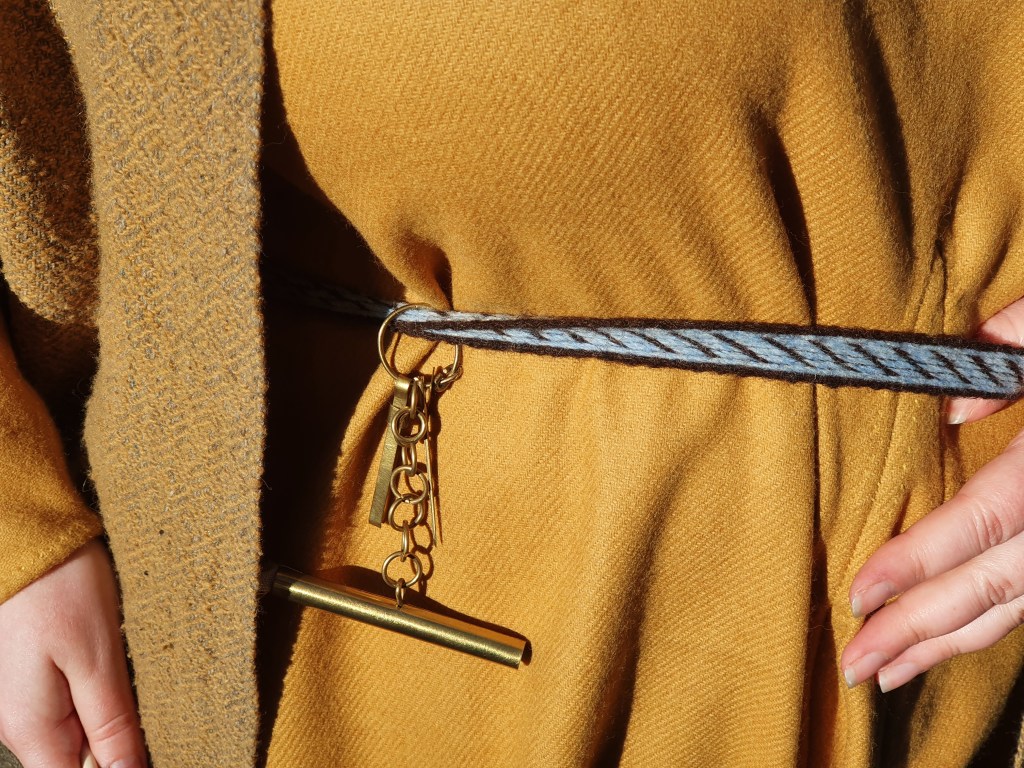
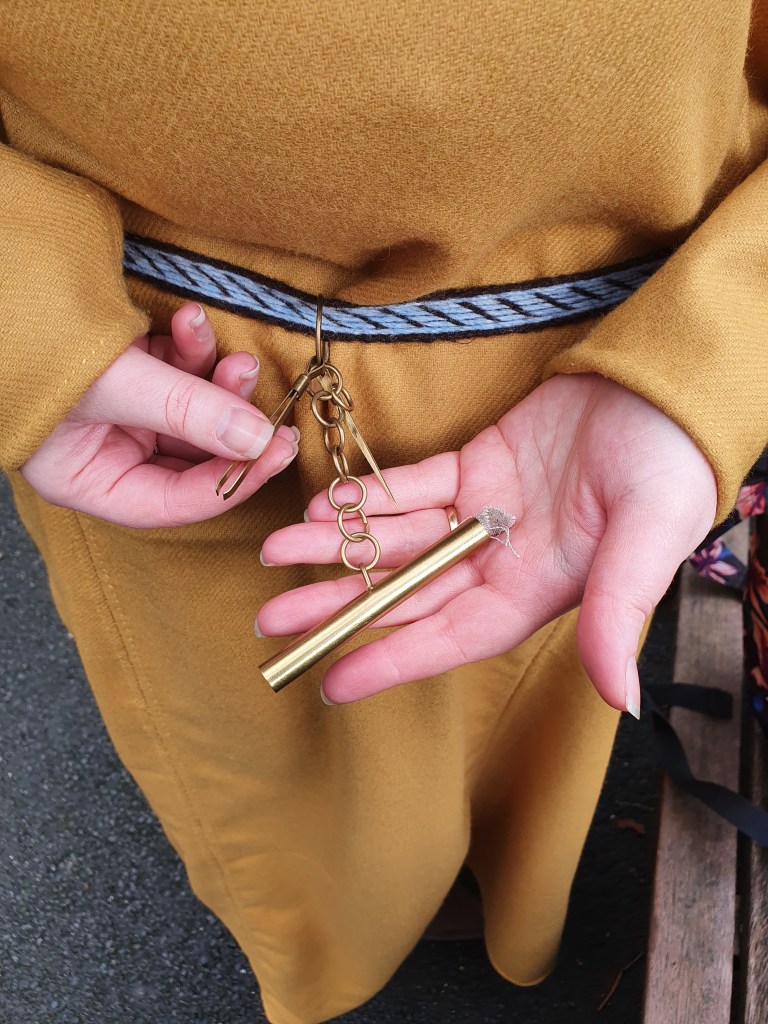
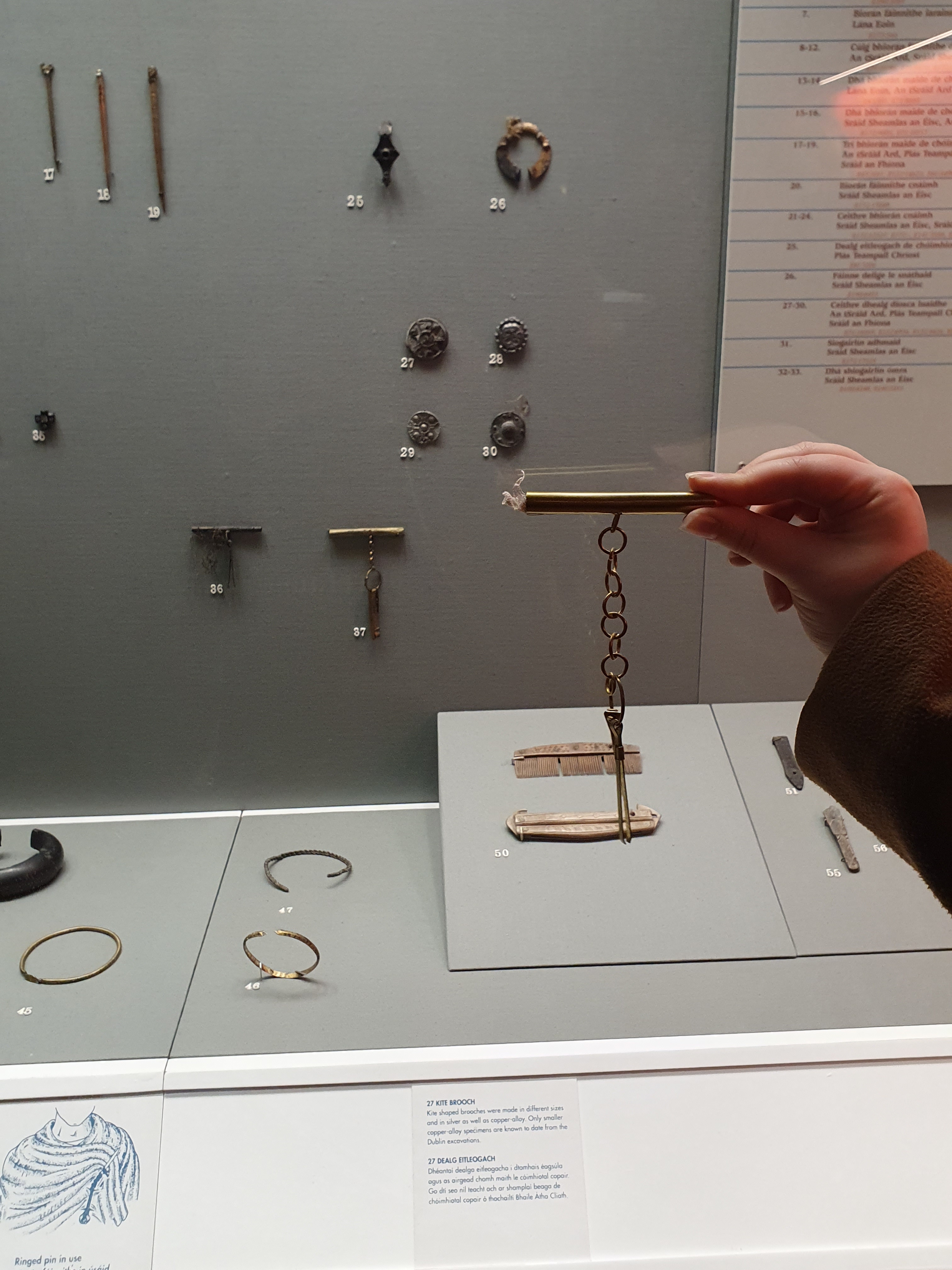
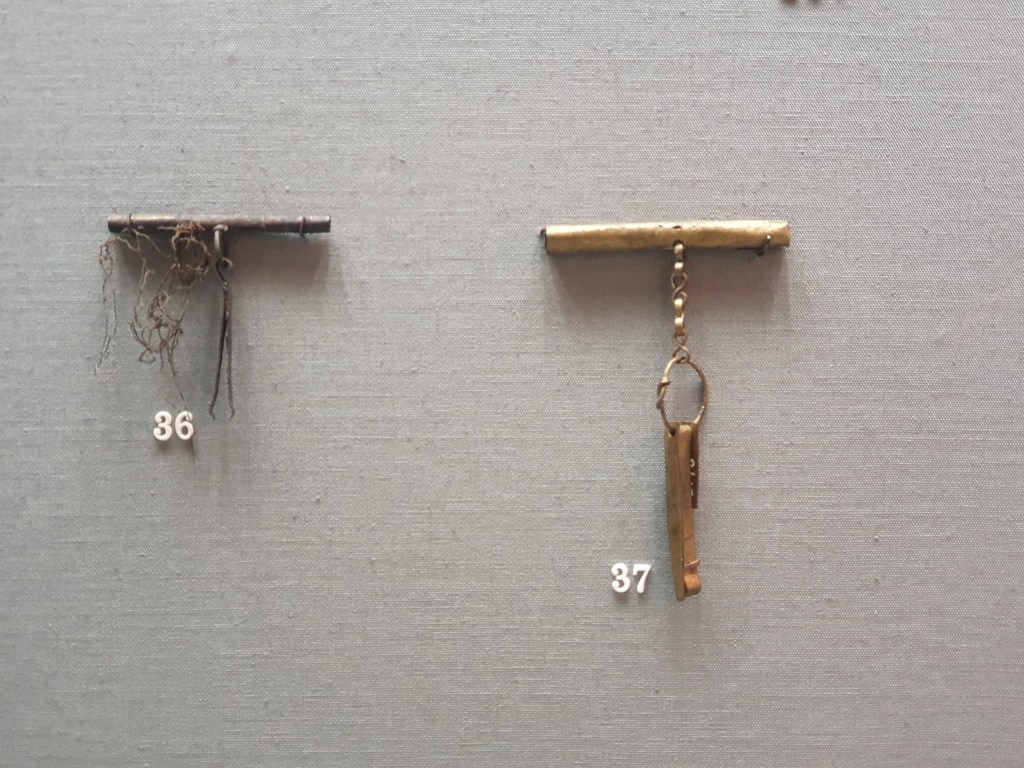
Toiletry sets like this one (E190:0000) are a relatively common find across the Viking world- other examples can be found from York, Hedeby, Birka, Gotland and many other sites. Mine is one of two found on Fishamble Street and is dated to the 10th century. It is made of copper alloy and consists of a little tube, hanging from a ring by a chain, along with several other tools- a pair of tweezers, a nail/tooth pick and one other unknown item which was broken.

The tube would have been used as a needlecase, either with a roll of fibre shoved inside with the needles or indeed with something blocking each end to make a sealed tube. Other examples from the Viking world indicate that sealed needle cases were common, though neither needle case found at Wood Quay had a stopper or a lid. I put a little linen cloth inside mine, more for appearances than anything else. The needles that your Hiberno Scandinavian lady would carry with her could be made from iron, copper alloy or bone- needles are a common find at Viking Age sites.

Textiles

I didn’t plan the textiles for this outfit specifically for a Dublin impression- so they aren’t perfect. I opted for a mustard yellow wool dress and a diamond twill shawl in a khaki green-mustard. Both colours can be achieved on wool using natural dyes used in period, namely dyer’s greenweed and weld.

In the absence of any Viking Age tunic finds from Ireland, the pattern for my dress was based on the 11th century Skjoldehamn find from Andøya, Norway. It has four gores from the waist, two at the sides, one at the front and one at the back. I feel like this gives a more swooshy skirted look that I really like and that fits with what few contemporary images of women from Ireland and Britain we have. My shawl is rectangular with tassels at each end.

The dress is made from a simple 2/2 twill, which is found commonly at many Viking Age sites. Under normal circumstances, I would also wear a tabby woven linen underdress- but I couldn’t fit one in my luggage! Next time, I’ll take the longship instead of flying Ryanair.

Pennanular brooch

For some stupid reason, I didn’t take any photos of the brooches in the museum! They’re in the background of a few other glamour shots of the toiletry sets, mocking me, but not sharp enough to show. Sorry!

Preferably, I would have a suitable little disc brooch to close my neckline for a Dublin impression. 30 such brooches have been found in 10-11th century contexts there and Wallace (2016, p.368) describes how they were likely imports from England or Germany, where they were very fashionable at the time. It’s also striking to note how similar many examples are to York and London finds. That being said, I didn’t want to use York brooches for a Dublin outfit! I’m searching for a good replica as we speak.

One example of a pennanular brooch from Fishamble Street is E190:6455. It’s made of copper alloy and dates to the 10th century. Wallace (p.280) relates this to another brooch from Ballinderry crannog among others, labeling the penannular style as an indigenously Irish one. He explains that this could indicate that Hiberno-Scandinavian townspeople had a taste for Irish jewellery or simply that an Irish person came into the town wearing their own native fashion.

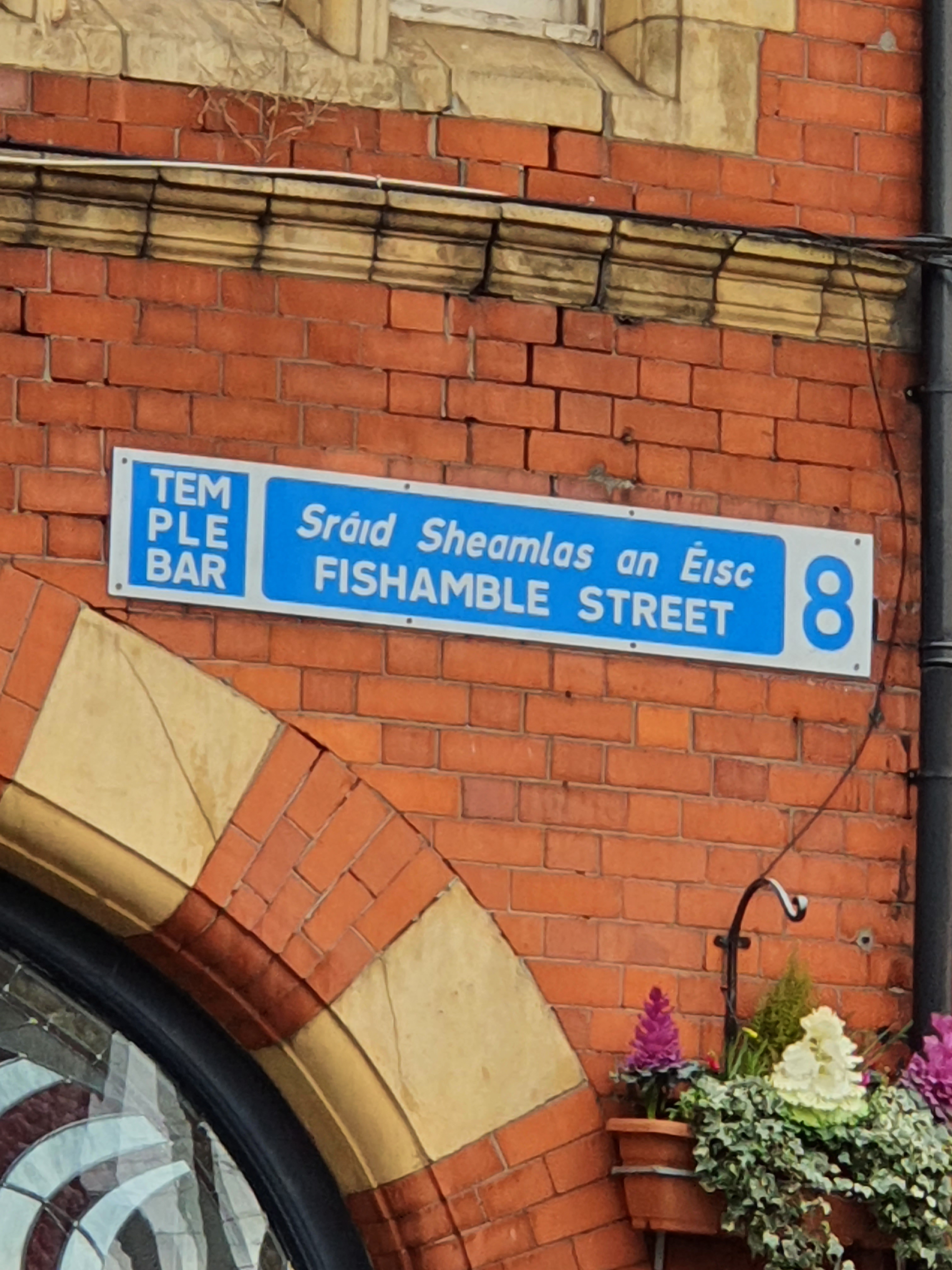
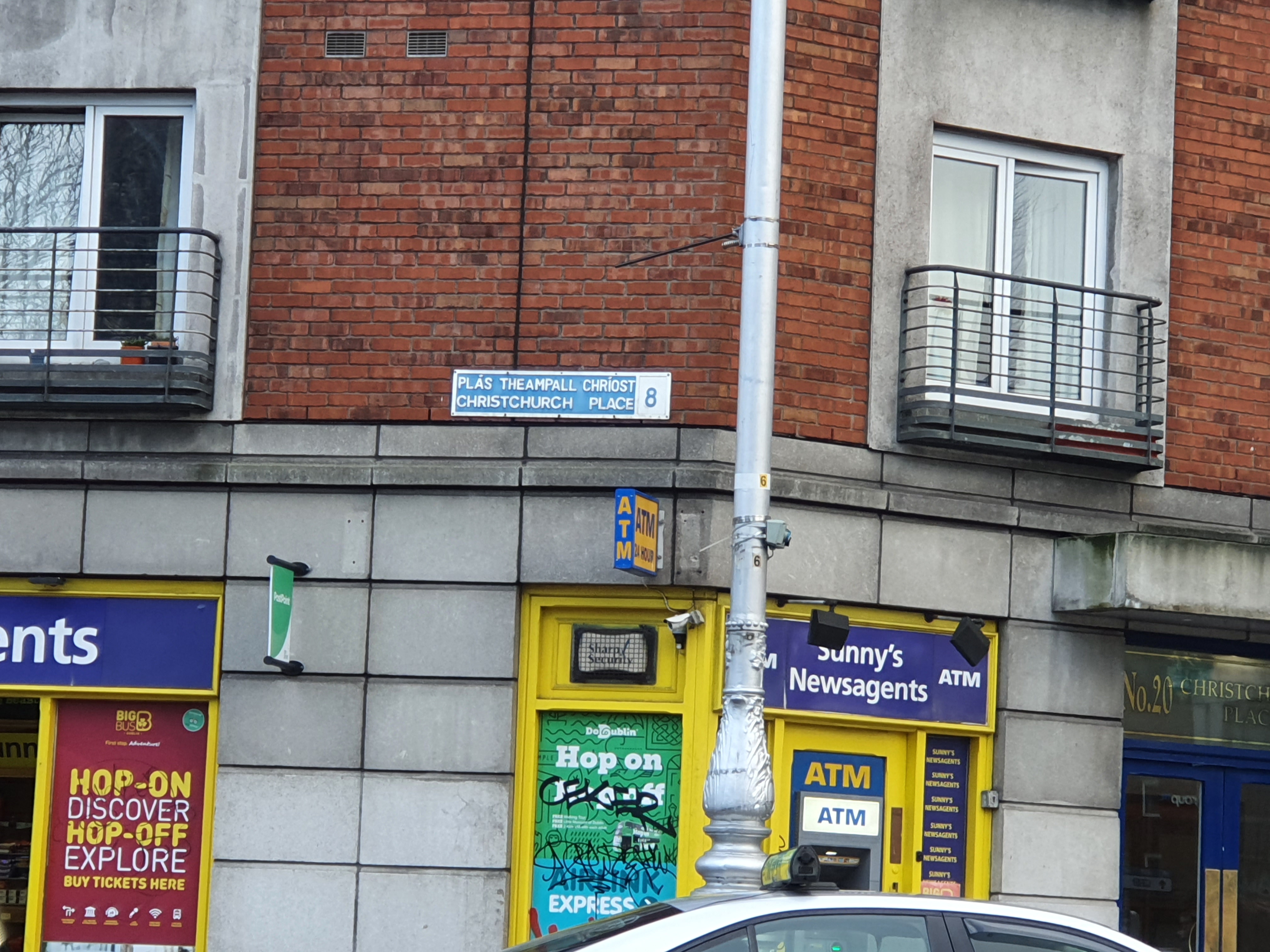
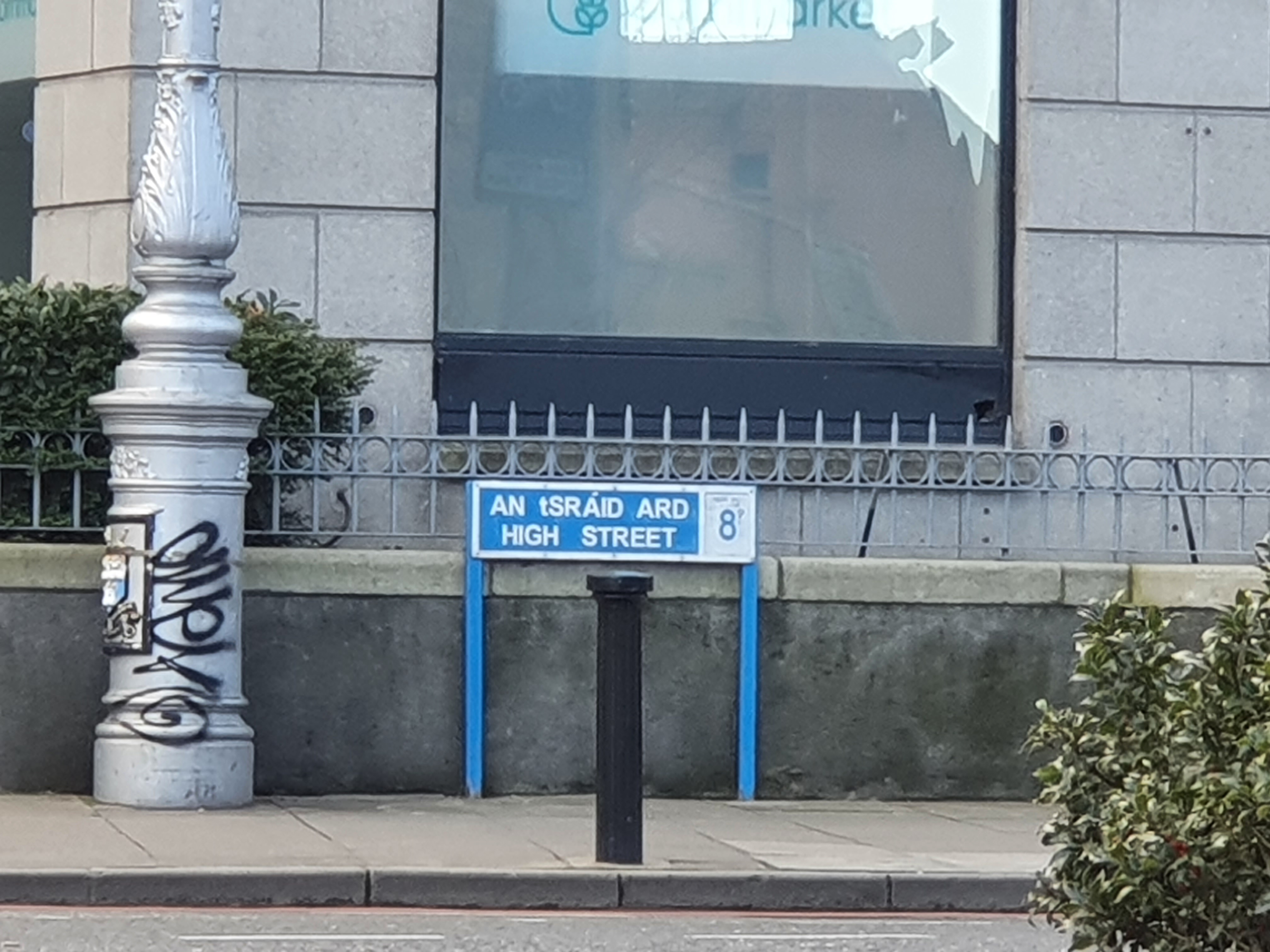
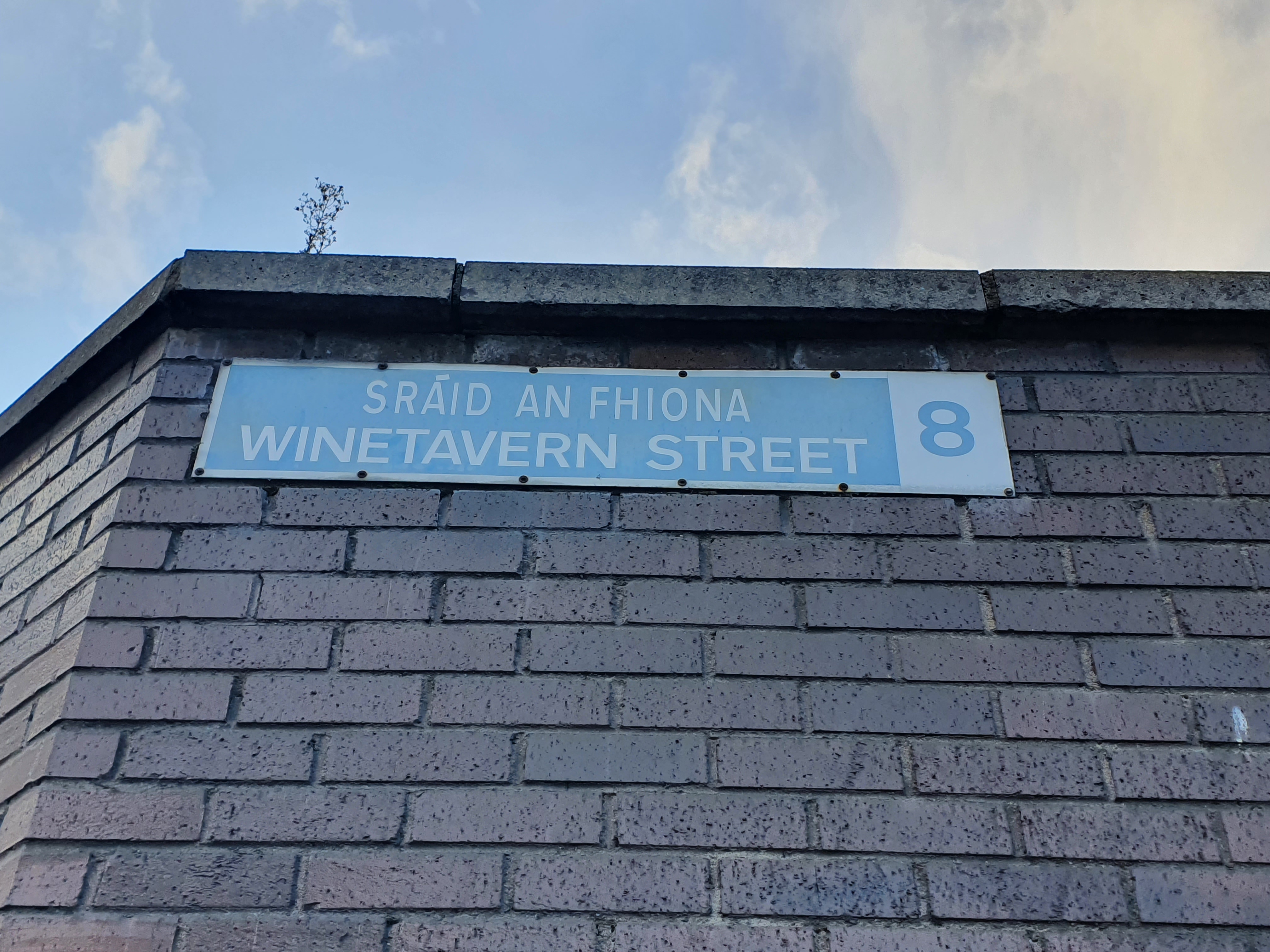
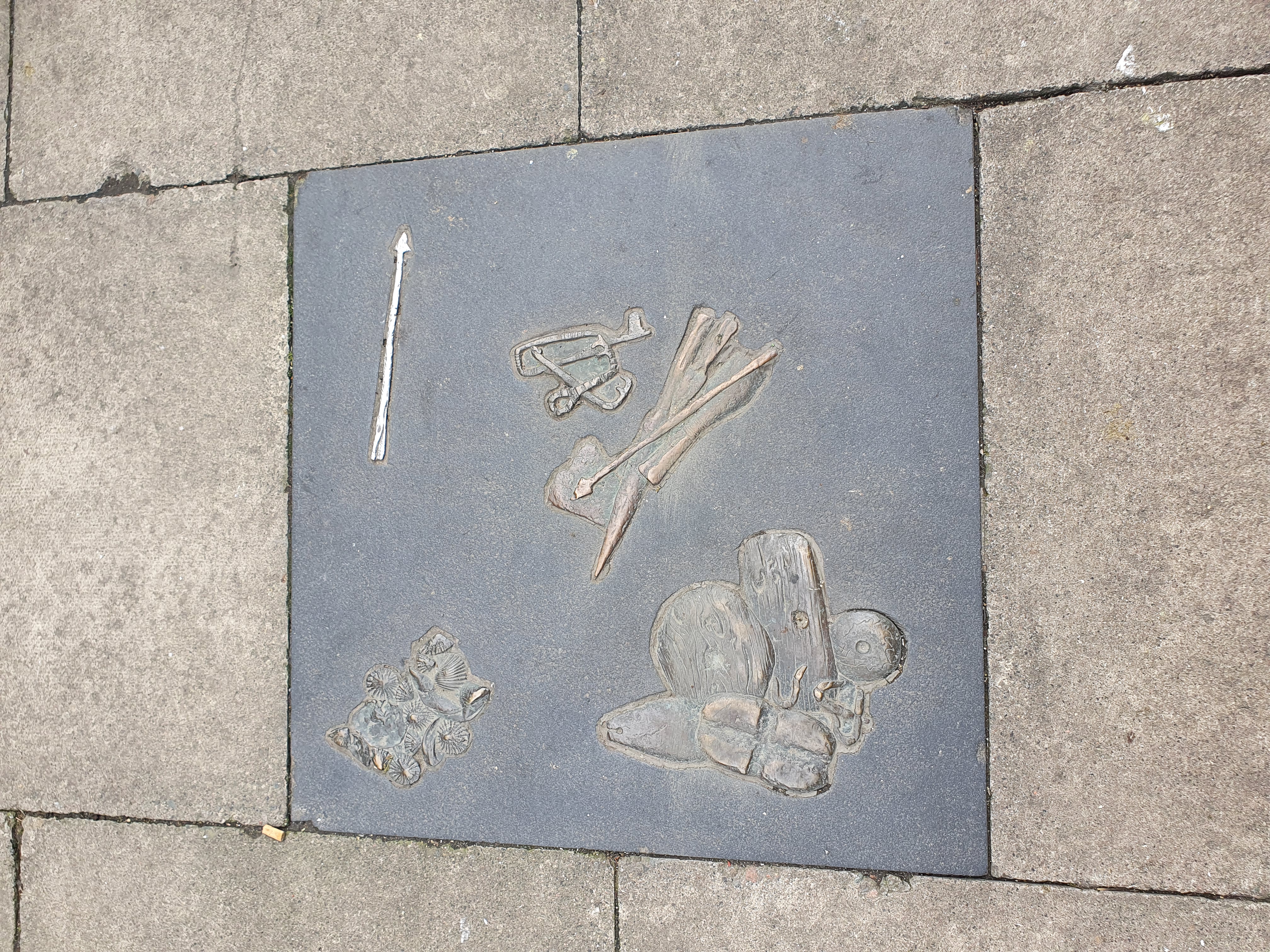
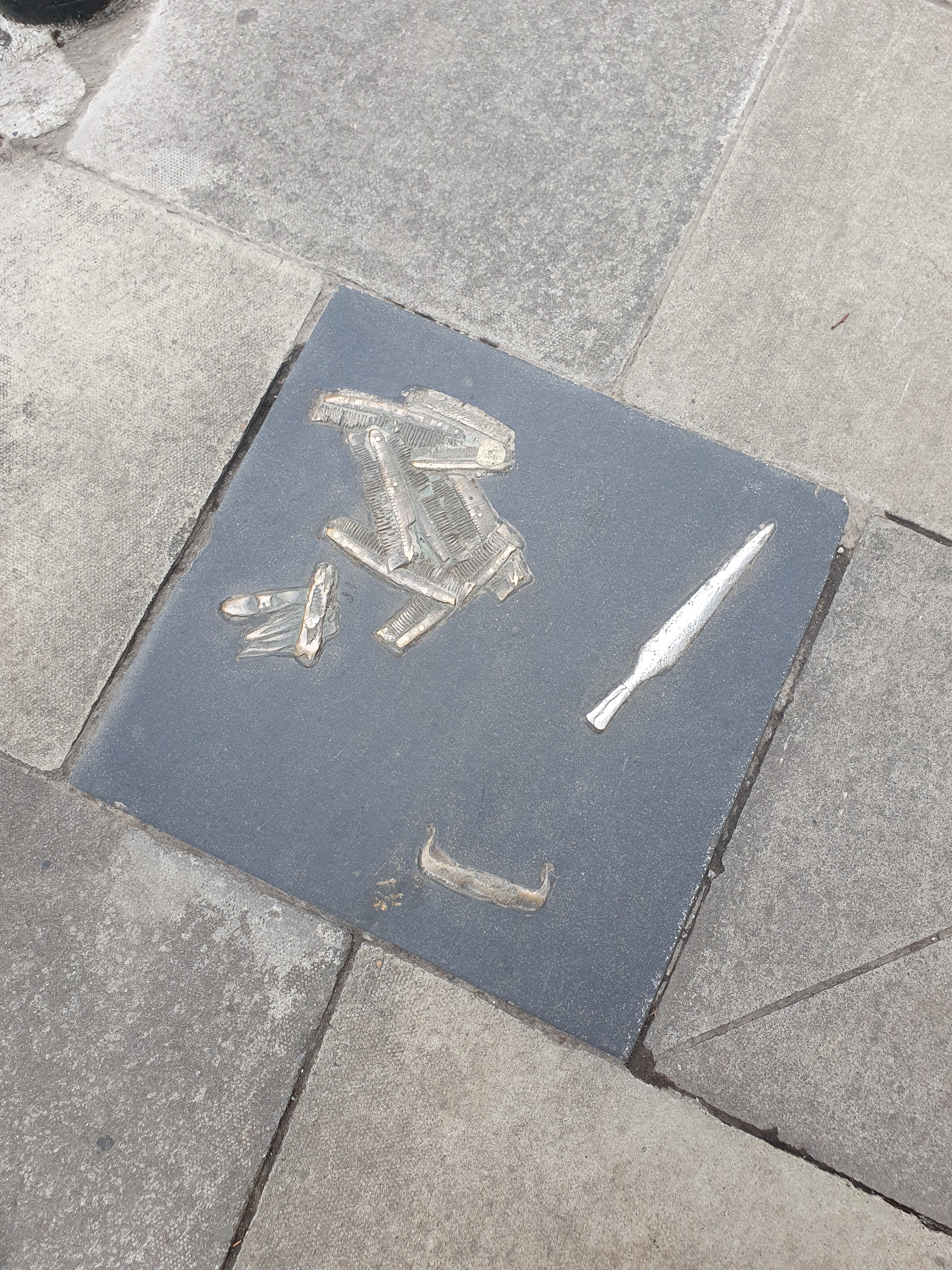
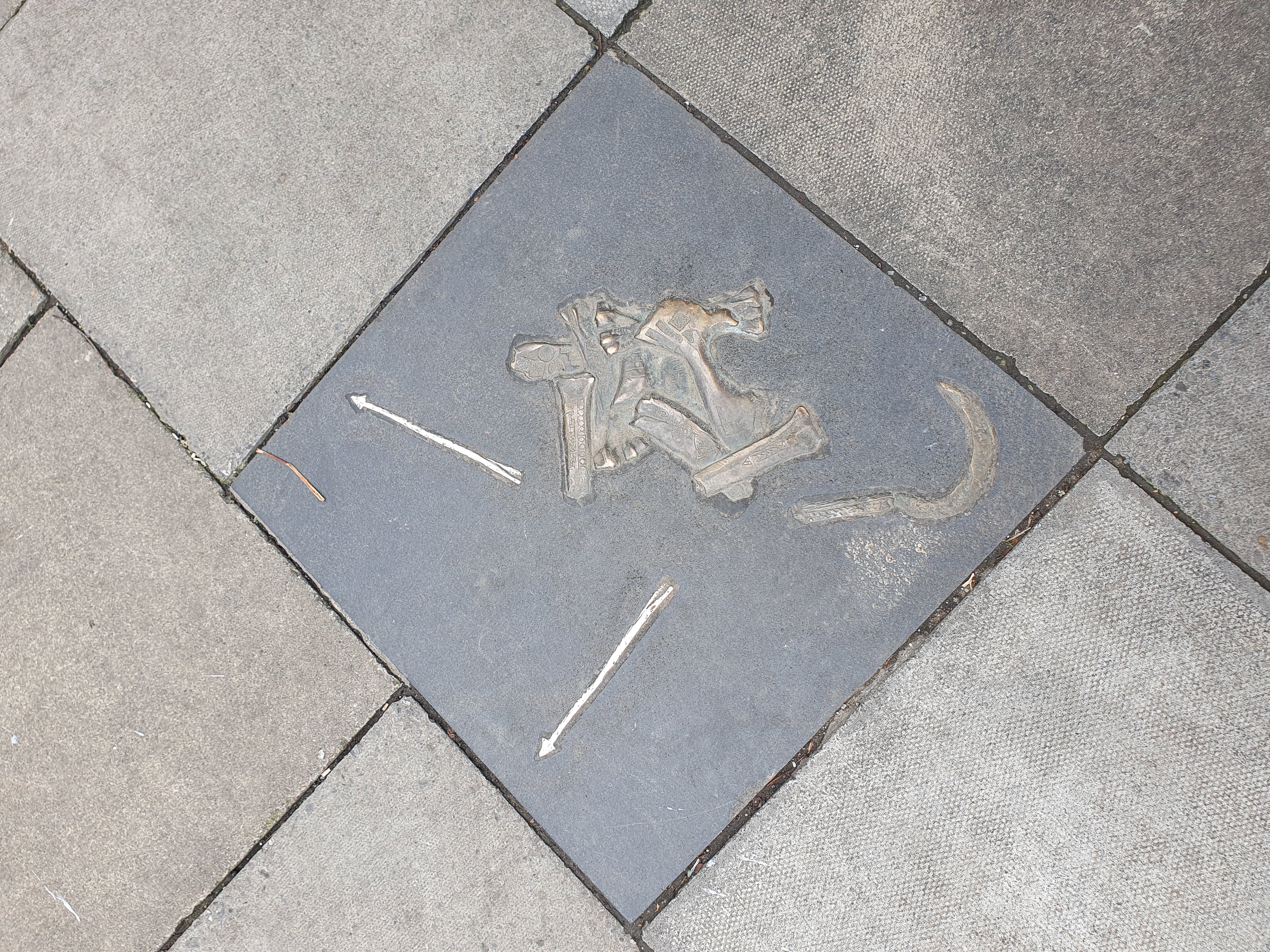
Bonus photo dump: street signs and Wood Quay pavement plaques

I’m just a massive nerd and I love seeing the street names I recognise from the archaeological reports.

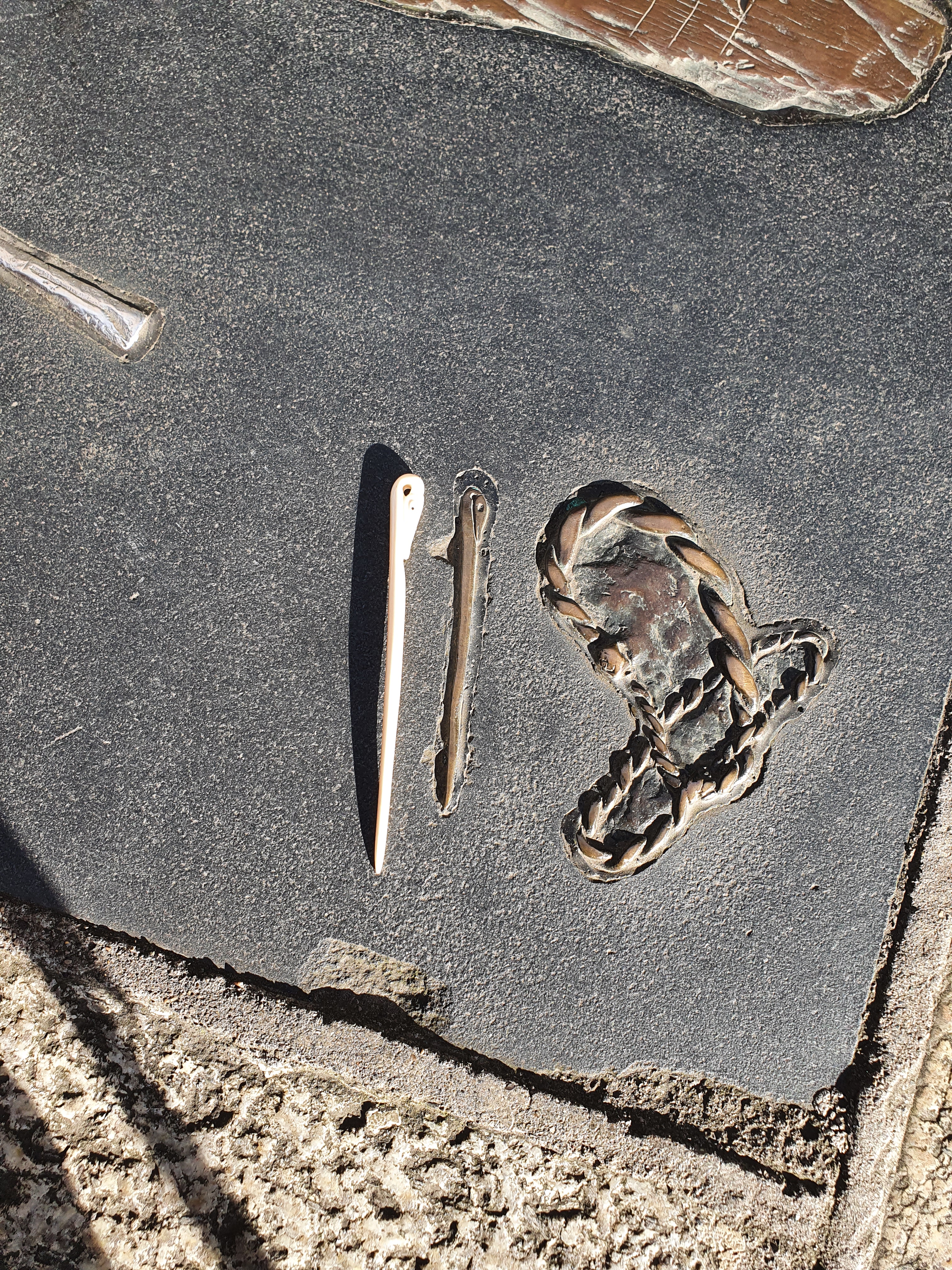
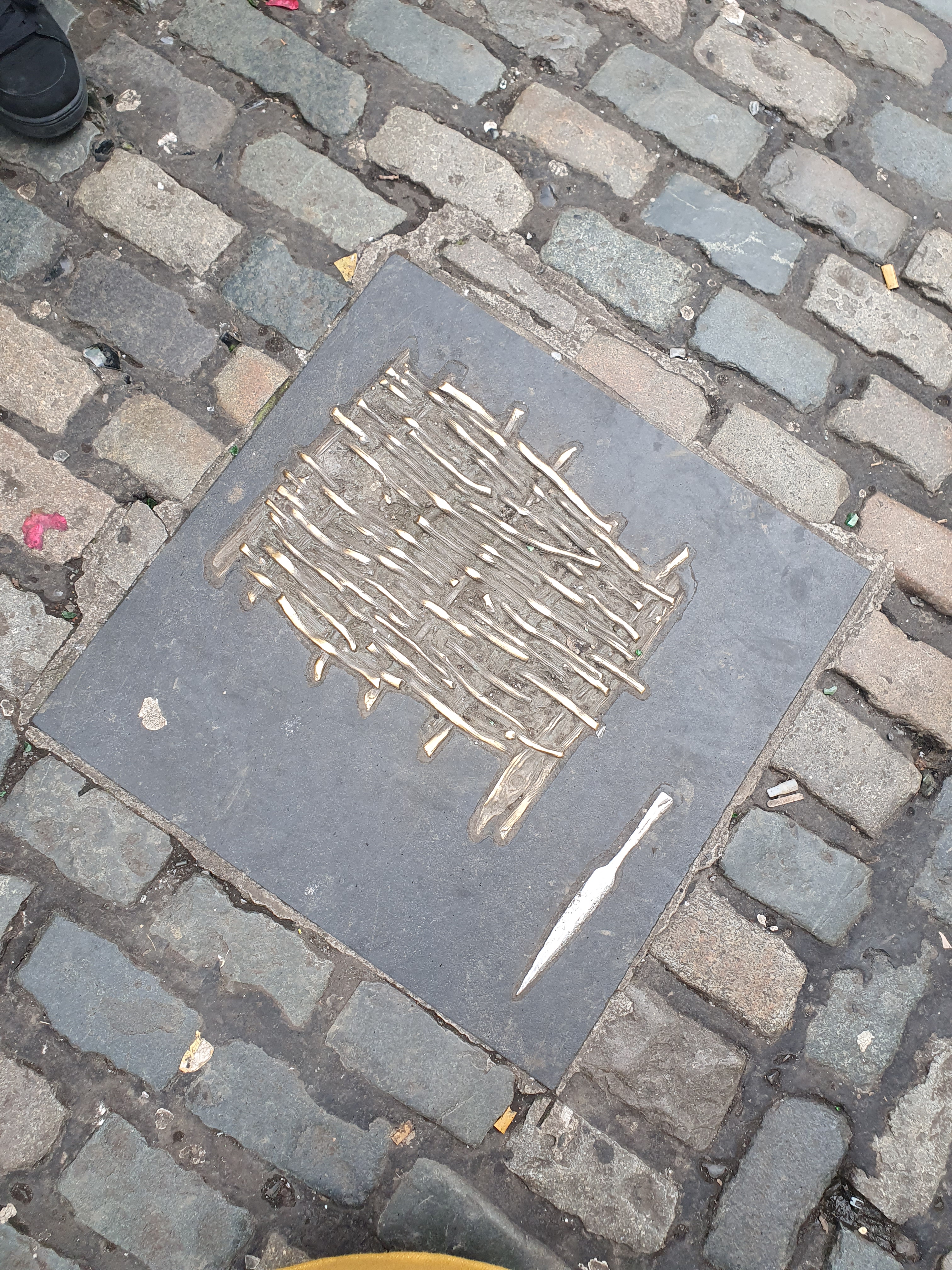
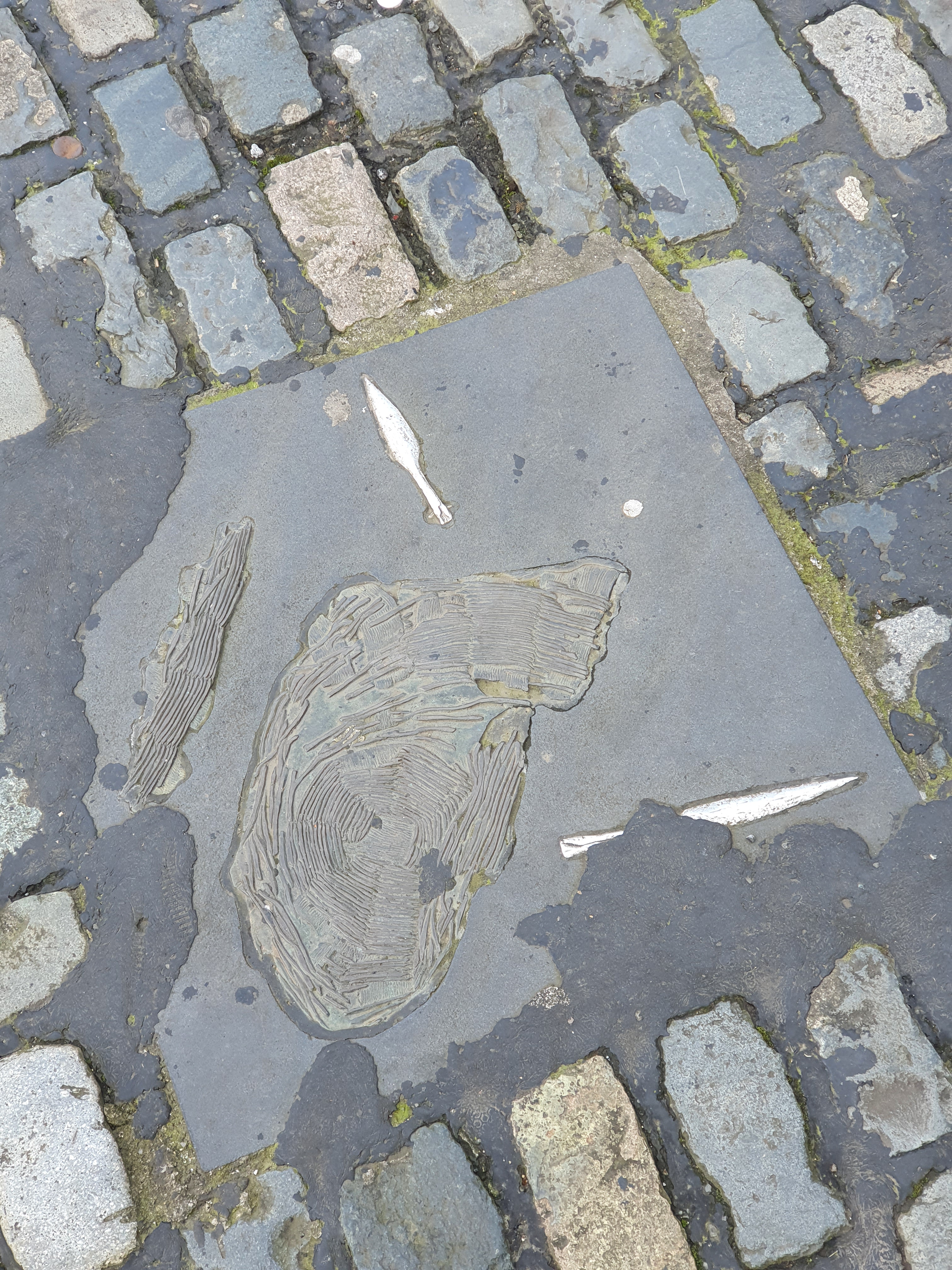
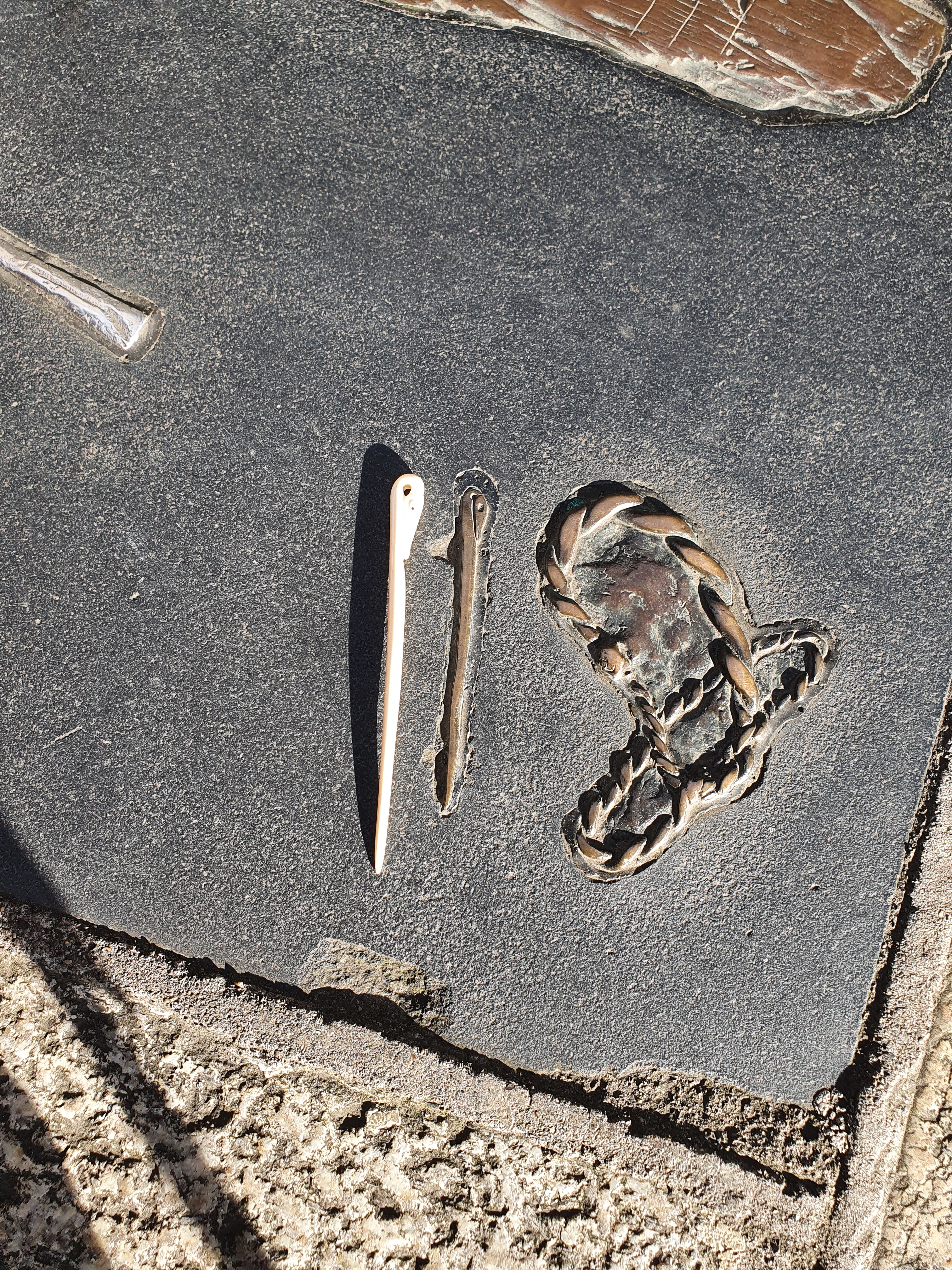
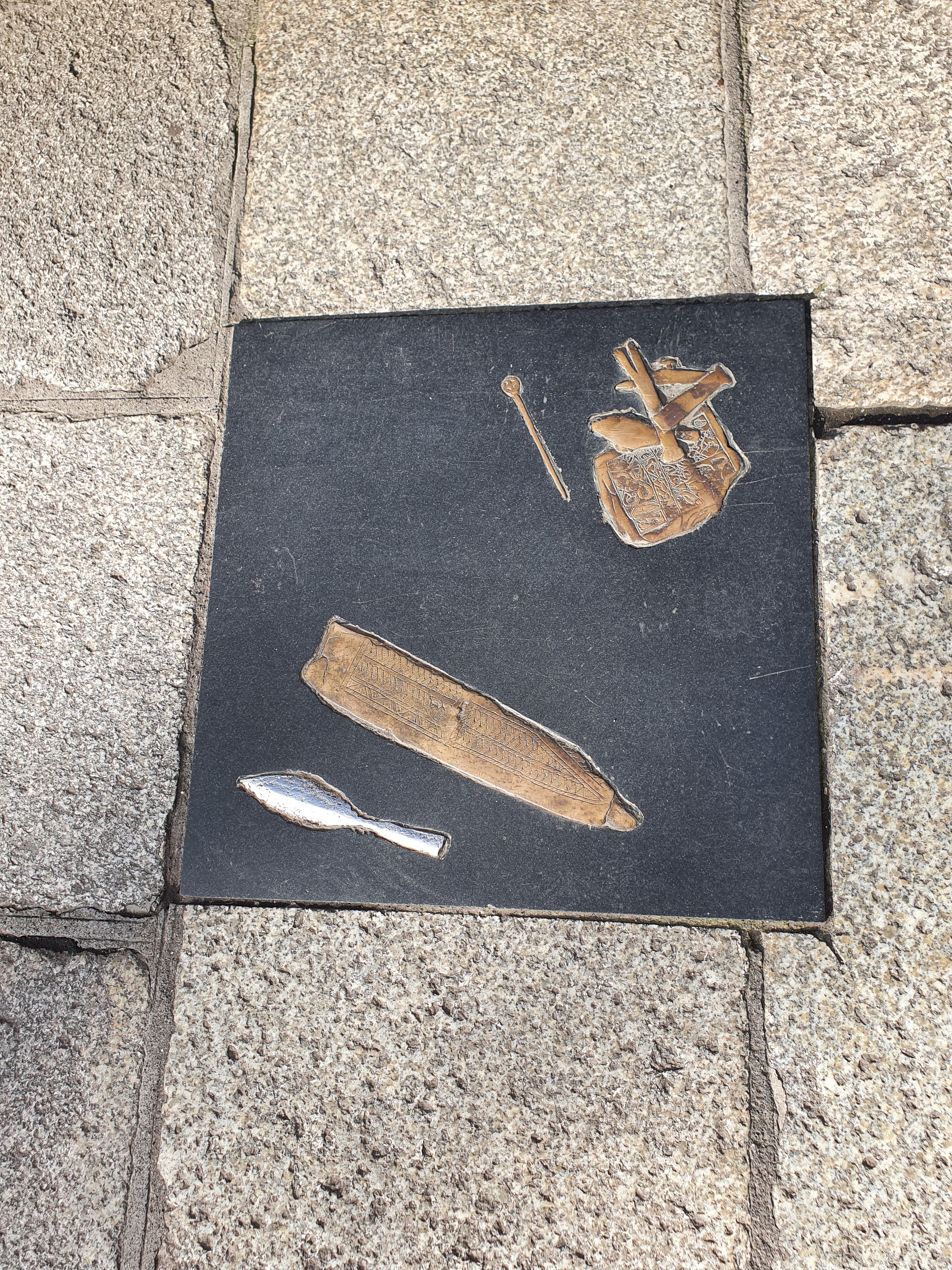
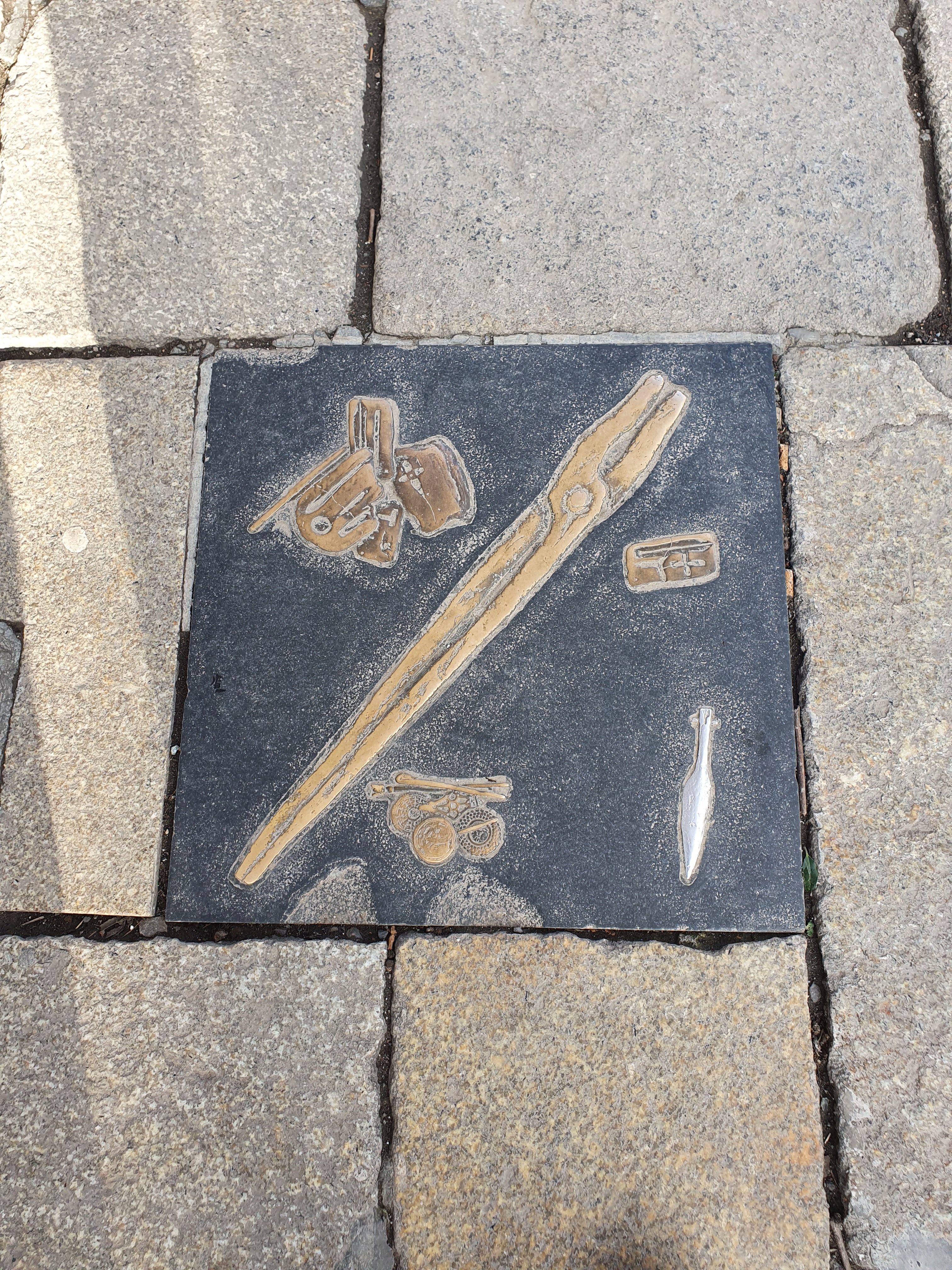
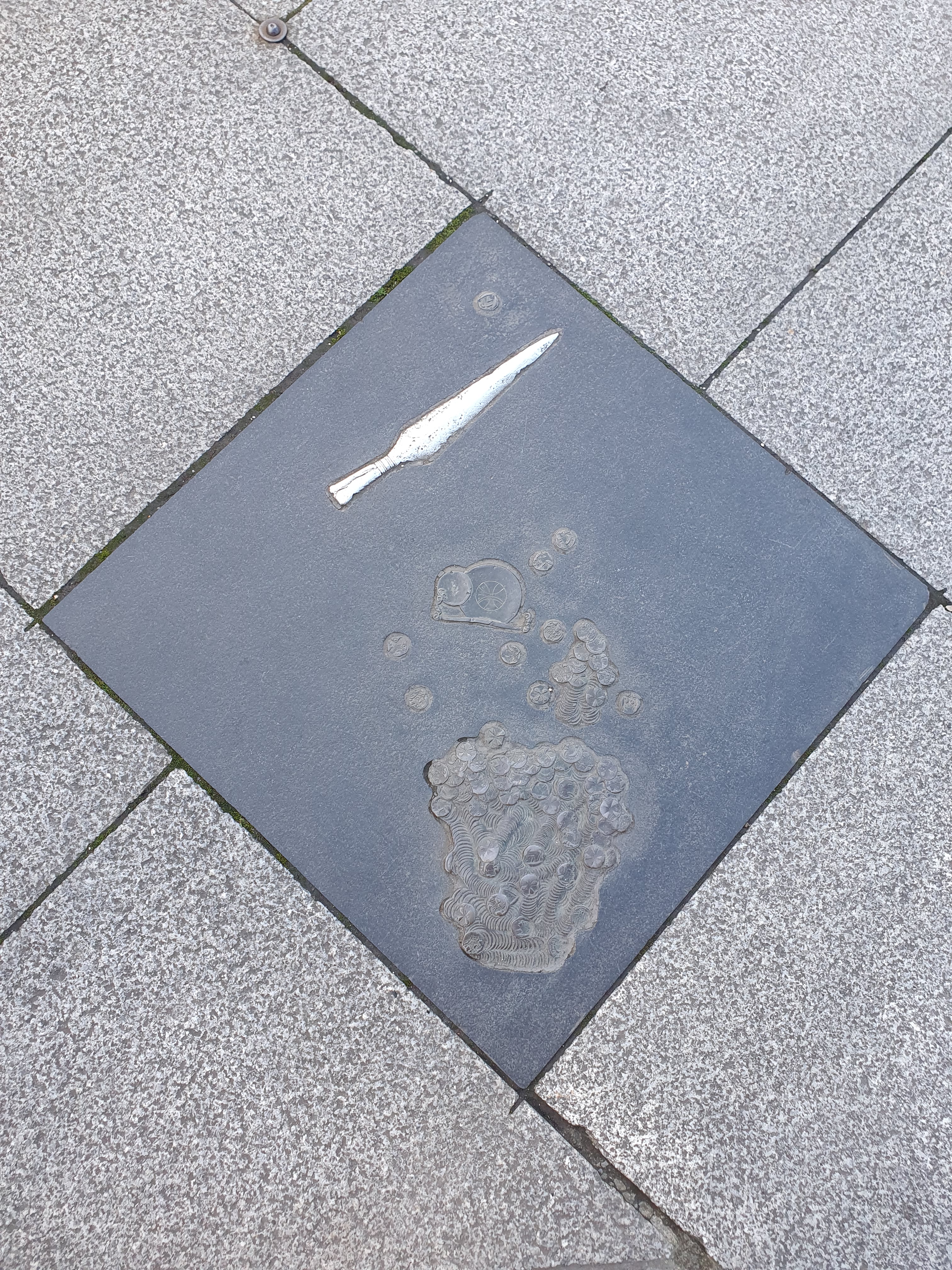
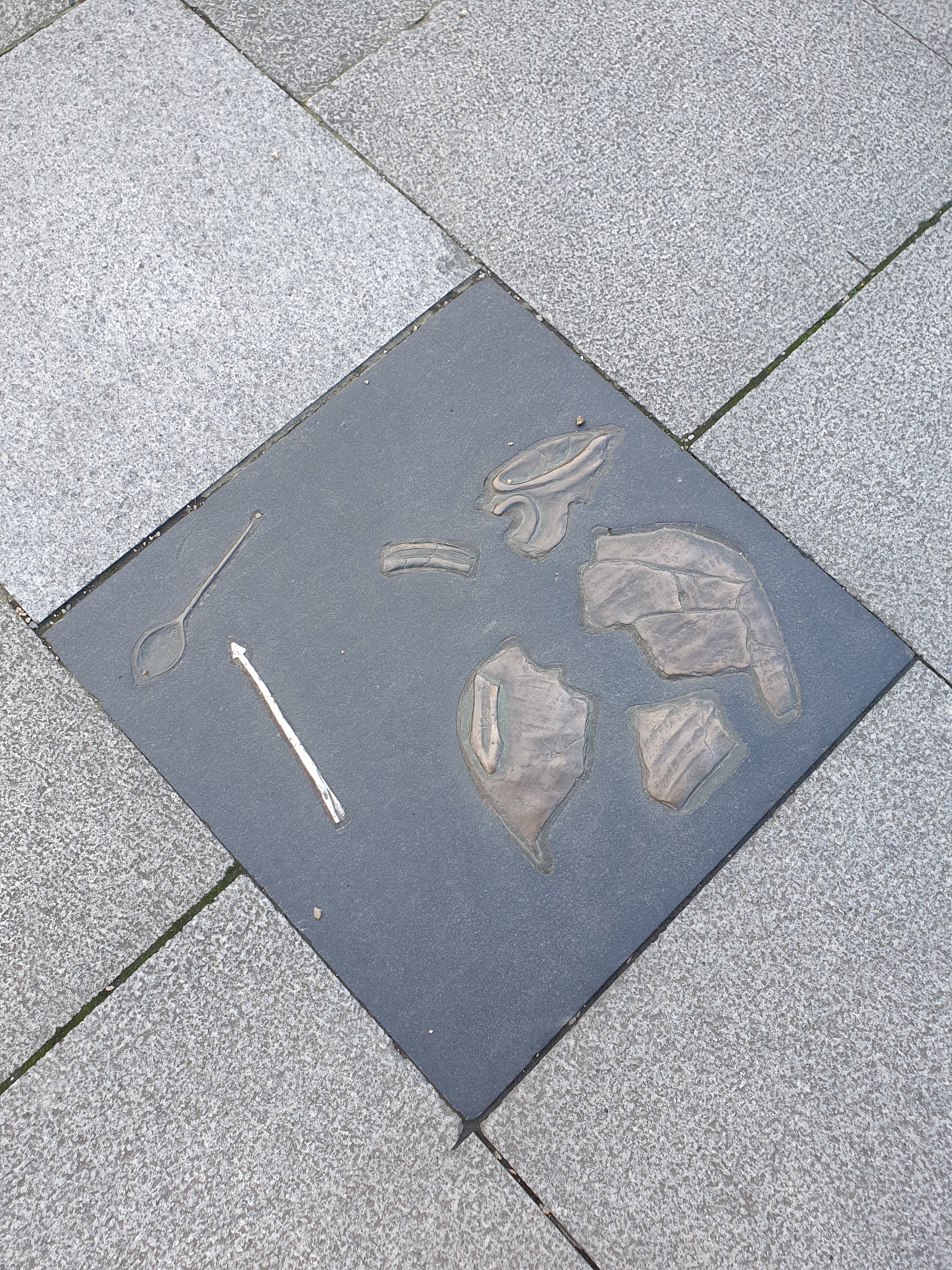
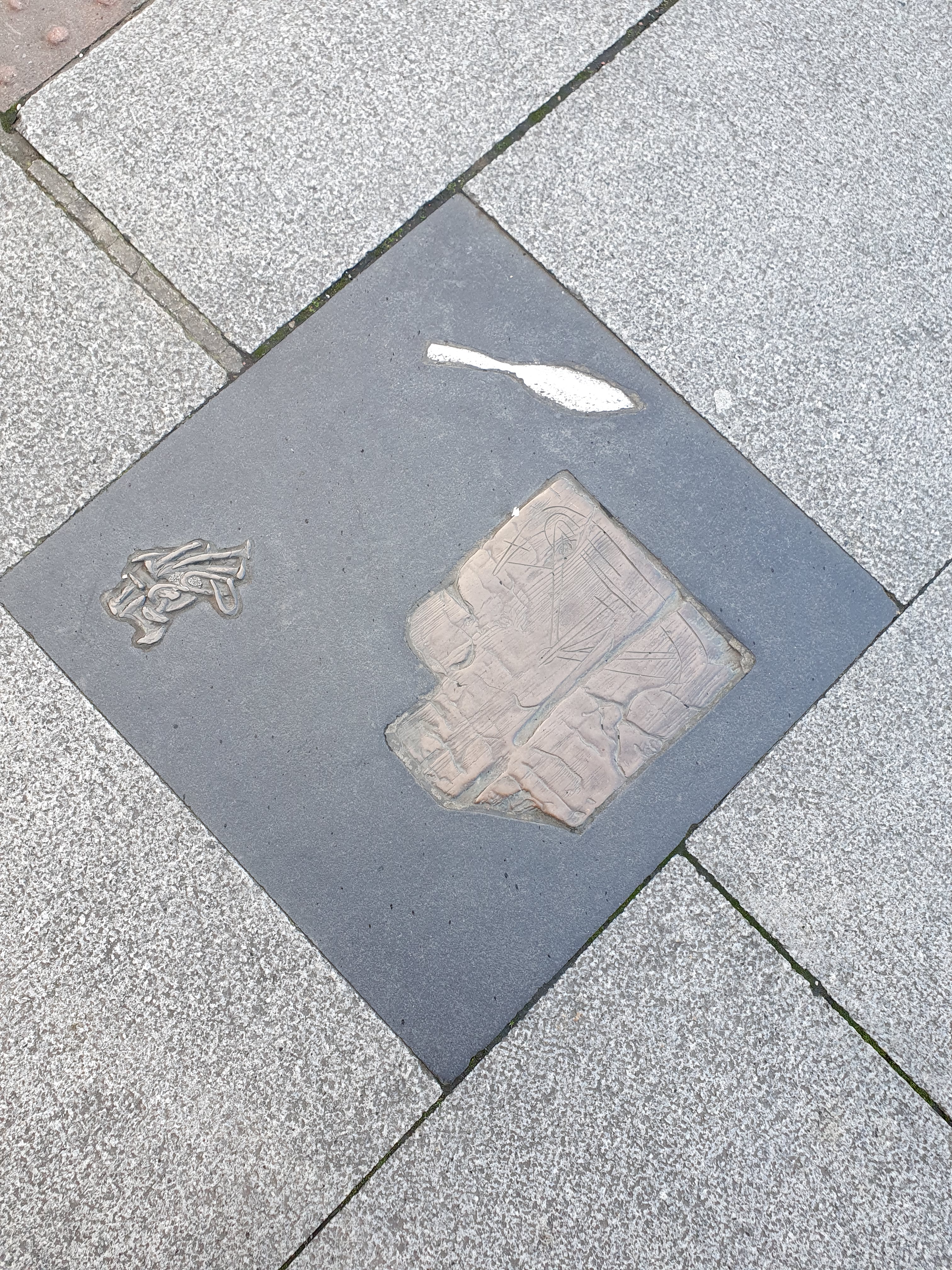
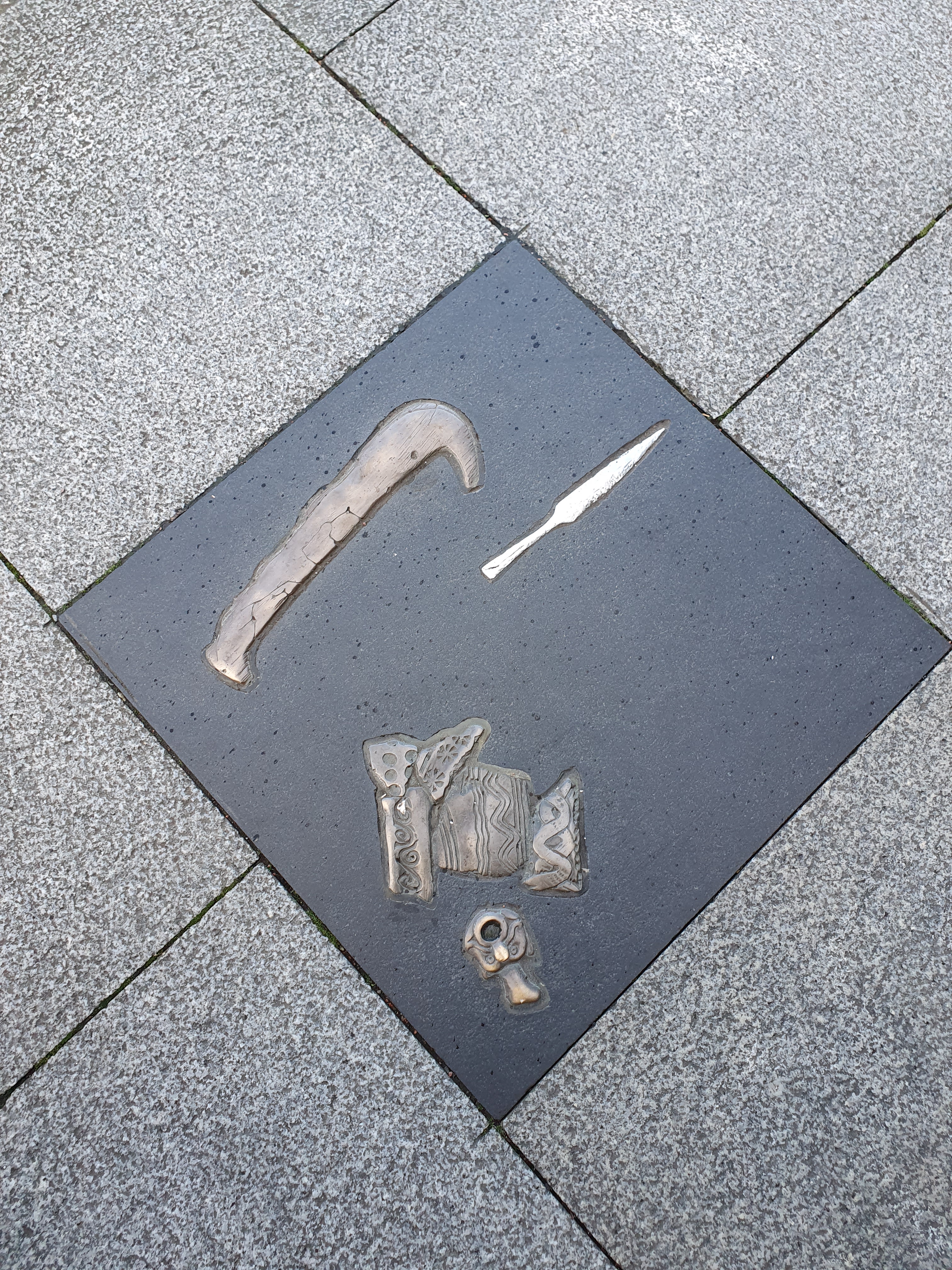
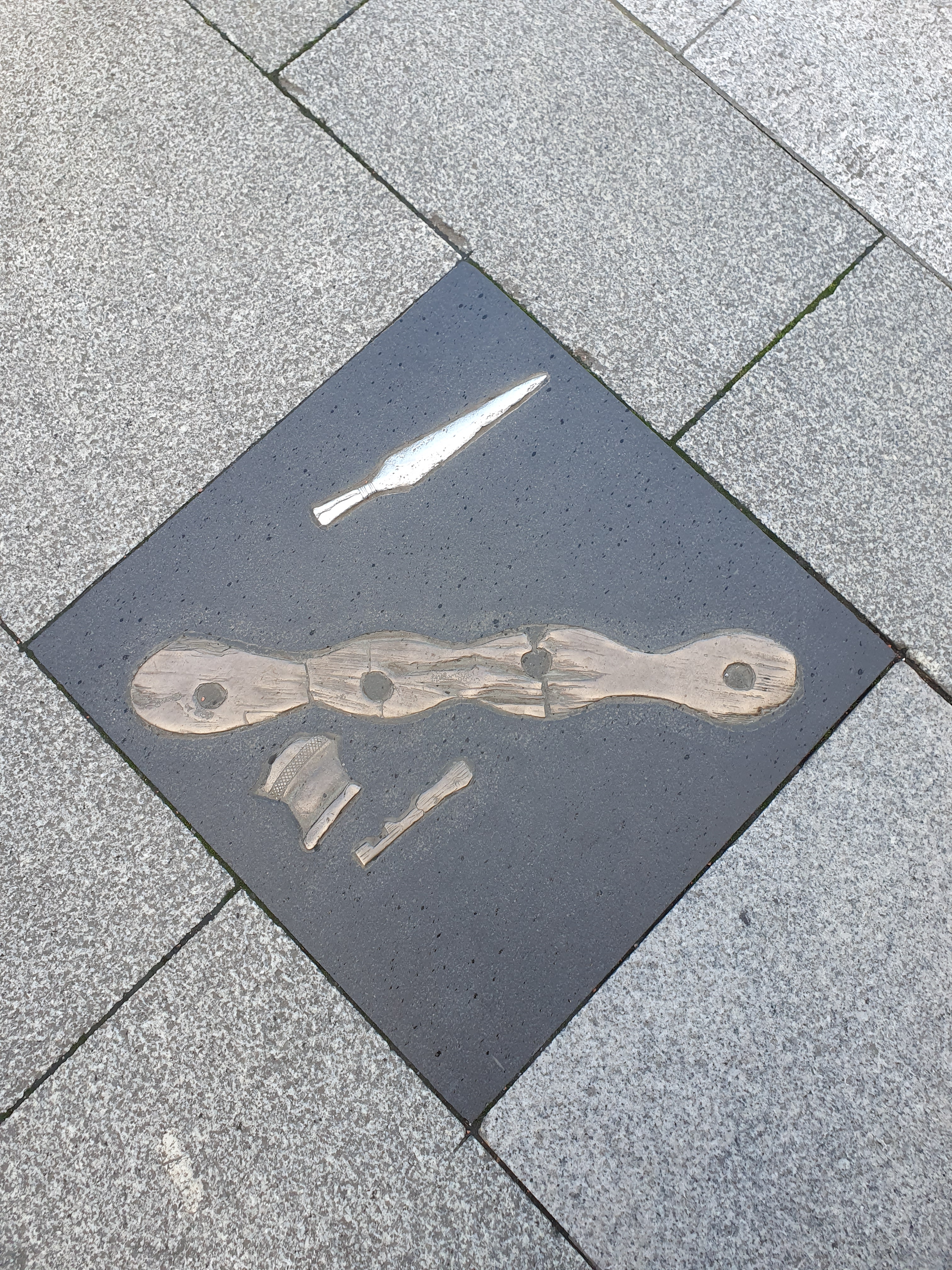
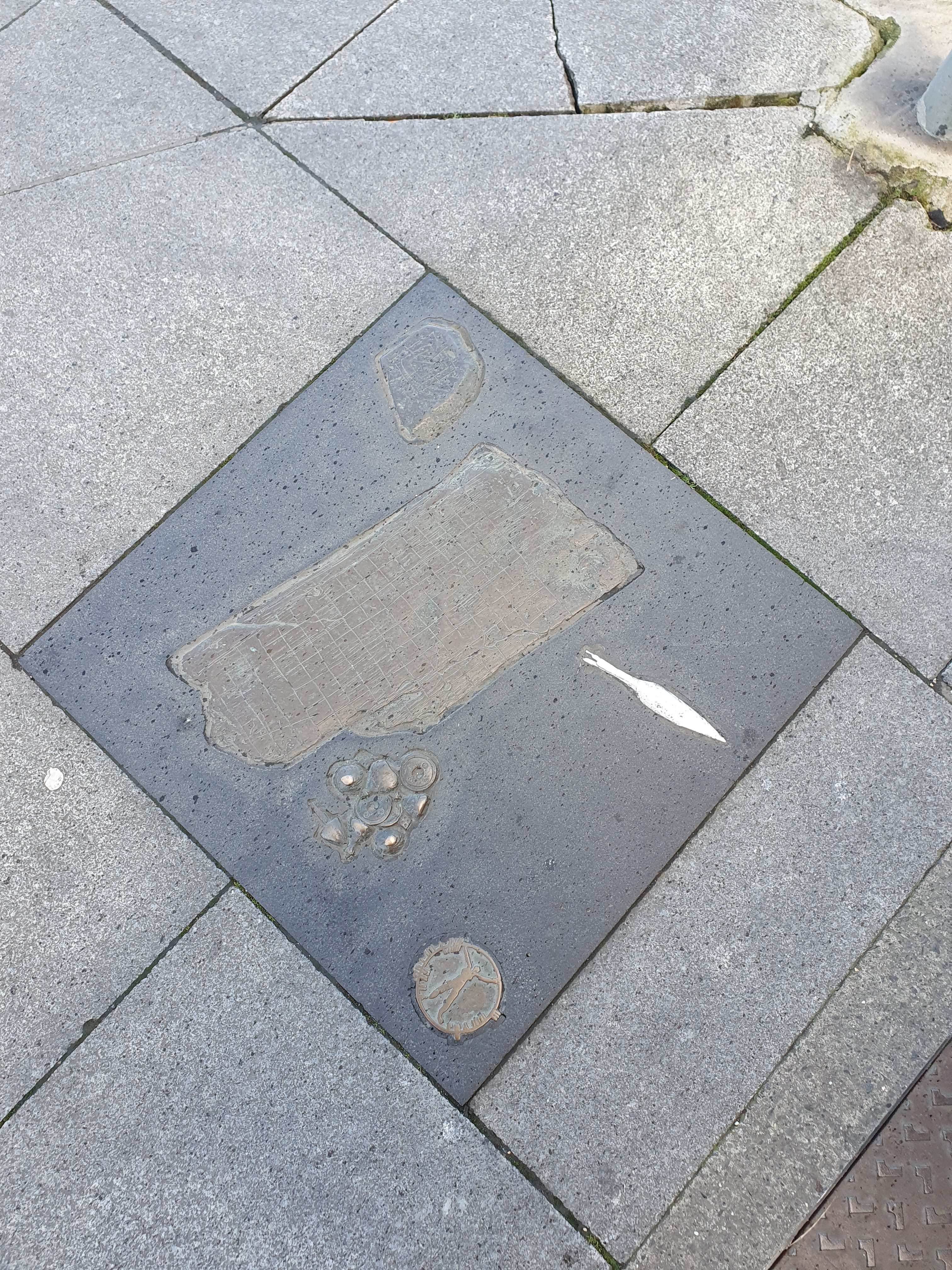
There are a series of bronze plaques in the pavements round Wood Quay, made by sculptor Rachel Joynt. An attempt to remind those walking the street of the history beneath their feet, they feature a great selection of the finds from the area- including a familiar bird pin!

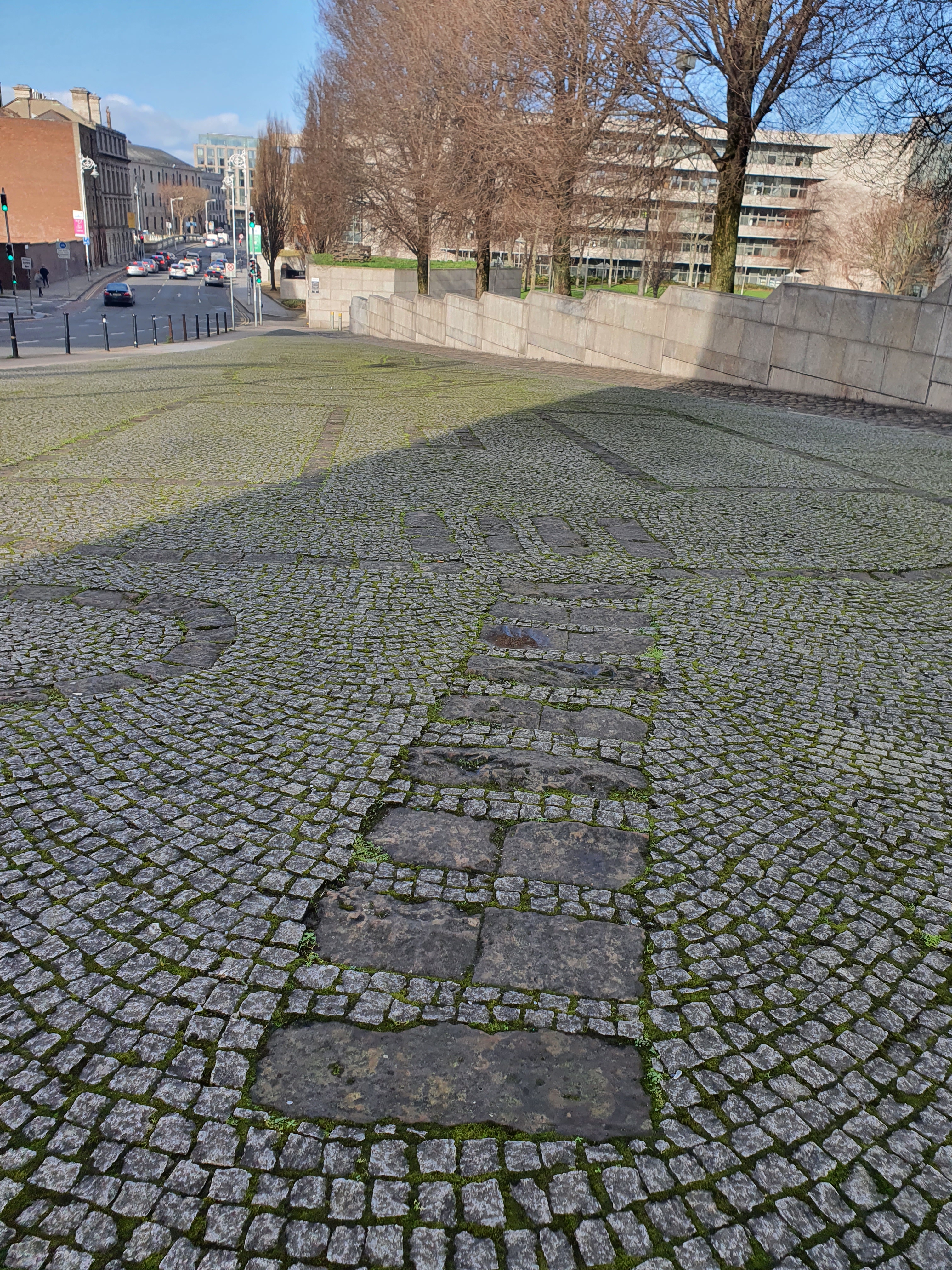
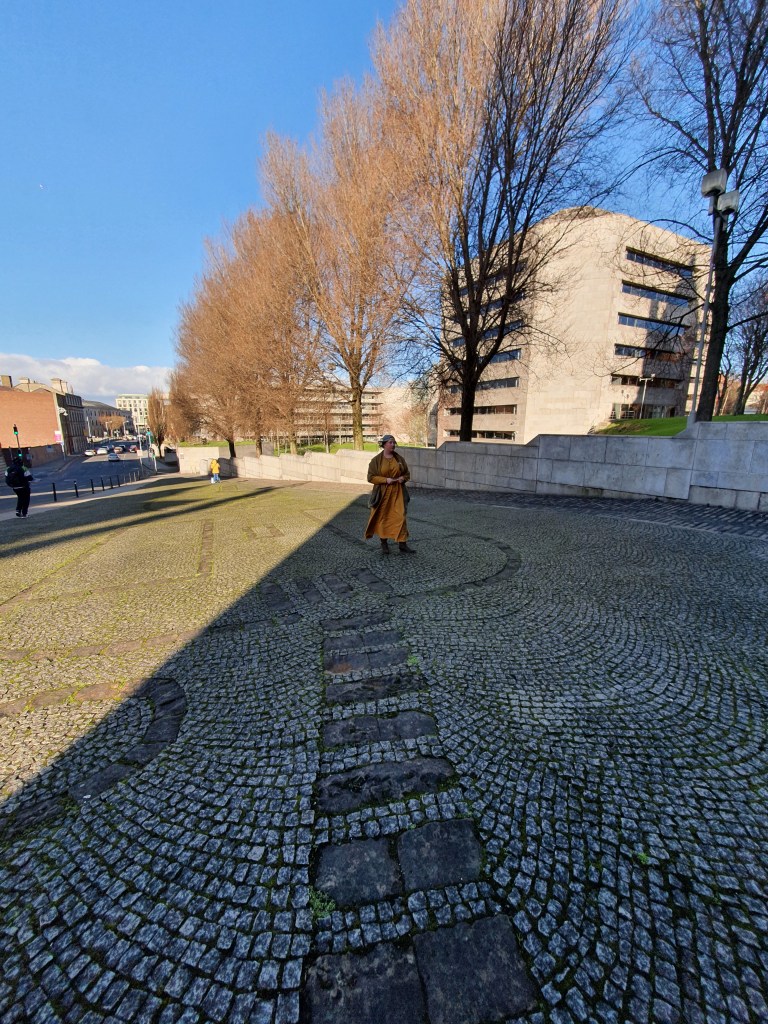
Another cool thing in Wood Quay is the outline of a few Viking homes on Winetavern Street. I took my photos stood in the porch of one such house, in the shadow of the cathedral and flanked by the imposing Dublin City Council offices. It was really cold that day, but it was powerful to stand in a little open space and to envision what came before and the quiet street that sits here now.

This was a spur of the moment thing and not as polished as I would normally like. I’m planning on finishing this set of clothing and have another one in the works- but I still had so much fun.

References

National Museum of Ireland (1973) Viking And Medieval Dublin. Catalogue of Exhibition . Dublin: An Roinn Oideachais. p51.

Wallace, P. F. (2016) Viking Dublin The Wood Quay Excavations. Sallins: Irish Academic Press. p1-558.

Wincott Heckett, E. (2003) Viking Age Headcoverings from Dublin. Dublin: Royal Irish Academy.

Stamford Bridge: A First Glimpse At Some Metal-Detectorists’ Finds

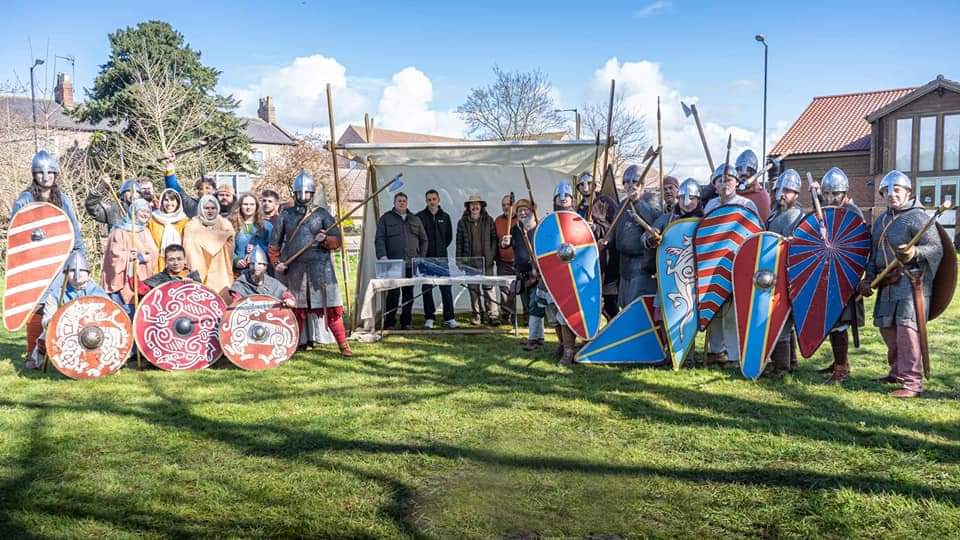
My group Vanaheim (left), members of the Stamford Bridge Heritage Society and metal detectorists Simon Richardson and John Benfield (centre) and Acle Early Medieval Re-Enactment Society (right.) Photo credit: Liam Norman.

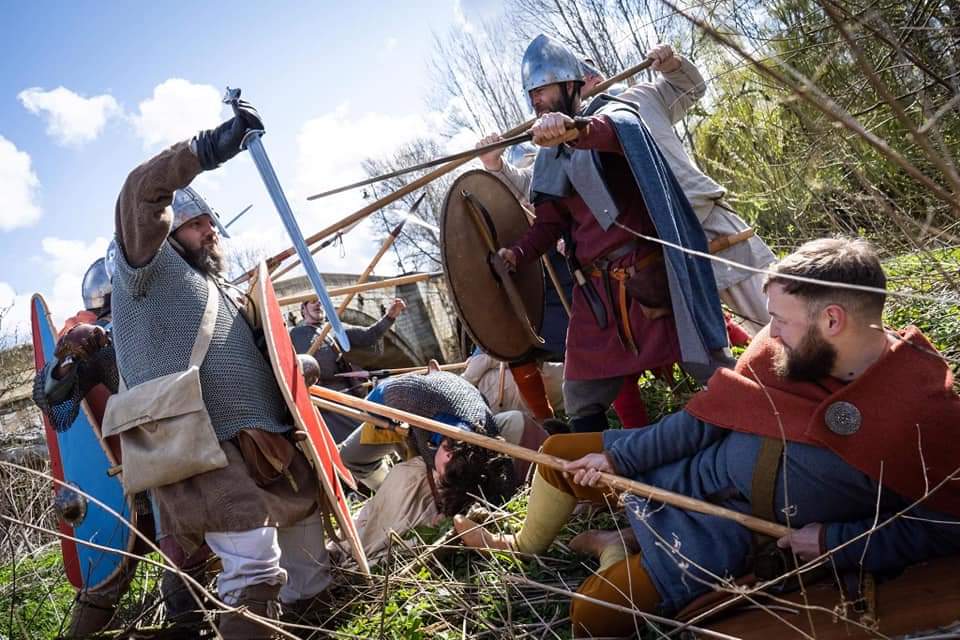
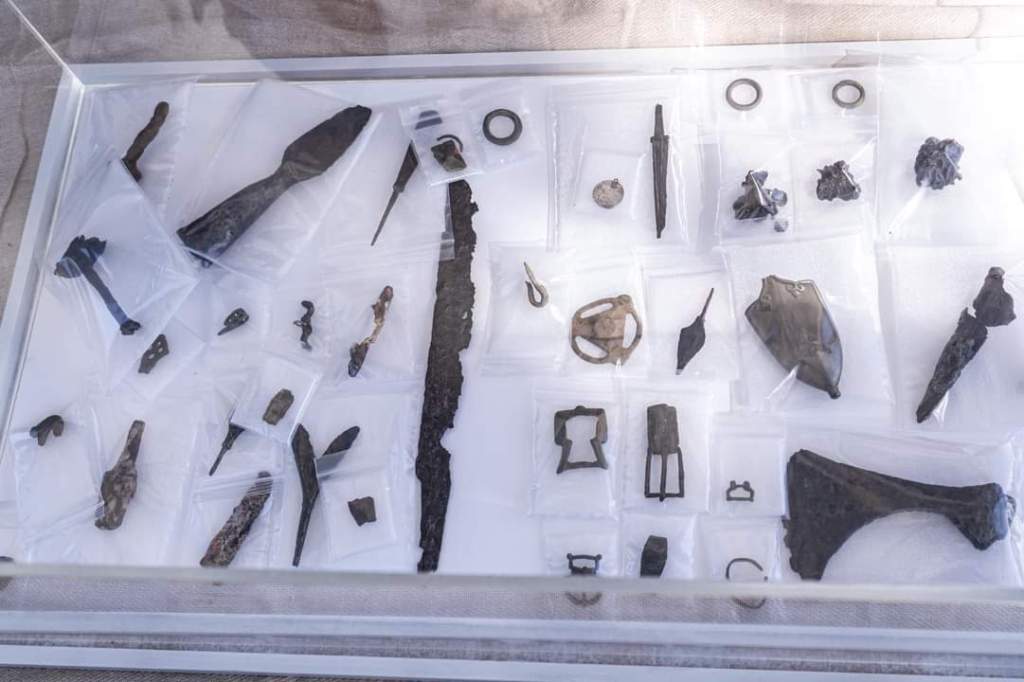
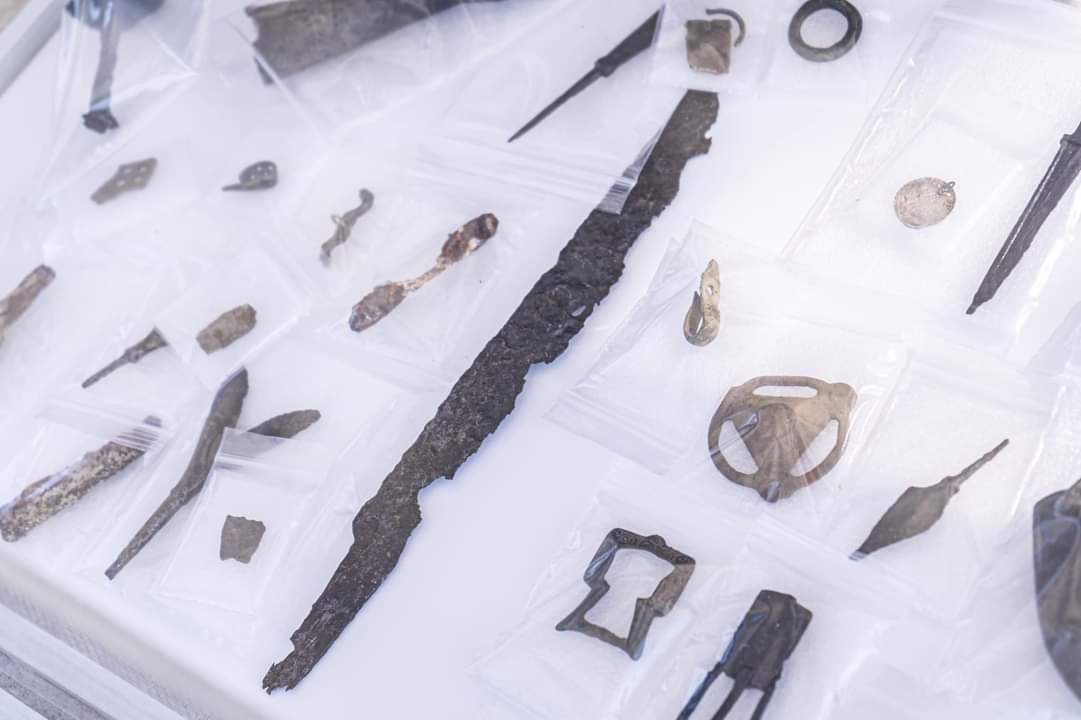
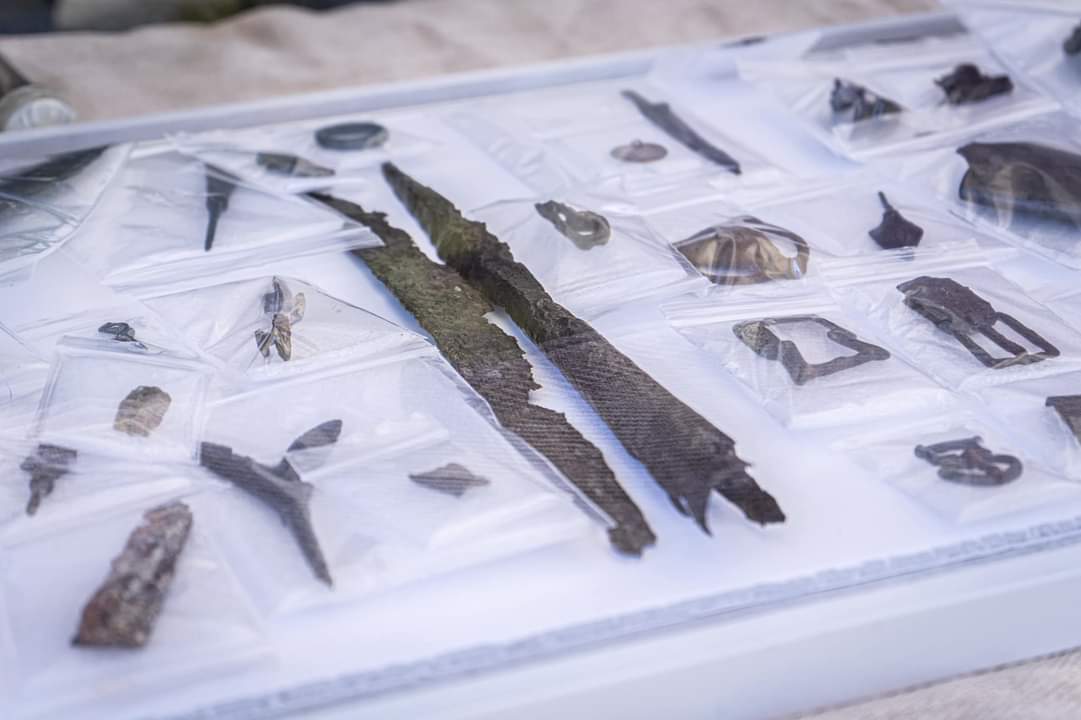
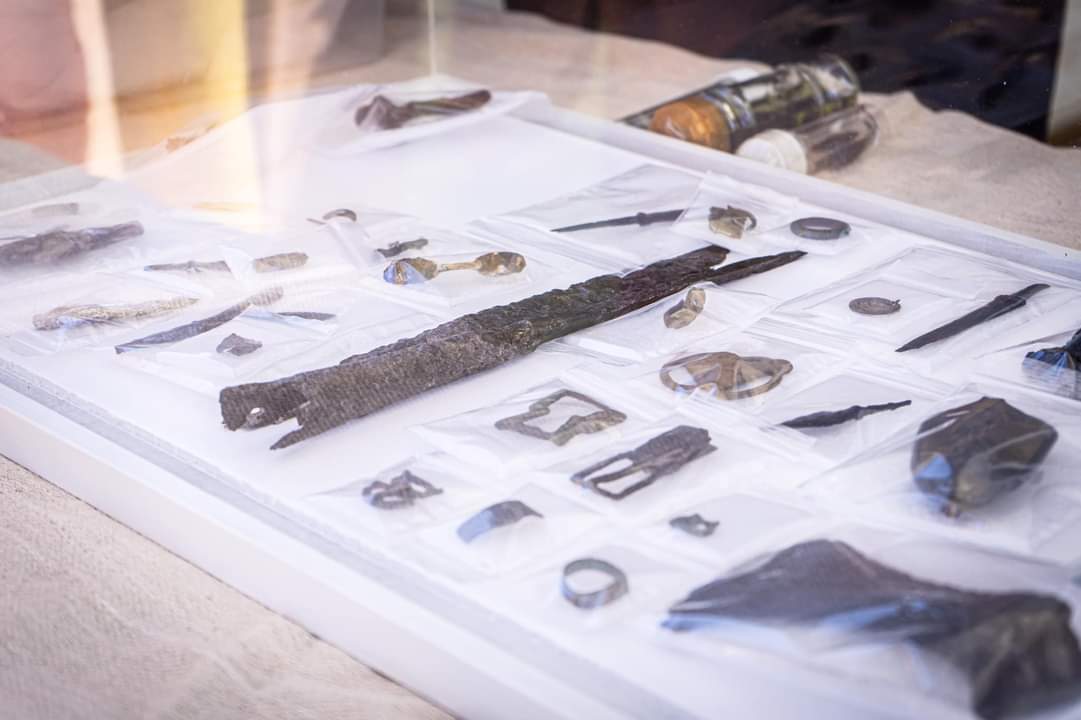
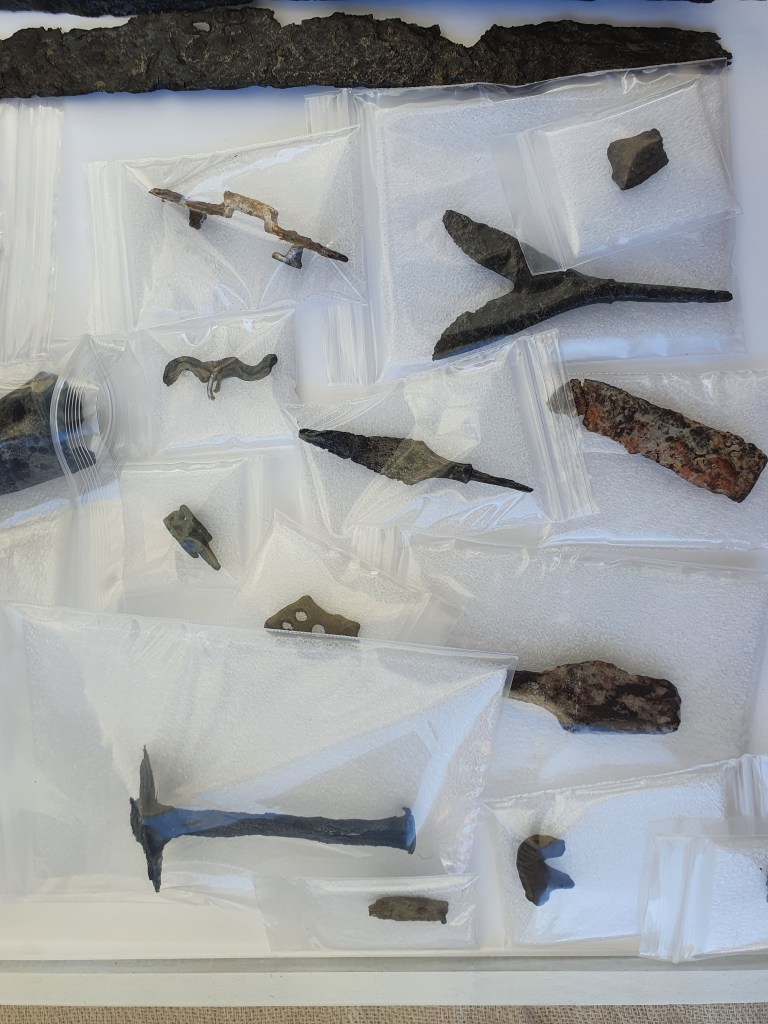
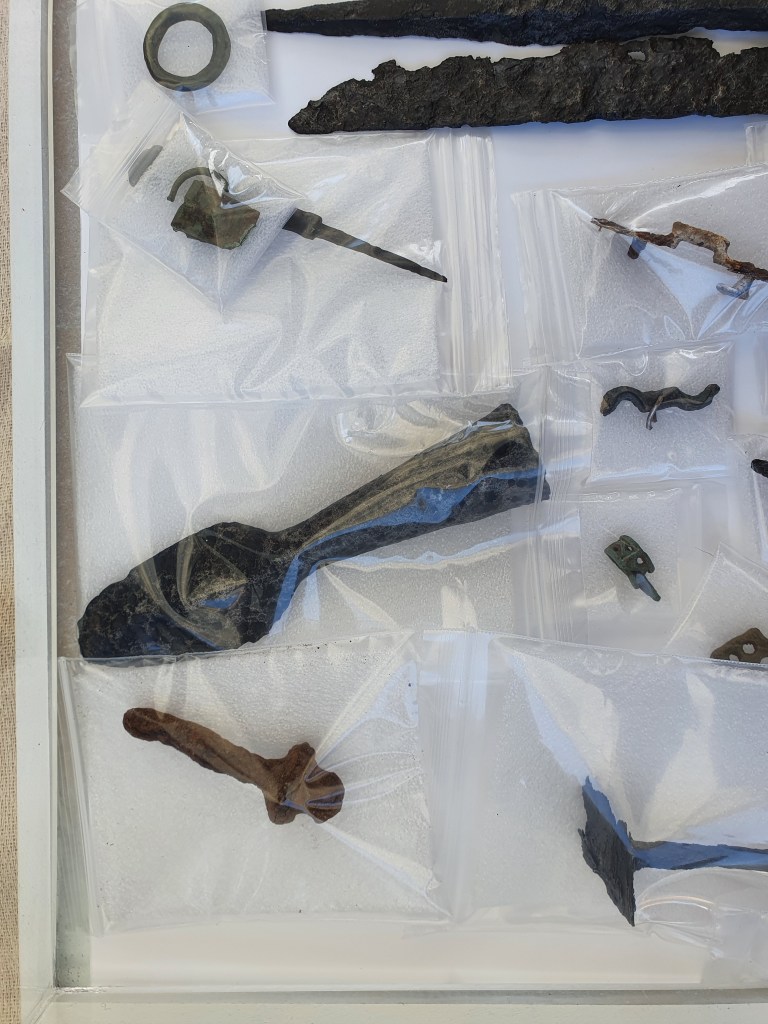
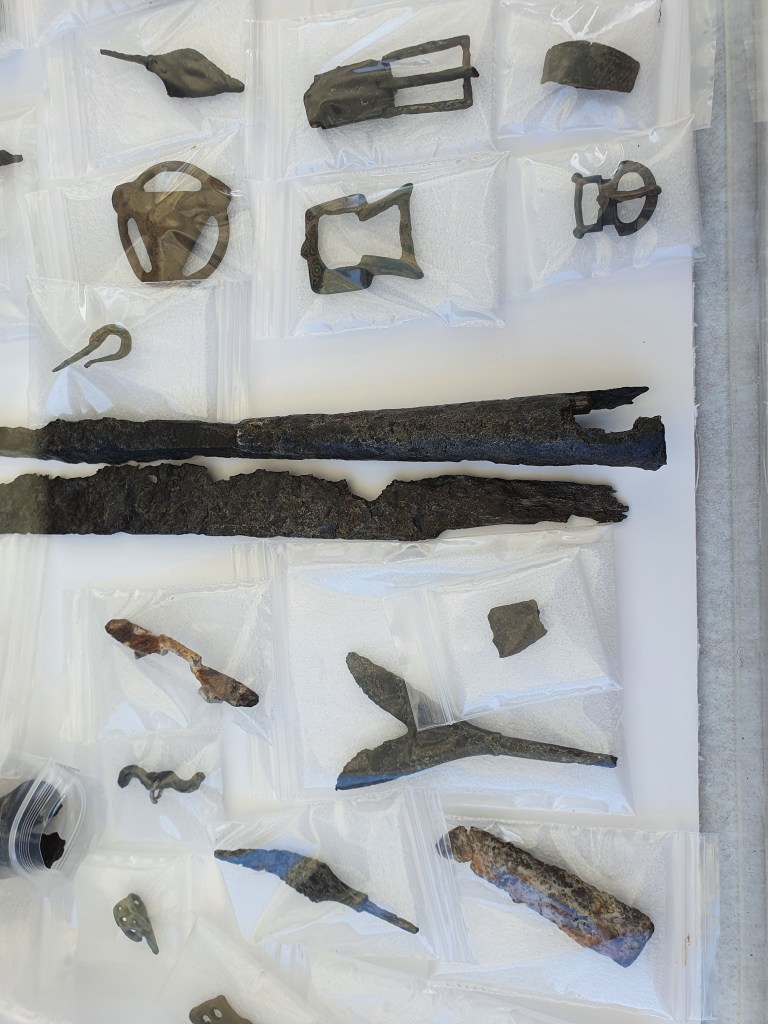
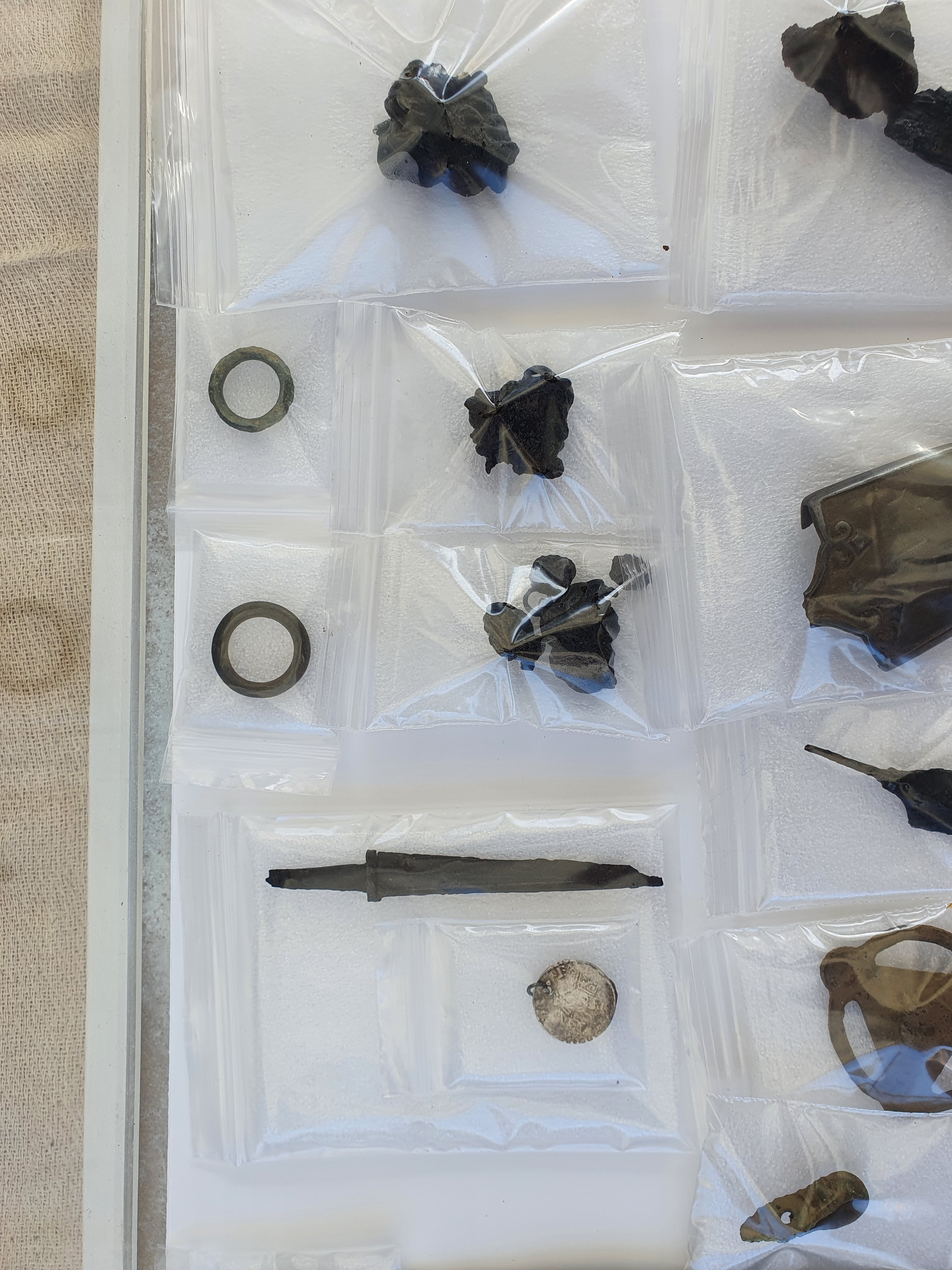
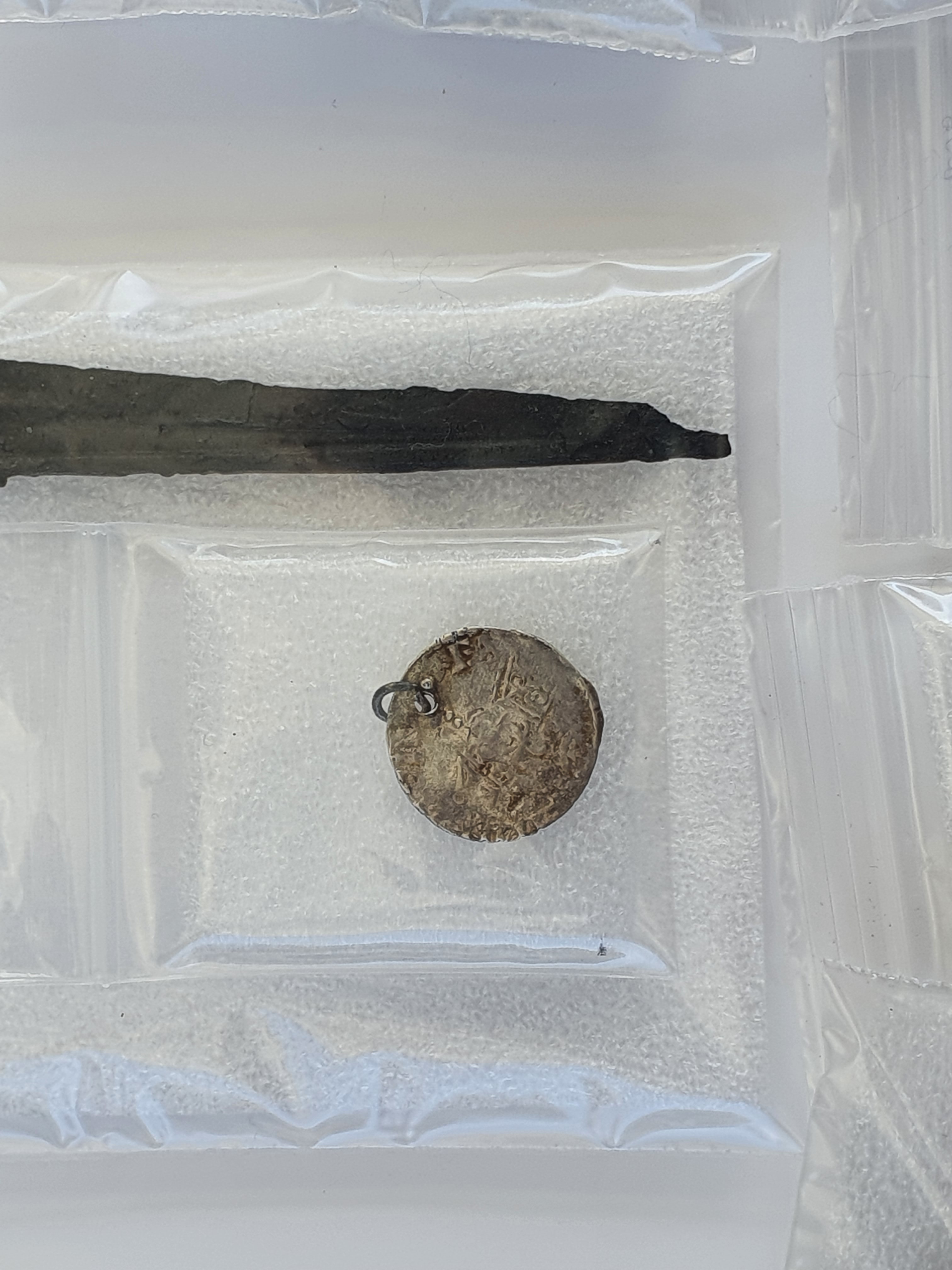
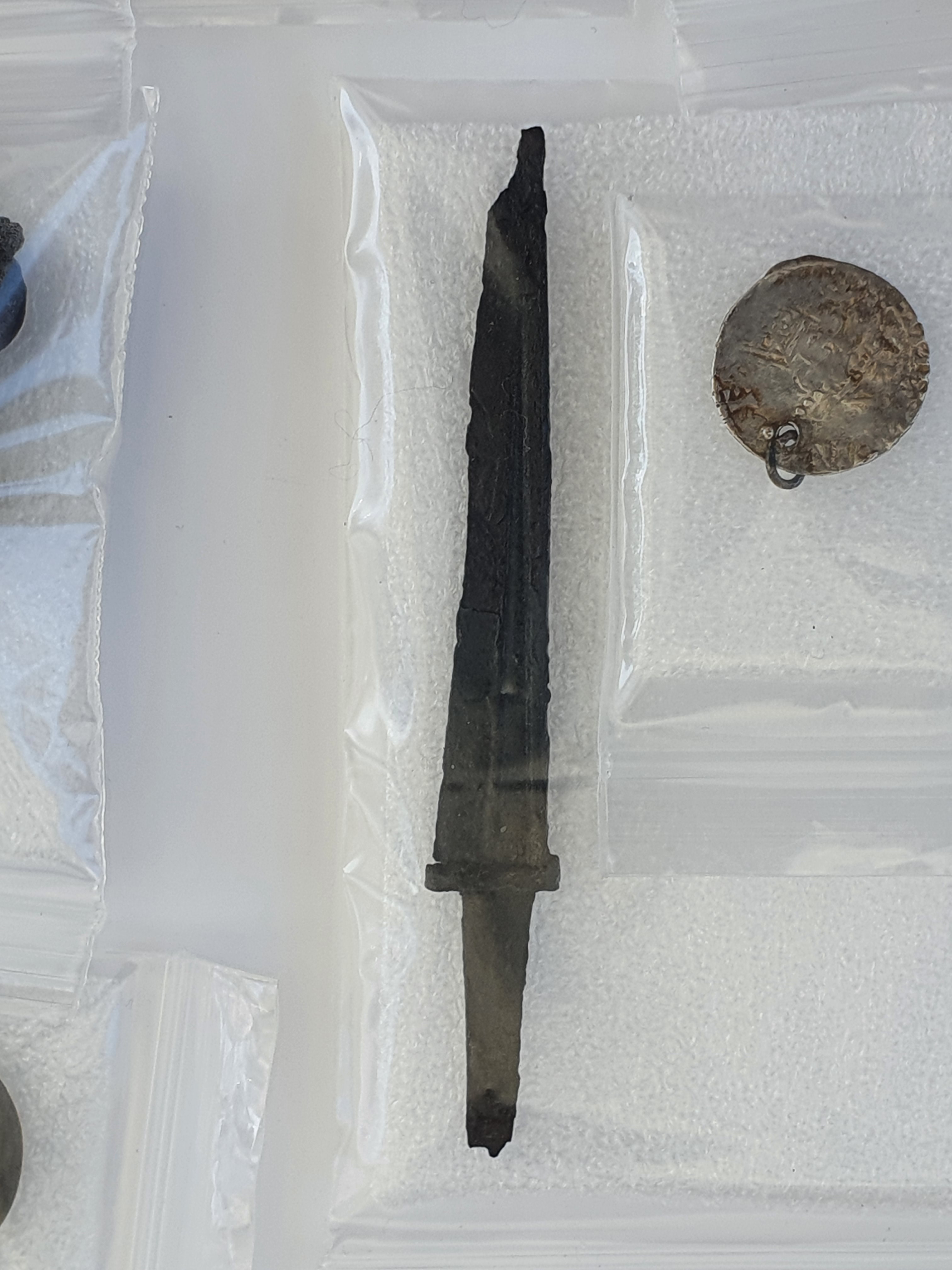
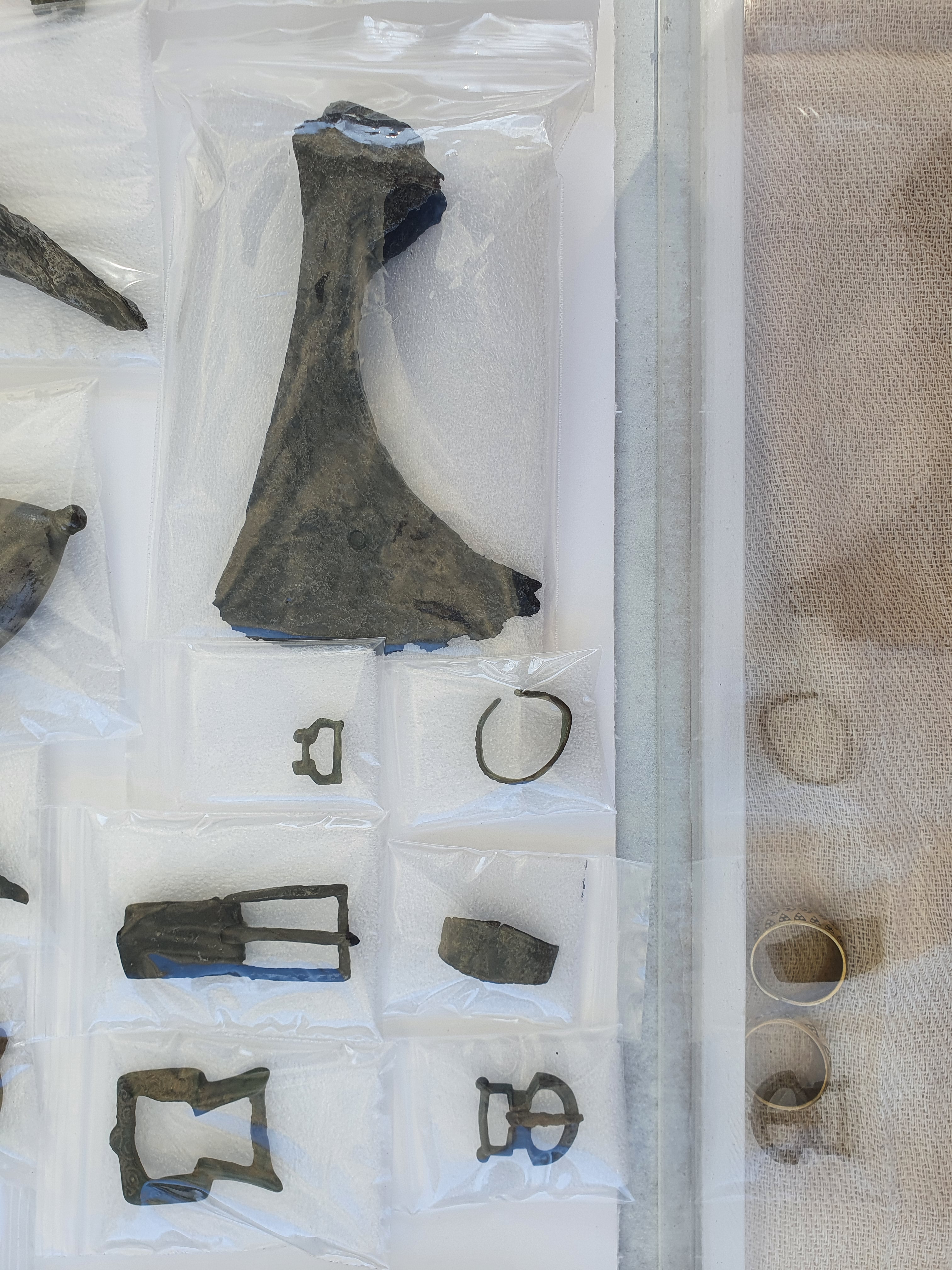
Yesterday, I had the absolute privilege to be among the first people to view artefacts thought to be evidence for the 1066 Battle of Stamford Bridge. If these artefacts are found to date to the mid 11th century, they would be the first archaeological evidence for the battle and could be of national importance.

My group and I were invited to share in this historic occasion by our friends and colleagues in the Stamford Bridge Heritage Society, with whom we run re-enactment events of the battle every September. Metal detectorists Simon Richardson and John Benfield brought along a portion of their finds, which are all sourced from a currently undisclosed site in the Stamford Bridge area.

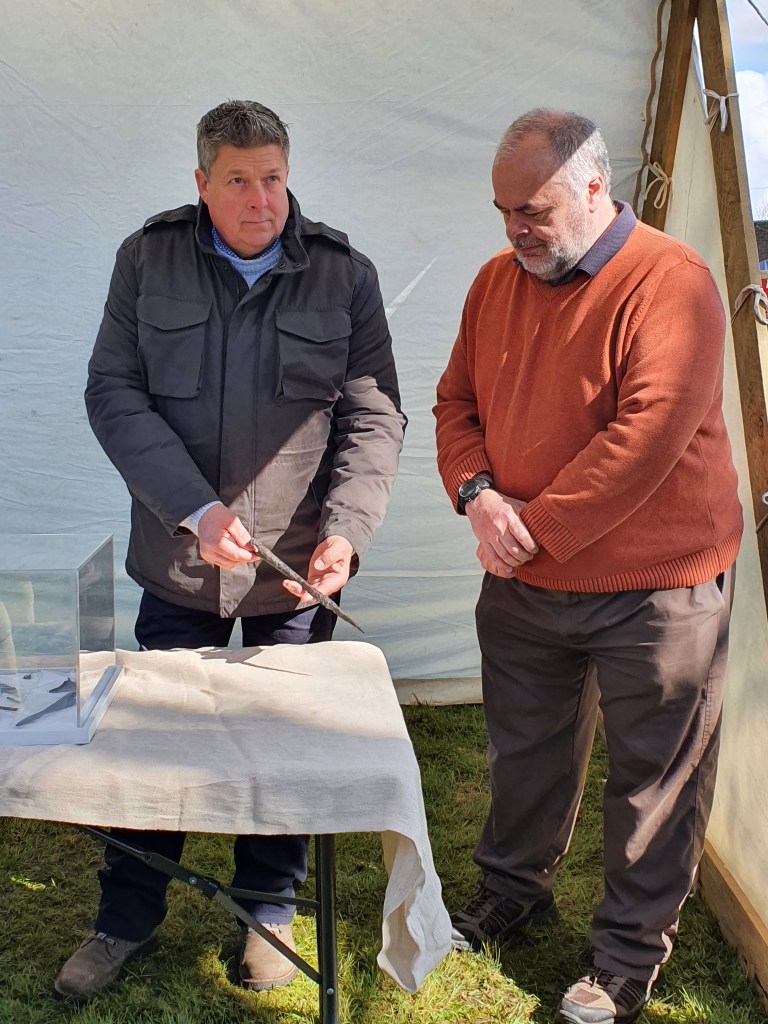
Simon Richardson (left) and Stamford Bridge Heritage Society’s archaeologist Peter Makey (right) examining one of the spear heads found.

Brian Birkett, chairman of the Stamford Bridge Heritage Society said of the discovery: “On the face of it, these finds could be a game changer in our search for the battle. We have worked for many years on researching the battle site and for these artefacts now to be discovered is remarkable. It is the aim of both the Society, and John and Simon, that one day we will be able to display these artefacts in a purpose built museum and visitors centre here in Stamford Bridge.”

According to Brian, some of the finds are pretty unusual in terms of appearance- several items resemble examples from Eastern Europe more than they do ones from the British Isles and Scandinavia. If indeed they are genuine, they would be the first of their type to be found in the UK and would really reshape our view of the period.

It is also possible that some of the artefacts could date to different time periods, both before and after the Viking Age. This would be unsurprising when you take into account the very nature of metal detecting and that the items are divorced from their original context. That being said, they could still provide valuable historical insight for the area.

The finds are currently being researched and analysed by the Heritage Society alongside national institutions, while plans for further investigation into the area are being developed. All of this is of course very exciting to me and to all fans of the period!

Photo credit: Liam Norman.

While I am a very enthusiastic living historian, I am not an archaeologist- so I will refrain from speculating too much on the purpose or origin of any of the finds. All photos are my own, unless otherwise stated.

Photo credit: Liam Norman.
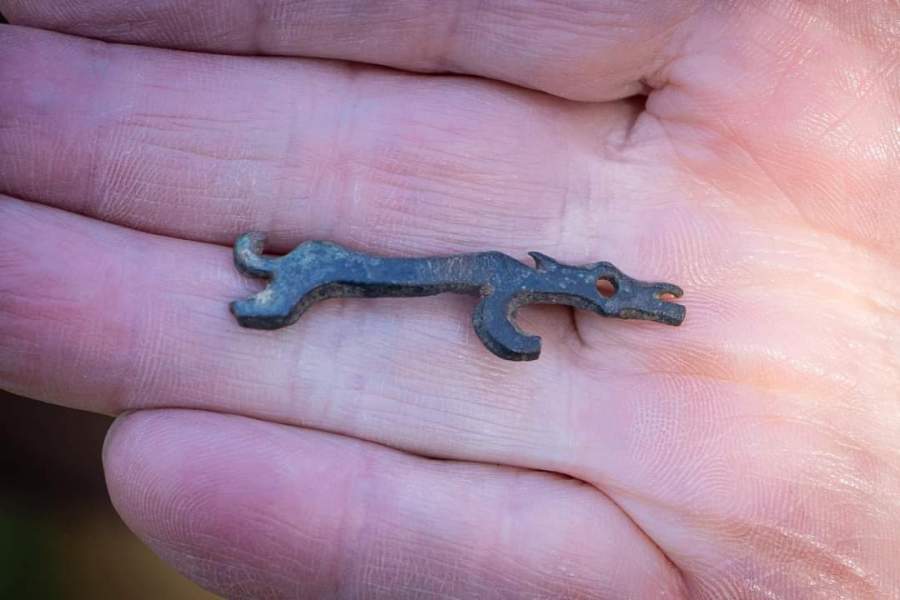
This is the thing I’m most excited for. This wood was found extant in the socket of one of the spearheads- they’re fundraising to afford carbon testing for it.

This is only a portion of what has been found so far. I was told originally that they’d found an axe head “or two” and some arrowheads- cue my absolute astonishment when I saw what they’d brought!

As with all metal detector finds, there is a process to be undergone to scientifically confirm authenticity and to provide dating- they are at the beginning of this process. However, it would be amazing if any of these artefacts are found to have an authenticated link to the battle itself. I for one am cautiously excited! Dig on, lads!

To keep up with any updates in Stamford Bridge, you can follow the Heritage Society on Facebook:

https://www.facebook.com/BOSB1066HeritageSociety/
If you’d like to have a look at my group Vanaheim, you can find us on Facebook and Instagram at Vanaheim Vikings York.

A Wool Scarf from 10th Century Dublin, DHC6

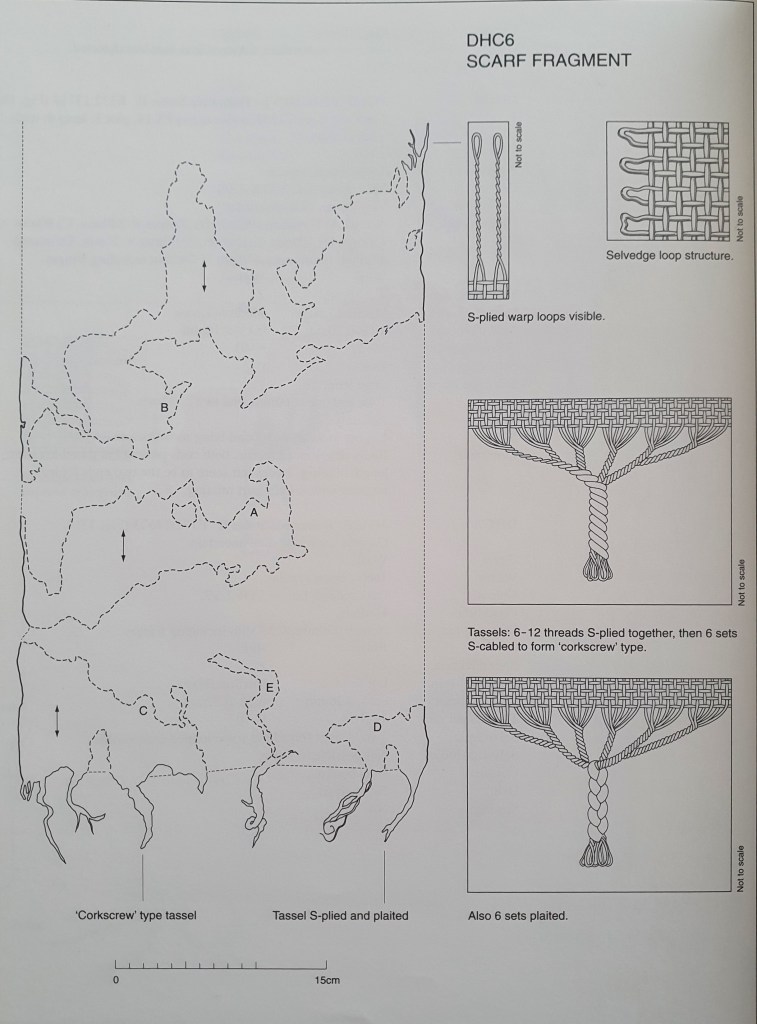
This wool scarf is based on fragment DHC6, found at Fishamble Street II and dated to a mid-10thC context, find number E172:13714 (Wincott-Heckett, 2003.)

Source: Wincott Heckett, E. (2003) p.16

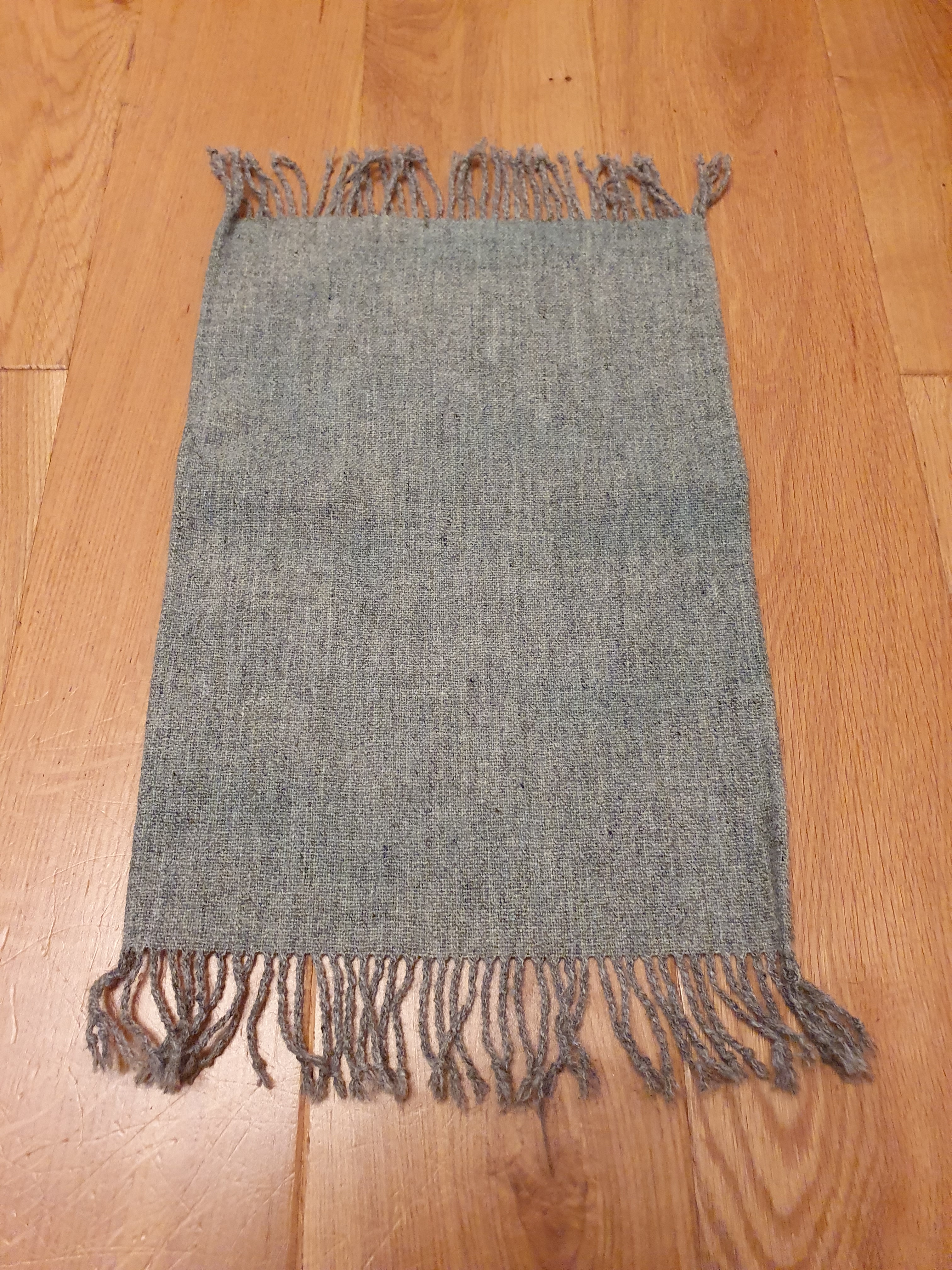
The fragment was estimated to have been 450mm by 240mm originally, including fringes at each end. I made mine to the same dimensions. Like most of the Dublin headcoverings, DHC6 was woven to size, which mine was not (meaning I had to do a small rolled hem each side.)

DHC6 was not analysed for dye, but it was described as being “very dusky red” in colour upon conservation. Many of the fragments were described thus, even those in which no evidence for dye could be found. The scarf I made was a natural light grey colour, which I overdyed with a weak fresh woad dye I happened to have on the go. Indigotin was possibly detected on another Dublin scarf, the silk fragment DHC12.

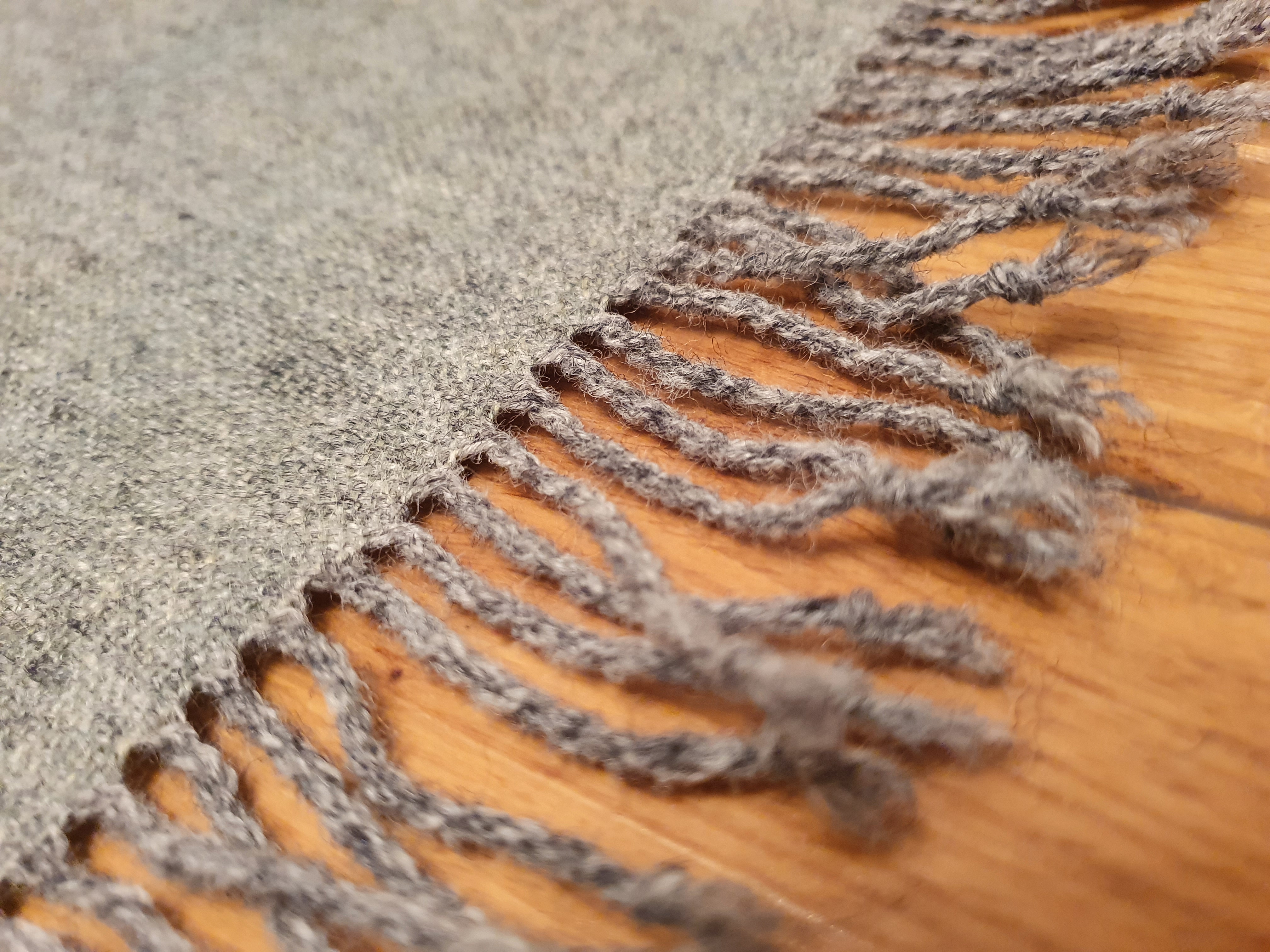
This scarf is the first I’ve made of this type and tasselled by hand. It felt like the fringe took a thousand years, it was not my favourite task. This is despite the fact that the tassels on many of the Dublin scarves are longer and more complex than the ones I did here. I can only assume that the folks making these scarves historically were skilled and very used to tasselling things, meaning they didn’t feel like they were losing their religion like I did.

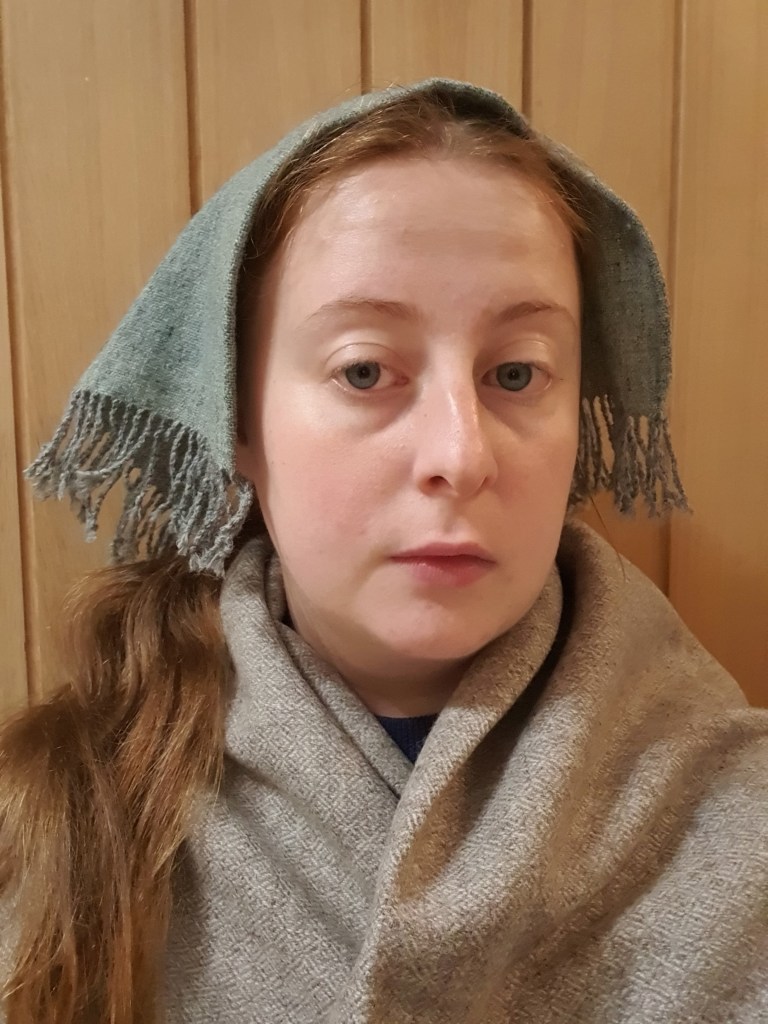
This fragment is assumed to be a headcovering and since it (and the others recovered from Wood Quay) are not grave finds, we have to rely on assumptions. I tried it on several different ways to see how it looked and well:

Simply pinned at the top of the head.
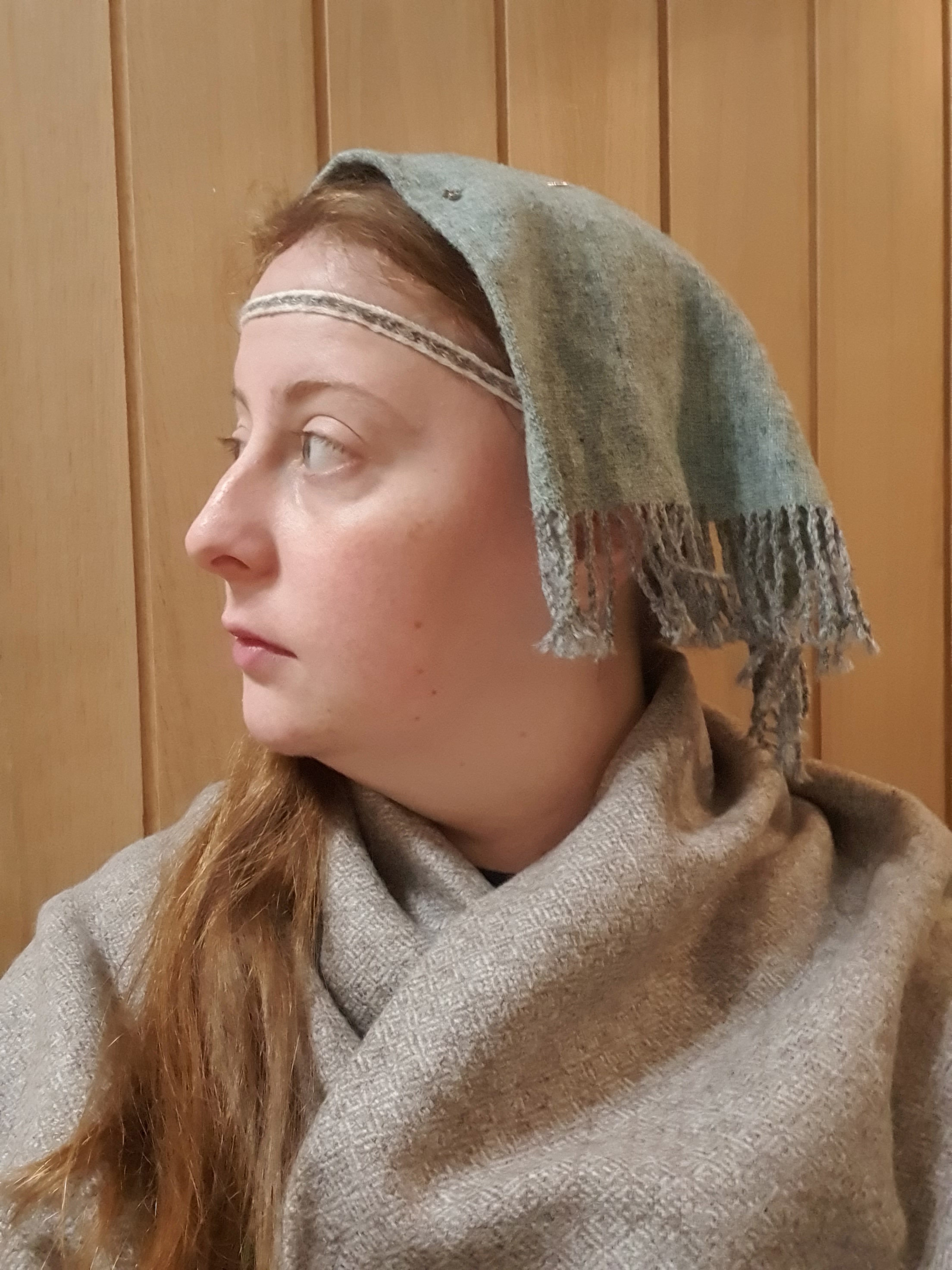
Side view.

It is safe to say that it is a bit goofy-looking. This has never stopped me however, so undeterred, I just accessorised more:

Pinned to the top of the head and worn with a woollen fillet.
Side view.

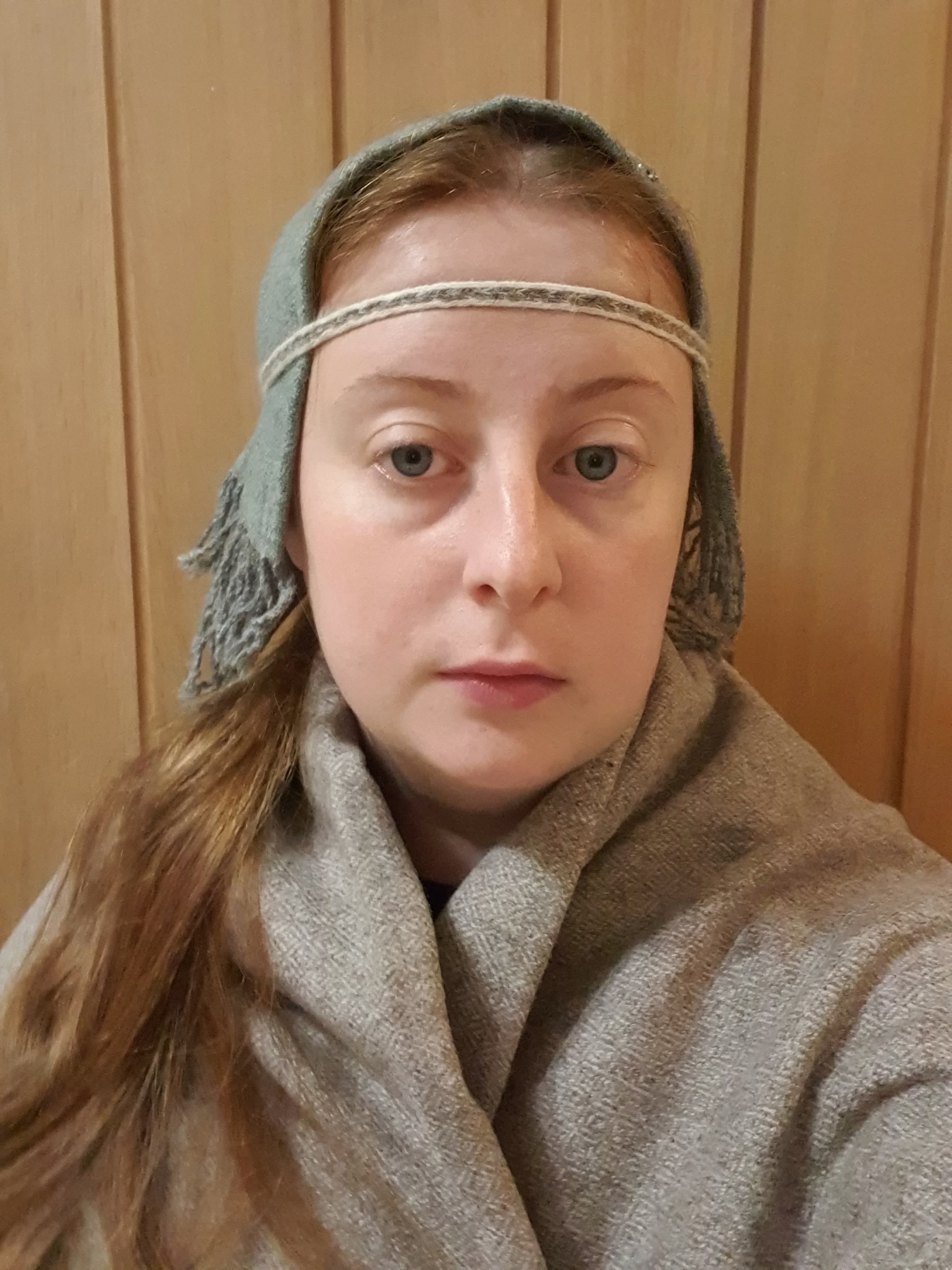
The wool fillet didn’t do much, except for cover up some of my formidable forehead. I tried it over the top of the scarf, which would at least add stability and make me look less like the Flying Nun.

Worn with the fillet over the scarf and tied behind the head.
Side view.

This way of wearing it did seem to be more suitable for day-to-day use and resembled the silhouette of Dublin or York caps more closely (not that this is necessarily the purpose.) It is suggested by Wincott Heckett (2003) that these scarves could have been worn as headbands or around the shoulders, which wouldn’t be possible with this scarf as it is just too small. I will test those ideas when I make some other scarves based on larger fragments, some dyed and some undyed.

I like this way of wearing the scarf best.

References

Wincott Heckett, E. (2003) Viking Age Headcoverings from Dublin. Dublin: Royal Irish Academy.

A 10th Century Tablet Woven Band of Silk from York

When I first started re-enacting, I was immediately drawn to tablet woven bands. They’re such a pretty and impressive-looking detail to add to one’s kit, especially if you’re wanting to be fancy.

Sadly, like many cool things in historical costuming, it can be overdone. I personally know of several living historians who no longer use it in their clothing at all (except for perhaps very plain belts) on the basis that it is not well-enough represented in the archaeological record, except for in very rich graves. Such bands are often woven as brocades with silk and precious metal threads- well-known examples in VA re-enactment costume are some of the bands from Mammen (Denmark), Birka (Sweden) and the “Dublin dragons”.

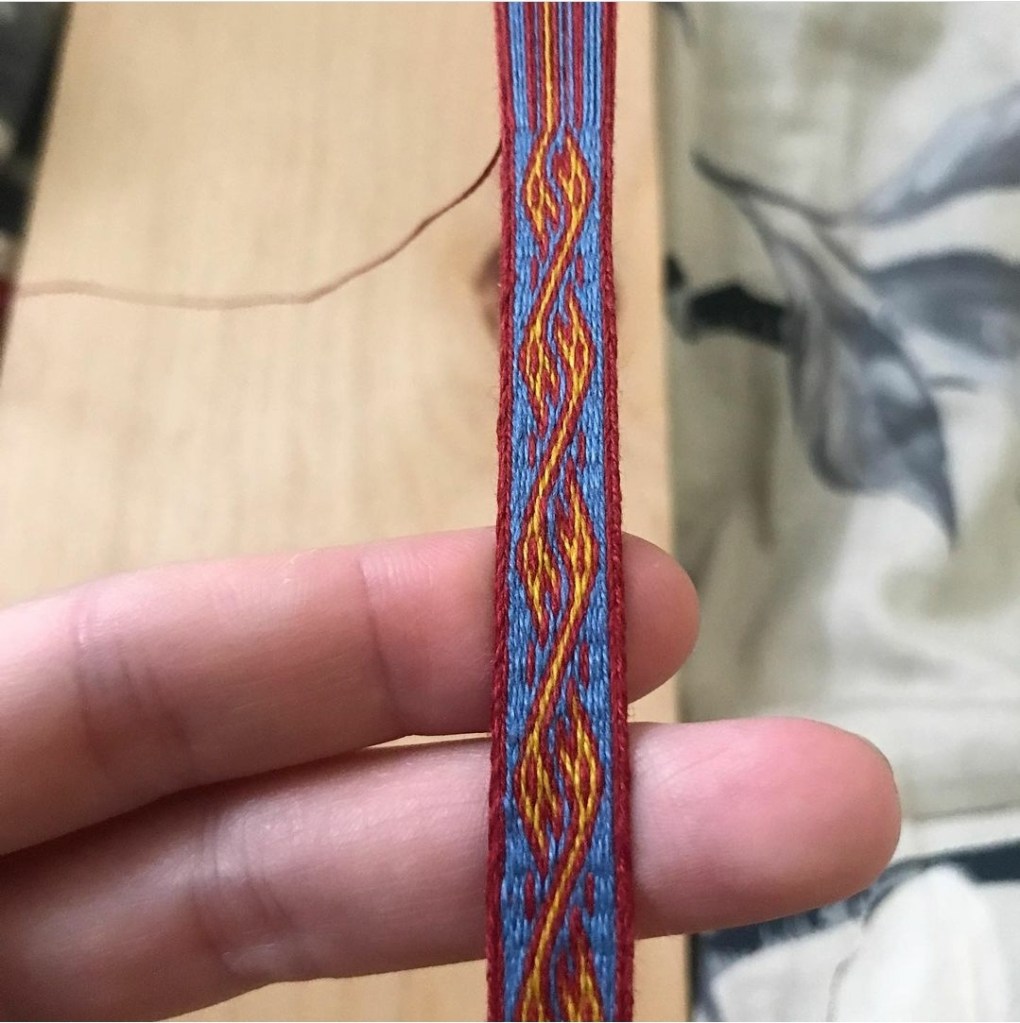
A beautiful example of the Dublin dragon pattern in linen, made as a surprise gift for me by my talented friend Sarah of Sarahjweaving.

I understand their concerns, but don’t go quite as far. I still use tablet woven bands in my impressions, albeit more sparingly than perhaps I used to. I would whinge that “there aren’t any English tablet weaving patterns from the VA”- fortunately, as is often the case, I was talking out of my backside.

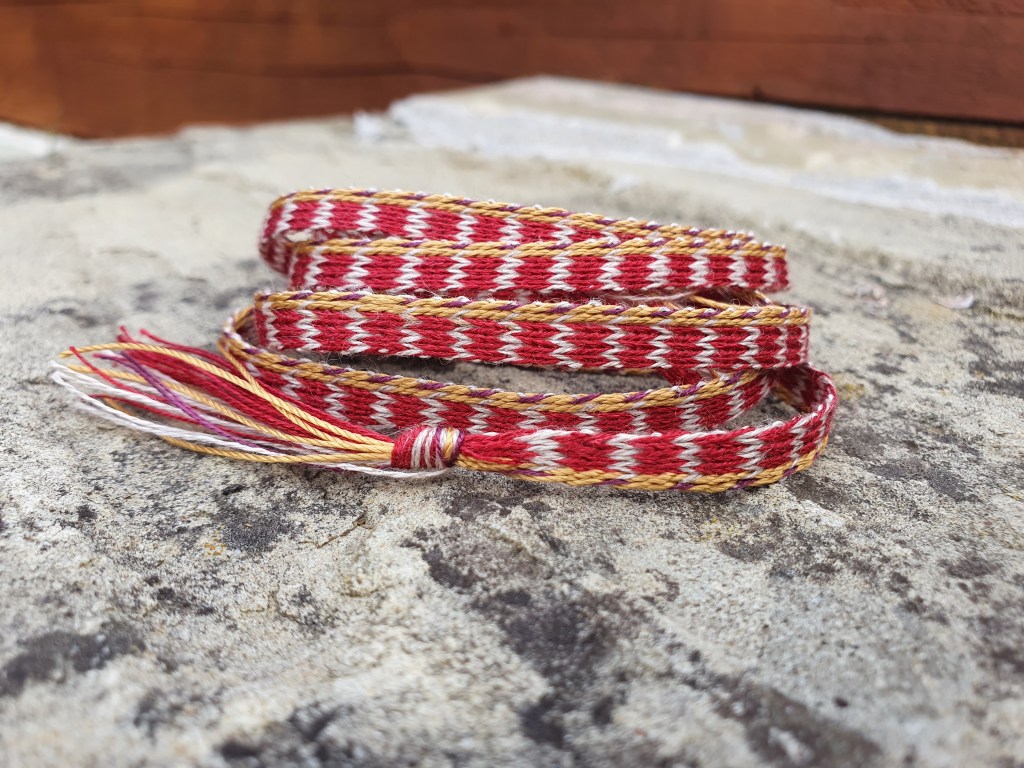
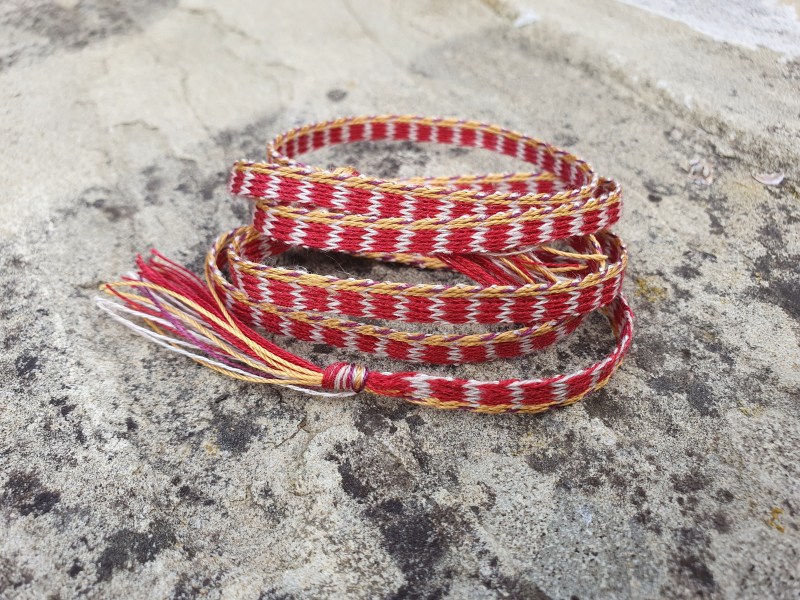
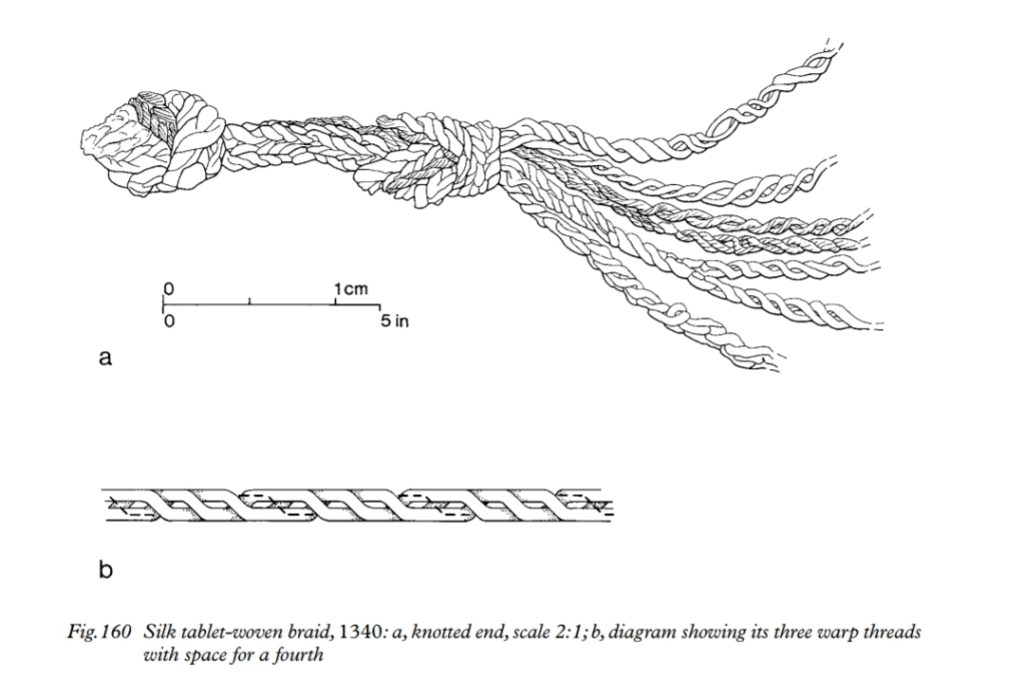
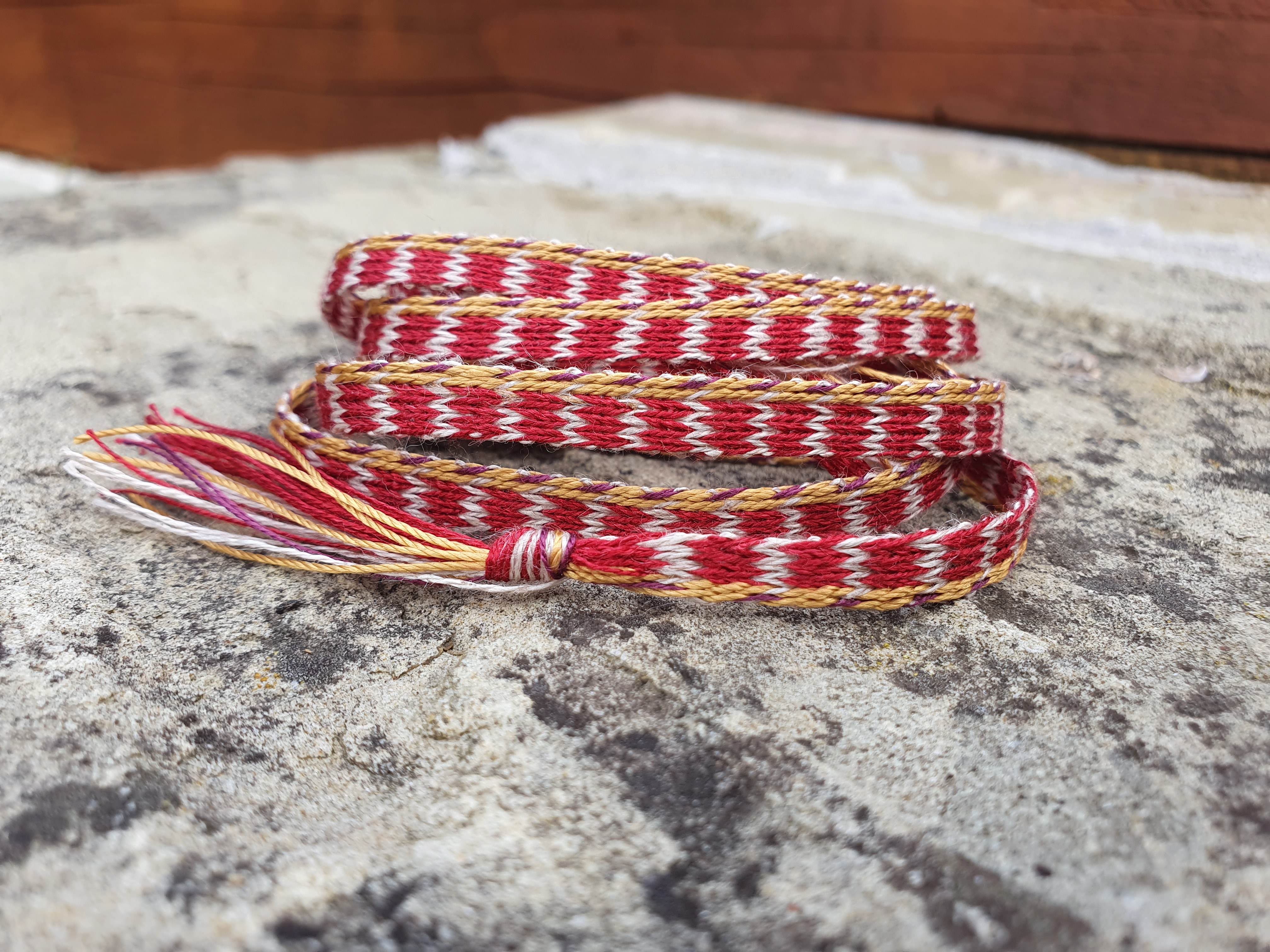
In the 4B levels at Coppergate (dating to approximately 930-975AD), the beginnings of a beautiful, narrow silk band (1340) was found. The fragment consists of silk threads dyed with madder and madder+indigotin, as well as several silk threads that had no dye detected. The piece is 1.47m long and appears at first to be a tangled length of threads tied together. There were a few gaps in the pattern that it is believed were originally filled with linen or some other vegetable fibre. I interpreted this as red silk (madder) and purple (madder+indigotin) with the undyed silk and linen being yellowish gold and pale grey, respectively.

Source: Walton, P. (1989) Textiles, Cordage and Raw Fibre from 16–22 Coppergate, p.382.

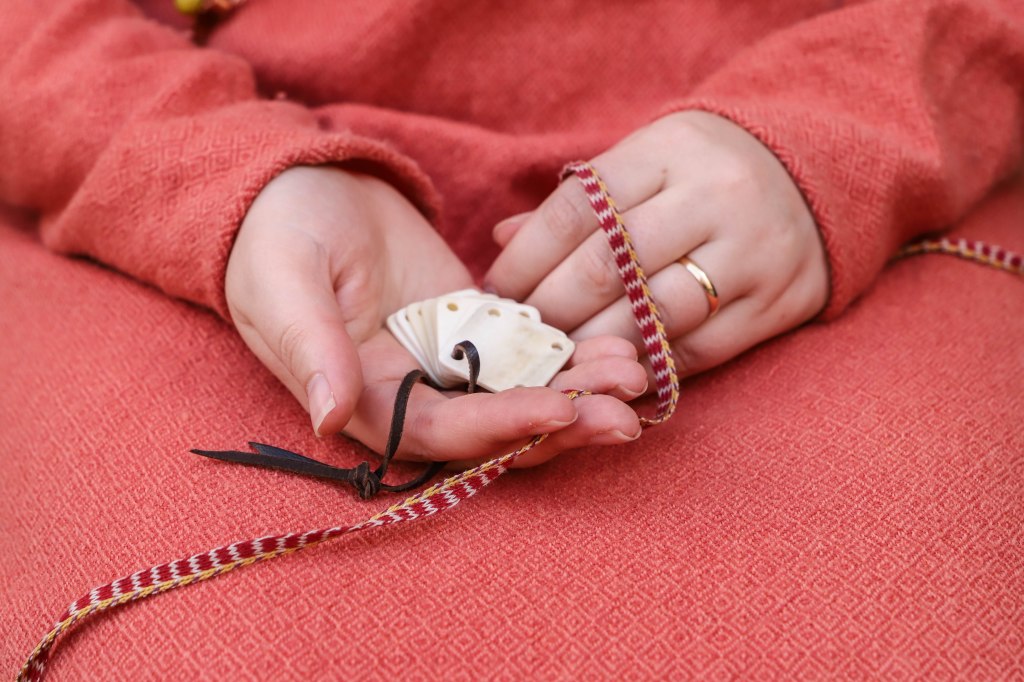
For my recreation, I was extremely grateful to Alicja of Hrafna Norse Crafts on Facebook for her article on the braid. She wrote up a pattern that I used and it can be found here. In her version of the braid, she used wool and chose a slightly different colourway, which I think is stunning!

When I said the original braid was narrow, it really is: 5mm in width! I am not a very good tablet weaver, but I did manage to keep it somewhere between 5 and 6mm throughout. It’s the teeniest braid I’ve ever woven and my first in silk!

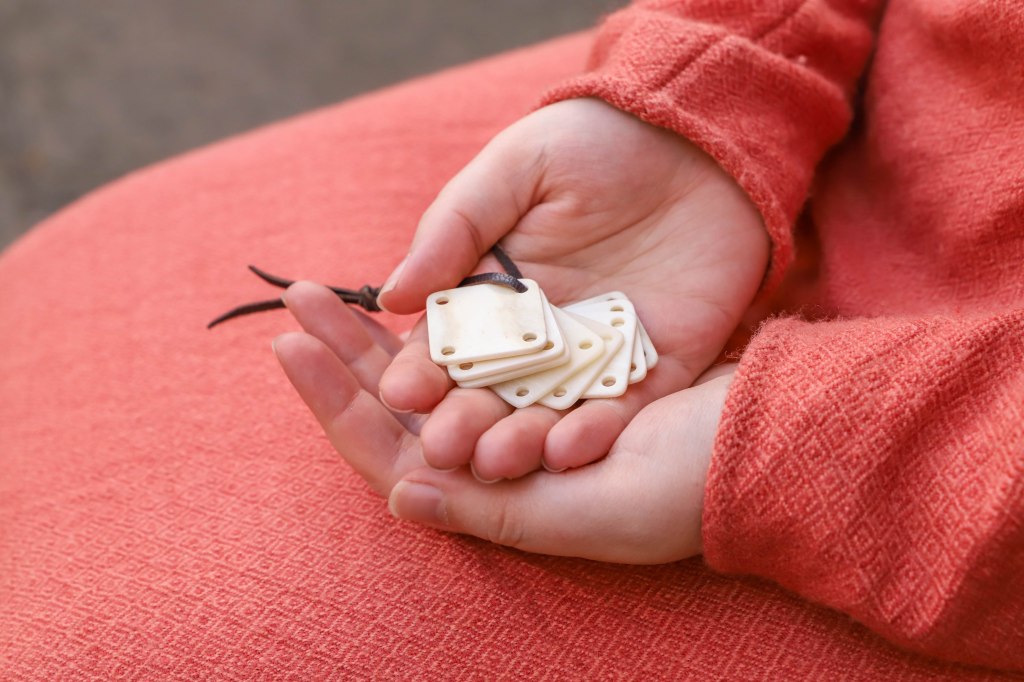
It’s interesting to note that Walton (1989) suggests that fragment 1340 was made domestically in Anglo-Scandinavian York, due to the imported silk threads being made to go further with the inclusion of cheaper linen thread. Indeed, a bone weaving tablet was found nearby to 1340 in the 16-22 Coppergate site. It is believed to be contemporary to the braid, which indicates that braids were being produced in the area at the time.

When filling in the holes left in each tablet with a linen thread, a simple but effective pattern is created. It reminds me a little bit of Snartemo II, though that is far earlier. It’s also asymmetrical, with the undyed silk and madder+indigotin silk forming a corded border on one side of the band. To my taste, it’s an elegant pattern and one that I think I’ll enjoy wearing.

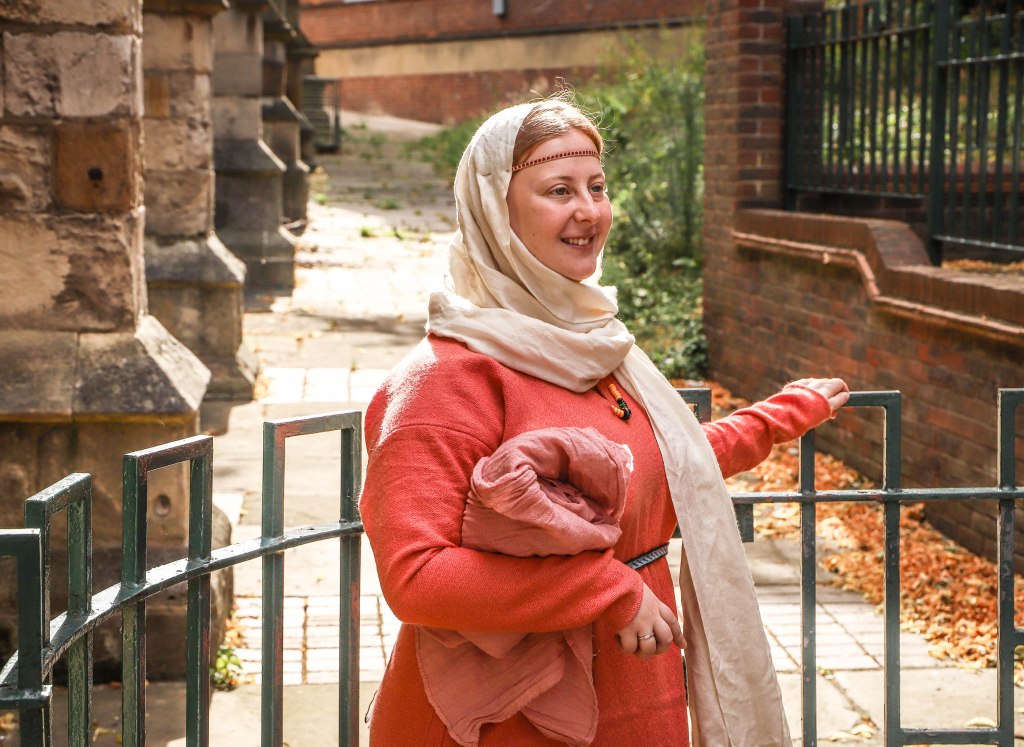
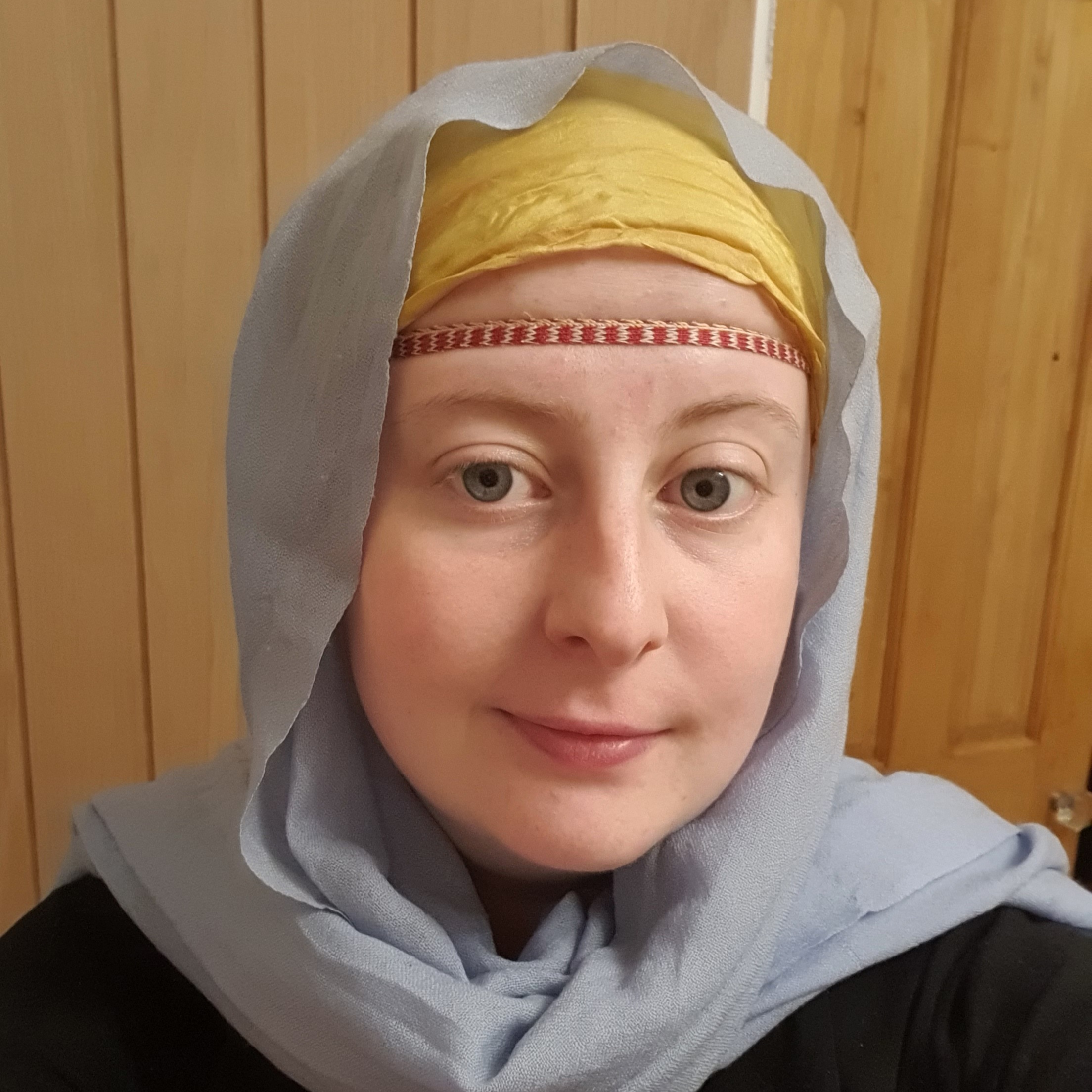
Due to the unfinished nature of fragment 1340, we don’t know what it was intended for. It could have been woven as a stand-alone piece like a fillet or indeed as a trim for a separate garment. However, it is fair to say that the original braid would have been expensive (since it was made of silk threads and contained dyes) and likely was intended for a richer sort. I chose to keep this first attempt as a fillet, mainly because I have a terrible habit of not measuring out enough warp. Perhaps in the future, I’ll have another go and weave enough for a neckline and cuffs of a gown.

Veils and fillets go perfectly with black t-shirts, actually.

References

Walton, P. (1989) Textiles, Cordage and Raw Fibre from 16–22 Coppergate. York: York Archaeological Trust. PDF.

Links

Sarahjweaving on Instagram.

Hrafna Norse Crafts on Facebook.

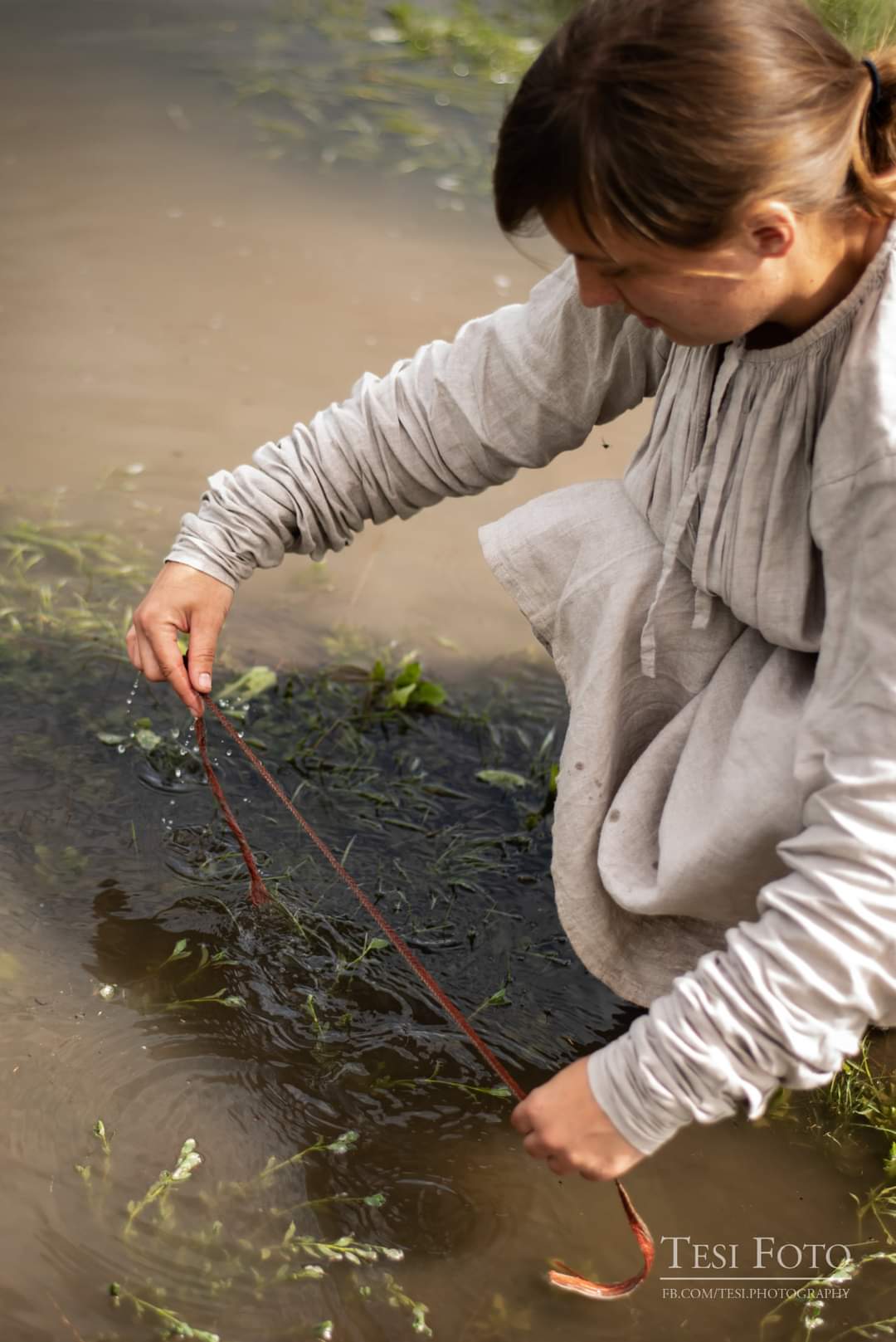
Tesi Photo on Facebook.

I Cooked Using Only 10th Century Ingredients For A Week. This Is What I Learned.


Note: I wrote the majority of this article in Winter 2020 and have learned a lot more about Viking Age food in the meantime. There are things I would do differently in future and I do plan on repeating this experience again, with more planning. I considered abandoning this article and not publishing, but I thought some folks might appreciate it as it is. I’m also interested in seeing what recommendations (hopefully of a yummy kind) I might get before I try it again.

Food is universal, yet what is eaten in a place or time can tell us so much about the culture or people doing the eating. Mealtimes contribute in large to the structure of our day and many of us get huge enjoyment from them. Food is one of the simple pleasures, after all. Food is also something that can be recreated and experienced, just as our forefathers did. To taste a historical dish made with love and careful attention to remaining evidence is to experience a fleeting sense of time travel.

So, I decided before I even started this blog that I wanted to do something with early Medieval food. I attended an modern training event for re-enactors early last year (blessedly just before Covid really kicked off) as a member of the kitchen crew and I met several excellent living historians with a lot of experience cooking Viking Age food in camp. Conversations with them set me thinking about food and the types of things I’d prepared for camp prior.

I was usually the person who cooked for my group, however, I began to realise that much of my knowledge of food and cookery in period was inherited “re-enactor’s knowledge”. People ate a lot of soup and bread, meat was expensive and everyone drank ale instead of the fetid bacterial soup that sat in wells. While this stuff was not wrong per-se, it was very unspecific. I knew that most vegetables at the time were smaller and far less uniform than the hyper-farmed examples we have today and that their carrots were probably not orange. However, I couldn’t tell you what fruits and vegetables were most commonly grown and I certainly couldn’t describe what material evidence there was at various settlements. How much of all that has survived, let’s say in Anglo-Scandinavian York?

It turns out, quite a bit. We don’t have any recipe books from any Viking Age Gordon Ramsays, but cooking equipment and food waste was found in spades here. By examining the animal remains and traces of vegetal matter left behind, we can form a surprisingly varied diet for the 10th century denizen of Jórvík.

Carolyn Priest-Dorman compiled the following list:

Jorvík [York], Danelaw [England]

  • Meat — red deer, beef, mutton/lamb, goat, pork
  • Poultry — chicken, geese, duck, golden plover, grey plover, black grouse, wood pigeon, lapwing
  • Freshwater fish — pike, roach, rudd, bream, perch
  • Saltwater fish — herring, cod, haddock, flat-fish, ling, horse mackerel, smelt
  • Estuarine fish — oysters, cockles, mussels, winkles, smelt, eels, salmon
  • Dairy products — butter, milk, eggs
  • Grains — Oats (Avena sativa L.), wheat, rye, barley
  • Legumes — fava (Vicia faba L.)
  • Vegetables — carrots, parsnips, turnips (?), celery, spinach, brassicas (cabbage?)
  • Fruits — sloes, plums, apples, bilberries, blackberries, raspberries, elderberries (Sambuca nigra)
  • Nuts — hazelnuts, walnuts
  • Herbs/spices/medicinals — dill, coriander, hops, henbane, agrimony
  • Cooking aids — linseed oil, hempseed oil, honey
  • Beverages — Rhine wine

I don’t know about you, but I saw this and thought “There’s a lot I can work with there.”

Being in the last week of the second national lockdown and not being one to do things by half, I decided on a week where I would use only foodstuffs from 10th century York. I toyed with the idea of doing a month, but I wasn’t quite that masochistic. This leniency extended to what I drank- I kept drinking water for obvious reasons and I allowed myself my various caffeinated beverages of choice. I didn’t fancy the splitting headaches that would come from going cold turkey and with the low amount of sugar in my 10th century diet, I knew that I would need the pick-me-up.

Furthermore, I must note the additional limitations of this little experiment- I did not pay much attention to seasonality of produce. This is something I would actually like to amend in future with more planning and preparation, however, this was a bit of fun and I just wanted to get stuck in with what I had access to. I also must state that in no way am I trying to claim that my menu is representative of what all Viking Age Yorkies would have eaten regularly, nor that my presentation or ingredient combinations are absolutely accurate. My aim was to educate myself on what foods there is evidence for in York and then to combine them in ways that would allow me to experience the flavour profiles possible with the ingredients available. I had to cook using modern cookware on a modern electric stove, but I did try to use cooking techniques that we have evidence for (e.g. boiling, shallow frying, roasting.) Despite these limitations, I do still believe that my very unscientific endeavour has merit (even if that is only to inspire others to look more into it and because I had fun.)

Day One


I decided to start gently today, with meals that wouldn’t look all that unusual in a modern household. It was mostly a day of prepping, as I had to make all my stocks from scratch for meals throughout the week. Today, I made vegetable stock and boiled a ham for the week.


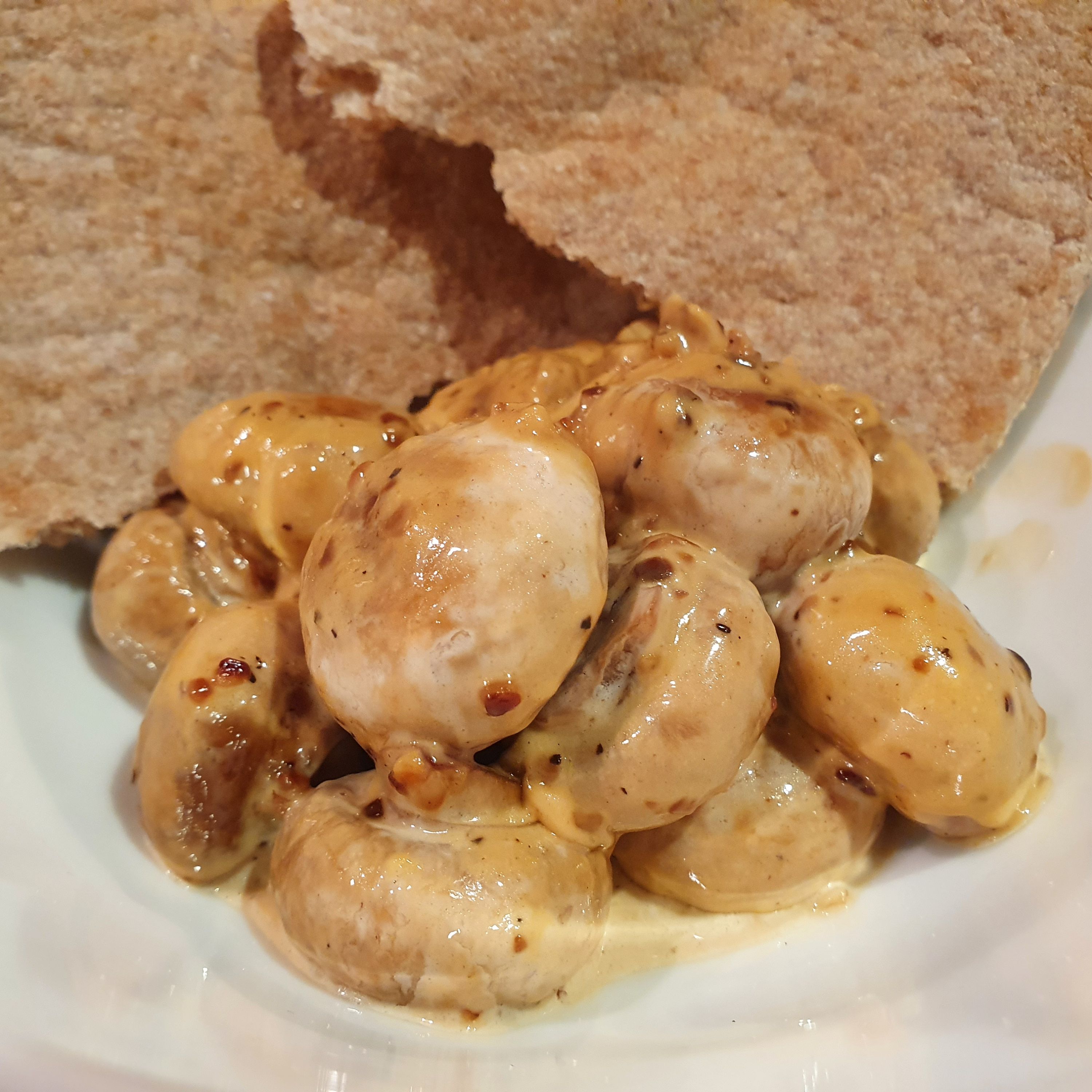
Brunch: Garlic mushrooms in a cream sauce with flatbread.

The mushrooms were shallow-fried in butter and garlic, with a dash of double cream added at the very end to bind it together and capture all the scrummy pan scrapings. The flatbread was (shamefully) shop-bought and consisted of wheat flour.


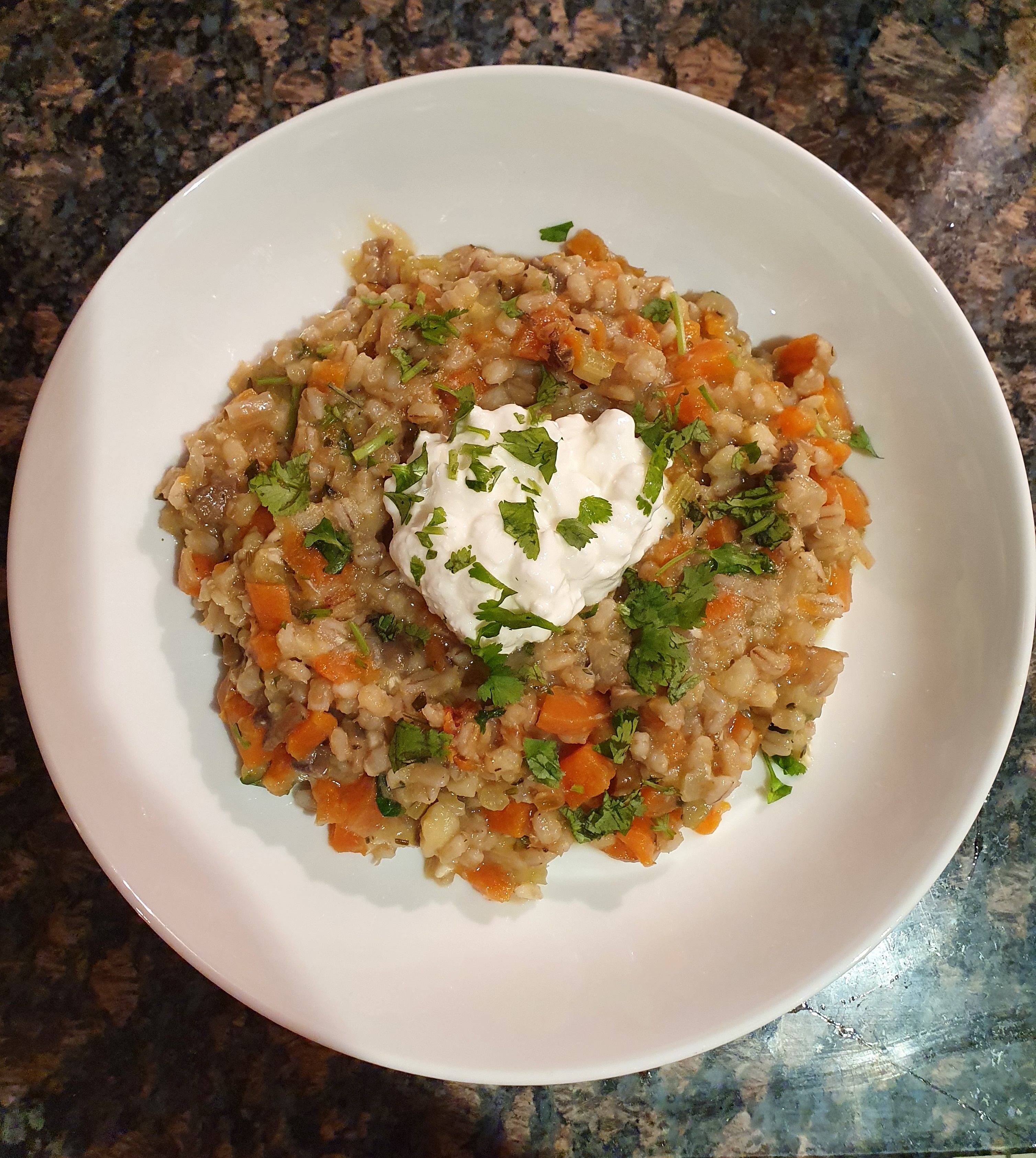
Dinner: Carrot and coriander pearl barley “risotto”, topped with cottage cheese.

This was super hearty and had me incredibly full- pearl barley is wondrous stuff. I cooked it slowly using some of the vegetable stock I had made earlier, crammed with lots of other veg (onions, carrots, parsnips, celery.) The cottage cheese added some needed creaminess and the coriander cut through the stodge of it all.

Snacks: Mint herbal tea and a handful of raspberries. I went to bed feeling pretty full.

Tuesday


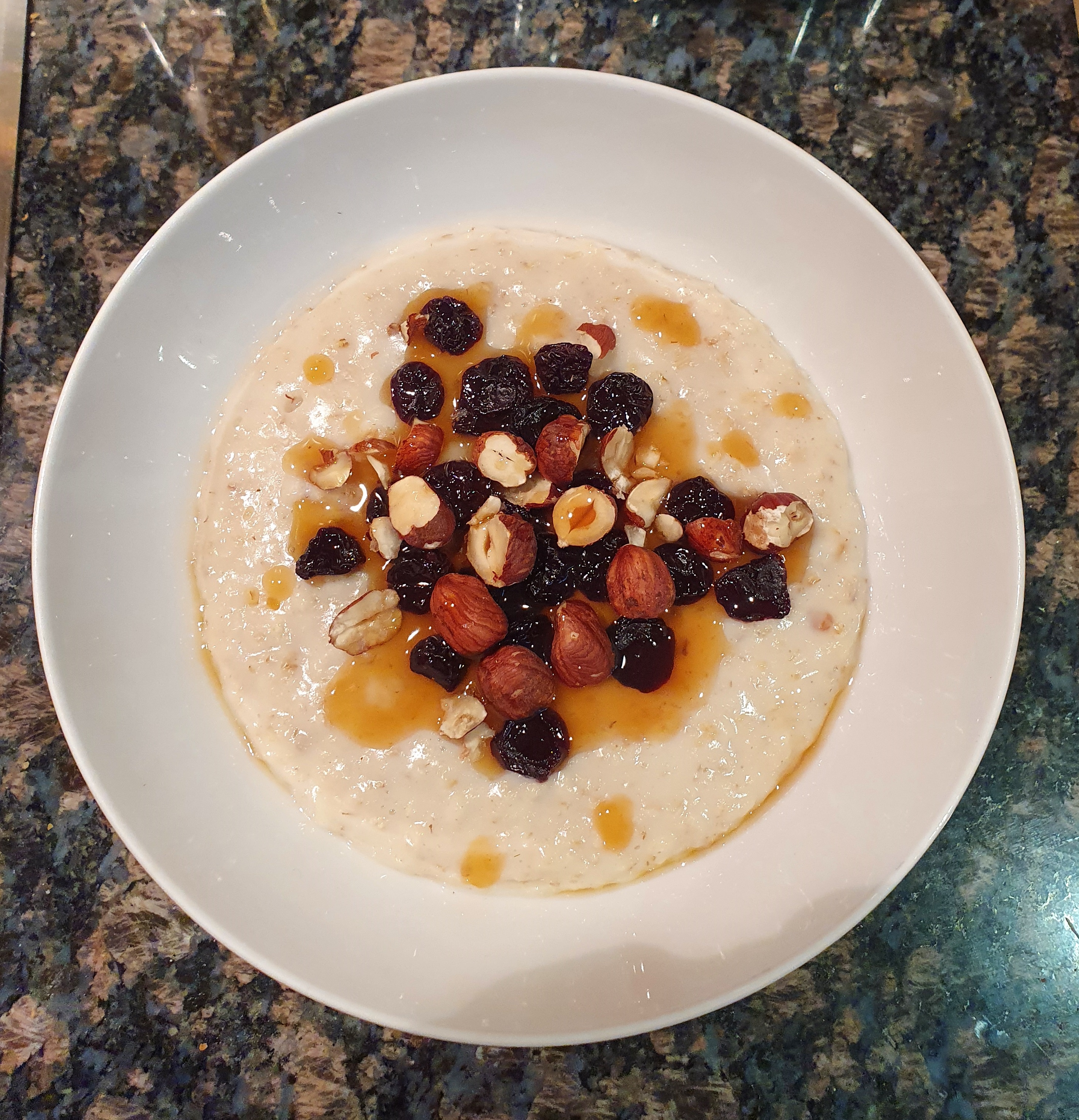
Breakfast: Oat porridge with dried sour cherries, hazelnuts and rosehip syrup. I made the rosehip syrup myself with only 3 ingredients: local honey, distilled water and rosehips I picked nearby.

It’s nice stuff- I’m not sure if it was the honey I used or the rosehips themselves, but it had a very herbal taste. Almost a bit like old school medicinal drops I used to get as a child! However, it’s far from unpleasant and any sweetness is welcome in the 10thC diet. The porridge was made with oats, water, a little dash of milk and a pinch of salt.


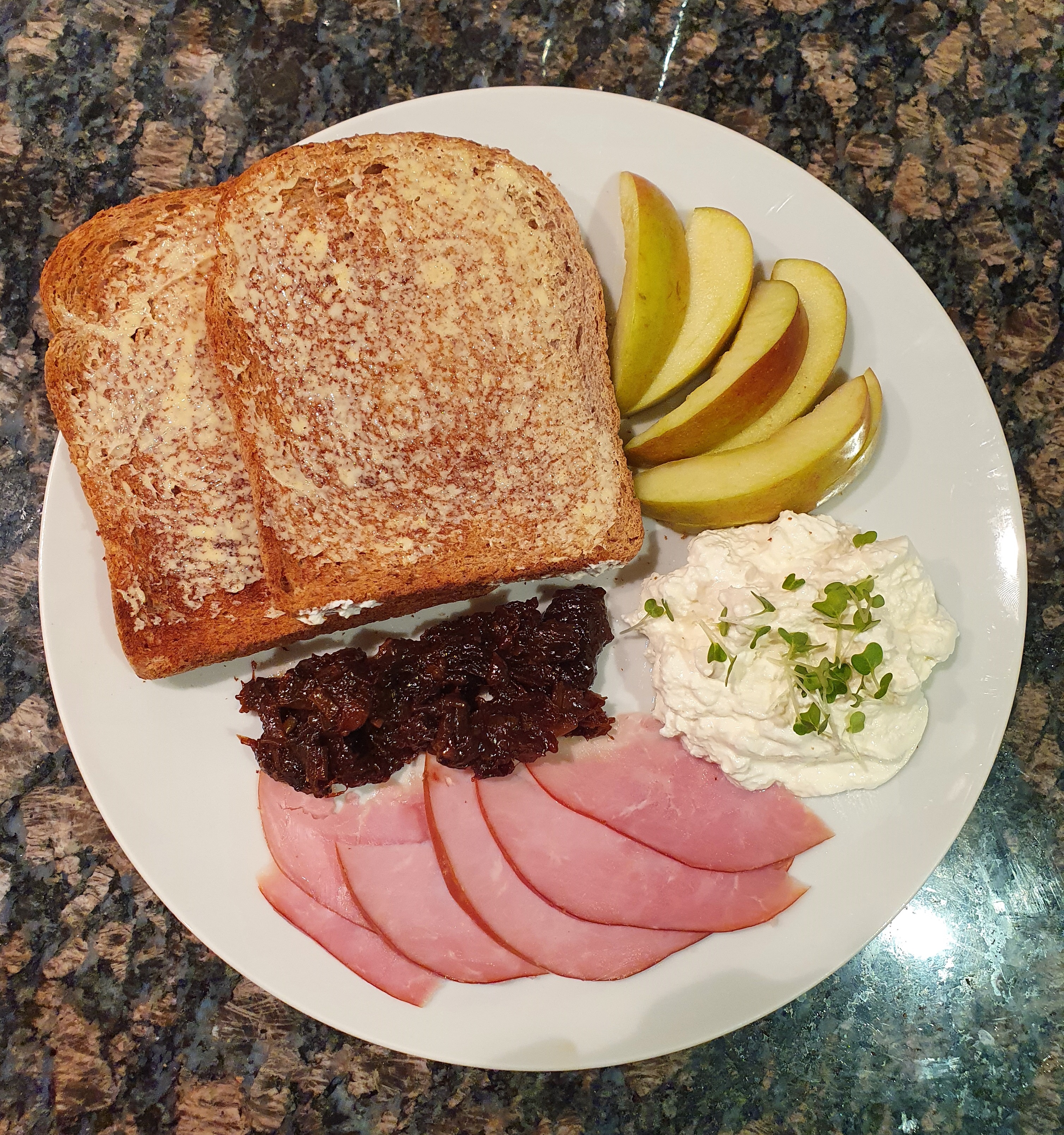
Lunch: Viking Age Ploughmans, bread, cottage cheese, water cress, apple, ham, plum chutney.

For some, cottage cheese is a shuddery horror reminiscent of old-school fad diets. I happen to be quite a fan of the stuff, though it certainly needed the strong flavours of the oniony plum chutney and smokey ham. The water cress was just something I had growing at the time, but it added a nice bit of peppery flavour to the cheese. I was quite surprised how much I enjoyed this lunch, despite it not being my usual mature cheddar and Branston pickle affair.

I’ve eaten variations of this simple meal in encampments across Europe and I suspect that this kind of fare would have been common with working people in the Viking Age, as it was among agricultural workers throughout the centuries since. It would work well with dried meats or fishes instead of ham, as well as substituting the cottage cheese with hard cheese or yoghurts too. Eggs are also a fab addition to a Ploughmans, though I didn’t have one with this meal.


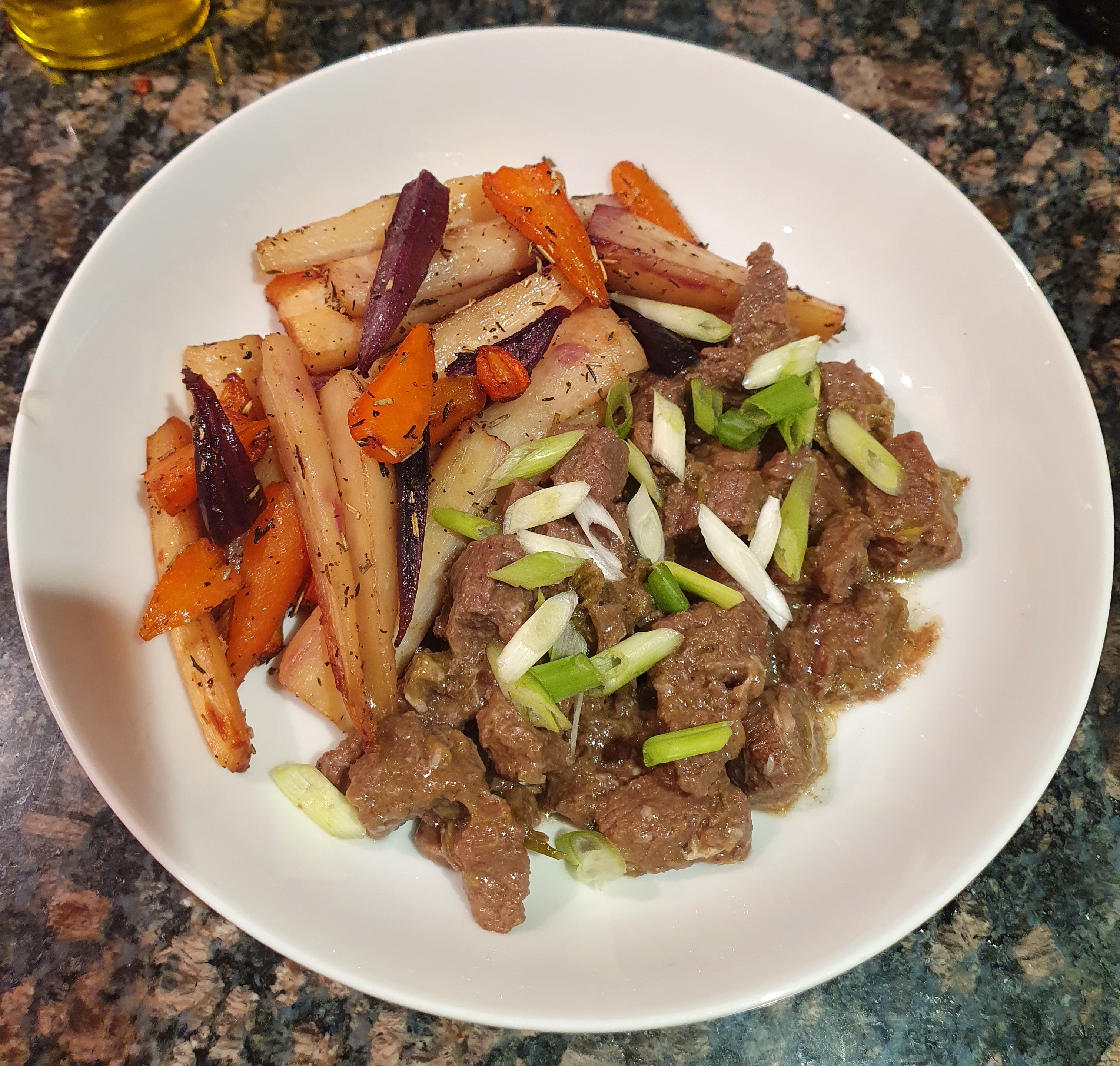
Dinner: Braised beef with garlic, roast parsnips and carrots with thyme.

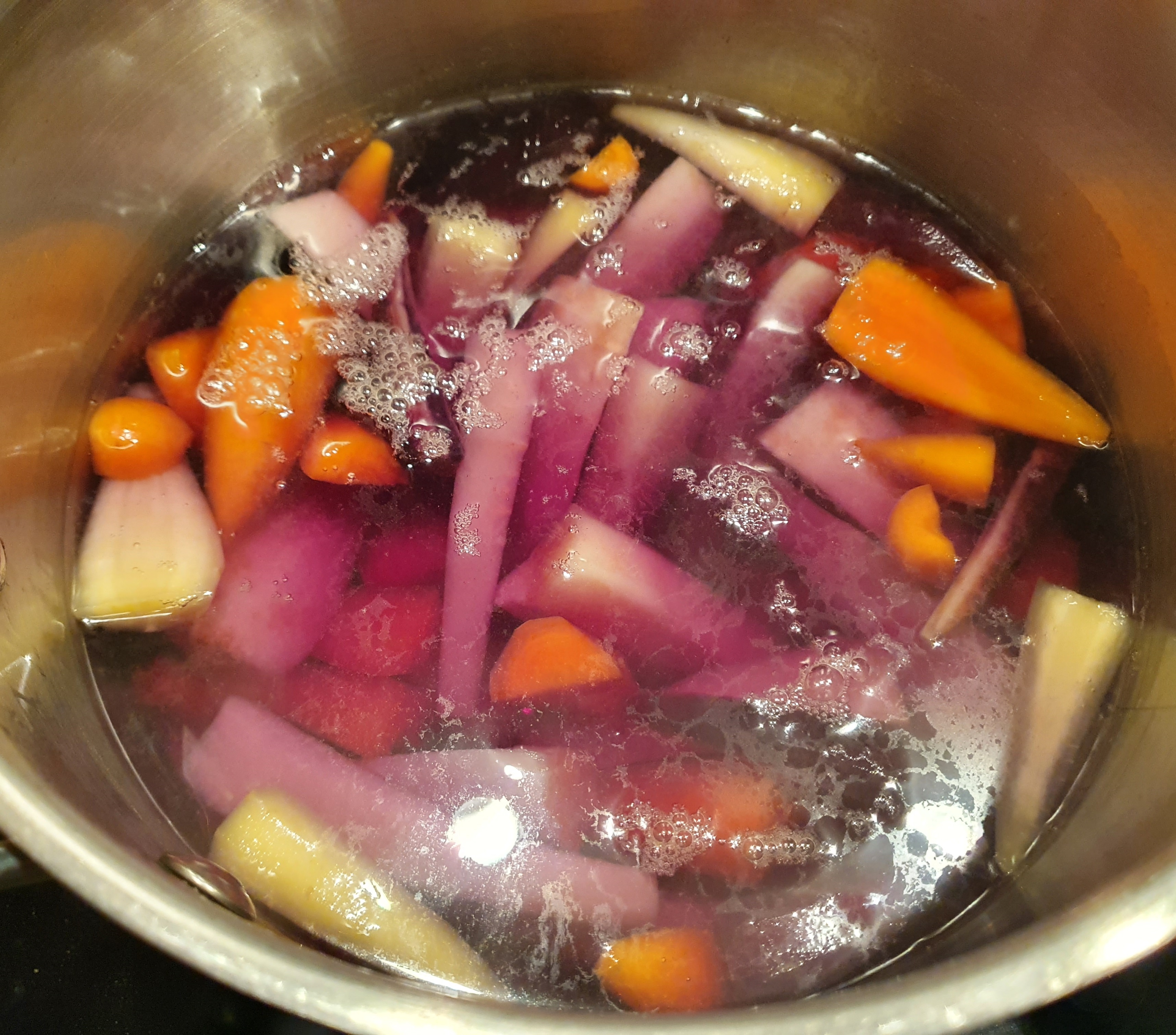
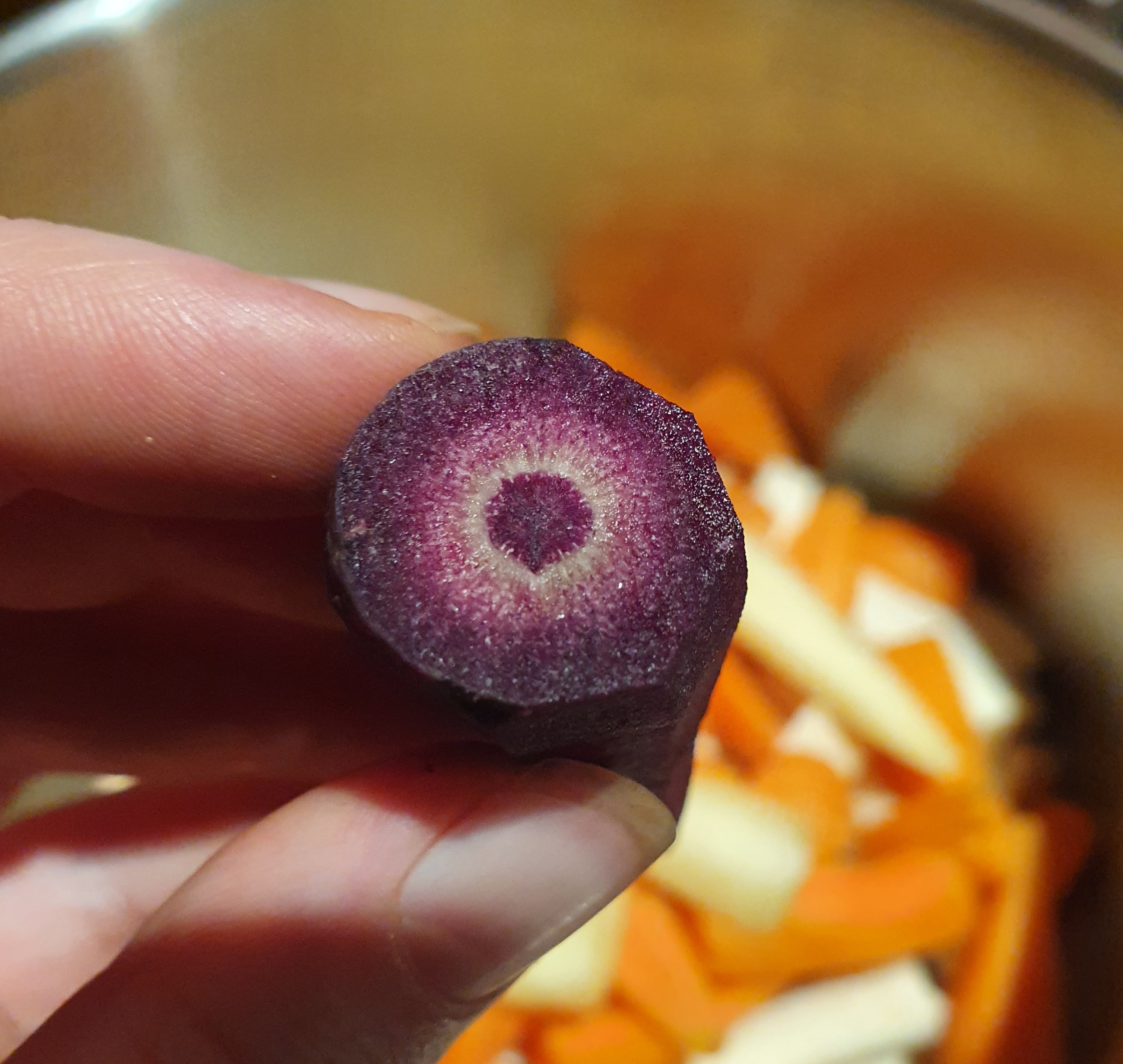
Again, this dish wouldn’t look that unusual on a modern dinner table. The carrots eaten in 10th century York will have likely born more resemblance to wild carrots than the orange behemoths in supermarkets today. Unfortunately for me, wild carrots are not as common as one might hope in the centre of modern York. I did manage however to bag some gorgeous local-grown, organic heritage carrots- at my local Spar of all places! That all might sound very hipster, but they were teeny, sweet and came in all colours. I boiled them with the parsnips before roasting and actually saved the purple boil water to use for stock later in the week- I think you’ll agree that it was too pretty not to.


Thyme has not been found in the archaeological record in York, however, strains of wild thyme are native to the British Isles. It is also mentioned in 10-11th century English medical text the Lacnunga, under the Old English name “bothen” (Wyrtig, 2015.)

Wednesday


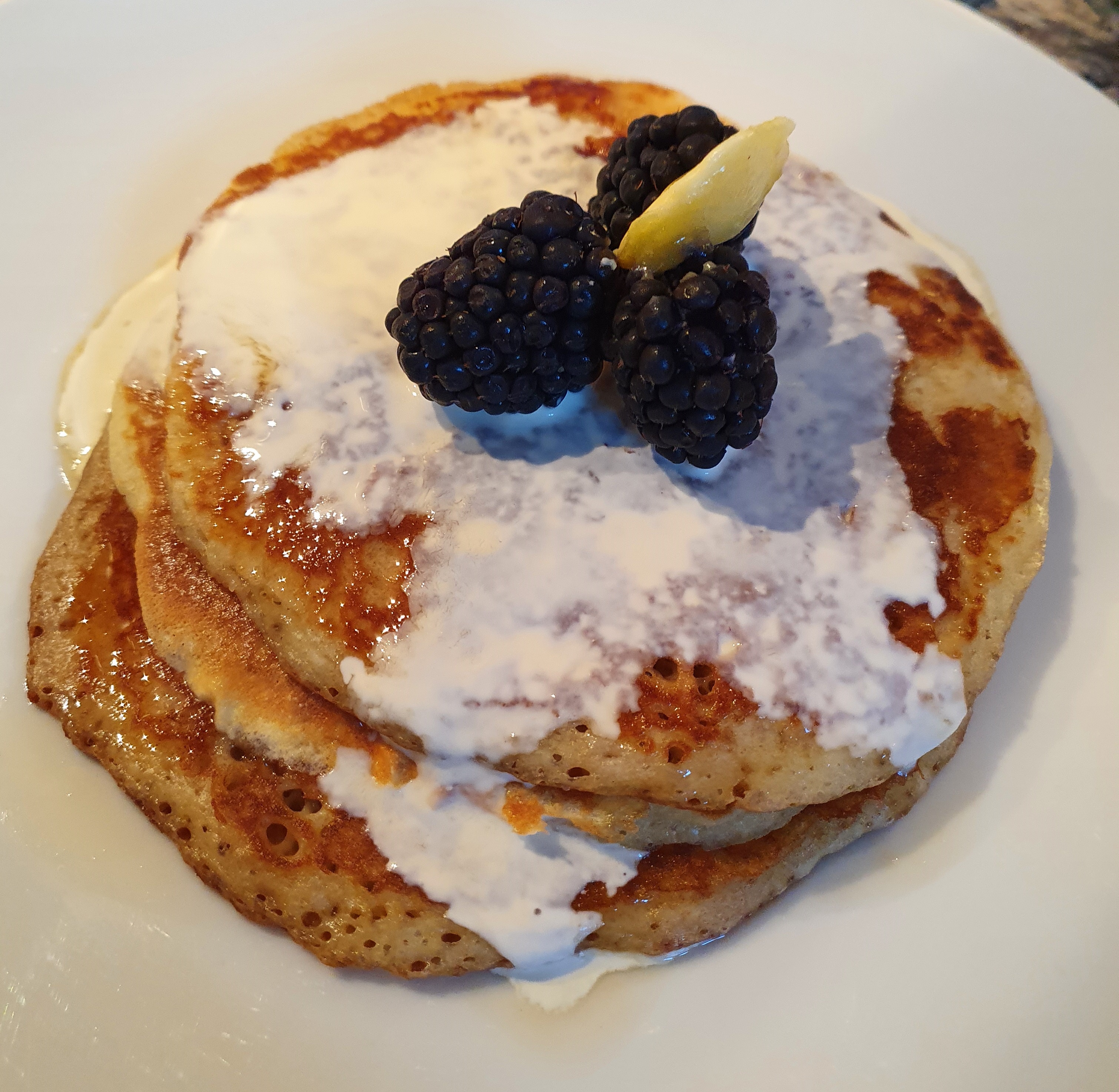
Breakfast: Buttermilk pancakes with rosehip honey syrup, topped with blackberries & double cream.

These pancakes were seriously decadent. I whipped up a huge jug of the batter (with honey in place of sugar) and got to frying up a couple of stacks, one for me, one for Eric and another for a dear friend. My friend and I took ours to go in very modern tupperware, while Eric devoured his at home. We had some errands to run in town that afternoon (the pigeons wouldn’t pick themselves up from the fishmongers, you know), so we had our brunch in a little corner near Coppergate itself.

The pancakes themselves were delicious, but very stodgy. I now know that one probably would have sufficed for me, but apparently that day I woke up and chose violence because we each had a stack of 3, plus cream and fruit. The acidity of the blackberries was welcome to cut through the stodge of the pancake, the cream too provided a necessary moistness and sweetness. Despite my whining though, the cakes themselves were very tasty and fluffy- I can’t be doing with a slimy pancake. Such a dish would have been possible with 10th century food stuffs, but I suspect they would have made their batter without a sweetener and relied on the topping for flavour.


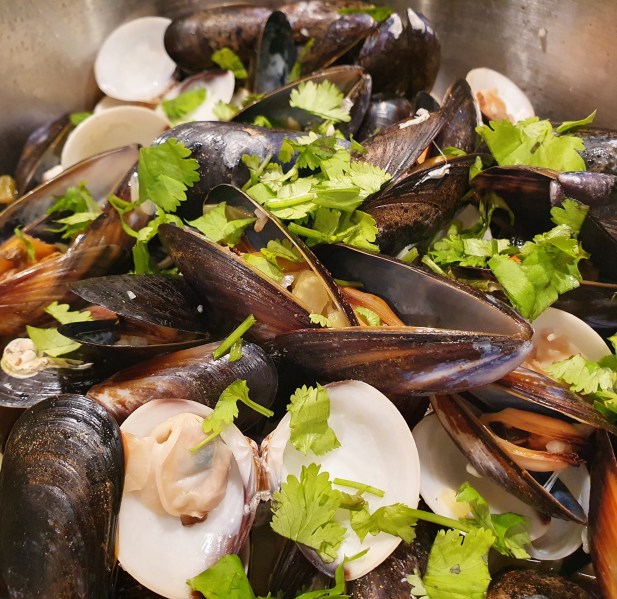
Dinner: Mussels and clams cooked in Rhine wine with garlic, onions and coriander.


This was one of my favourite meals of the week and was pleasingly cheap and easy to make. I was inspired by the steamed mussel dish included in An Early Meal (Serra & Tunberg, 2013), but made some changes to suit my own palate. I adore coriander and I think the lovely green brightened up the seafood, as well as giving it a gorgeous aromatic quality. Clams were also on offer and so in the pot they went. The discarded shells were carefully saved and added to the pan of fish stock I made later that night.

I hadn’t a clue what Rhine wine was before this project, so I looked it up. It turned out that we happened to have some dry white wines that were suitable for this recipe already in our wine cupboard, so I popped open a bottle and tried to imagine what wines from the Rhine might have tasted like 1000 years ago. We happily sopped up the wine sauce with bread after the mussels and clams were demolished.

If you like seafood, you’ll know that steamed mussels are a simple but divine pleasure. The rich marine scent of the mussels, combined with the softened onions, garlic and celery was intoxicating. The white wine just made it *chef’s kiss*.

Snacks: An apple, a hard-boiled egg and handful of blackberries.

Thursday


Lunch: Pan-fried cod fillet on crushed fava beans with mint.

This was one of my favourite meals of the week and let me tell you, I needed it. By Thursday, I was feeling quite sluggish and my appetite was much reduced. I think that this was a combination of all the cooking I was doing (I made all my stocks from scratch and some dishes took a long time to slowly stew away) and the relative lack of sugar. Sure, I was eating a lot of vegetables and some fruit, but it was a lot less than my modern diet. I have quite a sweet tooth and look forward to tea and a chocolate chip shortbread during my work day, as well as pudding after dinner often. Hard-boiled eggs and fruit weren’t cutting it.

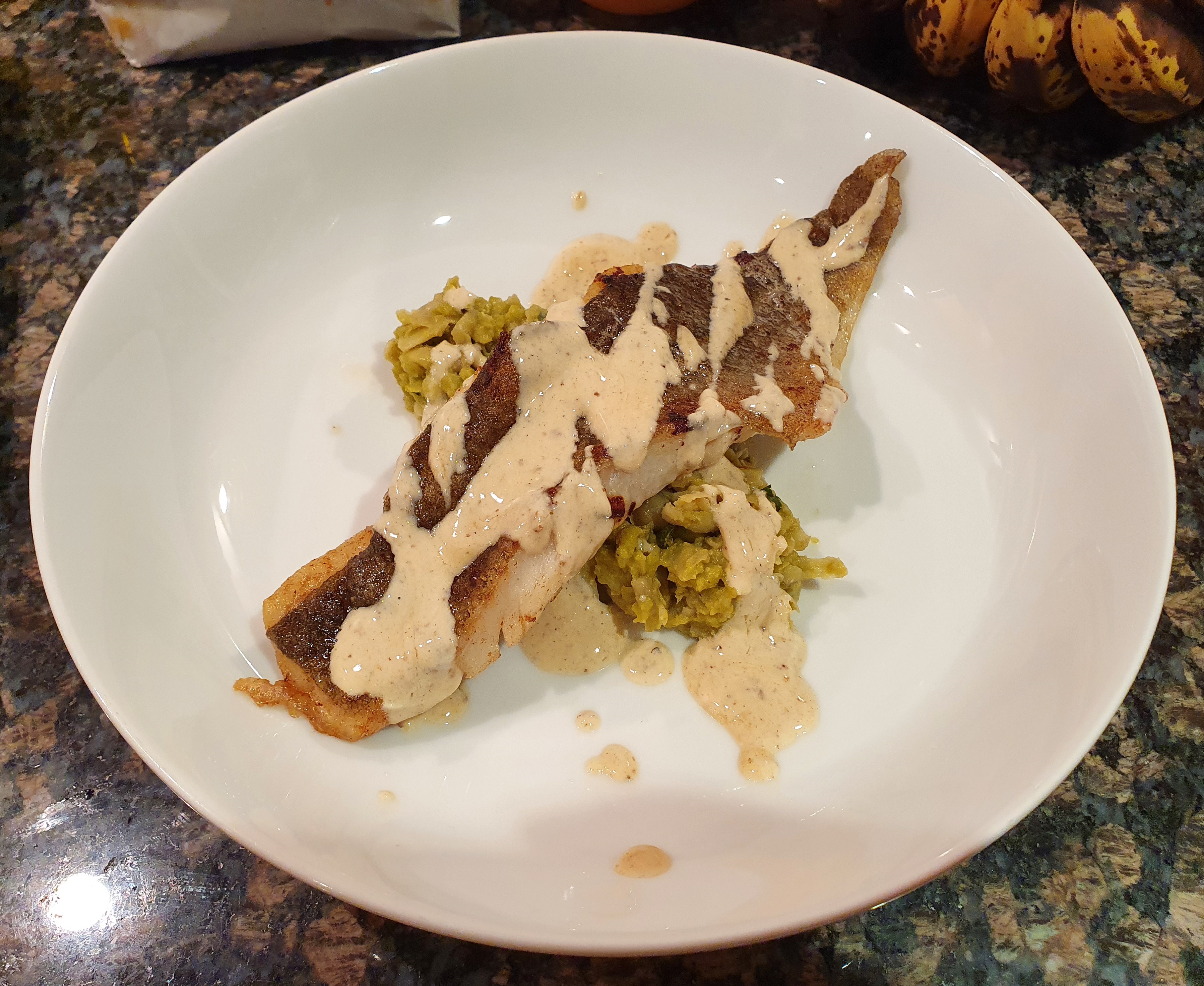
I got the cod on offer at one of our local supermarkets and being the Yorkshirewoman I am, I rejoiced. I pan-fried the cod in a little butter, making sure to get the skin all crispy. Meanwhile, I quickly boiled some tinned fava beans, drained and mashed them with some salt, butter and some freshly chopped mint leaves. Placing the cod on a little pile of the crushed beans, I added a little cream to the frying pan and made a quick sauce with the pan scrapings.

Like thyme, mint is a plant that has native strains found in the UK and was used extensively in medicine. I used peppermint as it was what I had access to, but other wild varieties would have been lovely too and would be closer to what could be found in Viking Age hedgerows.


Dinner: Traveller’s Pottage with apples, onions and ham.

This was heavily inspired by a fun video I saw on the Grimfrost YouTube channel. Hanna Thunberg (of An Early Meal authorship) made a simple winter dish that she terms a traveller’s pottage, as it contains ingredients that could be carried in a pack on a journey. Conveniently, it’s also exactly the kind of thing you would want to eat after a long hike. Her version is a Gotlandic twist on it, mine is a York kind of deal.

I made a simple porridge of pearl barley and my purple veg stock (it didn’t stay purple!!), combined with fried spring onions, some of my boiled ham chopped finely and some old apples I’d collected on a walk from Riccall to Stamford Bridge in September. Hanna talks about apples in the video, they will last heroically well if kept somewhere cool, dry and dark. They get sweeter over time and when cooked along with the onions, they really are delicious. I didn’t add hard cheese to mine as I didn’t feel confident in choosing a modern cheese that would be similar to historical examples- maybe in the future, I’ll make my own cheese and use that.

Snacks: Flatbread with cottage cheese and prune chutney, mint tea.

Friday


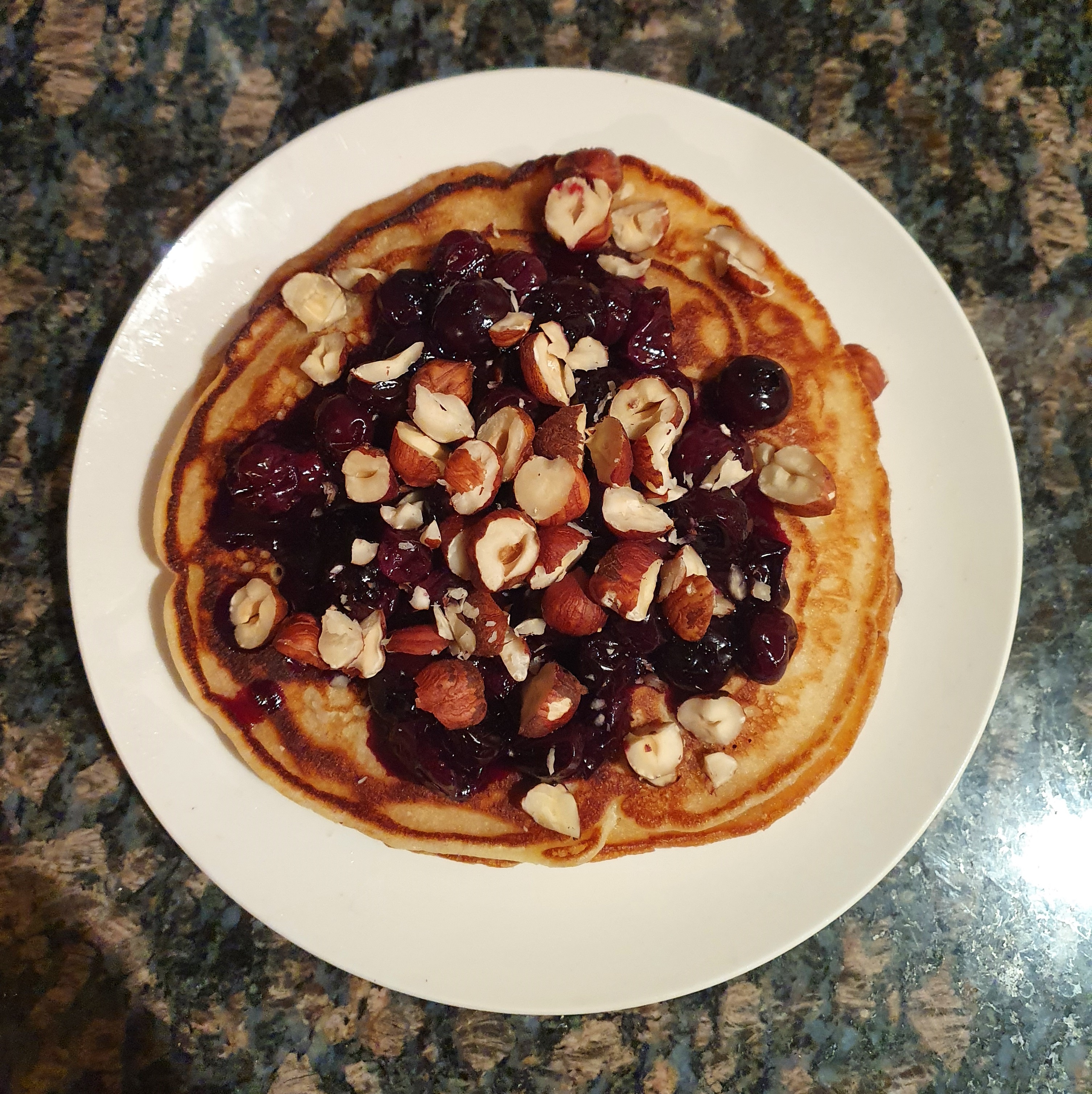
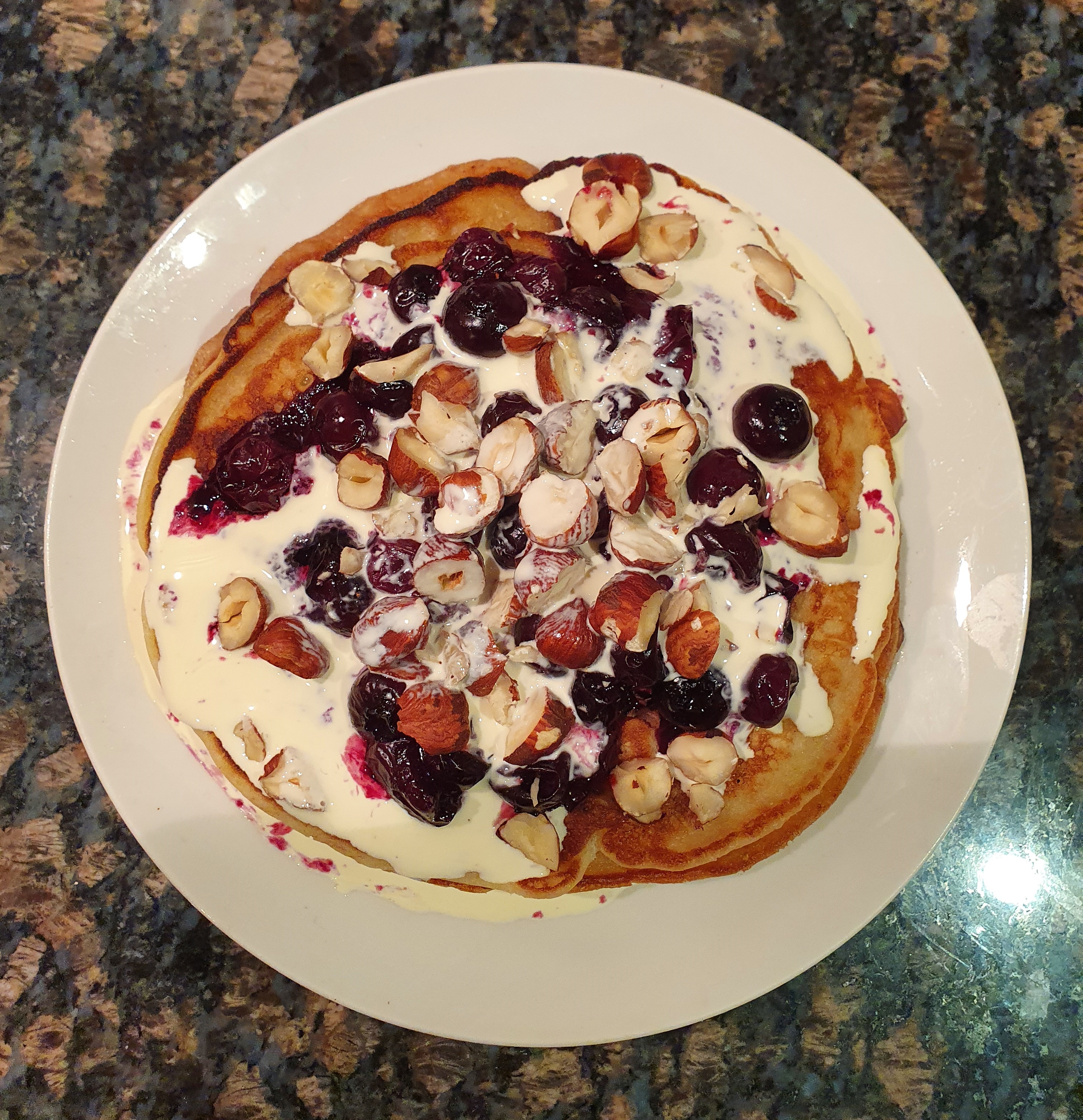
Breakfast: Buttermilk pancakes with blueberries, double cream drizzle and chopped hazelnuts.

The pancakes returned with a vengeance. As you can see, I learned from my greedy mistake earlier in the week and only cooked one. This time, I topped my pancake with some blueberries that I quickly softened in a hot pan with a little water, as well as some chopped hazelnuts and cream. I liked this better than the fresh blackberries, though the hazelnuts took quite a bit of chewing.

Blueberries are actually a New World plant, but their Old World cousins bilberries were found in York. However, finding dried or even frozen bilberries in November proved an almost Herculean feat. They do grow in the wild, but are not widely commercially available. So, I committed a cardinal authenticity sin and used blueberries.


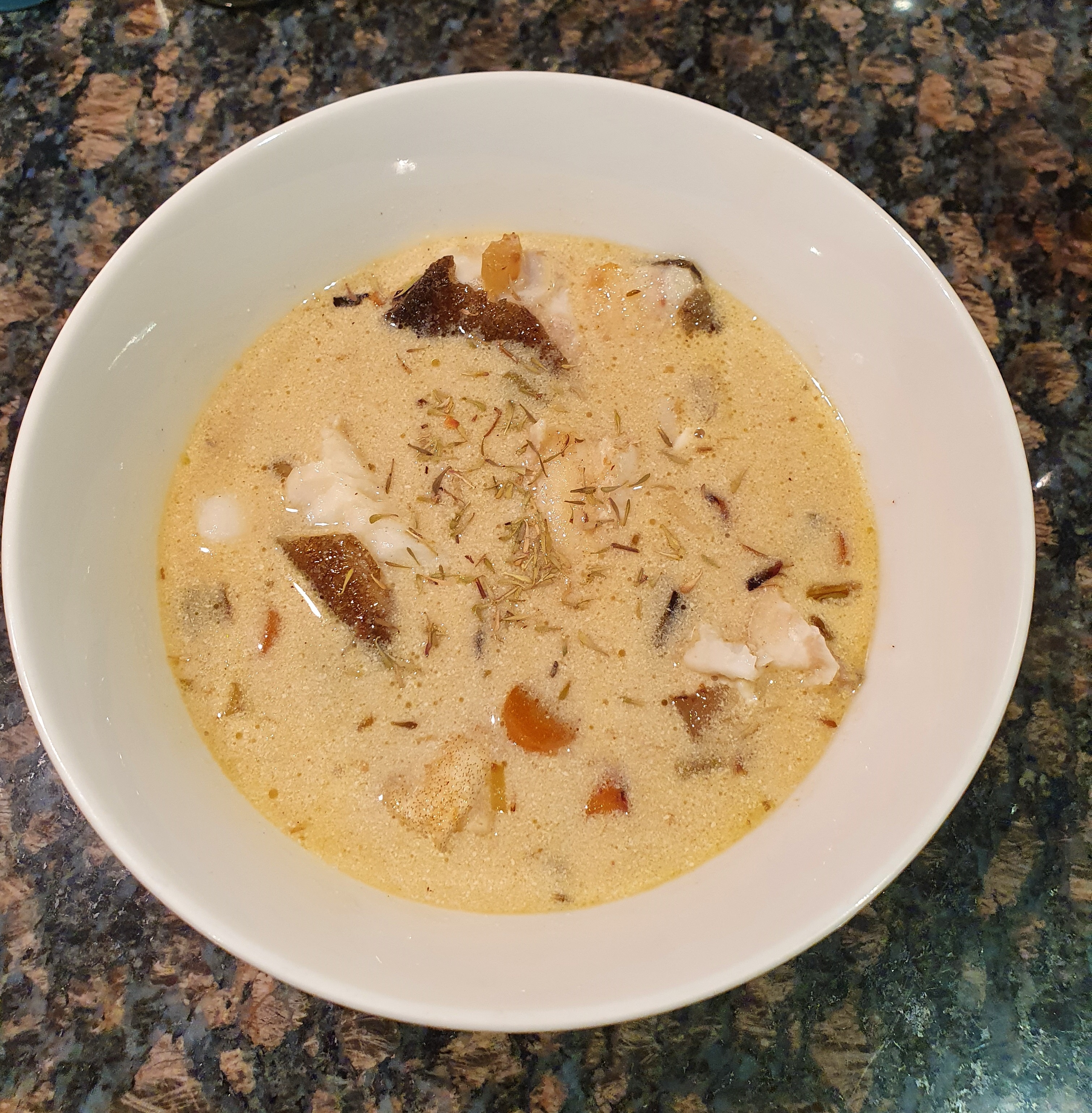
Dinner: Whitefish soup with cod, carrots, onions and thyme.

This dish was a bit of a trial. I was still feeling very lethargic and not especially hungry, but I had stunk out our entire flat making the fish stock and damn it, Mama didn’t raise a quitter. So, I fried up some remaining cod with some spring onions, celery and carrots, then topped it all up with the fish stock. A dash of cream later made it look a little less dire and more like a New England chowder. The taste was actually really nice and I do think making my own fish stock was worth it- the smell however lingered in the flat for days. This did nothing for my already diminished appetite.

Snacks: Rosehip tea, chopped ham.

Saturday

Breakfast: Hardboiled hen’s eggs, apple and flatbread.

Unfortunately, I didn’t photograph this. You will all have to console yourselves with imagining hardboiled eggs and apple.


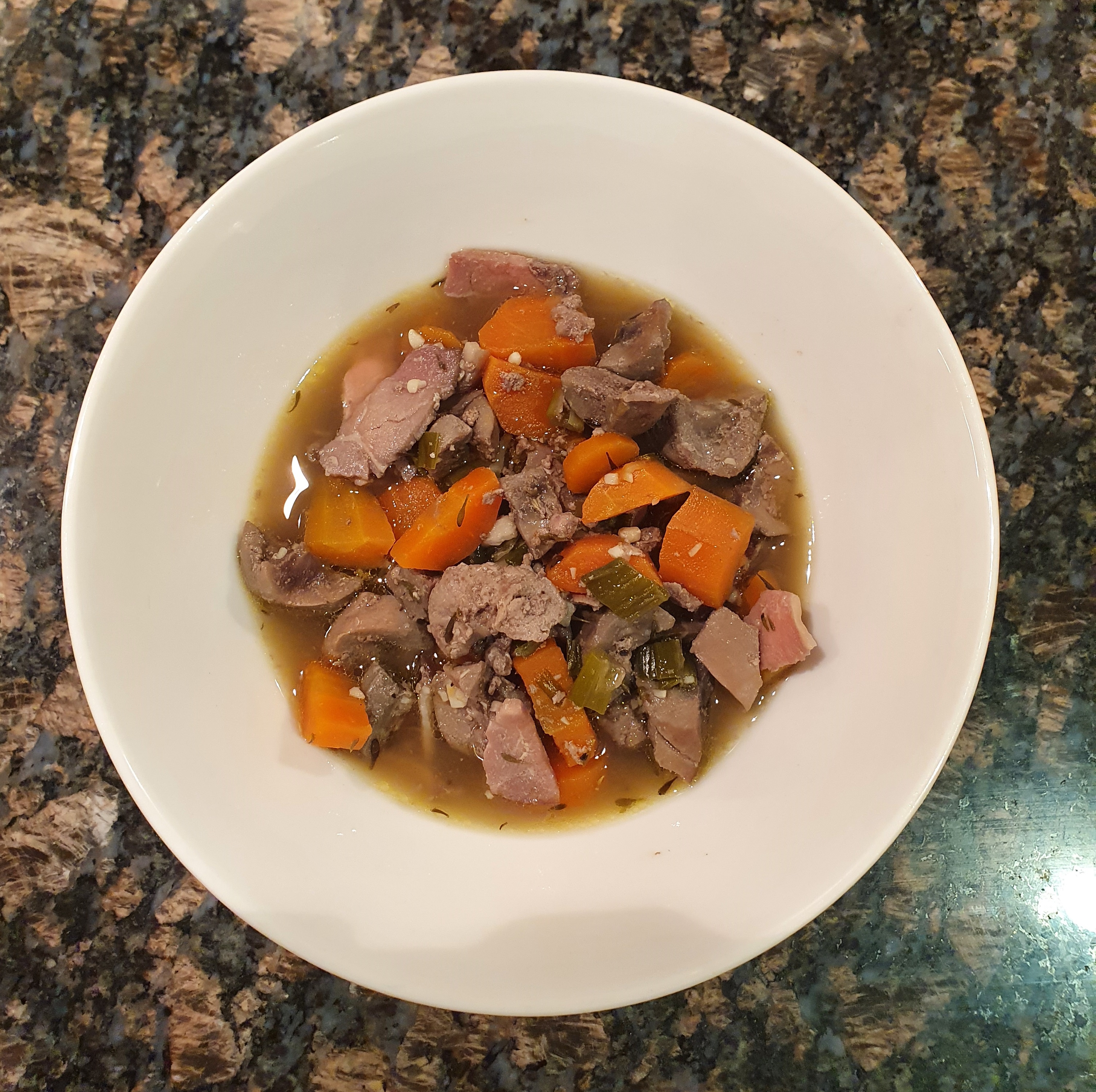
Lunch: Kidney and ham soup with carrots, spring onions and ham broth.

I think soldiering on through Friday’s fish trauma may have rekindled my appetite somewhat. Offal can be a divisive foodstuff for some, but I’m quite partial to it! I got some chopped ox kidney from our butchers for pennies and using veg and the broth saved from boiling my ham (with celery, garlic and ground coriander), I was able to make quite a tasty soup.

Animal remains from Anglo-Scandinavian York indicate that when folks did eat meat, they followed the nose to tail approach. Everything remotely edible on an animal was likely eaten. Personally, I believe that much of our modern snobbery and aversion to offal would have been baffling to Early Medieval Yorkies, who will have lived alongside what were essentially open air abattoirs. That is, however, just my view.

Offal generally is extremely high in vitamins and nutrients, which would have been an excellent supplement to a Medieval person’s diet (not that they would have known this.) Ox kidneys are apparently a great source of vitamin B12, selenium and riboflavin– which among other benefits, boost the immune system and reduce fatigue. Yet, here we are mostly putting them in dog food!


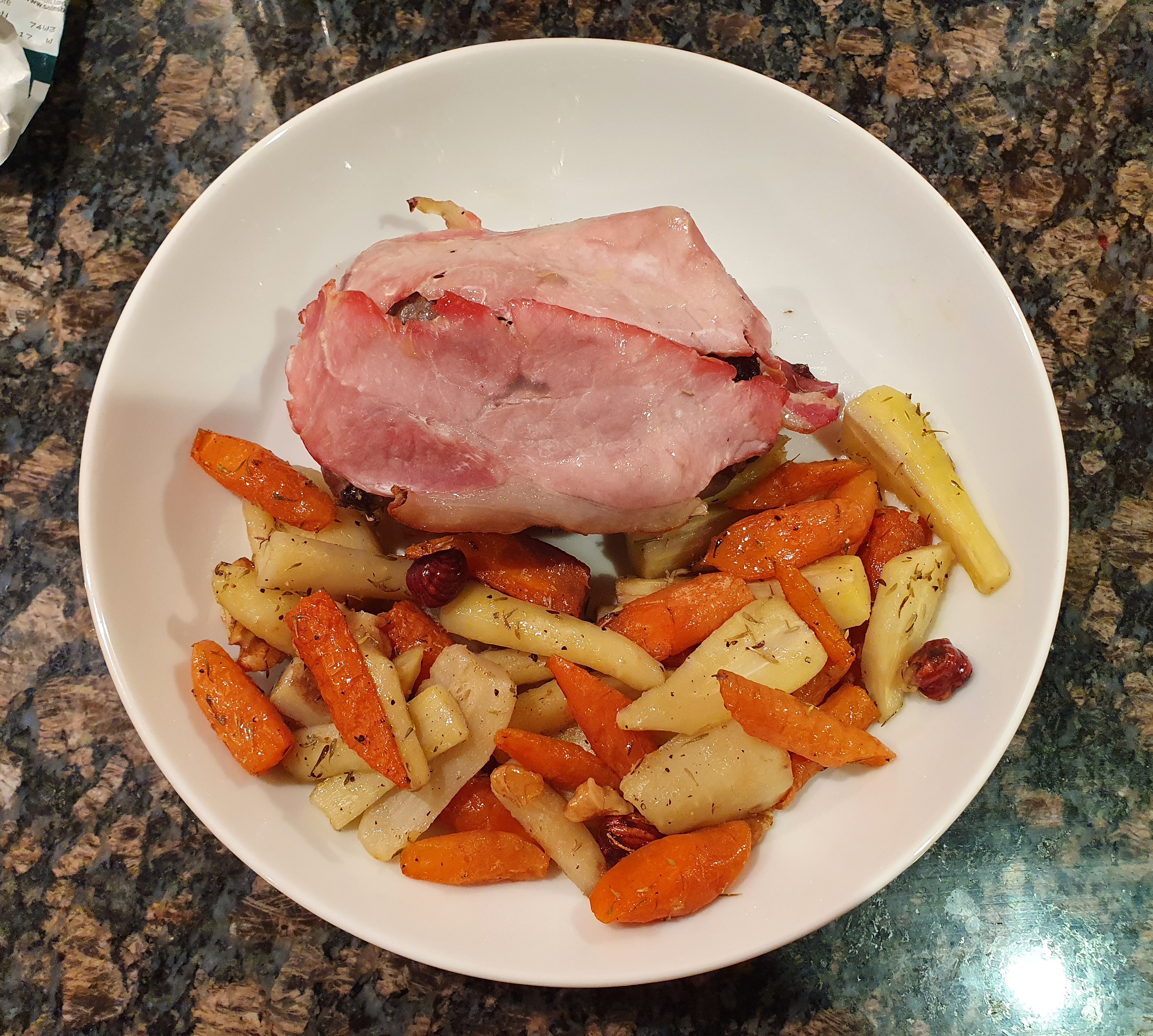
Dinner: Wood pigeon topped with bacon and stewed apple, stuffed with hazelnuts, walnuts and prune chutney. Served with roast mixed veg.

This is another dish that sounds quite posh, like something on the menu of a countryside pub with notions (you know the type I mean.) I had to ask around about where to get wood pigeons, as my grandparents didn’t have any in the freezer and they’re not exactly a common site at the big supermarkets. My grandad, who is a canny countryside gent, suggested that I go ask at the fishmongers on Market Street. I thought he was taking the piss at first- “Oh aye?” “Aye,” he said, so off I went.

Turns out he was right and the fishmongers really do stock wood pigeons, when they can get them. You heard it here first. Quite delighted, I ordered a couple and got some venison while I was at it (naturally, at a fishmongers.)

I roasted my prize bird and stuffed it carefully with the nuts and thick spoonfuls of plum chutney I made earlier in the week. The plum chutney really was gratifyingly easy to make and I think it would be even nicer if using spices and proper onions rather than spring onions. The secret is to use dried plums of the kind that would have been imported into Viking Age York- it makes for a much jammier chutney than fresh plums.

Regarding the pigeon itself, it wasn’t for me. The actual taste of the meat was gamey and almost bitter to my palate, thankfully Eric found it much more to his taste. The chutney and nut stuffing I was fond of, as well as the parsnips and carrots I roasted with the bird.


Snacks: Milk, dried sour cherries, mint tea with honey.

I’ve always been fond of mint tea anyway, but even more so when sweetness is limited. Aromatic herbal flavours seemed a lot more intense to me when I wasn’t eating so much processed sugar.

Sunday


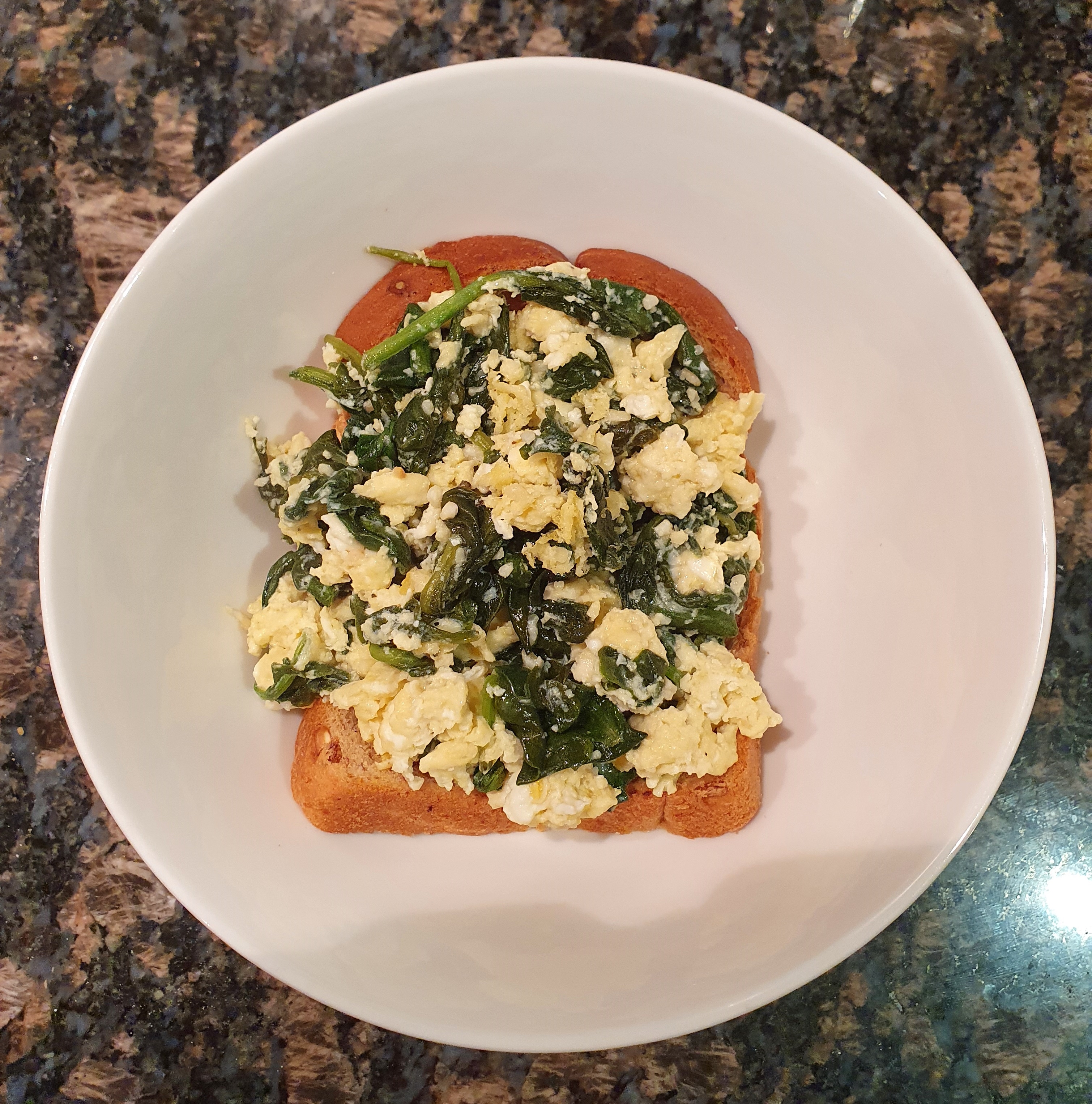
Breakfast: Scrambled eggs with spinach, on toast.

Just as it says on the tin, really. I did cheat somewhat and serve my hen’s eggs and spinach on top of regular sliced wheat bread- sue me. It was a Sunday, my entire home smelled of fish and if you’d asked me to bake a loaf or fry some griddle breads, I’d have strangled you.

Spinach is something I eat regularly in my modern diet, so I didn’t feel like eating it up until the end of the week. Leafy green vegetables like spinach would probably have featured prominently in the yards of Jorvík inhabitants, as they grow well year-round and are incredibly nutrient dense. To quickly wilt spinach with a little garlic and toss them with eggs seems as plausible a way to eat it as any, though I may be biased as this is how I often enjoy it in the 21st century.


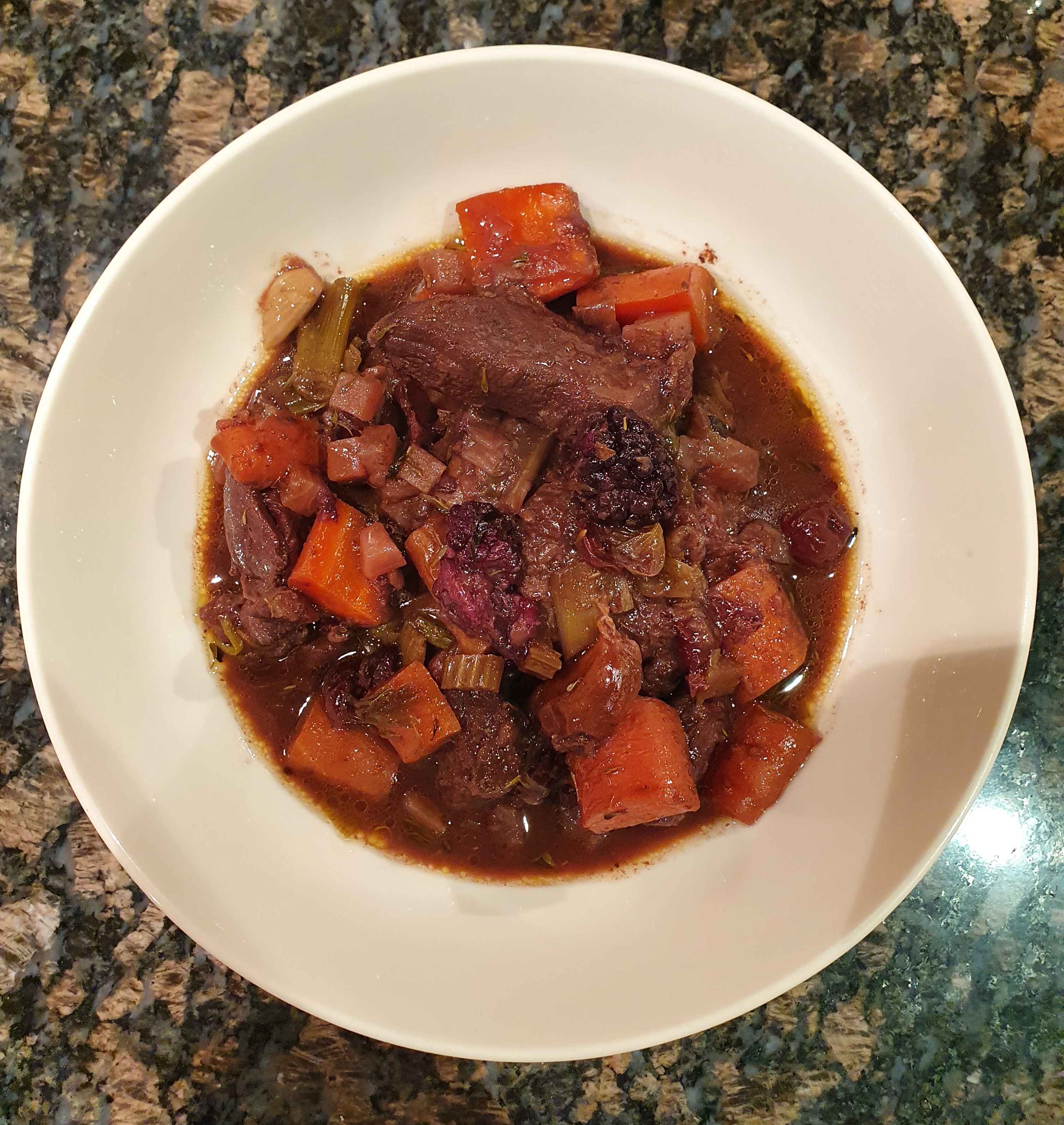
Dinner: Braised venison with blackberries and dried sour cherries, with veg (onions, garlic, celery, carrots, parsnips and pigeon stock.)

This was a special dish to end the week. I slowly braised the chopped venison steak over a low heat, adding dried sour cherries and fresh blackberries along with stock I made from the pigeon bones. The dried berries soaked up all the savoury stock and cooking juices from the venison, while imparting a woody sweetness to the dish. It went perfectly with the mixed veg I roasted alongside the meat.

This might have been quite a posh dish in period, with venison being a hunted meat and the dried cherries being imported from the continent. It certainly tasted decadent and I’d say that this is one of the dishes I would definitely make again, perhaps if friends came over to feast.

Closing note

This was most certainly a week. Despite frying everything in oil and butter, I actually lost 4lbs. I believe that this was due to my lack of appetite and most importantly due to cutting out much of the sugar in my diet. Weight loss was absolutely not my intention, but I’d be interested to see what would happen if I followed this kind of diet for a month instead. The lack of sugar had me feeling fatigued and generally pretty crappy for much of the week, but I think this would lessen if I’d have continued.

I found that my diet was pretty varied despite being (mostly) limited to the list above. Of course, it is important to remember that most Viking Age people would have eaten much of the same things most of the time, dependent on the season. It is a virtue of the modern age oft taken for granted that we can open the fridge and say “Huh, yesterday I had BBQ ribs, corn and mashed potatoes. I think today I’ll have a chicken dhansak.” This is a luxury that the huge majority of Early Medieval people simply didn’t have. They had the same kind of ingredients available to them during a given season and if they were lucky, they might zhuzh up a meal with the addition of a little something-something they caught or preserved earlier in the year.

The variety in my diet was a result of modern availability of foodstuffs year round and of refrigeration. Had I stuck to a week of bread and vegetable pottage with grains however, I doubt many of you would have found it all that interesting (the flatulence would have been astronomical, though.)

If I do repeat this week in the future, there’s quite a few ingredients that I didn’t get chance to use- these will come centre stage next time. I also avoided baking my own bread- I absolutely loathe making bread, but it would have no doubt been an essential part of most Medieval women’s day. So, I should probably make more of an effort to get my bake on next time! I’ll pay better attention to seasonality too. For now however, I am enjoying being able to indulge in spices, potatoes, chocolate and hot sauce. Not necessarily all at once.


References

Grimfrost. (2020). Viking Age food and cooking. [online video] Available at: https://www.youtube.com/watch?v=Io18i6Pfq_g. Last accessed 17th Jun 2021.

Priest-Dorman, C. (1999). Archaeological Finds of Ninth- and Tenth-Century Viking Foodstuffs. Available: https://www.cs.vassar.edu/~capriest/vikfood.html. Last accessed 17th Jun 2021.

Serra, D & Tunberg, H (2013). An Early Meal – a Viking Age Cookbook & Culinary Odyssey. Furulund, Sweden: Chronocopia Publishing. p1-192.

Wyrtig. (2015). The Lacnunga. Available: https://wyrtig.com/EarlyPlants/LacnungaPlants.htm. Last accessed 17th Jun 2021.

Bibliography

https://www.checkyourfood.com/ingredients/ingredient/716/ox-kidneys

Impressions: A Wealthy Anglo-Scandinavian Woman of Jorvík, Mid 10th Century

Location: Jorvík (York), England
Date: Mid to late 10th Century
Culture: Anglo Scandinavian
Estimated Social Class: Middle, wealthy urban

This will hopefully be the first of several speculative York impressions, built to showcase various artefacts and show how they potentially could have been worn/used in their day. It is not based on a grave nor is it to be taken as absolutely representative of the fashion of the place and time. My aim is to show a sensible and plausible outfit based on contemporary artefacts unearthed across York and give context to those remains and fragments.

Excuse my modern garden backgrounds, my 10th century longhouse was in the wash.

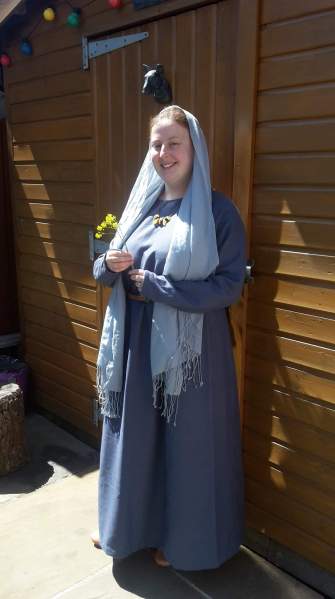
Starting from top to bottom:

Headscarf

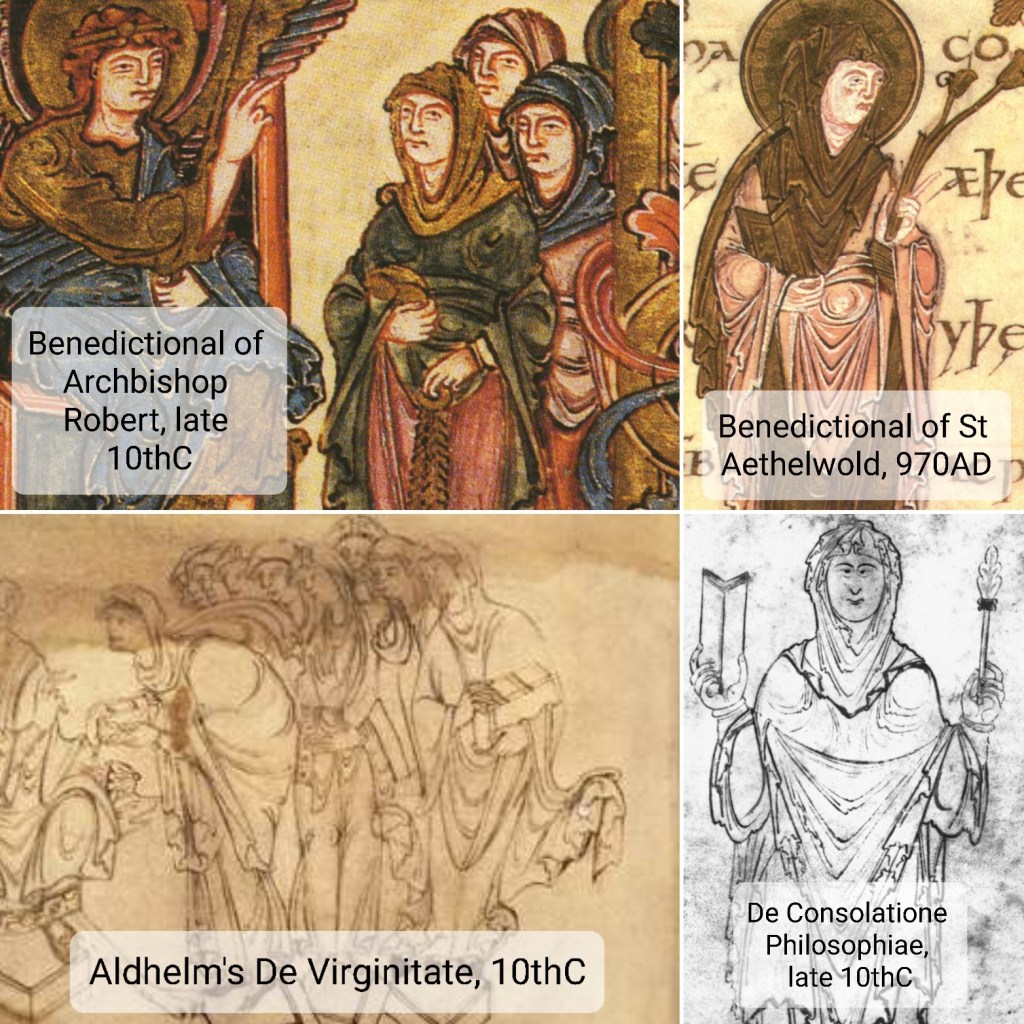
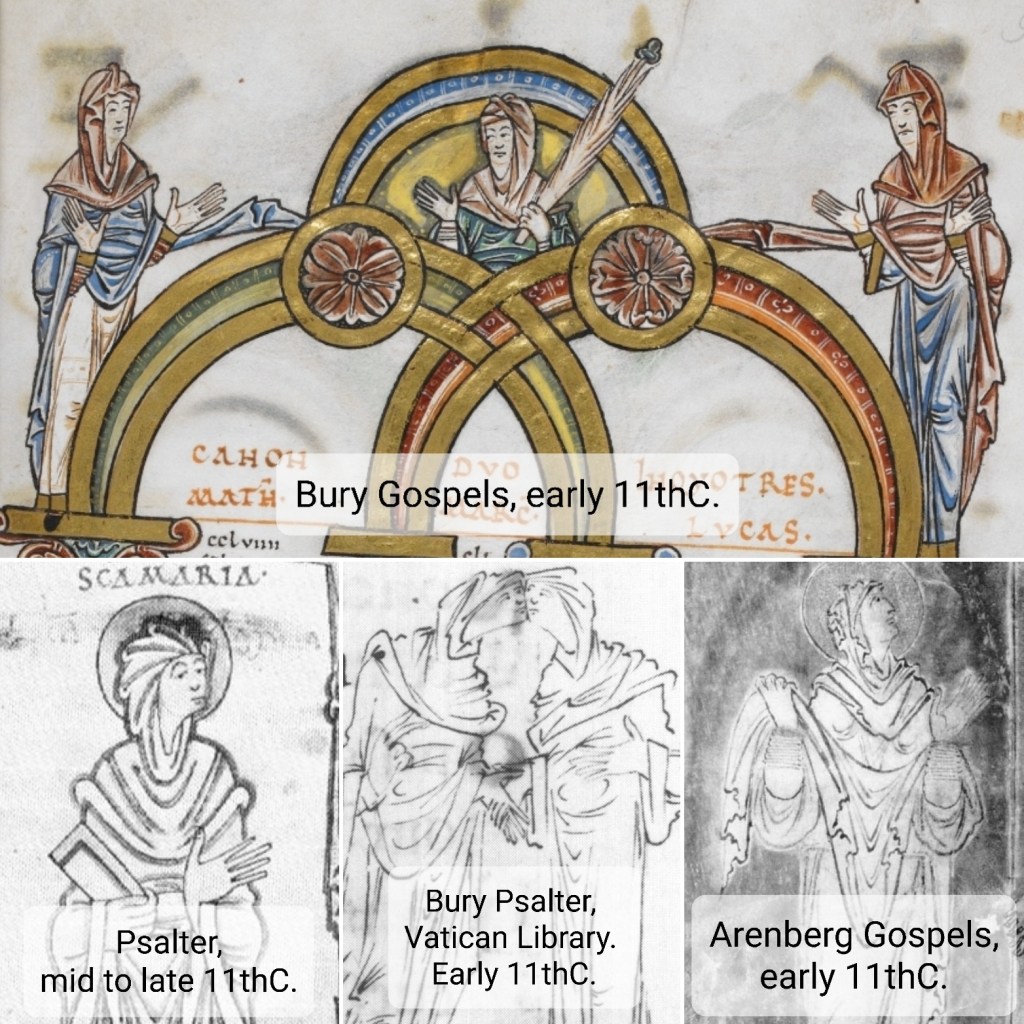
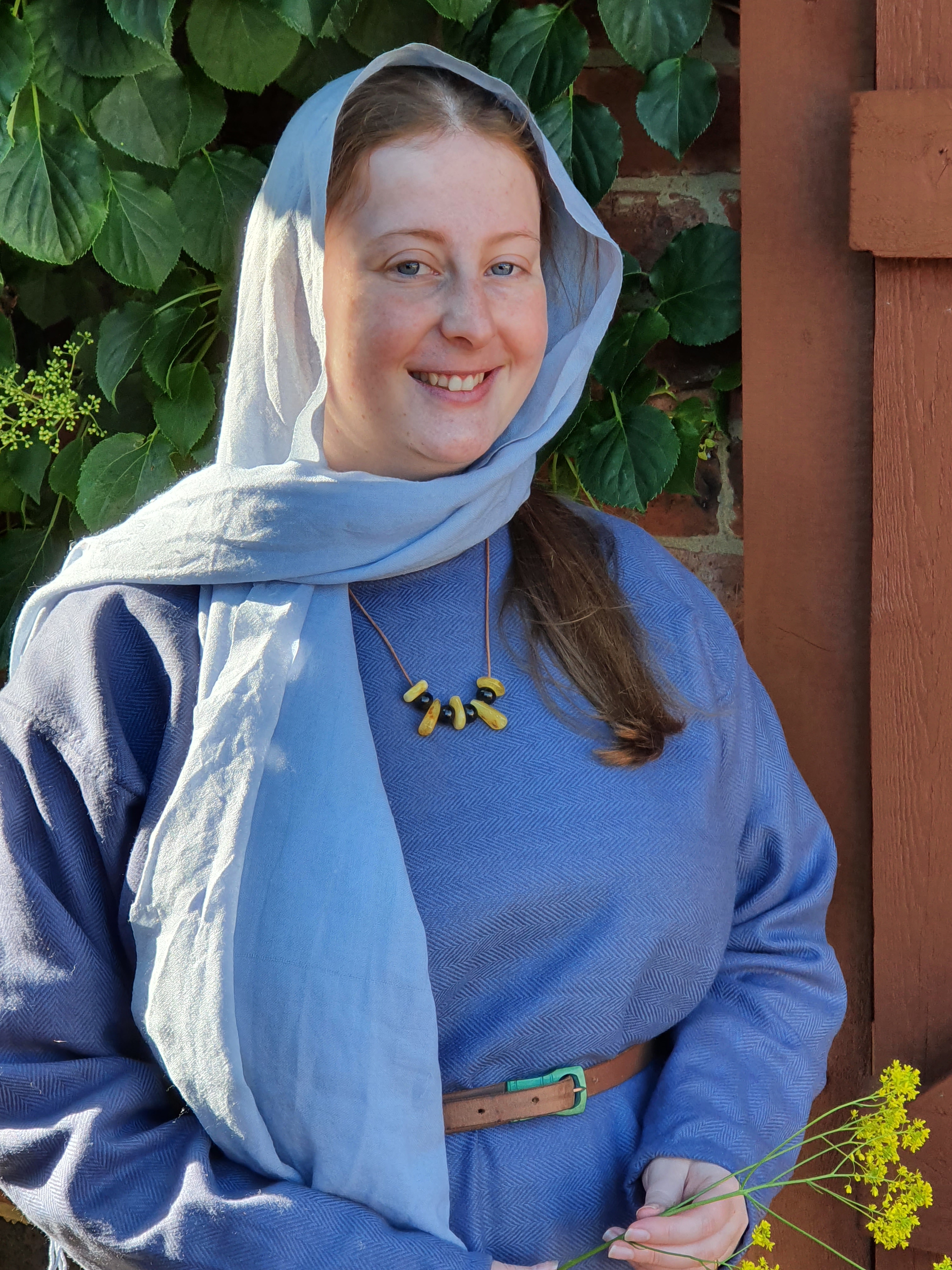
My veil is a plain weave, pale blue wool scarf. It is not naturally dyed, but in shade it closely mimicks woad. Women are almost exclusively portrayed veiled in Early Medieval English art, yet few examples of such veils are represented in the archaeological record. Fine woollen scarves with tassels have been found in Dublin, dating to the early 10th to mid 11th centuries (Wincott Heckett, 2003, pp.9-43). My veil is closer in size to the larger examples found at VA Dublin, such as the silk scarf DHC17 from Fishamble Street (dated to the early 11th century) but matches most closely with contemporary English manuscript depictions in size.

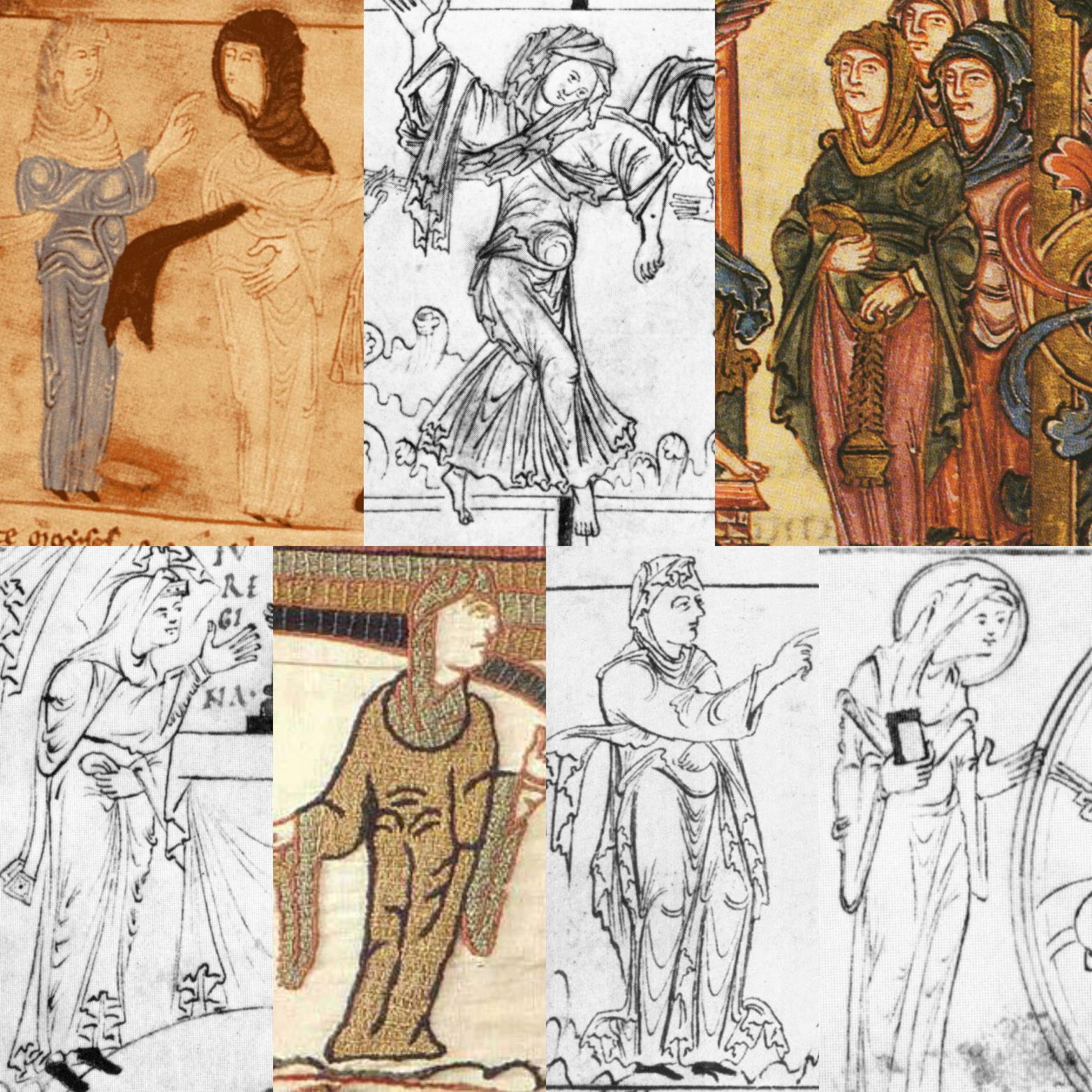
I wear this scarf several different ways even within the same day, tossing the ends over my shoulders as and when it’s required. The weather was balmy when I took these photos, so pins and a fillet weren’t needed. On windier days or if I’m feeling a little more haughty and austere, I’ll pin my veil onto a cap worn underneath and sometimes a fillet. Period variation in wimple/veil style is supported by English manuscript depictions, which show several different styles were worn. Presumably this was down to preference, though of course it could be an indicator of class or piety.

I could talk all day long about headcoverings, suffice to say that I will cover them in greater detail in a future post if people wish.

Necklace of amber and jet

The whole necklace, threaded on a fine leather thonging.
One of the triangular amber pendants.

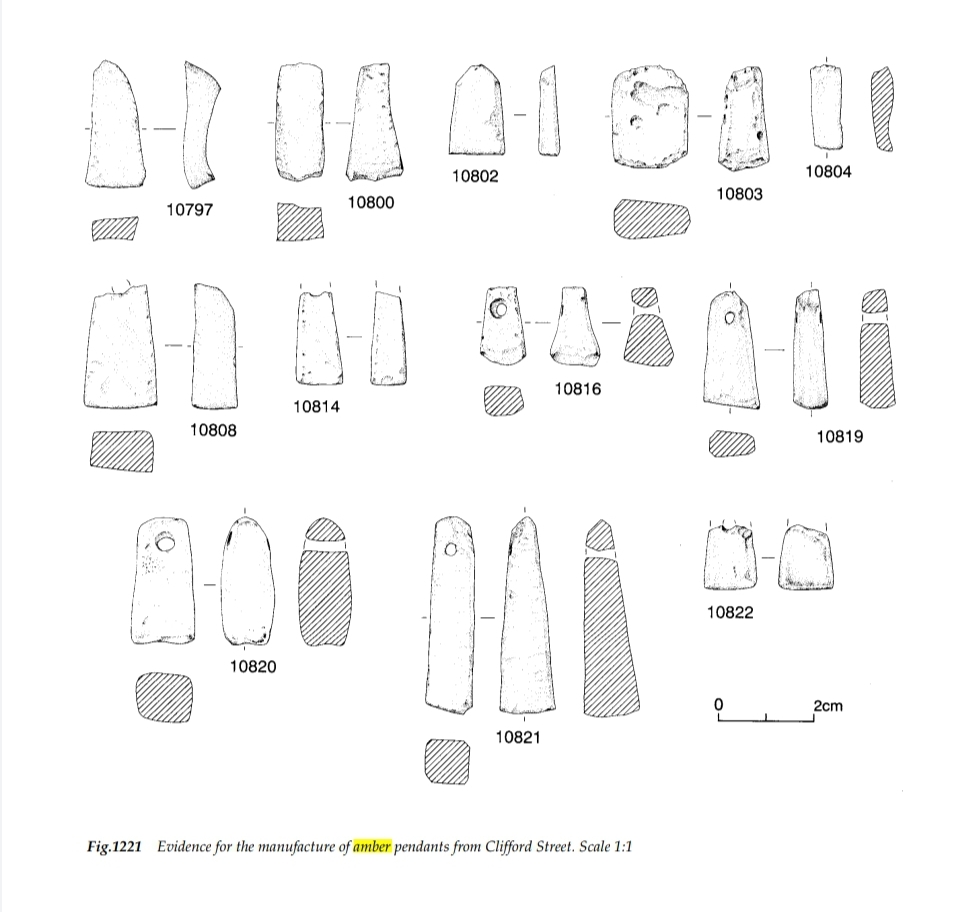
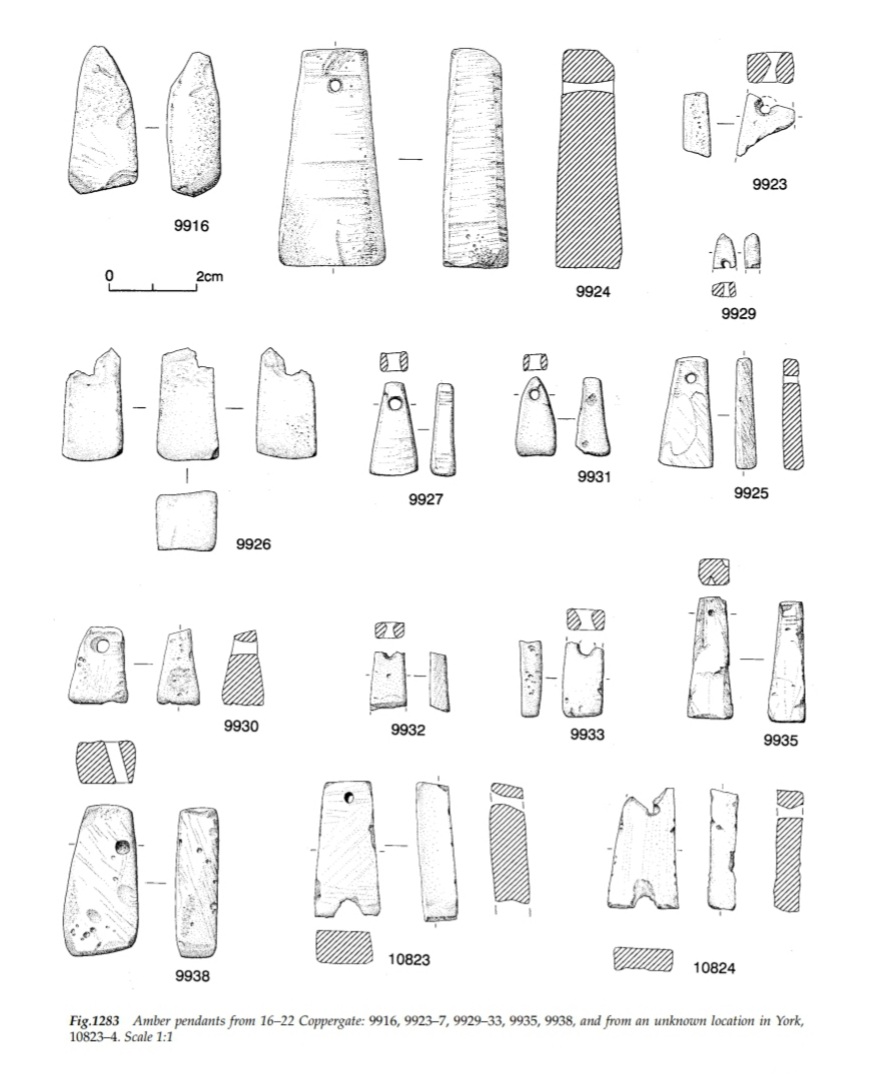
My necklace is made up of amber and jet, based on pendants and beads found at 16-22 Coppergate and other nearby sites. Extensive evidence for amber working in York was found at Clifford Street and 16-22 Coppergate, with fragments also being found at 22 Piccadilly and elsewhere on the Coppergate site (Mainman and Rogers, 2000). The wedge-shaped pendants I used are a little more rounded than the originals, but they can be replaced as and when I find a gemologist who will make me a more accurate replica. 😁 Many of the amber beads and pendants found at 16-22 Coppergate were dated to period 4B (c.930/5-c.975 AD.)

Found in (Mainman and Rogers, 2000, p.2507)
Found in (Mainman and Rogers, 2000, p.2589.)

The evidence for jet working at 16-22 Coppergate is definite, whether or not that evidence belongs to the Anglo-Scandinavian period is a subject of debate. Some items were found in Anglo-Scandinavian levels, but it has been argued that they were Roman items that ended up deposited in later levels through the passage of time. It does however remain possible that some of these jet items were indeed stratified correctly and I am working with that assumption.

The beads I used for my necklace are Whitby jet, dating to the late Victorian or early Edwardian period. They’d been reassembled into a new modern necklace, so I liberated them and used them for this project. Like their amber brethren, they are not perfect- they’re a little too spherical and neat. The jet finds from York consist of finger rings, bracelets, gaming pieces, pendants and manufacturing evidence (Mainman and Rogers, 2000). There was also an item identified as a bead (dated to the 5A period, approx 975 AD) but unfortunately it was stolen. I have included my beads in this impression based on the semi-worked fragments, the lost bead and the similar beads found in glass, amber and other materials.

Dress

The flower I am playing with is from my immortal woad plant, which is busy taking over my poor mum’s raised bed. I am pretending to be sorry about that.

My dress is made of a 2/2 chevron (herringbone) twill wool. I’ve dyed lots of wool blue using woad, but not this wool- it is chemically-dyed mimicking shades of a natural woad vat. It is handsewn by me with wool and linen thread. Textile fragments of broken chevron twill dyed with indigotin (the blue colour compound found in woad) were found at Coppergate, item number 1302 (Walton, 1989). The material was dated to period 4B, indicating a date of c.930/5-c.975 AD. It is described it thus:

“Fragments, largest 140 x 100mm, of mid brown 2/2 chevron twill, 8/Z/0.9 x 5-6/S/1.2 (Fig.134a). Yarn soft and unevenly spun. Fleece type, Z medium, S hairy. Dyed with indigotin. Hard concretions containing cess-like material adhere to parts of the textile.” (Walton, 1989)

In all the surviving textiles from Anglo-Scandinavian Jorvík, woad is represented but it is not the most common dyestuff. Madder- and bedstraw-dyed fragments are the most numerous by leaps and bounds, which indicates a distinctly English taste in Anglo Scandinavian York (I’ll discuss this at more length in a future article.) Woad however certainly did feature in the clothing of Jorvík city dwellers and I just so happened to have some suitable fabric leftover from a dress made for a dear friend many moons ago. Being a Yorkshire lass through and through, regardless of the century, I was using it.

No complete or near-complete garments have survived from Jorvík apart from the famous sock and several head-coverings. I therefore kept the pattern of my dress and undertunic as generic as possible. Women in contemporary English art are always shown wearing ankle length, long-sleeved garments, usually with some indication of skirted construction. It is believed that this might have been the case in Scandinavia too, with women in contemporary art there usually being shown to wear garments that are at least longer than men’s (Ewing, 2007).

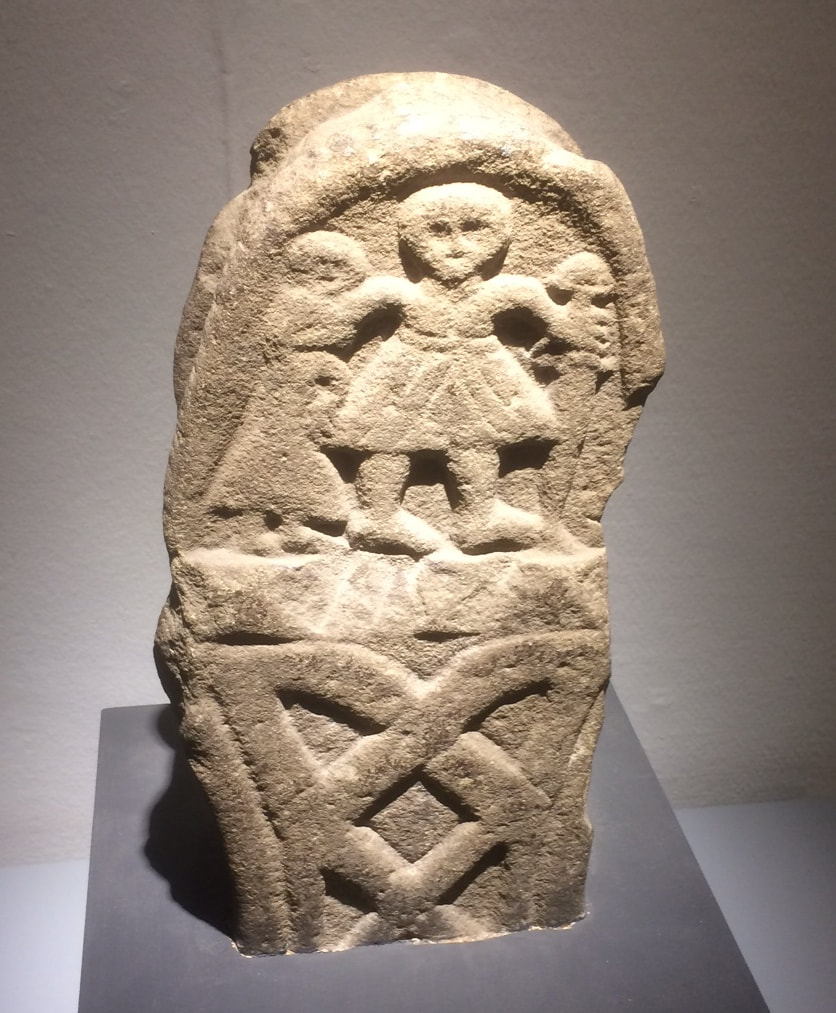
An Anglo-Scandinavian cross fragment from All Saints Church in Weston (North Yorkshire), dated to the 9th century. It is believed to show a warrior with a female captive and be a reworking of an original Anglian cross. Source.

Towards the end of the Viking Age in England, the sleeves on women’s overgarments appear to have grown wider, with tight-sleeeved garments being seen peeking from underneath them. I kept the sleeves on my dress relatively close to the arm so it would be more suitable for earlier impressions, with the opportunity to dress it up later with the simple addition of a mantle or baggier-sleeved overdress.

It is also prudent to note that almost all of the women portrayed in contemporary English art were very high in social status or were religious figures. They represent an ideal of the most aristocratic and modest women, not the daughters and wives of merchants (even wealthy ones) who might have walked through Coppergate. So, my York lady may well have worn her dresses with baggier sleeves on special occasions but likely not to go to the market.

Details from various 10-11th century sources: Top left- Folio 10 of the Old English Illustrated Hexateuch, 11thC English. Top middle- Luxoria from Prudentius’ Psychomachia, late 10thC English. Top right- Detail of supplicants from the Benedictional of St Aethelwold, late 10thC English. Bottom left: Detail of Queen Emma from the New Minster Liber Vitae, 1031 AD English. Bottom middle left- Detail from the Bayeux Tapestry, late 11thC English (suspected.) Bottom middle right- Patentia also from Prudentius’ Psychomachia. Bottom right: Mary also from the New Minster Liber Vitae. Source.

Surviving remains of skirted tunics such as the Skjoldehamn, Haithabu and later Herjolfsnes finds show examples of how these women’s garments in the Viking Age could have been constructed. Due to cloth constraints and to better fit my body, I opted for bottle-shaped side gores starting at my underarm. This construction provided the correct period silhouette while remaining comfortable.

My undertunic (or serk) was made in a similar pattern, only in undyed linen with a plain round neckline and triangular gores.

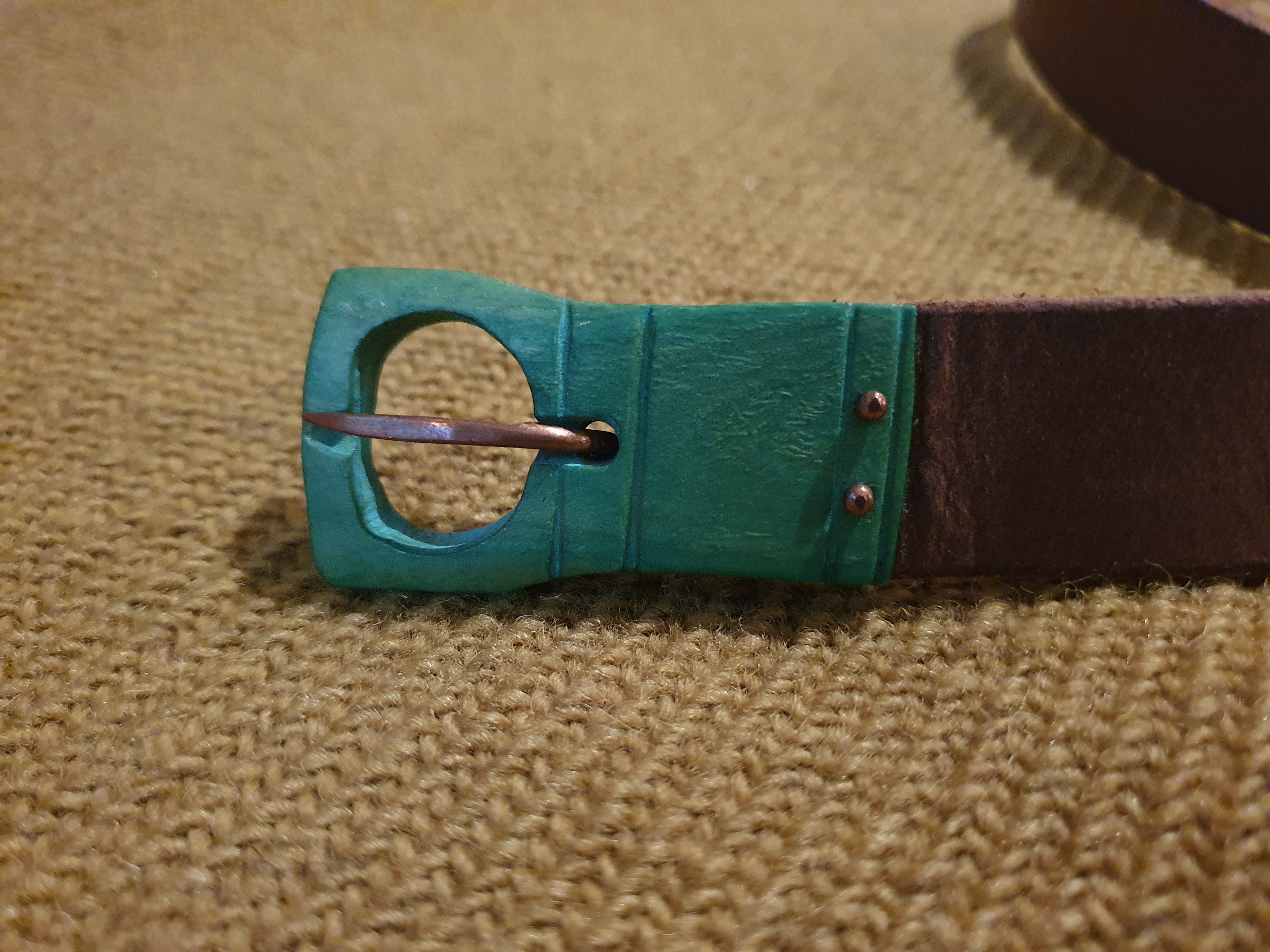
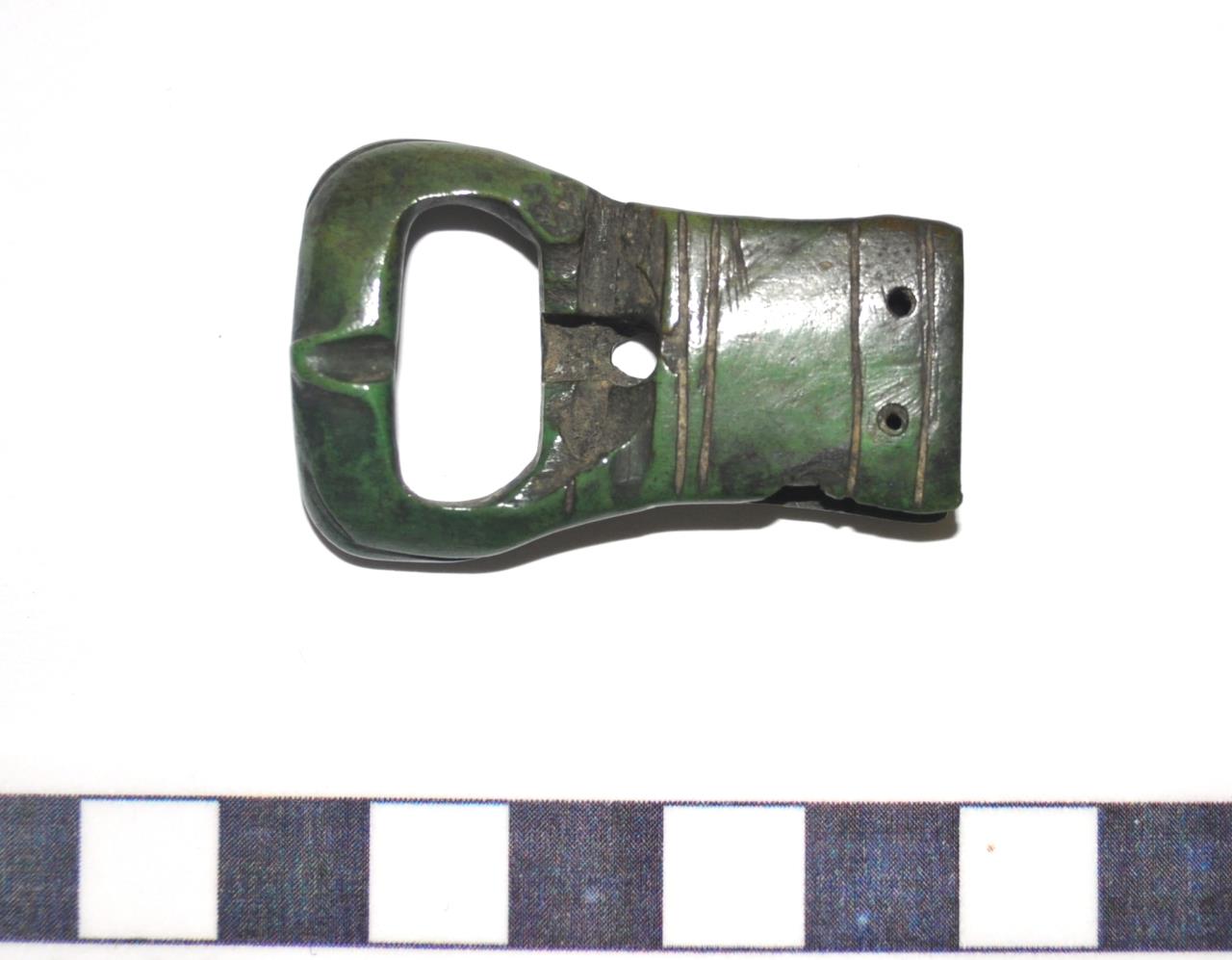
Leather belt with dyed bone buckle

Source.

Over my dress, I wear a belt of dyed bone buckle. This is an unusual item, currently kept in the Yorkshire Museum. The museum lists it only as Anglo-Scandinavian and dating to between 866 and 1066. It is generally believed that Early Medieval women did not wear leather belts, either opting for textile belts that have rotted away since or foregoing belts altogether.

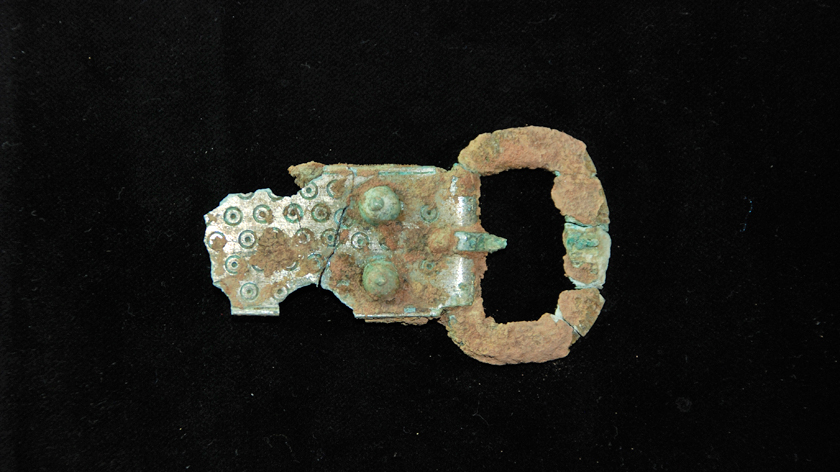
However, a 10th century grave of a woman in Cumwhitton (Cumbria) has challenged this assumption. One of the female graves contained a belt buckle and strap end, both made of copper alloy (Paterson, Parsons, Newman, Johnson & Howard Davis, 2014). I am fond of the York dyed buckle and since it was not found in a grave context, I feel comfortable including a leather belt as part of a wealthy female impression.

The Cumwhitton belt buckle from Grave 2. Source.

An interesting discussion of belt hardware surviving in female graves can be found in the bibliography. My replica of the belt and buckle was made by Sándor Tar on Facebook.

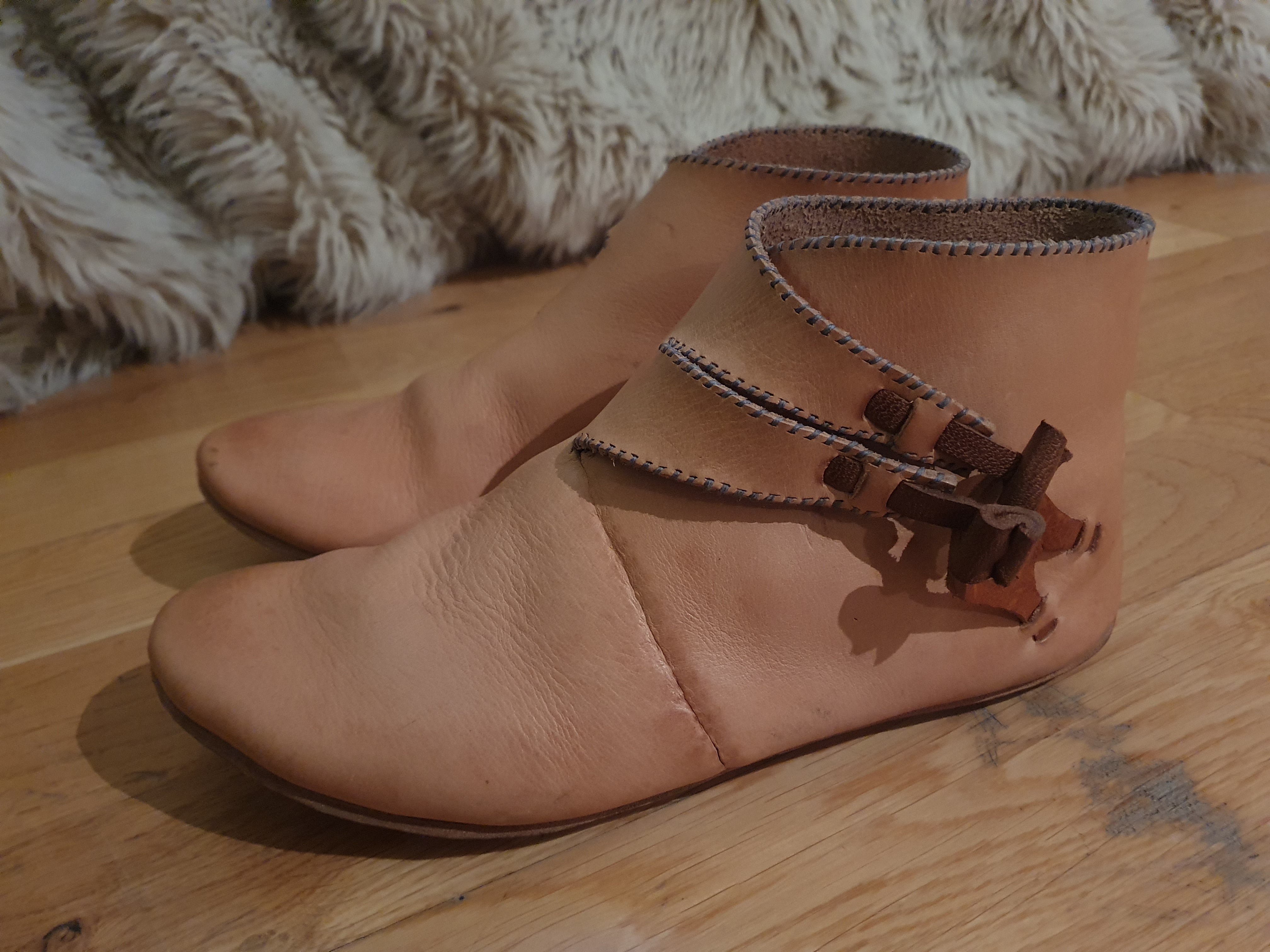
Leather turnshoes

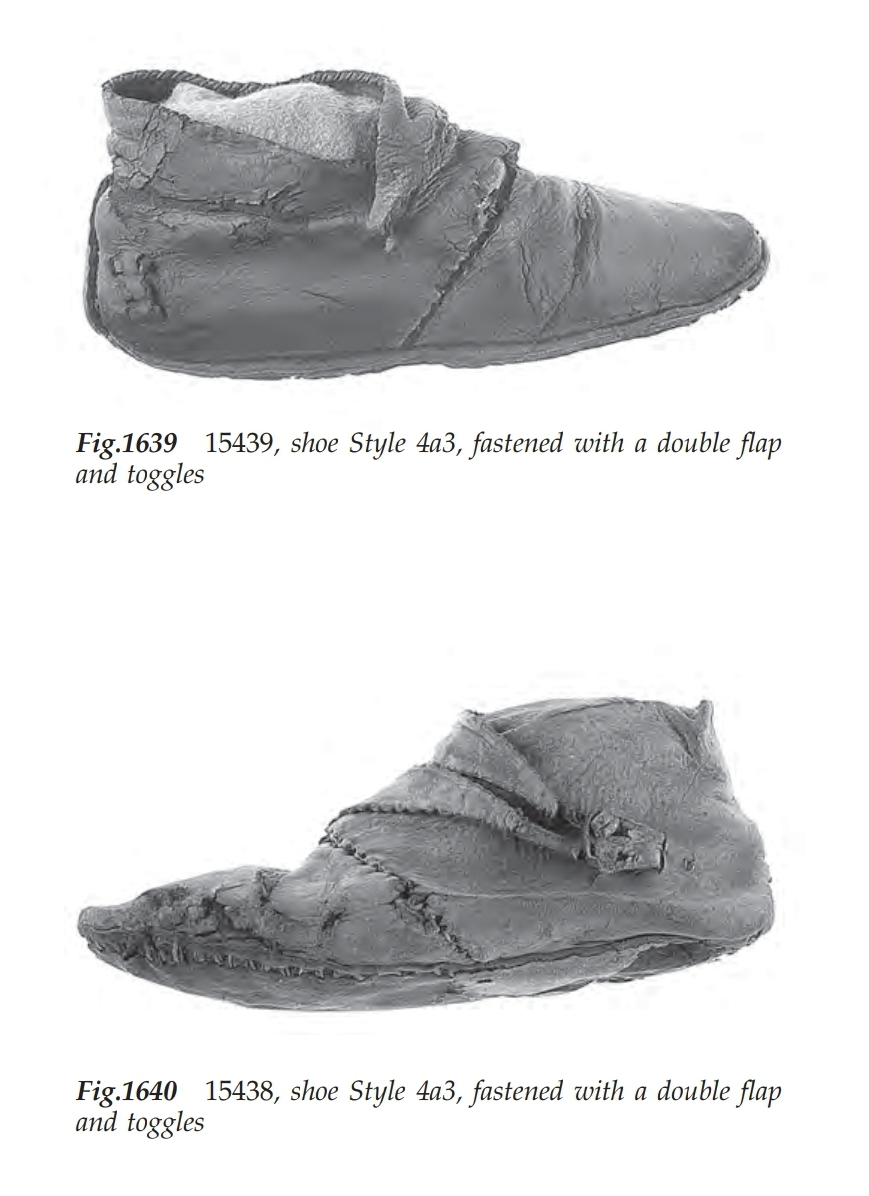
Type 4a3 leather turnshoes.

On my feet, I wear leather shoes, based on the Style 4a3. They are of a turnshoe construction and made of vegetable tanned leather. This pair was made by Torvald’s Leather Workshop.

Shoes of Style 4a3 have been found at 16-22 Coppergate from the earliest layers of occupation (mid-late 9th century at the earliest) throughout the whole Anglo-Scandinavian period, but finds of this type are most numerous in the mid 10th century layers (Mould, Carlisle and Cameron, 2003). Shoes of this style were also found at nearby Hungate and fragments indicating this style have been found in Oxford also.

Style 4a3 shoes, image from Mould, Carlisle and Cameron, 2003, p.3306.

I love this style of shoe, I think they’re really cute and so evocative in their style of Viking Age fashion itself. The only problem? The pair I have have the flaps on the wrong side of the foot! A large group of the shoes found in Jorvík had flaps and toggles over the instep- fastening on the inside of the foot, not the outside. Mould, Carlisle and Cameron (2003) even acknowledge that it seems like toggles on the outside of the foot would be more practical, but I found the opposite to be the case when actually putting them on. I’m aiming to replace these shoes in the future with ones closer to the originals, but they are gorgeous nevertheless and being handmade they are very comfortable.

Underneath these shoes, I wore a pair of woollen naalbound socks, loosely based on the Coppergate socks. However, they have graciously served me for several years now in all weathers and are not fit to be seen. I will certainly cover the mighty Coppergate sock in the future though.

Who might have worn this?

The wife or daughter of a wealthy urban merchant perhaps, someone who had the cash spare to afford dyed garments such as my dress and scarf. Worked amber and jet beads too would likely have been status items, with amber being imported from abroad from the Roman period.

It is also possible that a wealthy woman from more rural areas could wear an outfit like this, the wife of a rich farmer perhaps. This is not the kind of clothing one wears during the working day however, so it would be relegated to Sunday best or feasting clothing (I suspect that this would also be the case for an urban woman.)

References

Ewing, T. (2007) Viking Clothing. Stroud: Tempus Publishing. p9-70.

Mainman, A. J. & Rogers, N. S. H. (2000). Craft, Industry and Everyday Life: Finds from Anglo-Scandinavian York. York: Council for British Archaeology. p2451-2671.

Mould, Q., Carlisle, I. & Cameron, E (2003). Craft, Industry and Everyday Life: Leather and Leatherworking in Anglo-Scandinavian and Medieval York. York: Council for British Archaeology. p3306-3310.

Paterson, C., Parsons, A. J, Newman, R. M, Johnson, N & Howard Davis, C. (2014) Shadows in the Sand: Excavation of a Viking-age cemetery at Cumwhitton, Cumbria. Oxford: Oxford Archaeology North.

Walton, P (1989). Textiles, Cordage and Raw Fibre from 16-22 Coppergate . York: Council for British Archaeology. p285-474

Wincott Heckett, E (2003). Viking Age Headcoverings from Dublin. Dublin: Royal Irish Academy. p9-43.

Bibliography

The entry for the dyed bone buckle from York in the York Museum Trust online collection. https://www.yorkmuseumstrust.org.uk/collections/search/item/?id=7484&search_query=bGltaXQ9MTYmc2VhcmNoX3RleHQ9QnVja2xlJlZWJTVCMCU1RD0mR3MlNUJvcGVyYXRvciU1RD0lM0UlM0QmR3MlNUJ2YWx1ZSU1RD04NjYmR2UlNUJvcGVyYXRvciU1RD0lM0MlM0QmR2UlNUJ2YWx1ZSU1RD0xMDY2JkZOPQ%3D%3D

An article on belt hardware present in female graves in the Viking Age. http://www.medieval-baltic.us/vikbuckle.html

A corpus of 10-11th century images of English clothing in art. http://www.uvm.edu/~hag/rhuddlan/images/index.html

More information about the All Saints Church cross fragment (Weston, North Yorkshire.) https://m.megalithic.co.uk/article.php?sid=26680

March Round-Up: What am I up to?

Evening all. Spring is here and getting into full swing. The weather here in York has been gorgeous the past few days, much to my joy- the return of the rule of 6 couldn’t have come at a better time.

In the meantime, I’ve spent the past month fairly quietly. Eric and I are having to move house in the next few months, so we’ve been on a mission to find somewhere new (still within York though!) My roots are here and they grow deep, so I won’t be moved out of the city quite so easily.

As usual, I’ve been working best I can on commission work. I’ve got a queue of patient customers waiting and so their items must always come first. I’m lucky to get asked to do a nice mix of interesting bits and old-faithful kit pieces, so each customer is different.

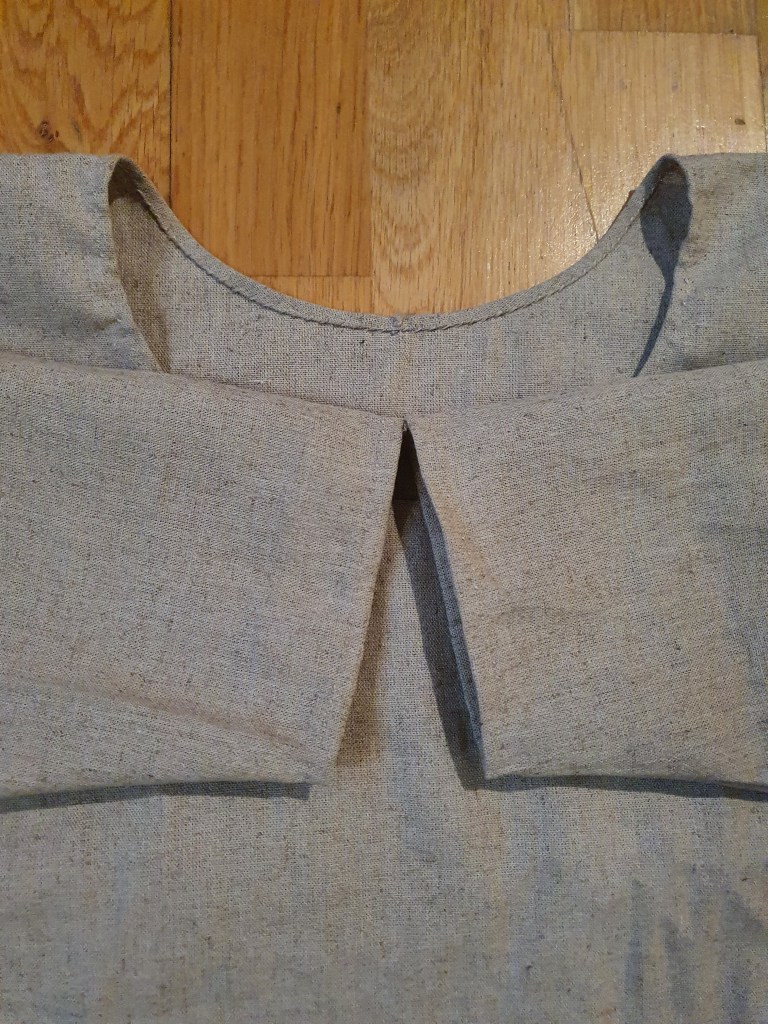
I do many, many of these plain linen tunics each year. I’m quite fond of them.
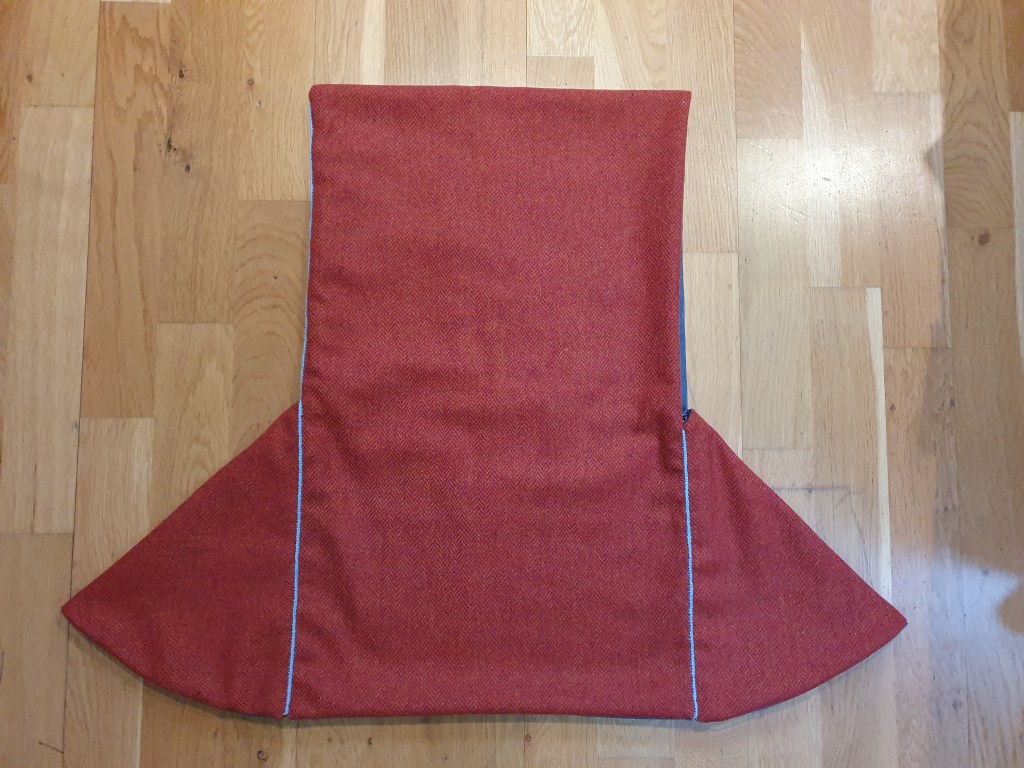
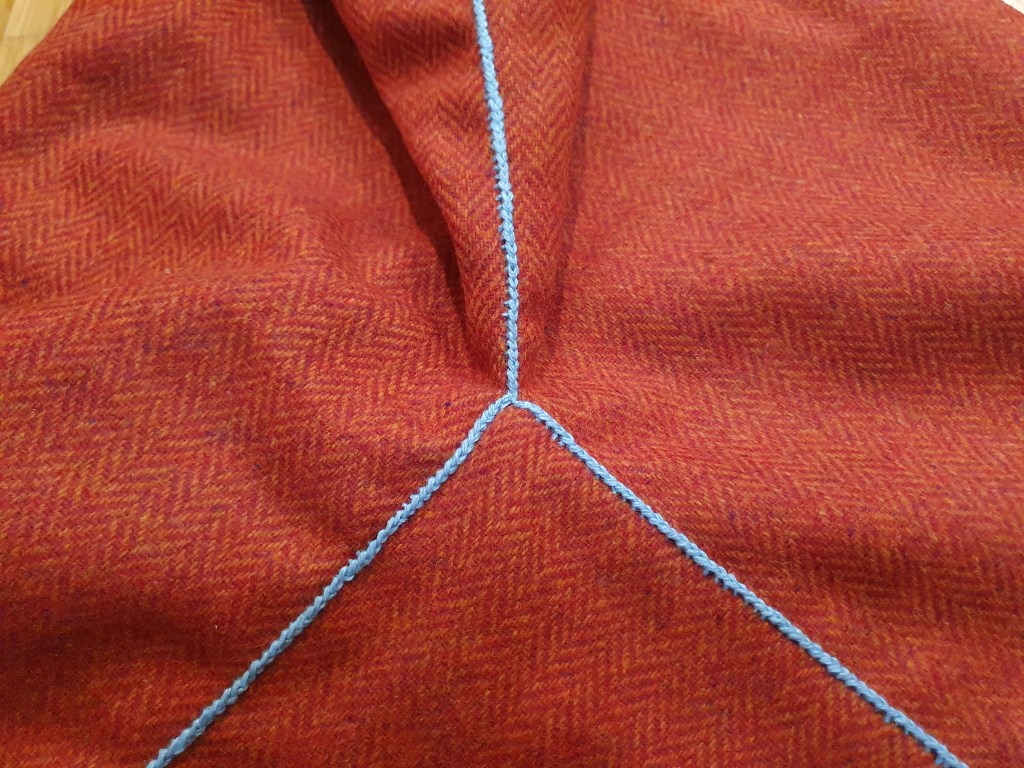
The customer wanted a bold red hood, a simplified design based on fragments found at Hedeby harbour. He wanted it lined in blue linen (we don’t have evidence for lined hoods, but he finds linen lining more comfortable) and so I used similar thread for a decorative seam treatment. I think it turned out nicely.

In my own time, I’ve been slogging away at a couple of different projects. Some are secret for now (I plan to give them their own articles in due course), some are just not all that exciting. I did manage to finally finish my own boy tunic at long last, which was a labour of love. I started it in early September using offcuts of leftover grey wool I had and intended it to be done in time for my walk from Riccall to Stamford Bridge. This obviously didn’t happen and I kept picking it up to do a seam here, a seam there. It is entirely handstitched and all the seams reinforced. It is extremely satisfying to manage to cobble together something useful from leftovers and perhaps even more so when the endeavour takes you a while. This one is an item I’ll probably write about and take some photos of, when I feel up to it.

All of the above are ongoing projects.

Anyway, that’s enough from me. To tell you the truth, I only logged in to write because I didn’t want to let March pass by without an update! It’s not been a month of note, but by no means have I been idle. 😁

I’ve got a few pieces I’ve been working on for a little while and I hope they’ll be of interest to some of you. Take care all, enjoy the nice weather while it lasts and keep washing your hands 😘

A Conversation with Popula Urbanum- Gender and Equality in Re-Enactment

Last month, I was pleasantly surprised to receive a message from my friend Nadeem (of the excellent Sogdian group Eran ud Turan), asking if I’d be willing to take part in a YouTube chat video about gender roles and inclusion in historical re-enactment. He’d previously taken part in a discussion on the same channel, discussing gate-keeping in the hobby and diversity.

I was flattered but very anxious to broach this topic. After all, I am both a living historian and a woman, but what could I have to add to the conversation?

We decided to just go for it and see where the conversation went. My gracious host and total legend Andrew (one half of Popula Urbanum) was a delight to talk to and we all enjoyed the discussion. Despite my constant umm-ing and ah-ing, we covered a couple of talking points relating to inclusion in the scene and how we can all go about mindfully considering how we might be coming across, both to the public and to our fellow re-enactors. If that sounds like your kind of thing, give it a watch!

Thanks for having me fellas, it was a pleasure!

Give some love to Andrew and Ocean over on their channel Popula Urbanum, they post regular videos on Medieval society, kit-making and re-enactment as a hobby. Nadeem is working on a photobook showcasing early Iranian fashion and artefacts, as well as regularly writing articles on his Patreon for Eran ud Turan– give him some love too!

If you found your way to my blog from this video, then hello and stay tuned. The Eoforwic Project is pretty new and I have a lot of big ideas to share with you all. To give you a “taste” of what you can expect very soon, I’ll leave you with this…


An 11th Century Man’s Hat from Dublin- A Parallel With Early Medieval Frisia?

Hats! One of my favourite things. The discerning Early Medieval woman (and those who wish to dress like one) seem to be relatively spoiled for choice: caps, hoods, veils, wimples and even headbands are all options. Unfortunately, the evidence for male headgear in period is generally not as well-represented. Chrystel R. Brandenburgh (2010) did a fantastic study of early textiles found in Frisia (a region in what is now the Netherlands) which details several hat fragments dated to the Viking Age, including an extremely spiffy example from Aalsum.


The original hat found in Aalsum (object nr. FM 33-373), in the collection of the Fries Museum. Photo taken from Brandenburgh (2010).

The Aalsum hat is dated to 750-900 AD, towards the end of the estimated habitation of the find site. It is woven in a 2/2 diamond twill and is made of brown wool with no dye being detected. While there are a couple of other hats from Frisia with some form of neck flap (presumably to shield the neck from the elements), I was interested by this hat. Nothing similar shows up in sources from the British Isles nor Ireland that I know of, either written or pictorial.

That is, until I saw this in one of my books on Viking Age Dublin.


Well. Hello, handsome.

This cute little guy is featured in Viking-Age Decorated Wood by James T. Lang, part of the Medieval Dublin Excavations 1962-81 series (page 32). A friend had mentioned this to me a few years ago, but we didn’t know anyone who had a copy to check. To my joy, I managed to snaffle one on eBay during the last lockdown and finally I was face-to-face with our lad.

He is described thusly:

“DW110. Small human head (gaming piece?) (E112:945) Christchurch Place (Fig.48)
In an antler pit, 26/1, contemporary with 11/1 platform. Late eleventh century.

H. 3.2 cm, D. 2.0 cm.

A primitive human head in a ‘Canterbury cap’. The eyes are mere dots.”


I hadn’t heard of a Canterbury cap before, so I Googled it. Turns out that this is a Canterbury cap, worn fetchingly by Archbishop Thomas Cranmer:


Hmmm. I’m not convinced. It’s not totally unlike the hat on the Dublin figurine, but I believe it to be distinct nevertheless. Other photos of Canterbury caps are just as different as Cranmer’s, they are much closer to a modern cardinal’s biretta than anything else. I would describe the Dublin figurine as having much in common with the Frisian Aalsum hat, despite there being an estimated 2 centuries between them (the Dublin figurine is put at late 11thC, meanwhile the Aalsum hat is dated to 750-900 based on the other objects found nearby.)

So, I decided to recreate a version of the Dublin figure’s hat, based on the earlier find from Aalsum. Bear in mind, this is highly speculative and something I did for fun. I do not believe that this one tiny late 11th century figurine is carte blanche for every Tumi, Ríkarðr and Halfdan to make them for their Danish or Anglo-Danish impressions. If you do find the Dublin figurine compelling, I would gently advise you to keep your hats for your late 11th century Dublin (or perhaps general Hiberno-Norse) outfits.


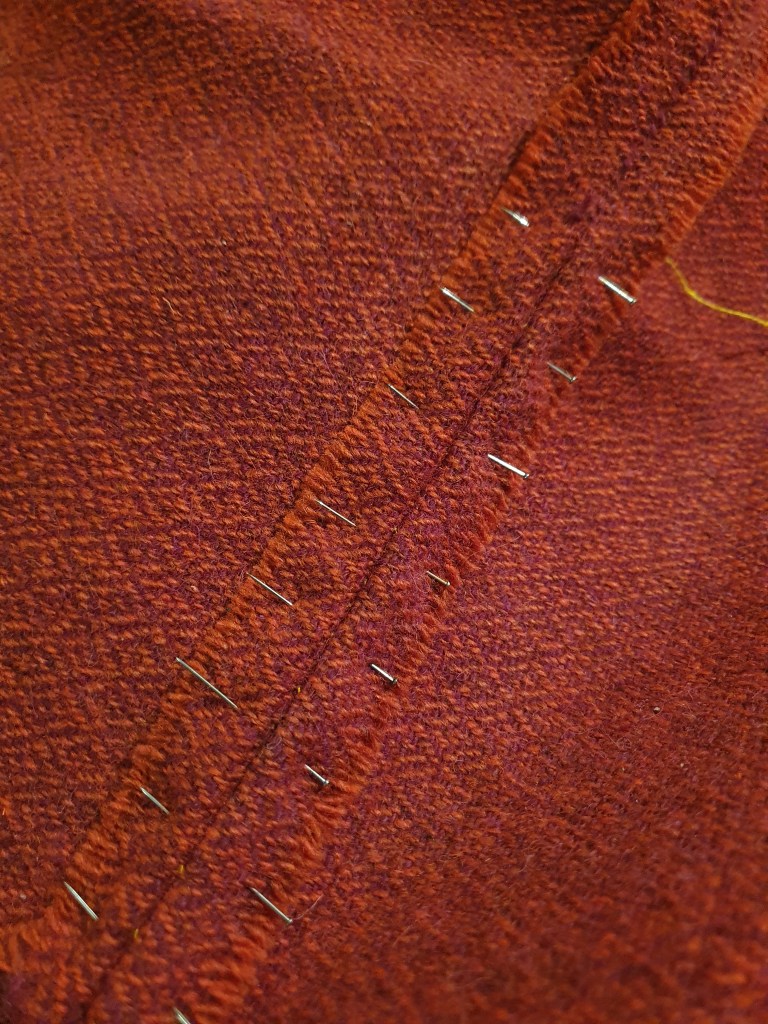
I actually made two hats- the first from some leftover red diamond twill and the second from some pinkish-lilac herringbone scraps. Both hats are made of wool and like the Aalsum find, they are not lined. I hemmed each piece individually with a rolled hem, then attached them all together with a whip stitch. Several of the Frisian hats were made in this way, as well as some of the woollen and silk caps from Dublin. It results in a strong and neatly constructed garment which is easy to fix if seams start to pull apart through wear.


Like every project, I learned as I went along. In future, I would cut the front piece of the hat a little shorter if I was really aiming for a Dublin figurine look. In addition to this, you can see in the photos of the red hat, there is a slight bunching at the front and the top seam had a habit of falling inwards slightly. This could be as a result of my pattern cutting (I drew out the oval for the top by hand) or indeed due to the nature of the whip stitched seam. I decided to try some decorative seam treatment on the second hat, both for aesthetic and structural purposes. I felt that it did remedy the caving-in issue somewhat due to giving it some more structure, plus it’s pretty. I used some woollen embroidery yarn that I had dyed with some of my homegrown woad, I think it gives a nice contrast to the pink-lilac.


Stitchwise, I opted for a chain stitch variant similar to the examples found on the hats from Dokkum, Oostrum and Leens. Most of these examples had a chain stitch that was visible on the outside of the hat and was done in a darker coloured thread, which would imply decorative contrast being the intent.

But the most important part: what is it like to wear? Well, my very own Dubgaill said he found this style of hat to be perfectly comfortable. He liked that it would protect the back of his neck from the elements and it’s cosy around the ears. That’s good enough for me!

I also had enough left of the pink herringbone to make myself a Dublin cap. We now have matching 10-11th century Irish hats, meaning we can be one of those sickening couples in both 2021 and 1021. Always good to know.


References:

Brandenburgh, C. R.. (2010). Early medieval textile remains from settlements in the Netherlands. An evaluation of textile production. Journal of Archaeology in the Low Countries. 2 (1), p41-79.

Flicke, G. (1545) Portrait of Thomas Cranmer. [Oil on panel] London: National Portrait Gallery. Found online at: https://commons.wikimedia.org/wiki/File:Thomas_Cranmer_by_Gerlach_Flicke.jpg

Lang, J. T. (1988). Viking-age Decorated Wood: A Study of Its Ornament and Style. Dublin: National Museum of Ireland. p32.